
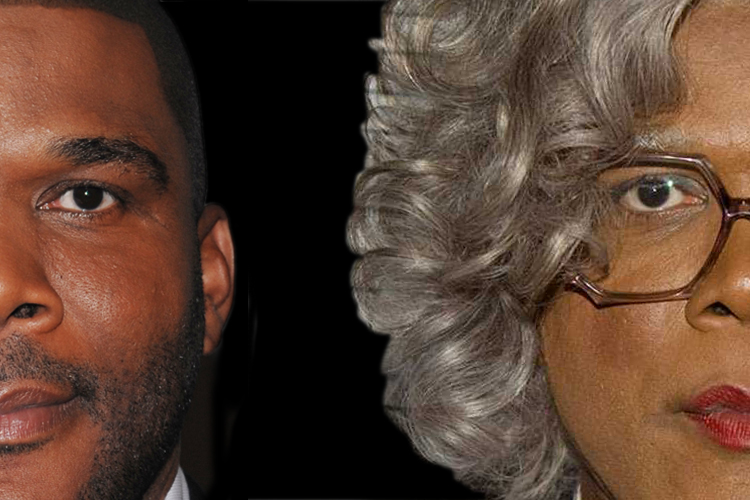

Tyler Perry, whose new movie opens today, is an American original who fought his way to significance from the margins. Once homeless and nearly penniless, he’s now a pop cultural force whose movies have earned over $400 million even though critics treat them with condescension or contempt when they bother to watch them at all. He remains an outsider — not just because he’s black, conservative, deeply (often sanctimoniously) religious and because of the persistent rumors about his sexuality (including rumors that he’s suing “Boondocks” creator Aaron Magruder for claiming that he is gay), but because he makes truly personal and often deeply strange films, and releases a new one every six months.
Reviewing Perry’s first solo outing as a screenwriter-producer for New York Press, I called “Diary of a Mad Black Woman” “a jumbled wreck of a movie, alternately prosaic and loony,” but added, “the source material is so rich and in-your-face sincere that it works anyway.” Here we are half a decade on: new movie, same verdict, times 100. Most of Perry’s movies are whiplash-inducing experiences, alternately clumsy and powerful, pandering and bold, crude and beautiful. Perry’s 10th film in five years, “For Colored Girls” — an adaptation of Ntozake Shange’s dramatic prose poem “For Colored Girls Who Have Considered Suicide/When the Rainbow Is Enuf” — is his most problematic work. It’s also his most ambitious.
Parts of it are so misjudged that it’s hard to look at the screen, and Perry still hasn’t overcome his greatest handicap, his tendency to treat the camera as a device for recording performances rather than as an expressive tool. But he’s made progress on that front, to the point where, in “Colored Girls,” he feels confident enough to block a scene of Loretta Devine’s character and her no-good boyfriend à la mid-’80s Woody Allen, letting them disappear momentarily behind walls and then reappear; or switch between plain expository dialogue and long sections of Shange’s poetry without breaking a sweat; or let monologues play out in long takes, often in gigantic, silent film-style close-ups. (Kimberly Elise — who starred in many Perry productions, including “Mad Black Woman” — is nothing short of astonishing here, plumbing depths of emotion that women rarely get to show in mainstream American films. She’s been as good during the past decade as Meryl Streep was in the ’80s, and she’s done it mostly without access to Streep-caliber projects.)
And even when it’s stumbling (which is often) “For Colored Girls” has an “I’m doing my thing, critics can go to hell” attitude that’s the hallmark of some of the more interesting auteurs, especially ones critics often write off as crude, simplistic, hysterical and otherwise unpleasant (Sam Fuller is one example). Perry never solves the stage-to-screen translation problem. But the path he has chosen is as intriguing as it is irksome, and it works better than you might expect. Perry comes from a tradition of Christianity-infused regional theater that defines characters in terms of social roles. Shange’s stage piece comes out of aggressively secular experimental theater and post-’60s concepts of black and female victimhood and empowerment. While not being remotely the same, the traditions are related, like cousins hailing from different branches of the same family tree. Shange and Perry are both mythologizers, converting unique personal experience into something universal.
Shange’s original was a “choreo-poem” that represented facets of black women’s experience in verse and dance. It was performed by seven unnamed speakers, each identified by a color (the woman in red, etc.). Perry’s movie integrates 14 of Shange’s poems into a characteristically Perry-esque ensemble that seems equally influenced by sitcoms, Douglas Sirk melodramas, Pedro Almodóvar pictures and early-’60s social problem dramas such as Sidney Lumet’s “The Pawnbroker” and the old CBS series “East Side, West Side.” Most of the major characters live in the same apartment building in Harlem and crisscross one another’s paths but don’t connect until the film’s final third. (The critic David Bordwell coined a great phrase for this kind of story: the “network narrative.”) The apartment building is managed by Gilda (Phylicia Rashad), a voyeuristic snoop who eavesdrops on fellow tenants but also offers advice and help and has a knack for talking troubled women off figurative ledges; it’s a holy-symbol-of-matriarchy role that would normally be filled by Perry himself, dolled up as Madea and bouncing around like a Bible-thumping Flip Wilson.
Perry pays tribute to aspects of his source without slavishly reproducing them. For instance, he and his production designer, Ina Mayhew, color-code the women and their stories via wardrobe colors and patterns, and with flower arrangements that appear at important junctures in the movie. More intriguing is Perry’s integration of poetry with straightforward movie dialogue, and his decision to have the women speak the poetry as if they were delivering non-musical arias — riding the crests of words, sometimes solo, sometimes in duos where monologues overlap or intertwine. (Why doesn’t Perry just direct a sung-through musical? His characters always seem like they’re on the verge of bursting into song anyway.)
The prose-poetry as opera lyrics notion might have been more effective if Perry hadn’t called attention to it. There’s a sequence toward the middle that cross-cuts between the brutal rape of one character — Yasmine, a dance teacher played by Anika Noni Rose — and an African-American opera company performing an Italian aria based on one of Shange’s poems. The sequence would be a bit much even if Perry didn’t pile on the woe by having another major character, magazine editor Jo (Janet Jackson), realize that her stockbroker husband (Omari Hardwick of “Kick-Ass”) is a closeted gay man by seeing him exchange glances with another hot guy in the opera house.
This is a prime example of the judgment problems I mentioned earlier. Simply by crosscutting between the aria, Jo’s realization and Yasmine’s assault, the sequence inadvertently suggests that the two women’s suffering is comparable, or all of a piece, or something, when in fact all it’s actually saying is, “See, folks, this material is operatic — and look, I turned it into an opera!” But on the plus side, I can’t think of another sequence in a recent American movie that throws aesthetic caution to the winds with such abandon, or portrays rape not merely as a physical attack, but as a spiritual violation. I’d rather watch a filmmaker attempt to be audacious and impassioned and fall on his face, as Perry does here, than watch mumbly-mouthed bromance characters lounge on sofas and insult each other’s video-game prowess.
A lot of cultural change has happened since 1974, and rather than simply update the play or set it in period, Perry sets it in a sort of theatrical never-never land, one in which people talk on cellphones and mention websites, yet wear faintly retro fashions (Kimberly Elise’s character, the magazine editor’s secretary, wears mid-’60s-looking short dresses and modified bouffant hairdo). It’s a film in which Loretta Devine’s character, a nurse and community center worker, can lecture a classroom full of women about the necessity for self-esteem and birth control and another character can contract HIV from a sleep-around lover, while yet another character, a young dancer named Nyla (Tessa Thompson from “Veronica Mars”), can get pregnant and decide to take care of it by visiting an alcoholic, chain-smoking abortionist mentioned (in a monologue, natch) by her promiscuous older sister (Thandie Newton).
To get to the abortionist, Nyla literally has to traverse a back alley and walk past a rogue’s gallery of ghetto scourges: dice-rollers, a junkie, a barking pit bull. Like so many Jesus-gonna-get-ya scenes in Perry films, it’s so intense that it crosses over into nutball comedy. (Perry could have gone for full-on “Airplane!”-style ludicrousness and capped the scene by having Nyla pass a mysterious figure in a black robe sacrificing a goat.) The scene is saved by the realization that less gothic versions of these situations still exist. And notice how Perry counteracts his fundamentalist antiabortion attitude by showing that Nyla, Tangie and their apocalyptically religious, pack-rat mother, Alice (Whoopi Goldberg), don’t question Nyla’s decision, and in fact seem to view it as inevitable and necessary. (Alice even remarks that Nyla had to get the evil out of her body.) The film encompasses pro-choice and antiabortion attitudes without making a fuss, and portrays the back-alley abortionist not as an evil person, but as a marginalized figure with serious substance abuse problems who nevertheless fills an urgent need within the community.
The film also encompasses other spectrums of attitudes toward hot-button topics. Jo’s on-the-down-low husband, for instance, defends his secret trysts by saying that he prefers to have sex with men but would rather have a woman as his life partner. In 99 out of 100 movies, the confession would be staged as a joke, proof of the man’s hypocrisy. In this film, the intensity and seriousness of it suggests that maybe the problem is one of categories — that there isn’t yet a label to affix to men like him, who have heterosexual minds and homosexual urges. (The film seems more disapproving of his failure to wear a condom than of his sexual life in general.)
Elise’s character, Crystal, has two young kids and is abused by their father, Beau Willie (Michael Ealy), an alcoholic ex-soldier (he was a Vietnam vet in Shange’s production but has been updated to Afghanistan service here). Although Perry gets a lot of flak for making his men irredeemably selfish or cruel and his women victims, I’ve never thought that criticism was fair. “For Colored Girls,” more than any of his movies, puts the lie to such complaints — especially in the Jo and Crystal storylines. What Willie does to Crystal is beyond awful, but between Shange’s original monologue, Perry’s wraparound screenplay and Ealy’s performance (his eyes seem to be imploding from sadness), we can’t despise the man. He’s a victim of both post-traumatic stress disorder and entitled patriarchal attitudes handed down over generations; he knows not what he does, and his wife and children are the ones who suffer because of it.
The flourish in Perry’s movie that might inspire the most debate is Gilda’s climactic statement to Elise that her pain won’t begin to heal until she admits that she bears partial responsibility for the miseries inflicted on her — that if she hadn’t stuck around so long, things might not have ended up so horrifically. Kirk Honeycutt’s Hollywood Reporter review of “For Colored Girls” calls this a “peculiar view” that suggests that “the women often collaborate in their victimhood. They invite the stranger into the home or let men stay when they clearly should go.”
That’s a neat trick on Honeycutt’s part, conflating Crystal’s misery (which is committed by a man she truly loves and who still has good in him) with Nyla’s rape (which is committed by a man she barely knows — a poster boy for macho entitlement, a guy who expects sex on the third date and won’t take no for an answer). There is no such “collaboration” in the movie, and Perry’s view isn’t a “peculiar” view at all. In fact, it’s modern. American feminism has changed a lot since 1975, and takes a less monolithic attitude toward male sexism and female suffering, conceding that while men can be oppressors and women oppressed, women do, after all, have free will; they can (and should) take responsibility for their pain as well as their pleasure. and exert control over both. These are more complex attitudes than Perry’s broad-brushstroke filmmaking might seem capable of articulating. Articulate them he does — not that critics notice or care. In their eyes he’ll always be an interloper, and he’ll never get credit for being anything but a vulgarian bumpkin who made a fortune pandering to black churchgoers and kissing Oprah Winfrey’s ring.
I’ve barely touched on what I like best about Perry: the fact that, in film after film, he gathers together some of the greatest African-American actresses in America — actresses who are lucky to get one or two scenes in a film with a predominantly white cast — in leading roles that let them chase dreams, make mistakes, fall in love, have their hearts broken, flirt, seduce, manipulate, preen, pout, rail against injustice, and endure and transcend Old Testament-level suffering. And they reward Perry with performances so heartfelt, and often so accomplished, that they make all of his films worth seeing no matter what you think of him as a director.
Consider Jackson, who made no particular impression as the title character in her debut film “Poetic Justice,” but has been knocking performances out of the park for Perry. She outdoes herself here — especially in the scene where she confronts her husband over his secret life, and Perry stays on her in a tight close-up while she describes exactly how he’s broken her heart. It’s not just Jackson’s short haircut and traumatized eyes that might remind viewers of Jane Wyman or Joan Crawford; Perry gets at the mix of masculine hyper-competitiveness and feminine vulnerability that has always defined Jackson, and links it to the wily, lonely coldness often captured in Wyman and Crawford performances, a directorial gambit of tremendous perceptiveness. He’s just as sharp directing Jackson’s costars — especially Elise, Rashad and Devine (who, judging from her work in Perry’s films and in assorted lowdown slapstick movies, can do just about anything). This isn’t just a repertory company he’s been building over the last few years. It’s an all-star team.
Perry gets grief from critics not just because he’s an outsider who’s still riding a learning curve, but because he mixes moods and genres with the blithe confidence of an old Hollywood filmmaker, switching from dumb slapstick to three-hankie melodrama and back again within minutes. (Critical barbs about Perry’s early films often boiled down to the critic’s belief that knife-twisting tragedy, drag comedy and you-go-girl empowerment messages can’t, or maybe shouldn’t, mix — a rule that will come as shocking news to Almodóvar.) If he had a strong eye and were able to modulate actors’ performances with more finesse, his uniqueness would be more celebrated.
He’s got a touch of the vibrant renegade looniness that they prize in directors such as Sam Fuller, who in the mental institution potboiler “Shock Corridor” had inmates deliver purplish rants about hot-button social issues as if they were projecting to the back row of some personal theater of the mind, and sometimes intercut the rants with footage from other Sam Fuller movies. Over the years I’ve often said that the only thing standing between Tyler Perry and a spot alongside Fuller in the pantheon of great American primitivists is half a year of film school. I stand by that statement. Perry has the soul of an artist but not the chops. If he could do something about that, he’d be unstoppable.
