Thanksgiving

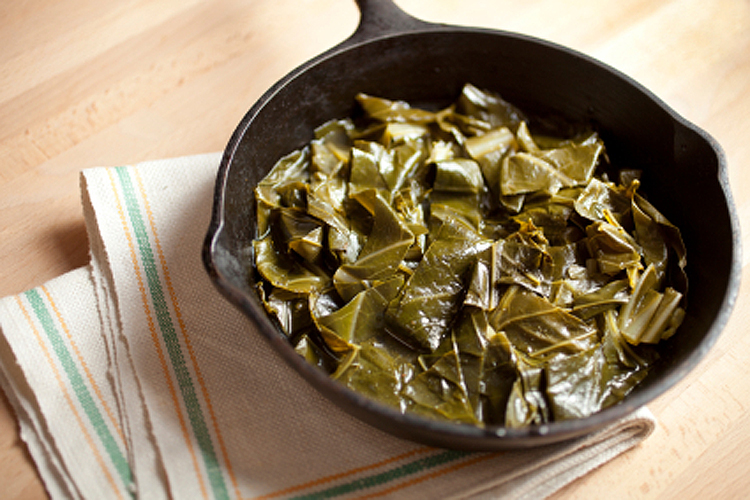
Slow-sauteed greens: Shelve the green-bean casserole

A twist on a Southern classic leaves the leaves sweet, savory and with concentrated flavor

  • more
    • All Share Services

Topics: , ,

Slow-sauteed greens: Shelve the green-bean casserole

Today in Foods for and With Which I Give Thanks, let’s talk about greens.

In many precincts of the South, people show their deep, pot-licking love of hearty greens by cooking the bejeezus out of them in ham hock-y stock, forever and ever, until they nearly melt into the smoky broth. Greens and pot-likker, as the broth is called, are the kind of thing that you will never make as well as someone’s momma, but if you’re close enough, you might get yourself an engagement ring. (True story.)

As only an honorary Southerner, I have yet to truly master greens, but when I moved down to Biloxi, Miss., I had to get with the program right quick if I ever wanted any vegetable matter to enter my body. I’d walk home from the market with a mess of collard or turnip greens so massive I looked like Bill Murray behind plant camouflage in “Caddyshack.” I stewed them with pig, and, cooking for non-pig-eating folks, with dried shrimp and shiitake mushrooms, Chinese ingredients I recognized at the local Vietnamese market. The reasons, at first, were practical — without pork at my disposal, I turned to these ingredients for deep flavor and lingering finish.

But then, as I started making more friends in my neighborhood — black, white and Vietnamese — I started thinking more and more that those greens were symbolic of my adopted Gulf Coast town, particularly after Katrina, when these communities worked together with a sense of commonality in the rebuilding. I started making mac and cheese with Vietnamese rice paper rolls as the noodles and baking corn bread to sop up those Asian-inflected greens.

One day, without the time to properly cook up a batch of collard greens, I took another Asian cue and thought to stir-fry them with onions and fish sauce, the secret weapon of the Southeast Asian pantry. Of course, the greens themselves are too dense, too tough to cook over high heat, so I started them sizzling, turned the heat way down to let them cook through — and what happened was pure magic. By the time the greens were tender, they still had a satisfying chewiness and their flavor both intensified and mellowed — deeply green and earthy — combining beautifully with the sweet, now-caramelized onions and the briny depth of the fish sauce.

This method works beautifully no matter if your regional cooking greens are collards and turnips or, if in the north, kale. (Chards or even spinach also work nicely, but they cook much more quickly and don’t have quite the same firm texture.) With their peak season in December, the more tender young greens are plentiful in November, which makes them a perfect replacement for the heavy, off-season green-bean casseroles no one really loves anyway. (Sorry, Aunt Maude.) They’re also great to toss with pasta, with a finishing splash of good olive oil and maybe a shaving of parmesan cheese for a quick dinner.

For myself, every time I make these, I think of the people I met in Biloxi, the fishermen, bakers, cooks and everyone else who, while trying to rebuild their city, took the time to welcome me into their lives. And I’m thankful for them.

Slow-sauteed greens

Serves 6-8 as a side

Ingredients

  • 2 pounds cooking greens (collards, kale or turnip, etc.)
  • 1 large onion, sliced
  • fish sauce, to taste
  • black pepper, to taste

Directions

  1. Strip off the leaves and wash them under running water to get off any grit. (Either save the stems for stewing or keep them for a vegetable stock.) Dry the leaves in a salad spinner or pat dry with a towel. Stack the leaves on top of each other, and roll up as if for a cigar. Slice the rolled greens, giving yourself ½-inch-wide strips. Chop them further, if you’d like, which will speed up the cooking.
  2. Pour enough oil to generously coat the bottom of a large, wide pan with deep sides, and set it over medium heat. Add the onions, stirring to coat them in oil, and let them cook. Aim for a moderate sizzle, and when they look glassy, turn up the heat to high. When the onions start to sizzle more intensely, give them a couple dashes of fish sauce and add as many handfuls of greens as can comfortably fit in the pan. Stir them until they wilt, and add more greens, a handful or two at a time, until they’re all in or until you start to really wonder if you used a big enough pan. (If that’s the case, don’t worry; get another pan hot, divide the greens in half, and keep cooking.)
  3. Once the greens have all turned bright green and started to wilt down, turn the heat to medium-low or low, and now begins the long dark journey into night. OK, not really, more like 20 minutes. Season them with black pepper and a few more dashes of fish sauce, to taste, and stir the greens every few minutes. What you’re looking for is a slow sizzle, throwing off some steam as the greens’ moisture evaporates. Stirring keeps the onion sugars from burning, which is really the only danger in this dish, but if you have to walk away, go ahead and pour a little water in the pan, say, a ¼ cup, and cover it. This helps prevent scorching, and you can always uncover and cook off the water when you come back.
  4. Continue cooking until the greens are tender, but still have a little bit of pleasant chew. Either serve right away or let them cool and reheat with a quick sauté.

Note: depending on the kinds of greens you use, and how mature or tender they are, the cooking time can vary widely. The more tender, the quicker they’ll cook.

For more unconventional Thanksgiving traditions:

Yesterday: The finest use for turkey since the evolution of birds

Tomorrow: A super-quick, super-delicious Plan B dessert

Continue Reading Close

Francis Lam is Features Editor at Gilt Taste, provides color commentary for the Cooking Channel show Food(ography), and tweets at @francis_lam.

How turkey came to our Thanksgiving table

Once shunned by my Muslim family, the bird finally found a place in our home, just like so many American traditions

  • more
    • All Share Services

Topics: , , ,

How turkey came to our Thanksgiving table (Credit: SunnyS via Shutterstock)

My Pakistani and American Muslim social circles celebrate Thanksgiving each year alongside our Eid festivities and Super Bowl Sunday parties, featuring homemade guacamole dip, chips and samosas. But it wasn’t always like this. For my family, this marriage between East and West was three decades in the making.

The 1980s:  An “Amreekan Holiday”

As a child, I often asked my mother what we were eating for Thanksgiving.

“Food,” she replied matter-of-factly.

“Are we eating a turkey?” I asked.

“No, only Amreekans eat turkey.”

Any immigrant or child of immigrants understands that “Amreekan” is a code word for “the mainstream,” which really means “white people.” In addition to celebrating Thanksgiving with a turkey, here are some other things we learned only “Amreekans” do:

  • Wear shoes inside the home
  • Receive “time out” as a valid form of punishment for unruly behavior
  • Talk back to elders
  • Have sex before marriage
  • Put grandparents in senior homes
  • Sleep over at friends’ homes
  • Tattoos
  • Christmas trees
  • Cable television
  • Shop at stores other than Ross, K-Mart, outlet stores, Marshalls and Mervyns (RIP)

Now, I don’t begrudge my parents their position toward turkey. It’s a confounding bird for most immigrants, who are generally more comfortable with the bleats of a goat or a lamb, the squawks of the simple-minded chicken. The turkey was an enigma: a heavy, feathered bird with its “gobbledygook” mutterings, freakish red wattle and vast supply of dry, juiceless meat.

“Do the Amreekans realize it is dry?” ask my still perplexed relatives living in Pakistan. “Where is the masala? The taste? The juices? Why do they eat this bird?”

Besides, most first-generation immigrants in America retain the romantic, deluded concept that “We will eventually go back home to the Motherland.” They will never be “Amreekan.”

Of course, they never do go back and instead firmly plant their familial, cultural, economic, religious and political roots in this foreign yet welcoming “Amreekan” soil. They have second-generation kids — yours truly — who are as “Amreekan” as apple pie, burritos and biryani.

And so Thanksgiving traditions began to leak into our old-school immigrant mentality. I watched the annual Macy’s parade, hoping to see a Spider-Man float. I played Super Mario on my Nintendo and looked forward to spending the evening with Snoopy, Linus, Charlie Brown and the gang, all the while eating a traditional Pakistani dinner. No turkey — yet.

The ’90s: Introducing the Thanksgiving Chicken

In my teen years, I discovered hair in new places and found the courage to demand authentic “Amreekan” requests from my parents.

“Give me turkey, woman!” I once commanded my mother for the upcoming Thanksgiving festivities.

“Here’s some money. You buy it and make it yourself if you like it so much,” she replied.

Foiled again. She knew my inherent culinary uselessness and overall laziness far too well. Well played, Mother. Well played.

During this decade of grunge and Bill Clinton, the immigrant generation in our family gradually replaced the “We will go back to the motherland” mantra with disillusioned rants about how “The motherland is going to hell” after they returned from visiting.

American pop culture effortlessly coexisted within the confines of our Pakistani-American home. Visiting from college one day, I descended the stairs to Nusrat belting out a qawwali in Punjabi. Moments later my father changed the track to Jimi Hendrix’s “Purple Haze.” He was in the kitchen rubbing traditional South Asian spices into pieces of steak he would later cook on his brand-new George Foreman grill.

My mother relented to my requests and made a meal on Thanksgiving. Instead of cooking a turkey, though, she insisted on roasting two whole chickens.

“What’s the point of having a chicken on Thanksgiving of all days?” I asked. “It’s like passing out omelets to kids on Easter instead of colored eggs.”

“I like chickens. I can cook a chicken. Chickens are tasty,” my mother replied. “I’m not wasting my time cooking a dry bird.”

She ruled the kitchen with an Iron Ladle.

But the consumption of “some form of a bird” on Thanksgiving was remarkable progress toward fully celebrating this Amreekan holiday. Furthermore, the religious clergy in our communities realized the obvious: Thanksgiving dinner is actually harmonious with Muslim values. After all, aren’t we reconciling with our family and communities and being thankful and grateful for all of our blessings? Isn’t that what Muslims are supposed to do on a daily basis?

Score one for theology in supporting rational arguments to consume dead birds.

That night, we ate two fully roasted whole chickens (quite tasty), and my mother also made basmati rice, daal (lentls), chicken khorma (curry) and kheema (South Asian ground beef.)

It wasn’t perfect — but it was a start.

The new century: Let there be turkey

The 21st century opened the culinary floodgates. It was a brave new world. Turkeys were unleashed to South Asian and Muslim American homes on Thanksgiving with wild abandon. No American holiday would be left unattended and no holiday sale would be forsaken by the immigrant communities! The musings of “going back to the motherland” have now transformed into semi-annual visits to see relatives and nothing more.

Even Muslim butchers are readily selling Halal turkeys in their local community shops. (Halal meat refers to animals slaughtered according to Islamic custom similar to Kosher slaughtering practices for Jews).

2002 was the “Great Turkey Explosion,” when Chandni, the neighborhood South Asian restaurant/wedding reception hall/religious ceremony hall/miscellaneous space used for all celebrations, started offering an “authentic Thanksgiving buffet” for $11 on Nov. 24-25. I had heard rumors of this awesomeness, but I had to drive there and witness morsels of turkey flesh swimming in a broth of fat and oil to believe it myself. And, lo and behold, in front of the South Asian buffet table — which featured lamb karahi, chicken tikka masala, and saag ghosht (spinach with meat) — there was “Thanksgiving” buffet table with turkey, gravy, mashed potatoes and bread rolls.

In our home, my father made the official decree that the Ali family would now and forever more eat turkey on Thanksgivings – provided he could successfully cook it, which meant “Not cooking it like the Amreekans who always make it too dry.” He felt ambitious in his old age and wanted to test his expanding baking skills by finally tackling the Gobbling-Goliath.

His initial attempt in 2003 was conservative, baking the turkey over several hours as per custom. There was also corn. The mother made some chicken khorma as emergency along with Basmati rice. Some cans of mango and lime pickle achar (relish) were opened just in case. The turkey was both edible and tasty. The family had successfully conquered the mythical bird and stuffed it with so much masala juice it developed a South Asian accent, bhangra dance moves, good credit and IT tech support skills.

A few years later, the family decided to up the ante and “brine” the turkey after some intense Googling sessions researching “Best Way to Cook + Turkey.” This time, we added gravy, mashed potatoes and soft rolls to the menu, along with corn.

Some Thanksgiving staples, however, remained foreign. Yams could only be justified if it was added with meat to a curry. Pumpkins were still regarded as an “exotic vegetable” only to be seen and carved on Halloween. Cranberry sauce was something you drank out of a bottle as a juice concentrate and never ate on the side. “Stuffing” was still only understood as a verb and not an edible noun.

Fast-forward a few years to 2011, and lo and behold, our turkeys have been successfully baked, roasted, brined, deep fried — and thoroughly enjoyed. The annual turkey now sits on a large dining table next to homemade sweet yams, mashed potatoes and gravy, corn bread, rolls, corn on the cob, and store-bought pumpkin pie and cranberry sauce. And yes, there is always a South Asian curry dish just in case.

We also wash down the gluttony with the American Muslim version of Cristal: Martinelli’s Apple Cider.

But this isn’t just a story about how we integrated a strange-looking bird into our dinners. It’s how my American Muslim Pakistani family integrated into the American cultural fabric. It’s the same messy, colorful but inevitable way immigrants all over enter the American narrative, bringing their own flavors to collide, merge and spill outside the pot.

It’s as Amreekan as turkey and chicken khorma.

Continue Reading Close

Wajahat Ali is a playwright, attorney, journalist and essayist. His award winning play"The Domestic Crusaders," was published by McSweeney's in 2011. He is the lead author of "Fear Inc., Roots of the Islamophobia Network in America." He is currently writing a pilot for HBO. He is co-editing the anthology "All American: 45 American Men on Being Muslim" published in June 2012.

My drunken Thanksgiving

I made two mistakes on the day I met my future in-laws: Trying to shed my shy exterior and, then, the casserole

  • more
    • All Share Services

Topics: , ,

My drunken Thanksgiving (Credit: Tatiana Morozova via Shutterstock)
This piece originally appeared on Marcelle Soviero's Open Salon blog.

The first time I met my boyfriend Eric’s family my sweet potato casserole went on fire. It was Thanksgiving 2003. Eric, whom I felt funny calling my boyfriend, since we were 36 and 40 at the time with five children between us, had invited me to his sister Julie’s house for the holiday. Since neither of us had our kids for Thanksgiving that year, Eric and I would get to be grown-ups, not parents. No strollers. No strained peas.

Eric drove up to Julie’s the night before Thanksgiving to cook. An obsessed chef, Eric had spent a week planning the menu with his siblings. “I’m making my sweet potato casserole,” I said to Eric as he made a grocery list, “with mini marshmallows on top.” I sensed disappointment, a Campbell’s Soup casserole stuck out among toasted almond haricot vert and saffron-infused stuffed turkey, a recipe that involved coriander, cumin, cranberries and couscous. My mother roasted a turkey every year and we were lucky if she remembered to take the giblets out. “You don’t have to make anything,” Eric said. But alas, I insisted.

I drove the two hours to Julie’s house in Vermont on Thanksgiving Day, sweet potatoes on the passenger seat next to me. I imagined what I would say when I met Eric’s large family. Painfully shy, I needed to rehearse.

I arrived at Julie’s house an hour late due to my inability to find something to wear. Eric answered the door, handsome, his gray hair mussed, his apron flecked with gravy. He guided me inside. His two brothers, two sisters, their husbands and wives and Eric’s mother, sat on the plaid couches. Eric’s father stood in the center of the living room miming something by putting his hand over his head and squat-walking like a penguin.

Charades. A game that is pure torture for the introvert. But Eric’s family grew up in the theater. His father having been dean of the theater department at University of Vermont, his sisters and brothers all actors at some point in their lives. I was terrified when they called me into the crowded room to play the game, no doubt anxious to see what the new girl would do. And what I was wearing was just wrong, I was dressed for a city Thanksgiving with a miniskirt and see-through silk blouse, among a room of turtlenecks, wool slacks and pearl earrings.

I accepted a glass of wine without hesitation, despite the fact that drinking doesn’t do anything for my personality, other than change it completely. My shy side flips; an introvert gone awry. I talk too much, use my hands to gesticulate, and by the end of the night a few cocktails always make me sick.

But I took the drink because I could not play charades without tilting a glass. I needed a little dose of confidence before I could possibly pretend to be a snow blower in front of a room of strangers. “I have to put the potatoes in,” I said when it was my turn. Eric’s mother followed me into the kitchen. While I sipped my wine I unloaded the basket of bread that I fashioned to look like a turkey. “That’s adorable,” his mother, a warm lovely Vermonter, gushed. Then I took out my sweet potato casserole, topped in a sheet of tinfoil.

The family joined his mother and me in the kitchen. They’d moved on to martinis for the cocktail hour and I could not help but participate.

“What do you do?” Eric’s identical twin brother asked me.

“I’m a writer,” I said, tipsy, and trying to keep a straight face. For some reason looking at a carbon copy of Eric was funny to me.

“Have you published anything?” Jon asked. I felt the familiar kick in my gut, never sure how to answer that question.

“I’m an unknown,” I said, taking a sip of my martini.

“What’s that smell?” John said next, scarves of smoke coming out of the oven, a fragrance of burned tar in the air.

“Do you have a fire extinguisher?” I panicked, my sweet potatoes on fire. I jostled the hot pan of burned marshmallows in my hands, my blond hair seemingly singed while Jon put out the flames.

I recovered; Eric’s family was kind. Before dinner, I scraped off the black parts and served my sweet potatoes anyway, my brain hitting that yolk-like stage where nothing seems real. I proceeded to say the dinner prayer, which led into a long toast about how much I loved Eric. I nibbled on turkey. But I missed dessert altogether. I’d shot out of my seat at the table to go pass out in the master bedroom.

I married Eric several years later, and even today I don’t drink on Thanksgiving, still proving to my in-laws that I am not the lush they first met. Given that first impression I never expected the close relationship I share with Eric’s family now. But they love me and I love them, enough so that I play charades every Thanksgiving. And I make my sweet potatoes — minus the marshmallows.

Continue Reading Close

Thanks to you!

The people we're most grateful to have around this year

  • more
    • All Share Services

Topics: , , , , , , ,

Thanks to you!Clockwise from upper left: Elizabeth Warren, Wael Ghonim, Diane Ravitch and Ray Lewis

Admittedly, I spend a lot of time grousing and naysaying. Today, though, we put that negativity briefly aside, as we celebrate a day of thoughtful reflection, and a night without a GOP presidential debate. I thought it appropriate, on the occasion of Thanksgiving, to thank some of the people who’ve worked to make the country and the world a better place over the least 12 months.

Thanks to Wall Street Occupier Jesse LaGreca, who didn’t only show up the Fox reporter sent to embarrass occupiers, but also managed to get the OWS message across on a Sunday political chat show, which is essentially unheard of. So thanks to you, for bringing up economic justice to the ancient panel of crusty establishmentarians on “Meet on Press.”

Thanks to Scott Olsen, the Iraq vet and victim of brutal police overreaction at Occupy Oakland, for showing the many forms that fighting for one’s country can take. We’re especially thankful that he’s recovering from the coma induced by a tear gas canister fired directly at his head, and is well enough to give public statements.

Thanks to retired Police Capt. Ray Lewis, who participated in Occupy Wall Street in full uniform, and was arrested for his participation. As stories of police brutality spread, Lewis reminds us that most cops are fellow members of the 99 percent, working hard to stay afloat in an increasingly class-segregated nation. Most of them aren’t happy being seen as serving the interests of the oligarchy, and where there’s abuse, it’s generally the result of poor training and misguided priorities from the top, not the rank-and-file.

Thanks to Diane Ravitch, and other school reform critics like Dana Goldstein, for adding desperately needed perspective and balance to the school reform debate, a debate in which one side receives what could charitably be referred to as the lion’s share of favorable press coverage and philanthropic support. Their needling forces school reform advocates and foes alike to examine their assumptions and strengthen their arguments, and they sometimes end up causing even dilettante education policy gurus like Steven Brill to see that the seductive claims made by technocrat reformers tend to be overstated. Better, smarter policy debates are enough of a rarity that we should all be thankful for anyone who can manage to produce them.

Thanks to Wael Ghonim for putting aside his very good job with Google to put his life on the line for freedom and liberty for his people in Egypt. Lots of tech entrepreneurs and engineers talk of changing the world; few of them spend weeks in custody as political prisoners for their efforts. Wael Ghonim was instrumental in organizing the popular revolt that toppled a dictatorial regime,

Thanks to Nick Davies, who, along with Guardian investigative correspondent Amelia Hill and others at the Guardian, has been relentlessly exposing News Corps’s criminal news-gathering practices in the U.K. Reporting on the misdeeds of the powerful — and News Corp is hugely powerful, especially in Great Britain — is the best reporting there is, and the investigations and arrests that have resulted from Davies and Hill’s reporting will change the culture of the international media industry for the better. We’ll be especially thankful if News Corp shareholders force the giant conglomerate into more responsible corporate management.

Thanks to Elizabeth Warren for perfectly articulating the liberal ideal of the social contract. One good senator may be limited in how much she can achieve, but if she wins and inspires more like her to follow — and imitate her unapologetic rhetoric of fairness — we’ll have even more to be thankful for.

Thanks to Sree Sreenivasan, dean of the Columbia School of Journalism, for making a mockery of dishonest bully James O’Keefe. O’Keefe’s only power comes from other media outlets taking him seriously. In one hilarious video, Sreenivasan showed why O’Keefe’s a joke.

Continue Reading Close
Alex Pareene

Alex Pareene writes about politics for Salon and is the author of "The Rude Guide to Mitt." Email him at apareene@salon.com and follow him on Twitter @pareene

The birth of America’s bastardized cuisine

Since that mythic first Thanksgiving, we've relied on native plants to augment dishes from the old country

  • more
    • All Share Services

Topics: , ,

The birth of America's bastardized cuisine Jean Leon Gerome Ferris' "The First Thanksgiving 1621" (Credit: Library of Congress)

America is a country originally settled by scoundrels and religious zealots — thieves, embezzlers, prostitutes, arsonists; English Puritans, French Huguenots, German Amish, Czech Moravians and Russian Mennonites. The screwed-over Scotch-Irish, the shanghaied London street punk, the peace-loving, slave-owning Quaker, the enslaved Gullah. It is also the native land of the Ojibwa, the Zuni, the Makah, the Miwok and the Seneca. This alchemy of sinner and saint, “savage” and sophisticate is the source of our original cuisine: a stolen, borrowed, distorted culinaria that can pique the tongue, clog the arteries, fire the belly, or mellow the soul.

In keeping with American tendencies, Thanksgiving is a bastard holiday, cobbled together from homegrown traditions and the hokey imaginings of 19th century writers, along with actual historical facts. The facts are thus: The “first American Thanksgiving” was probably observed in the South, not at Plymouth, and it would have been a day devoted to prayer, not pie. As for the famous Plymouth pilgrims? The settlers that staggered off the Mayflower to strike up a miserable township on the rocky shore did not call themselves pilgrims. At the time, they were known by cagier names: separatists (religious idealists) and strangers (various dreamy and desperate characters the separatists had recruited in order to swell their meager ranks and coffers). The settlers wore colorful clothing and did not favor buckles, though they did sport the tall broad-brimmed hats, which you may remember from your elementary school days.

The old schoolbook story is true: Tisquantum (or Squanto) taught the Plymouth settlers how to grow corn. The tale is iconic because it illustrates how native plants and Native American traditions were instrumental in the forging of American identity. From Cape Cod to Cape Perpetua, native plants were instrumental not only in the survival and health of the settlers, but in the creation of a uniquely American cuisine that is one of the least revolting results of European conquest.

Tisquantum was a handsome man and a talker; the turn of events in his life had given him many opportunities to hone his silver tongue. Six years before he had been kidnapped by Thomas Hunt, a lieutenant of Captain John Smith (more famous for his dalliance with Pocahontas). Hunt sailed for Spain to sell his captives into slavery. Catholic priests of an anti-slavery bent intervened, and Tisquantum escaped to England, where he learned to speak English. He talked his way onto a fishing boat bound for Newfoundland. The trip was more roundabout than he intended and required a good deal of fast-talking. When Tisquantum finally arrived home, his struggles must have seemed all in vain: He stepped ashore to discover the aftermath of European-borne plague. The bones of his friends lay scattered in the sun, and his home village, Patuxet, overtaken by the creeping detritus of the forest.

Tisquantum was later captured by Massasoit, a leader of the Wampanoags, the confederation of tattered tribes that lived in the forests surrounding Plymouth. Massasoit was in need of an interpreter, and once again Tisquantum’s talking skills came in handy. Over shots of separatist moonshine, he negotiated a testy alliance between Massasoit’s people and the separatist settlers. Massasoit, whose village had been decimated by the plague, saw the alliance as a measure against his ancestral enemies, who might otherwise take advantage of the confederation’s weakened state. The settlers, who had lost half their population to scurvy and starvation during that first brutal winter, also saw the alliance as a means of survival. They, at least, were correct.

With Tisquantum’s help, the settlers were able to put in stores for the next winter. That following autumn Edward Wilson would write, “We set last spring some twenty acres of Indian corn, and sowed some six acres of barley and peas; and according to the manner of the Indians, we manured our ground with herrings, or rather shads … Our corn did prove well; and, God be praised, we had a good increase of Indian corn …” In the same letter he describes the celebratory feast that would become the basis for our modern concept of Thanksgiving: the settlers provided fowl and Massasoit’s people brought five deer.

Despite that feast’s later relevance to American culture, at the time the settlers did not seem to ascribe it much importance. As far as we know, they did not call it Thanksgiving or commemorate the feast in years to come. To the Native Americans, separatists and strangers involved in the feast, it was probably just that: a good meal. Regardless, the three-day festival in 1621 is emblematic of the birth of American cuisine. From cornmeal mush to maple syrup, this cuisine reflects not only the bounty of American plains, prairies and forests, but also the ingenuity of Native cooks, whose culinaria incorporated roasted and stewed meats, steamed or boiled vegetables, baked or fried cakes and breads, and dressings of fat, nuts, oils and seasonings.

Native farming was equally refined. America’s people had been cultivating maize for thousands of years. Kernels were passed from culture to culture, and the plant was revered as the staff of life. The Maya worshiped a maize god, a beautiful young man who grew from the corn foliage; in his honor, Maya nobles performed ritual bloodletting in stone temples decorated with corn. The Seneca goddess of maize delivered ears of corn from her breasts. In Zuni mythology, corn appears as a cadre of seven sexy maidens who each represent a type of corn: blue, red, white, speckled, black, and the youngest sister, sweet corn.

With the pantheon came an equally enticing assortment of food. The Maya steamed tamales and grilled tortillas over blazing comals; the Navajo mixed a pinch of cedar ash with corn meal and pit-baked corn cakes; the Hopi seared blue corn flat bread on griddles slick with sunflower seed oil. Settlers would adopt and adapt these culinary techniques as they forged across America’s grasslands, woods and deserts to settle in her hamlets and hollows. Their corn-based innovations include buttery cornbread, spoon bread, fried cornmeal mush with maple syrup, and bourbon.

In modern Mexico, every facet of culture reflects Native influence. In one version of the story, the Aztecs and the Zapotec and the Hauxtec were thoroughly subjugated, but you still see their folkways and bloodlines reflected in mainstream Mexico: from the color of skin to the tortilla on the table. In the United States, your typical citizen doesn’t look down at his or her own skin and get a reminder of the legacy of European/Native American interaction. We don’t dwell among the tangible ruins of lost civilizations. To most of us, the story of interaction between settlers and natives is a bloody story with a sad ending: the once proud bands vanished like ghosts; survivors stripped of their land and language and funneled into reservation schools where they were taught to forget everything they knew. The blood shed obscures another story: in the beginning, settlers observed and absorbed the survival tactics of the American Indians. Our original culture is more Native than we remember, and our cuisine mirrors this other story.

Native residents of New England taught settlers which beans were well adapted to the land’s climate; colonists copied native recipes for life-sustaining bean and corn stews. As settlers moved west, they learned to gather wild rice like the Ojibwa. They picked up the Ojibwa and Iroquois habit of tapping the maple tree in springtime. They copied the Menomoni practice of sweetening the bitter fruit of another native shrub that grew in bogs and hollows. Settlers called the shrub “craneberry” because its white blossoms looked like tiny cranes. The first American cookbook, “American Cookery,” recommends that cranberry sauce be served with Turkey.

Pumpkin pie didn’t grace the table at the “first Thanksgiving,” but pumpkins were certainly a staple food in the Americas. Native Americans ate pumpkin dried, stewed, baked and roasted. In the Great Lakes area, tribal cooks roasted pumpkins stuffed with wild rice, rendered fat, venison and buffalo. In New England, colonists took a cue from the locals and figured out ways to sneak the hardy squash into every meal of the day: settlers consumed pumpkin pancakes, pumpkin flower blossom sandwiches, pumpkin cornbread, pumpkin soups, and, inevitably, pumpkin beer. A pumpkin pie recipe appears in the 1796 edition of “American Cookery,” though in the early days settlers were more likely to bake a whole pumpkin, hollowed and filled with sweetened milk and spices.

In the South, colonists would rely on the big three of Native cooking: corn, beans and squash, as well as more obscure ingredients: possum grapes, poke and the paw paw. On the big plantations, African cooks fused Native American ingredients and African techniques and ingredients to invent a rich culinaria that, in its greasy and imaginative glory, is a direct result of both the cruelty and the eternal promise of America.

In Lousiana’s bayou country the Choctaw powdered native sassafras leaves to create a flavorful thickening agent, which became the filé powder in the sacred canon of gumbo ingredients. (Hence the Hank Williams song “Jambalaya (On the Bayou)”: “Jambalaya and a crawfish pie and a filé gumbo.”) In addition to appreciating the culinary properties of the plant, natives and settlers used sassafras root as a medicine. As the excellent and largely forgotten J.C. Furnas notes in “The Americans”: “The first homeward-bound cargo out of Jamestown consisted of clapboard riven from American logs … and of the pungent wood or roots of the sassafras tree, then highly valued in medicine on the principle that whatever smells queer (if seldom as pleasantly as sassafras) is probably good for what ails you.” Sassafras would still be a popular home remedy 200 years later; in a 1866 guide to home health, sassafras appears as an ingredient in tonics invented to cure “inward hurts and ulcers,” “dropsy,” “rheumatism in the loins,” “white swelling,” as well as consumption, ague and scrofula.

Sassafras was a common remedy among Appalachians. As an old-timer put it: “That mountain is like a drugstore. You don’t have to have money, you just need a little bit of knowledge.” Peppermint tea was sipped for upset stomachs; goldenseal for sore throats or ulcers; and clover tea “just for enjoyment.” Settlers learned plant lore from the Appalachian natives, who made poultices of poke, and dined on pigweed, spring beauty and fiddleheads. In the spring, families took to the woods to gather ramps; the pungent wild onions offered a welcome change of pace from the winter’s starchy diet. In the sonorous and wild hills, native ingredients and culinary techniques of varied immigrant traditions fused, giving forth regional delicacies such as eggs scrambled with poke weed, cornbread gravy and, of course, moonshine.

When settlers finally reached the immense, rain-drenched forests of the Pacific Northwest, they discovered a culinaria built upon salmon, and supplemented with wild plants such as fiddleheads, salal and camas. Like their Appalachian counterparts, settlers learned the Native sources of springtime vitamin C: salmonberry shoots and the delicate stalks of the thimbleberry bush.

Two hundred years later, many of our essential American food and beverage traditions still stem from American plants, though the manifestation may be twisted beyond recognition. Take, for example, cream of tomato soup, the corn dog, the corn flake, the French fry and the Manhattan. Despite the potential presence of Sara Lee pies and boxed stuffing, our Thanksgiving table still represents the bounty of our once wild land: pumpkin pie by way of Central America, mashed potatoes by way of South America, and of course, those satisfying slices of gelatinous cranberry sauce. Tradition never tasted so sweet.

Continue Reading Close

Felisa Rogers studied history and nonfiction writing at the Evergreen State College and went on to teach writing to kids for five years. She lives in Oregon’s coast range, where she works as a freelance writer and editor.

How to give back this Thanksgiving

Between turkey, football and Black Friday planning, take a moment and help someone who needs it

  • more
    • All Share Services

Topics: , ,

How to give back this ThanksgivingA 3-year old girl holds her mother's hand as they carry bags with food from the North Fulton Community Charities food bank in Alpharetta, Ga., in this picture taken June 4, 2008.(Credit: Reuters/Tami Chappell)

The annual celebration of Thanksgiving — looking beyond its function as a filler of stomachs and provider of marquee football matchups — is perhaps America’s clearest exercise in mixed signals.

On one hand, the act of gathering around a dinner table with loved ones, taking stock of our lives and giving thanks, isn’t just one of our nation’s most staid traditions; it’s also a fundamentally humble act that harks back to the collectivist underpinnings of America’s founding myth. Consistent with that ethos, giving has become the order of the day; and each November, millions of Americans do.

It’s no small irony, then, that this modest yearly ritual is followed by Black Friday — the high holiday of conspicuous consumption.

Economists may quibble over whether we’re still in an official recession, but for millions of jobless Americans the answer is clear. Occupy Wall Street has drawn much-needed attention to the specter of income inequality and helped to reinvigorate the national dialogue about social safety nets. But whatever future improvements the movement might yield, there remain many, many people across the country who need help now. Forty-six million Americans currently live below the poverty line, the largest number in a half-century.

Yes, the annual mass pilgrimage to big-box stores and shopping malls is upon us. But that doesn’t mean we can’t still honor the spirit of the season and give back, even if we can’t afford to give much. A donation of just $10 can make an enormous difference to those hit hardest by the recession.

Below we’ve compiled a list of worthy charities that address four basic but vital categories of expenses: food, housing, utilities and healthcare. We’ve also included information on how you can give back to men and women who’ve served in the military. Charity Navigator, an independent website that rates a variety of nonprofits across the U.S., has awarded each of these nonprofits a four-out-of-four star rating. (All figures from CN represent the fiscal year ending December 2009.)

- – - – - – - – - – - -

Food

Gleaners Community Food Bank (Detroit)

In recent years, Detroit has become something of a standard-bearer for recessionary America. Already struggling under the weight of a weakening automotive industry when the financial crisis hit, the city has suffered one of the highest unemployment rates in the country for years (11.7 percent as of September). Thirty-three percent of all Detroit residents fell below the poverty line at some point between 2005 and 2009, more than double the statewide average. And, as winter approaches and expenses creep up, the onus of feeding a family will become even harder to bear.

That’s where Gleaners Community Food Bank comes in. Each dollar donated to the organization produces three additional meals for those in need; the bank distributes 65,000 meals each day.

“Particularly in southeast Michigan, the economy is still struggling,” said Anne Schenk, senior director of development at Gleaners. ”We have an enormous population of under- or unemployed folks in the region, and we’re seeing the need for emergency food continue to rise.”

“The holidays are a huge drain on families: Kids are out of school, so they aren’t getting those subsidized meals, and parents have to provide them,” she said. “Oftentimes daycare becomes an added expense. And, in southeast Michigan, it’s getting cold. Heating bills go up.

“It’s a really tough time for families, and there’s a huge demand for emergency aid.”

DONATE HERE

Other four-star options:


Housing/Shelter

Habitat for Humanity Las Vegas (Las Vegas)

Nevada, and Las Vegas in particular, has been hit especially hard by the housing market collapse, consistently suffering some of the nation’s highest rates of foreclosure. (Statewide, one in every 180 households was foreclosed on in October, according to RealtyTrac.) Habitat for Humanity Las Vegas provides homes — sold under market value, through a zero-interest mortgage — for families that earn less than 80 percent of their area’s median income.

Habitat Las Vegas estimates that every $10 donated pays for a box of nails, while $75 covers the cost of a window, and a gift of $150 buys a front door.

“Habitat for Humanity Las Vegas isn’t a handout,” said Meg Delor, the organization’s executive director. “We work to provide decent, affordable housing to working-class families in Clark County, Nevada. The program helps to create community stability, and it really helps to solidify neighborhoods and offer better opportunities for the people who receive it.”

DONATE HERE

Other four-star options:


Utilities

Dollar Energy Fund (Pittsburgh)

As the winter approaches, the cost of heating becomes yet another financial hardship for struggling families. The problem is particularly acute in places like Pittsburgh, whose harsh winters pose a significant challenge to those living below the poverty line (22 percent of residents between 2005 and 2009). The Dollar Energy Fund provides support for families by helping them pay their mounting utilities bills through the winter months. The organization is the largest hardship fund in Pennsylvania, and among the largest nationwide. Ninety-five percent of every dollar donated goes directly to program expenses.

DONATE HERE

Other four-star options: 


Healthcare

Children’s Health Fund (National)

Nearly 16 million children in the U.S. live in poverty according to a 2010 survey from the U.S. Census Bureau — and 1.1 million of them were added to the list between 2009 and 2010, as the country struggled through the recession. The Children’s Health Fund boasts a national network of 22 pediatric programs (and two affiliates) that provide healthcare to children who might otherwise go without. The group also pays special attention to treating childhood asthma and obesity, and providing medical transportation in areas where it can be difficult for children to access immunizations and routine checkups.

A representative with the nonprofit provided some additional context: A charitable contribution of $25 is enough to provide a pair of glasses for a child with vision loss. A $50 gift corresponds to an appointment with a nutritionist. And a $100 donation covers the cost of an hourlong visit with a pediatrician.

DONATE HERE

Other four-star options:


Veterans

Hope for the Warriors (National)

As of this year, more than 40,000 service members have been wounded while deployed in Iraq and Afghanistan. Coping with the often-devastating periods of convalescence and reacclimation is a burden that many suffer silently. Hope for the Warriors provides a number of services for wounded service members and their families, including immediate financial assistance, career training and emotional support. It’s also among the highest-rated nonprofits on Charity Navigator.

“Our military families incur many expenses while they stay at or near military medical centers, never leaving their wounded service member’s side,” said Anne Woods, the public relations director at Hope for the Warriors. “Many of these expenses are low in dollar amount but add up very quickly as the days extend to weeks.  At the same time, parents and spouses have left their jobs to become full-time caregivers.

“A $10 donation would pay for a meal from the hospital cafeteria, laundry service, basic necessities, toiletries and more.”

 DONATE HERE

Other four-star options:

Continue Reading Close

Page 1 of 11 in Thanksgiving