
Iran
Israel on Iran: So wrong for so long
The extremely long history of incorrect Israeli predictions about when Iran will obtain a nuclear bomb
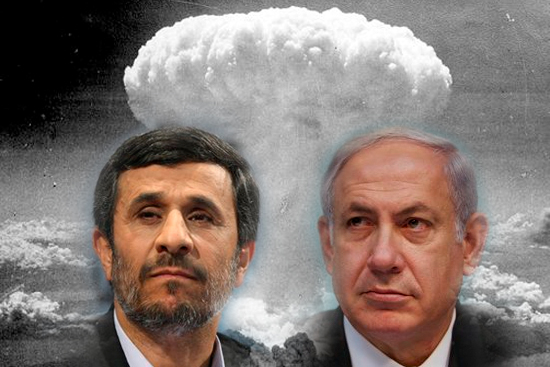
Iranian President Mahmoud Ahmadinejad and Israeli Prime Minister Benjamin Netanyahu Officials at the U.S. Department of State, we learned from the secret cables released by WikiLeaks last week, have serious questions about the accuracy — and sincerity — of Israeli predictions about when Iran will obtain a nuclear weapon. As one State official wrote in response to an Israeli general’s November 2009 claim that Iran would have a bomb in one year: “It is unclear if the Israelis firmly believe this or are using worst-case estimates to raise greater urgency from the United States.”
So we thought this was as good a time as any to look at the remarkable history of incorrect Israeli predictions about Iran — especially given that the WikiLeaks trove is being used to argue that an attack on Iran is becoming more likely.
According to various Israeli government predictions over the years, Iran was going to have a bomb by the mid-90s — or 1998, 1999, 2000, 2004, 2005, and finally 2010. More recent Israeli predictions have put that date at 2011 or 2014.
None of this is to say that Iran will not at some point get a nuclear weapon — though the Iranian government has maintained that its nuclear program is for peaceful purposes. That said, Iran has not fully cooperated with international inspectors. But even assuming that Iran is seeking a nuclear weapon, estimates still vary widely on when it will reach that goal.
So what the below timeline should show us is a few things: making accurate predictions about the future is difficult; the Israelis are almost certainly not always offering good-faith assessments of intelligence on Iran; and reporters and the public should demand evidence for assertions about an Iranian nuclear program, whomever the source. Here we go:
October 1992: “Warning the international community that Iran would be armed with a nuclear bomb by 1999, Peres told France 3 television in October 1992 that ‘Iran is the greatest threat [to peace] and greatest problem in the Middle East … because it seeks the nuclear option while holding a highly dangerous stance of extreme religious militantism.’”
Source: Then-Foreign Minister Shimon Peres in an interview with French TV, as described in the book “
Treacherous Alliance
.”
November 1992: “But the Israelis caution that a bigger threat to Middle East serenity — not to mention their own country’s security — lies in Teheran, whose regime they say is sure to become a nuclear power in a few years unless stopped.”
Source: New York Times, “Israel Focuses on the Threat Beyond the Arabs — in Iran”
January 1995: “Iran is much closer to producing nuclear weapons than previously thought, and could be less than five years away from having an atomic bomb, several senior American and Israeli officials say.”
Source: New York Times, “Iran May Be Able to Build an Atomic Bomb in 5 Years, U.S. and Israeli Officials Fear”
1995: “The best estimates at this time place Iran between three and five years away from possessing the prerequisites required for the independent production of nuclear weapons.”
Source: Benjamin Netanyahu, in his book “Fighting Terrorism: How Democracies Can Defeat the International Terrorist Network”
February 1996: “On February 15, 1996, Israeli Foreign Minister Ehud Barak told members of the UN Security Council that Iran would be able to produce nuclear weapons within eight years.”
Source: Barak comments reported in “
Treacherous Alliance
“
April 1996: “I believe that in four years they [Iran] may reach nuclear weapons,” [Israeli Prime Minister Shimon] Peres told ABC television during an interview.
Source: Agence France Presse, “Iran could have nuclear weapons in four years: Peres” (via Nexis)
November 1999: “Unless the United States pressures Russia to end its military assistance to Iran, the Islamic republic will possess a nuclear capability within five years, a senior Israeli military official said Sunday.”
Source: Associated Press, “Israeli official: U.S. must pressure Russia to end military cooperation with Iran” (via Nexis)
July 2001: “‘I mentioned to our friends, the Turkish leadership, that we are more than worried about the very rapid development taking place regarding nuclear weapons,’ [Minister of Defense] Binyamin Ben-Eliezer told reporters. ‘As far as we know by the year 2005 they [Iran] will, they might, be ready.’”
Source: Associated Press, “Israeli defense minister: Iran could have nuclear weapons by 2005″ (via Nexis)
August 2003: “Iran will have the materials needed to make a nuclear bomb by 2004 and will have an operative nuclear weapons program by 2005, a high-ranking military officer told the Knesset Foreign Affairs and Defense Committee on Monday.”
Source: Jerusalem Post, “Iran can produce nuclear bomb by 2005 – IDF”
February 2009: “Netanyahu said he did not know for certain how close Iran was to developing a nuclear weapons capability, but that ‘our experts’ say Iran was probably only one or two years away and that was why they wanted open ended negotiations.”
Source: Then-candidate for Prime Minister Benjamin Netanyahu in conversation with an American congressional delegation, as described in a cable released by WikiLeaks
June 2009: Barak estimated a window between 6 and 18 months from now in which stopping Iran from acquiring nuclear weapons might still be viable.
Source: Defense Minister Ehud Barak in conversation with members of Congress, as described in a cable released by WikiLeaks
June 2009: “Unless their programme experiences technical problems, the Iranians will have by 2014 a bomb ready to be used, which would represent a concrete threat for Israel,” said [Mossad chief] Meir Dagan.
Source: Agence France Press, “Iran will have nuclear bomb by 2014: Mossad”
November 2009: “General Baidatz argued that it would take Iran one year to obtain a nuclear weapon and two and a half years to build an arsenal of three weapons.”
Source: Brigadier General Yossi Baidatz, an Israeli military intelligence official, in conversation with an American defense official, as described in a WikiLeaks cable.
September 2010: “The reasoning offered by Israeli decision makers was uncomplicated: Iran is, at most, one to three years away from having a breakout nuclear capability (often understood to be the capacity to assemble more than one missile-ready nuclear device within about three months of deciding to do so).”
Source: Jeffrey Goldberg, reporting the Israeli point of view in a cover story on Iran in the Atlantic
Justin Elliott is a reporter for ProPublica. You can follow him on Twitter @ElliottJustin More Justin Elliott.
Obama’s Iran charade
The shrill, militaristic Manichean worldview that brought us the Iraq war is gone -- except when it comes to Iran
The main reactor at the Bushehr nuclear facility in Iran. (Credit: Reuters/Raheb Homavandi) The nuclear summit that concluded last week between Iran and six world powers was a ridiculous charade. The Obama administration never intended it to succeed. Its sole purpose was to placate hawks in U.S. Congress, ensure that Democratic donors keep writing checks during election season, and buy another month of time during which Israeli Prime Minister Benjamin Netanyahu will not be able to bomb Iran. In the meantime, American drivers can sit back and enjoy more $4-per-gallon gas.
The talks failed because the U.S. and the rest of the P5+1 (Russia, China, Britain, France and Germany) refused to take yes for an answer. The key issue on the table was Iran’s accumulation of uranium enriched to 20 percent – not a high enough level to make a nuclear weapon, but close enough that it would be much easier for Tehran to do so. Iran made it clear that it was prepared to stop enriching to 20 percent and to even ship its stockpile of enriched uranium out of the country, if the U.S. and the other powers agreed to relax the draconian sanctions they have imposed on the country.
Continue Reading CloseGary Kamiya is a Salon contributing writer. More Gary Kamiya.
Energy wars heat up
From Africa to South America, conflicts over waning resources are becoming more tense -- and dangerous
A member of the military stands guard near pump stations before a
ceremony in which oil operations at Heglig oilfield will resume in
Heglig, Sudan, May 2, 2012.
(Credit: Reuters/Mohamed Nureldin Abdallah) Conflict and intrigue over valuable energy supplies have been features of the international landscape for a long time. Major wars over oil have been fought every decade or so since World War I, and smaller engagements have erupted every few years; a flare-up or two in 2012, then, would be part of the normal scheme of things. Instead, what we are now seeing is a whole cluster of oil-related clashes stretching across the globe, involving a dozen or so countries, with more popping up all the time. Consider these flash-points as signals that we are entering an era of intensified conflict over energy.
Continue Reading CloseNYPD must spy on all Muslims to protect us from Iranian photographers
New York City's own constitutionally iffy intelligence agency justifies itself with fear-mongering
Ray Kelly (Credit: Reuters/Brendan McDermid) The NYPD is less a “police department” than a secretive and unaccountable international intelligence-gathering organization with a large minority-frisking division and the firepower of a mid-sized army. Lately they have been facing a bit of criticism for their style of intelligence-gathering, which seems to be done with more gusto than concern for civil liberties or… accuracy. Sometimes the NYPD’s muscular-but-stupid approach to spying gets them in trouble with the FBI. And when the organization that fights terror by recruiting shady weirdos to try to trick random Muslims into saying “jihad” into tape recorders says your practices are counterproductive and out of line, they are probably pretty counterproductive and out of line.
Continue Reading Close
Alex Pareene writes about politics for Salon and is the author of "The Rude Guide to Mitt." Email him at apareene@salon.com and follow him on Twitter @pareene More Alex Pareene.
Former Bush official warns against Iran attack
National Security Council advisor and Iraq hawk Stephen Hadley counsels diplomacy, not war
Stephen Hadley (Credit: AP/Alex Brandon) Another voice against war in Iran is heard and from perhaps an unexpected source. Former Bush administration National Security Advisor Stephen J. Hadley warned against an attack on the Islamic Republic yesterday. “If something needs to be done, it is not military action,” said Hadley. “There’s a wide spectrum between sheer diplomacy and military action.”
Hadley was an early and enthusiastic functionary in the war against Iraq. During the George H. W. Bush administration, he was a Pentagon aide to uber-hawk Paul Wolfowitz, and later served as a senior foreign policy advisor to George W. Bush’s presidential campaign. Hadley was instrumental in allowing the “Yellowcake Forgery” fabrication into Bush’s 2003 State of the Union address, a mistake for which he reportedly offered to resign. Taking over as national security advisor in 2005 from Condoleezza Rice, he was known for being on the relatively moderate spectrum of the Bush administration (well, at least when compared to Cheney and Rumsfeld). Upon leaving office, he formed a consulting shop with Rice, and he recently co-wrote a piece calling for negotiations with the Taliban.
Continue Reading CloseJordan Michael Smith writes about U.S. foreign policy for Salon. He has written for the New York Times, Boston Globe and Washington Post. More Jordan Michael Smith.
What Iran’s election results mean
The growing divide between the president and the Supreme Leader could be good news for the West
In front of a portrait of late Iranian leader Ayatollah Khomeini, former President Akbar Hashemi Rafsanjani casts his ballot for the parliamentary elections at a polling station in Tehran, Iran, Friday, March 2, 2012 (Credit: AP Photo/ISNA, Ruhollah Vahdati) BOSTON — It was no coincidence last week when Iran’s Supreme Religious leader, Ayatollah Ali Khamenei, praised a 64 percent turnout for parliamentary elections at home as well as President Barack Obama’s words that dampened talk of war against Iran. The elections gave him a commanding authority at home and a freer hand to deal with foreign threats.
Continue Reading CloseNazila Fathi reported out of Iran for nearly two decades, most recently for The New York Times. In 2009, following the elections, she was forced to leave the country because of government threats against her. She was a Nieman Fellow at Harvard in 2010 and is currently a fellow at the Shorenstein Center on Press, Politics and Public Policy at the Harvard Kennedy School. More Nazila Fathi.
Page 1 of 91 in Iran
