
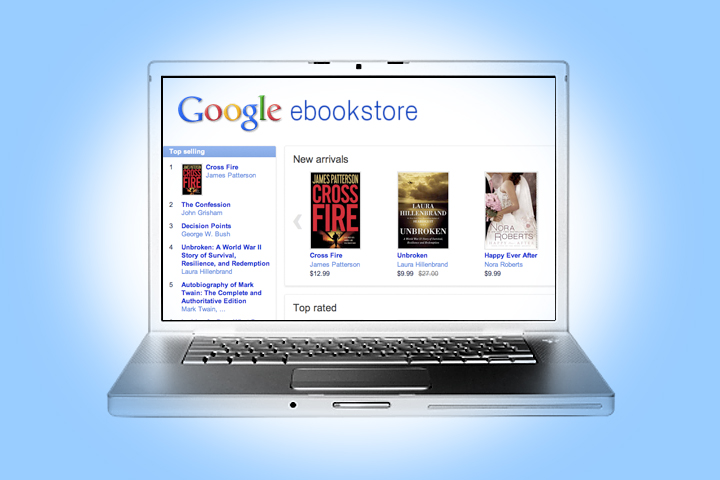

By the time Google eBookstore finally launched on Monday, it was already being touted as a revolution in the marketplace for digital books. It offers more titles — nearly 3 million free, public domain books and “hundreds of thousands” of newer books available for purchase — than any other retailer, and promises every customer “seamless” cloud-based access to their personal e-book library from (almost) any device, no matter where they are.
Whether these features will mean much to the average e-book reader, however, is another matter. Sales of e-books have grown by triple-digit rates in the past year, and industry experts predict no immediate end to the expansion, given that e-reader devices and tablet computers are expected to be popular gifts this holiday season. For every person I’ve met who swears she will never be lured away from her beloved print books, there’s another who raves about finally reading “Middlemarch” on his smart phone during his daily wait for the bus and someone else who reports devouring twice as many books as she did before she got a Kindle.
But if the e-book boom shows us anything, it’s that there’s an infinite variety to what people want from their books. For some, the immateriality of an e-book is a deal-breaker — they can’t pass it on to a friend or sell it to a used bookstore once they’re done with it. For others (like me), this is a feature, not a bug; I can retain a copy of it without having to clear space in the overflowing shelves of my small apartment, and I never have to figure out where I put the thing if I happen to want it in the future. (I’m always misplacing books, so this is a big plus for me.)
Google eBookstore addresses a complaint many have lodged against Amazon’s Kindle: The books bought for it can only be read using Kindle software. This would be a major problem if there weren’t Kindle apps for iOS and Droid devices, as well as for Windows and Mac computers; I don’t own a Kindle, but I own several Kindle e-books and read them on my iPhone and iPad. What I can’t do with my Kindle books is read them on a friend’s iPad during a visit, or on a shared work computer if I want, say, to point out an interesting passage to a colleague. Google’s e-books will be accessible via a user’s Google account from any device that runs a Web browser (that includes tablet computers and smart phones), as well as via apps designed to run on various mobile platforms. I can also read my Google e-books on a Nook or Sony Reader, should I ever decide to buy one, something I can’t do with Kindle titles. But remember: You also can’t use your Kindle to read any e-books you buy from Google.
So let’s review: Google eBooks is a big improvement on the Kindle (still the most popular dedicated e-reader device) if you anticipate wanting to switch from one dedicated e-reader device to another, but if you’re switching to an iPad, then it’s a wash. On the other hand, if you’re a student at the library one afternoon without your Kindle or iPad and you want to be able to access a Kindle book you bought for a class, you’re out of luck. (If that last example strikes you as an exotic scenario, bear in mind that while Kindles are the most popular dedicated e-reader devices, the majority of people who read e-books still read them on a laptop or desktop computer, and many of these readers are students.) Your Google e-books, however, can be read on the library’s computer using a Web browser. But hold on a minute! — Amazon just announced that it will be introducing its own Web-browser-based Kindle reader in a month or so.
In other words, figuring out which e-book system will best meet your needs is really, really confusing. News reports on the latest developments tend to be full of glaring errors — the most common assumption being that you have to have a Nook or a Kindle e-reading device to read Nook or Kindle e-books. And keep in mind that there are also several other smaller e-book formats, devices and vendors, every one of which offers the same public domain titles. If you want to read mostly classics, you might prefer the look of one of these other formats to that of any of the major players. One advantage to the iPad/iPhone is that I’m able to buy and read Kindle, Nook, Stanza and Google e-books as well as use public-domain-only apps like Eucalyptus, a favorite of one of my Salon colleagues. Most public-domain book apps are free, but she was willing to pay for Eucalyptus (which, alas, has only been released for the iPhone) because its superior design makes reading that much easier.
If you’re intrigued by e-books but don’t want to deprive your local independent bookstore of your patronage, Google eBooks may have the answer to your dilemma. Google has formed partnerships with several indie bookstores, enabling them to sell Google eBooks from their websites for a cut of the sales. This a great way to support neighborhood bookstores and it also allows Google eBookstore customers to partake of the expertise of people whose life’s work is connecting readers with the right books. Booksellers also make the best ambassadors to late adapters. The explanation of Google eBooks on the website of the legendary Tattered Cover bookstore in Denver, for example, is much clearer and more comprehensive than the one offered by Google itself.
Then there’s the issue of selection. I don’t doubt that Google eBooks carries more titles than the Kindle store, but that distinction is only meaningful if the additional titles happen to be books you want, and you can figure out how to find them. I spent a few hours banging around on Google eBookstore, comparing it primarily to Amazon’s Kindle store, and came up with some interesting results.
The first is that Google eBookstore isn’t necessarily easy to search — an irony considering that the Google empire was built on search. There’s only one search field in which to enter terms, and while it’s possible to delimit the search by using such formulations as “inauthor:’George Meredith'”, this isn’t explained anywhere and there’s no advanced search page allowing you to specify that you only want to see results with, say, the title “Diana of the Crossways” and the author “George Meredith.”
Because Google eBookstore is somewhat awkwardly integrated with Google Books, a vast library of full and partial scanned texts designed more as a research tool than a store, it returns a lot more results than you get from searching Amazon. Those results will include every book that even mentions “Diana of the Crossways” or “Meredith,” in addition to the book I actually wanted, “Diana of the Crossways” by George Meredith. All these extraneous titles are merely annoyingly if you happen to have gotten all your search terms right, but I misremembered the title of this Victorian novel as “Diana of the Crossroads,” and got a pageful of results many of which didn’t seem to have anything to do with the book, such as a 1910 law text titled “The Constitution of the United States: Its History Application and Construction.”
Google eBooks does offer an e-book of “Diana of the Crossways,” but it was hard to find without the exact title, whereas on Amazon I could plug “George Meredith” in the author field and “Diana” into the title field and get the right book, in its Kindle version, as the second result. Searching on “George Meredith Diana” in Google eBookstore turned up mostly useless garbage, including dozens of weird little overpriced booklets apparently derived from excerpts from “Bartlett’s Familiar Quotations,” and, strangely enough, no copy of “Diana of the Crossways.”
Any bookstore clerk can tell you that many customers are looking for books whose authors and titles they can’t quite remember. Muddying the water with a lot of irrelevant information doesn’t help in such situations. Wanting to buy a copy of “Diana of the Crossways” and wanting to survey a list of books that mention it are two entirely different sorts of searches, and you should be able to do one without mucking about with the other.
That said, there are titles you can buy on Google eBookstore that you can’t get from the Kindle store: “Imaginations” by William Carlos Williams and “Austerlitz” by W.G. Sebald (chosen by Salon as one of the best books of the year in 2001) are two. On the other hand, I was able to buy an e-book of Dorothy Dunnett’s “Game of Kings” from the Kindle store, while Google eBookstore apparently carries none of her books. Neither store offers e-book versions of “Riddley Walker” by Russell Hoban or “Street of Crocodiles” by Bruno Schultz, two titles I recently thought I’d like to have stashed in my iPad. This is often the case with in-copyright books that are more than a decade or so old. Google may someday be able to add them to its store if it can ever resolve the endless legal disputes surrounding its efforts to scan the contents of the world’s major libraries.
One interesting aspect of Google eBookstore’s public domain titles derives from the fact that many of them began as scanned copies of library books. Using your browser or Google eBook app, you can view these books either in their scanned version — with the original type, page numbering and even library stamps and marginalia, basically photographs of the printed pages — or as searchable “flowing text,” rendered by optical character recognition. There’s been a lot of debate about the uneven quality of the scans used by Google Books; scholars have reported crumpled pages, obscuring thumbs and fingers, and smeared or blurry images. You can see evidence of some of that in the Google version of L. Frank Baum’s “The Patchwork Girl of Oz,” including duplicate pages and page clips, but it’s nice to have the option of seeing the print book’s beautifully designed pages with illustrations by John R. Neill — and even a careful inscription by the book’s original child owner, one Camilla Merriman.
Unfortunately, the public domain titles I did find in Google eBookstore were often of lesser quality than the free or very low cost versions in the Kindle, Nook and iBooks stores. The text version of Elizabeth Gaskell’s “Cranford,” for example, had obviously not been proofed and the scans of the original pages were difficult to read. The Kindle texts seem to be created from Project Gutenberg files, which are usually proofed, and some care has been taken in their design, a factor too many penny-pinching e-book buyers fail to account for in their quest for free stuff. One thing you can say for those e-book retailers who, unlike Google, are pushing a pricey gadget: They have more motivation to provide decent free or nearly free content to install on their users’ new toys.
Google eBookstore’s poor consumer interface — you can tell it was devised by people who know next to nothing about the book trade — isn’t going to introduce many readers to new books and authors. It’s about as dismal in that respect as the iBooks store, and neither can compete with the rich customer-generated metadata offered by longtime online booksellers like Amazon and Barnes & Noble. Google has incorporated reader reviews from the social networking service GoodReads, which helps, as these are often more thoughtful than the average Amazon reader review, but the “related books” suggestion lists still have some kinks to iron out — fans of Rebecca Skloot’s “The Immortal Life of Henrietta Lacks” are referred to a trashy novel titled “Bling Addiction,” for example.
If Google is as smart as it’s made out to be, it will realize that its indie bookstore affiliates are its secret weapon. Helping readers find new books and new favorite authors is their area of expertise. So far, though, the Google eBookstore page dedicated to its partnerships with booksellers is pretty skimpy; it shows logos for Alibris and Powell’s Books, but doesn’t actually link to their sites. For a service that claims to be “all about choice,” it still has a ways to go.
Further reading:
Google eBookstore explains itself
Tattered Cover Books on everything you always wanted to know about e-books
A list of independent booksellers who sell Google e-books on their sites
What Apple’s iBooks needs to learn about selling books
How rampant errors threaten the usefulness of Google Books for scholars
