
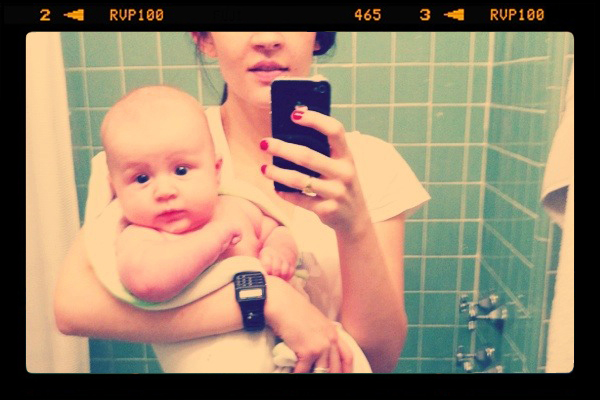

At first glance, Naomi and Stacie and Stephanie and Liz appear to be members of the species known as the “Hipster Mommy Blogger,” though perhaps a bit more cheerful and wholesome than most. They have bangs like Zooey Deschanel and closets full of cool vintage dresses. Their houses look like Anthropologie catalogs. Their kids look like Baby Gap models. Their husbands look like young graphic designers, all cute lumberjack shirts and square-framed glasses. They spend their days doing fun craft projects (vintage-y owl throw pillow! Recycled button earrings! Hand-stamped linen napkins!). They spend their weekends throwing big, whimsical dinner parties for their friends, all of whom have equally adorable kids and husbands.
But as you page through their blog archives, you notice certain “tells.” They’re super-young (like, four-kids-at-29 young). They mention relatives in Utah. They drink a suspicious amount of hot chocolate. Finally, you see it: a subtly placed widget with a picture of a temple, or a hyperlink on the word “faith” or “belief.” You click the link and up pops the official website of the Church of Jesus Christ of Latter-day Saints.
Yep, Naomi and Stacie and Stephanie and Liz are Mormons. They’re members of a large, close-knit network of Mormon lifestyle bloggers — young stay-at-home-moms who blog about home and hearth, Latter-day Saint-style. From Rockstar Diaries (Naomi) to Underaged and Engaged (Stacie) to Nie Nie Dialogues (Stephanie) to Say Yes to Hoboken (Liz), Mormon lifestyle bloggers occupy their very own corner of the blogosphere.
Their lives are nothing like mine — I’m your standard-issue late-20-something childless overeducated atheist feminist — yet I’m completely obsessed with their blogs. On an average day, I’ll skim through a half-dozen Mormon blogs, looking at Polaroids of dogs in raincoats or kids in bow ties, reading gratitude lists, admiring sewing projects.
I’m not alone, either. Two of my closest friends — both chronically overworked Ph.D. candidates — procrastinate for hours poring over Nat the Fat Rat or C. Jane Enjoy It. A recent discussion of Mormonism on the blog Jezebel unleashed a waterfall of confessions in the comments section from other young non-religious women similarly riveted by the shiny, happy domestic lives of their Latter-day Saint sisters.
“They have lovely homes, picture-perfect kids, loving, super-attentive husbands, and things seem very normal and calm,” writes a commenter named BrookeD, who admits to reading five Mormon blogs daily.
“I thought I was the only one!!” responds another commenter.
“THANK YOU,” adds a third. “I’m another closet non-Mormon reader of Mormon mommy blogs.”
So why, exactly, are these blogs so fascinating to women like us — secular, childless women who may have never so much as baked a cupcake, let alone reupholstered our own ottomans with thrifted fabric and vintage grosgrain ribbon? It’s not as though we’re sniffing around the dark side of the faith, à la “Big Love.” And it’s not about religion. As someone married to a former Saint (my husband left the church as a teenager), I certainly have no illusions about what life as a Mormon would be like, and I’m sure it’s not for me, which makes my obsession with these blogs all the more startling.
Well, to use a word that makes me cringe, these blogs are weirdly “uplifting.” To read Mormon lifestyle blogs is to peer into a strange and fascinating world where the most fraught issues of modern living — marriage and child rearing — appear completely unproblematic. This seems practically subversive to someone like me, weaned on an endless media parade of fretful stories about “work-life balance” and soaring divorce rates and the perils of marrying too young/too old/too whatever. And don’t even get me started on the Mommy Blogs, which make parenthood seem like a vale of judgment and anxiety, full of words like “guilt” and “chaos” and “BPA-free” and “episiotomy.” Read enough of these, and you’ll be ready to remove your own ovaries with a butter knife.
“It seems that a lot of popular culture wants to portray marriage and motherhood as demeaning, restrictive or simple, but in the LDS church, motherhood is a very important job, and it’s treated with a lot of respect,” says Natalie Holbrook, the New York-based author of the popular blog Nat the Fat Rat. “Most of my readers are non-LDS women in their late 20s and early 30s, college educated, many earning secondary degrees on the postgraduate level, and a comment I often get is, ‘You are making me want kids, and I’ve never wanted kids!'”
Indeed, Mormon bloggers like Holbrook make marriage and motherhood seem, well, fun. Easy. Joyful. These women seem relaxed and untouched by cynicism. They throw elaborate astronaut-themed birthday parties for their kids and go on Sunday family drives to see the fall leaves change and get mani-pedis with their friends. They often have close, large extended families; moms and sisters are always dropping in to watch the kids or help out with cake decorating. Their lives seem adorable and old-fashioned and comforting.
“I’ve gotten e-mails from readers thanking me for putting a positive spin on marriage and family,” Holbrook says. “It’s important to acknowledge the hard parts — and I think we all do — but why not focus more on the lovely and the beautiful? That positive attitude is a very common theme throughout all aspects of the Mormon faith.”
This focus on the positive is especially alluring when your own life seems anything but easy. As my friend G. says, of her fascination with Mormon lifestyle blogs, “I’m just jealous. I want to arrange flowers all day too!” She doesn’t, really. She’s just tired from long days spent in the lab, from a decade of living in a tiny apartment because she’s too poor from student loans to buy a house, from constant negotiations about breadwinning status with her artist husband. It’s not that she or I want to quit our jobs to bake brownies or sew kiddie Halloween costumes. It’s just that for G., Mormon blogs are an escapist fantasy, a way to imagine a sweeter, simpler life.
There’s been a lot of talk in recent years about “the New Domesticity” — an increasing interest in old-fashioned, traditionally female tasks like sewing, crafts and jam making. Some pundits see this as a sign that young women yearn to return to some kind of 1950s Ozzie and Harriet existence, that feminism has “failed,” that women are realizing they can’t have it all, after all. That view is utterly nonsense, in my opinion, but I do think women of my generation are looking to the past in an effort to create fulfilling, happy domestic lives, since the modern world doesn’t offer much of a road map. Our parents — divorced, stressed-out baby boomers — are hardly paragons of domestic bliss. Nor are the Gen X “Mommy War” soldiers, busy winging snowballs of judgment at each other from across the Internet. (Formula is poison! Baby wearing is child abuse!)
If those are the options, I’ll take a pass, thanks.
Enter the Mormon bloggers, with their picture-perfect catalog lives. It is possible to be happy, they seem to whisper. We love our homes. We love our husbands.
Of course, the larger question is, are these women’s lives really as sweet and simple as they appear? Blogs have always been a way to mediate and prettify your own life; you’d be a fool to compare your real self to someone else’s carefully arranged surface self. And Mormons are particularly famous for their “put on a happy face” attitude. The church teaches that the Gospel is the only authentic path to true happiness. So if you’re a faithful follower, you better be happy, right?
The phenomenon of the happier-than-thou Mormon housewife blogger is so well-recognized it’s even spawned a parody blog, Seriously So Blessed, whose fictional author brays things like “We have non-stop fun all the time and are LOVING married life!” and “Speaking of fall, I kind of sometimes want to start a non-profit to help moms who go all of fall without blogging pics of their kids in pumpkin patches, because it seriously breaks my heart!”
So why are Mormon women such prolific bloggers? “It probably has something to do with the fact that Mormons are the world’s biggest journal-keepers,” says my husband, offering a partial explanation. Church elders have long encouraged members to keep regular journals for the dual purposes of historical record-keeping and promoting spiritual insight, and as a result Mormons are champion journalers and scrapbookers. In the 2000s, church elders began officially promoting new media technologies like blogs as a way of spreading the gospel, and the Mormon blogging community soon became so large it earned itself a punny nickname: the Bloggernacle.
For many LDS women, blogging about the domestic arts is a natural fit. As ex-Mormon designer Emily Henderson explains on her blog, The Brass Petal, growing up in large families engenders an attitude of make-do thriftiness — homemade bread, recycled soda can Christmas ornaments, Salvation Army fashion. With the rise of DIY culture across secular America, all of a sudden those skills have become trendy, even bankable.
“Blogging is something they/we can do that feels productive, can potentially make money for our families and can be done from the home at any time,” Henderson writes. For young Mormon women, who face immense cultural pressure to stay home with children rather than pursue a career, blogging about their adventures in homemaking becomes a sort of creative outlet, a way of contributing to the larger world beyond the home.
The bloggers I read may be as happy with their lot as they seem. Or not. While some Mormon women prosper under the cultural norms for wife- and mother-dom, others chafe. Utah is, after all, the state with the highest rate of prescription antidepressant use, a statistic the president of the Utah Psychiatric Association attributes to the pressure among Mormon women to be ideal wives and mothers. The creator of Seriously So Blessed, an anonymous Mormon woman, addresses this pressure in an online archive of Mormon women interviews called the Mormon Women Project: “In any highly homogeneous culture we all feel pressure to be and look and think and act a certain way,” she says. “You start to think you need to be absolutely perfect in every area.”
Clearly, life for the Mormon wife is not all crafts and cupcakes. Even if it were, I seriously doubt that crafts and cupcakes are all that much fun when you do them all day, every day.
But the basic messages expressed in these blogs — family is wonderful, life is meant to be enjoyed, celebrate the small things — are still lovely. And if they help women like me envision a life in which marriage and motherhood could potentially be something other than a miserable, soul-destroying trap, I say, “Right on.” I won’t be inviting the missionaries inside for hot cocoa now or ever, but I don’t plan on stopping my blog habit any time soon.
