
Egyptian Protests
The blogger who still loves Mubarak
Pamela Geller cheers for mass arrests, worries that Obama will throw our "ally" under the bus
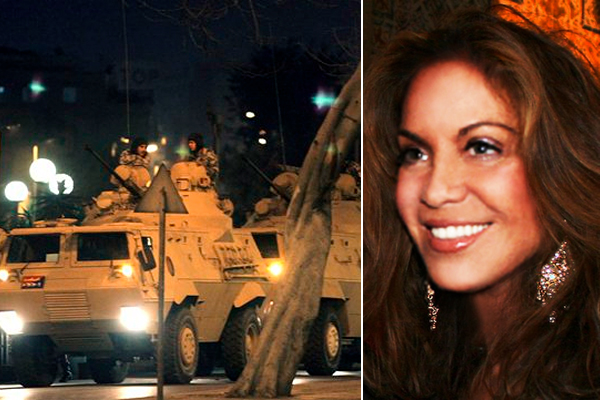
Pamela Geller, left. Right: Egyptian army armored vehicles patrol a street in Cairo following protests in Cairo, Egypt, Friday, Jan. 28, 2011. While some conservatives fancifully imagine that George W. Bush’s foreign policy misadventures led to these demonstrations in the Arab world, and while others acknowledge that Mubarak is awful but the rest of those Muslims are even worse, one prominent conservative blogger is openly rooting for the repressive Mubarak regime to survive: Pamela “Atlas Shrugs” Geller.
Last night, a classic Geller headline: “GOOD NEWS: EGYPT ARRESTS MUSLIM BROTHERHOOD LEADERS.”
In other words, members of the opposition were swept up and jailed in preparation for a day of demonstrations against the authoritatian government. And this opposition group was not even involved in the initial protests, though they joined in the ongoing demonstrations that began on Friday. “It’s a good preventative measure no matter who wins this power struggle,” Geller wrote.
But as the world became transfixed by the images out of Egypt today, Geller worried that Barack Obama might abandon our wonderful ally, Hosni Mubarak.
Mubarak has been a US ally for decades. We send three billion dollars a year to Egypt. And Egypt made a peace deal with Israel. But knowing Obama, he will throw another ally under the bus.
Geller continued to demonstrate the limits of her simplistic, binary understanding of the world. “I am all for political freedom,” she wrote, except that she prefers Mubarak to, uh, political freedom.
Alex Pareene writes about politics for Salon and is the author of "The Rude Guide to Mitt." Email him at apareene@salon.com and follow him on Twitter @pareene More Alex Pareene.
Can Egypt reignite the Arab Spring?
Huge protests marked the revolution's anniversary as many dissidents hope to spark an uprising against the army
(Credit: AP Photo/Muhammed Muheisen) CAIRO, Egypt — It may have been the largest demonstration Egypt’s ever seen.
Hundreds of thousands — some boasted a million — descended on Cairo’s iconic Tahrir Square Wednesday to mark the first anniversary of the uprising that toppled President Hosni Mubarak and to call for an end to military rule.
The square was so packed that the crowds spilled onto the bridges and streets that fan out from the plaza and into Cairo’s downtown streets, with chants for freedom thundering against the area’s crumbling, colonial-era buildings.
Continue Reading CloseThe devastating crackdown on Egypt’s revolution
Since Mubarak was deposed, over 12,000 civilians have been tried by shadowy military tribunals
Om Ahmed demonstrates for the release of her son and his friend on July 1, 2011. Both were sentenced to five years in prison in a military trial for breaking curfew. (Credit: Mona Seif/Courtesy) CAIRO — Before the pro-democracy movement’s demonstrations swelled the streets of this city and ousted President Hosni Mubarak, Amr El-Beheiry was a 32-year-old factory worker who hailed from Nile Delta and was proud of his large and very close family.
El-Beheiry struggled like most Egyptians, but his family says he kept a simple dream of being able to afford an apartment and to save enough to finance a modest wedding. He minded his own business.
Continue Reading Close“Liberation Square”: A thrilling account of Egypt’s revolution
From Facebook martyrs to camelback attacks, a Cairo reporter gives a street-level view of history in the making
Ashraf Khalil The overthrow of Hosni Mubarak’s regime in Egypt last year served as dramatic proof that the Arab Spring wasn’t just a passing, or purely Tunisian, phenomenon. Egypt’s revolution heralds the coming obsolescence of the late-20th-century-style militarized pseudo-democracy in the Middle East, and its influence has extended as far as Wall Street’s Zuccotti Park. Future generations will surely study Tahrir Square and what happened there intensively, but anyone in search of an expert account today need look no further than Ashraf Khalil’s “Liberation Square: Inside the Egyptian Revolution and the Rebirth of a Nation.”
Continue Reading Close
Laura Miller is a senior writer for Salon. She is the author of "The Magician's Book: A Skeptic's Adventures in Narnia" and has a Web site, magiciansbook.com. More Laura Miller.
Thanks to you!
The people we're most grateful to have around this year
Clockwise from upper left: Elizabeth Warren, Wael Ghonim, Diane Ravitch and Ray Lewis Admittedly, I spend a lot of time grousing and naysaying. Today, though, we put that negativity briefly aside, as we celebrate a day of thoughtful reflection, and a night without a GOP presidential debate. I thought it appropriate, on the occasion of Thanksgiving, to thank some of the people who’ve worked to make the country and the world a better place over the least 12 months.
Thanks to Wall Street Occupier Jesse LaGreca, who didn’t only show up the Fox reporter sent to embarrass occupiers, but also managed to get the OWS message across on a Sunday political chat show, which is essentially unheard of. So thanks to you, for bringing up economic justice to the ancient panel of crusty establishmentarians on “Meet on Press.”
Continue Reading Close
Alex Pareene writes about politics for Salon and is the author of "The Rude Guide to Mitt." Email him at apareene@salon.com and follow him on Twitter @pareene More Alex Pareene.
Amid street fighting, Egypt’s cabinet resigns
Demonstrators flooding Tahrir Square demand military relent to civilian rule
Protesters move away from tear gas fired by Egyptian riot police during clashes near Tahrir Square in Cairo on Monday. (Credit: AP/Tara Todras-Whitehill) CAIRO — The military-appointed cabinet of the Egyptian government submitted letters of resignation late Monday night after three days of demonstrations rocked downtown Cairo and claimed nearly 40 lives. Just a week before Egypt’s planned parliamentary elections, the real political battle is being fought on the streets of Cairo while the military government and nascent political parties play catch-up.
The tumult began last Friday when thousands of peaceful protesters marched in Tahrir Square to condemn a constitutional proposal which would place the Supreme Council of the Armed Forces (SCAF) beyond civilian control. On Saturday afternoon, military police then cleared the square of demonstrators using tear gas but the crowds soon returned, forcing the security personnel out. Ever since, protesters and police have been playing an ever-escalating game of cat-and-mouse through the downtown streets.
Continue Reading CloseAvi Asher-Schapiro is a writer living in Cairo. More Avi Asher-Schapiro.
Page 1 of 46 in Egyptian Protests
