
Bookstores

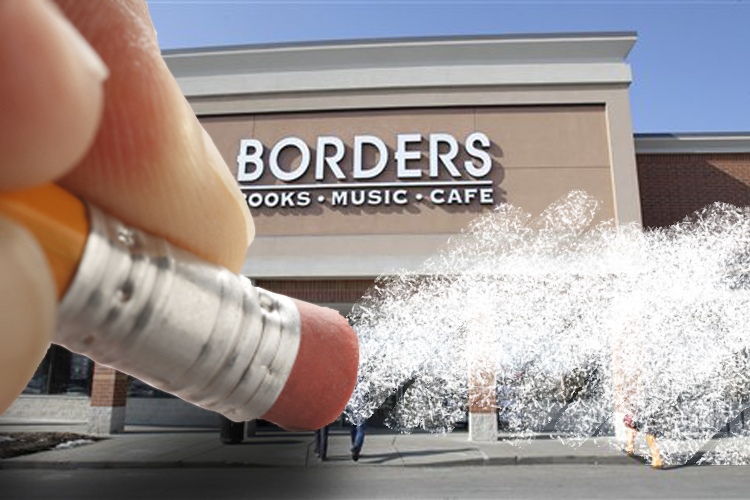
How Borders lost its soul

The store went from a true alternative to a big-box bore. Now, it's the independent shops who come out the winners

  • more
    • All Share Services

How Borders lost its soulCustomers walk into a Borders Books & Music store, which is on the closing list, in Ann Arbor, Mich., Wednesday, Feb. 16, 2011. Borders, which helped pioneer superstores that put countless mom-and-pop bookshops out of business, filed for bankruptcy protection Wednesday, sunk by crushing debt and sluggishness in adapting to a rapidly changing industry. (AP Photo/Carlos Osorio)(Credit: Carlos Osorio)

When I was a teenager, there were two off-campus bookstores that shaped my reading life. The first was Jocundry’s, in East Lansing, Mich., which I discovered when I was in high school. I could always go there for a copy of Michael Moore’s alternative newspaper, the Michigan Voice, or a book by George Bernard Shaw or Friedrich Nietzsche, two authors I liked to be seen reading. A bearded Michigan State University historian was always sitting inside the front door of Jocundry’s with his dog, reading The New York Times.

The second was Borders, the chain bookseller that declared bankruptcy on Wednesday. As a freshman at the University of Michigan in Ann Arbor, I was awed by the sight of the original Borders, on State Street. Never in my 18 years had I seen two stories of books. I spent nearly as much time reading at Borders as I spent reading in class while my professors lectured. There was nothing to do at Borders but read. In the mid-1980s, a coffee shop was still a diner that served pancakes until 11 a.m.

A decade later, as Borders spread nationwide, I was as excited as a Starbucks drinker from Seattle. In those years, on the cusp of the World Wide Web, I was living in a small industrial city in Central Illinois. Its only literary outlets were a newsstand, whose owner constantly reminded me he wasn’t running a library, and a Waldenbooks at the Hickory Point Mall. When I wanted a book of short stories by V.S. Pritchett, I ordered it through a clerk, and waited two weeks. But with Borders invading shopping malls in Erie and Wichita and Normal, everyone in America could have the same instant access to V.S. Pritchett that I’d enjoyed in Ann Arbor.

Unfortunately, the ascendancy of the mega-bookstores ended up destroying Jocundry’s, and its dog-friendly atmosphere. Barnes & Noble took over an empty supermarket a few miles from Michigan State’s campus. Jocundry’s moved into a bigger space to compete with B&N’s inventory. The expense ruined them. Jocundry’s closed in 2001. Soon after, Barnes & Noble moved into downtown East Lansing, claiming its independent rival’s turf.

And so it went in the era of 25,000-square-foot mediasauruses, as Borders and Virgin and 16-screen multiplexes barreled into malls and booming suburbs and cloistered Manhattan neighborhoods. The demise of Jocundry’s was the first incident that soured me on big box bookstores. The second was publishing a book myself. When I tried to schedule a signing at my neighborhood Borders, I experienced the difference between a bookseller and a corporation that sells books. As a first-time author, I quickly learned that Borders was not going to let me read when it could get Dennis Rodman or Rudy Giuliani instead. The store manager told me to fax a request to the regional events coordinator. I did so, emphasizing that I’d been shopping at Borders before Dan Brown had ever heard of the store. Borders never called back.

When I published my most recent book, “Young Mr. Obama: Chicago and the Making of a Black President,” I did the first signing at 57th Street Books, in Chicago’s Hyde Park neighborhood, near the University of Chicago. It was the obvious location, because it’s the president’s favorite bookstore. How did I arrange an event there? I called the manager, Jack Cella, and said, “Jack, I just wrote a book about Obama and I want to do a book signing.” 

About 10 years ago, Borders opened a store in Hyde Park, less than a mile from 57th Street Books. It’s on this week’s extinction list. So it turns out that after all the Op-Ed fretting about neighborhoods being swallowed by commercial behemoths, there are neighborhoods where an independent bookstore served the local market better than Borders.

“Initially, they certainly were a competitor,” 57th Street manager Jack Cella said, when I called him on Thursday. “Going back a ways, Borders used to run really good bookstores. It’s been awhile. The one in Hyde Park never understood what the neighborhood was about. It’s university. It’s African-American.”

Borders, the store whose independent spirit once made it so much more exciting than the Waldenbooks at the mall, turned into the generic fluorescent bookstore it once aimed to replace. The tables are heaped with blockbusters by Keith Richards and Stephen Colbert. Those escalators, those cash registers, those fidgety coffee lines — it’s not the relaxing hangout it was in 1985. With its one-size-fits-America model, Borders never had the flexibility to file books under “Gender Studies” or “Marxism,” popular sections in 57th Street’s sister store, the Seminary Co-op, a series of underground caverns packed to the ceilings with esoteric academic titles.

Borders ended up caught between the variety of the Internet and the intimacy of the independents. Its outlets could never stock as many books as Amazon. Nor could they duplicate the native flavor of the corner bookstores, with their local author readings and folk music nights.

So bookstores like 57th Street will outlive the local Borders because they’ve made themselves community institutions. Nearly every serious reader in Hyde Park owns a $30 share in the store, good for a 10 percent discount. (President Obama has been a member since 1986.)

“I think people are naturally inclined to support a neighborhood-focused bookseller, and one they have a stake in,” Cella said. “Our customers are very devoted, and they’re not at all shy about offering suggestions.”

Thirty years ago, a customer suggested to Cella that Islam was too big a faith to be hidden in Comparative Religions. So Islam got its own section.

Of course, 57th Street’s neighborhood has been home to 85 Nobel Prize winners, including Saul Bellow and J.M. Coetzee. In communities with lesser literary traditions, Borders is the only store in town.

“I think, in a lot of ways, independents are in the same boat as these chain stores,” Cella said. “We’re trying to give people a reason to shop locally rather than online. I don’t really feel good about Borders [closing], because in a lot of places, they were an important part of community life. They were meeting grounds. I don’t think Borders’ closing is necessarily going to help independents, but people are looking for alternatives.”

Even with Borders disappearing, the independents will still have to face competition from the Kindle, the Nook and the iPad, not to mention Amazon. But as paper books become a niche product, niche retailers will be the best place to buy and sell them. Book lovers will always want a place to gather and hear recommendations from a bookseller who knows their reading habits, and their community. Borders belonged to an era when book retailing was a big enough business to monopolize. Now that there’s no money in it anymore, we may have to go back to shopping for books in stores that let dogs wander through the stacks, and don’t even serve coffee.

Defeated by TSA

Sometimes you just can't win. Plus: OK, not all the airport bookstores are bad

  • more
    • All Share Services

Defeated by TSA (Credit: Jason Reed / Reuters)

Thoughts running through my head at the TSA checkpoint …

All of these measures in place today — the liquids and gels rules, the pointy object confiscations, the multiple ID checks, the body-scanners and the pat-downs — would they have stopped the Sept. 11 attacks?

Of course not. The success of the 2001 attacks had nothing to do with box cutters. The hijackers’ critical tool was an intangible one: the element of surprise. That is, taking advantage of our understanding and expectations of a hijacking. What weapons they had in their bags was irrelevant. They could have used anything.

For that matter, would any of these measures have prevented the terrorist bombing of Pan Am 103? How about the bombings of Air India 182 or UTA 772?

Again the answer is no. It was bombs in the lower holds that got those planes.

I don’t know about you, but when I’m on a plane I worry a lot more about what’s going on below deck — in checked luggage and cargo — than I do about passengers and their carry-ons. The Transportation Security Administration tells us that all checked bags are scanned nowadays for explosives, and that’s about the most valuable thing the agency does for us. I just hope agents do it with as much over-the-top scrutiny as they use to paw through carry-ons looking for forks and toothpaste.

I’m traveling off-duty, just a regular old passenger. Approaching the body scanner, I “opt out,” as I always do. I’ll be taken aside for a thorough pat-down.

I don’t opt out because of worries about radiation. I do it because I find it appalling that passengers are effectively asked to pose naked in order to board an airplane. And because the scanners are strategically ineffective. I don’t “believe in them,” you might say. I mean, think about it: You’ve got a scanner at one checkpoint, but no scanner at the one right next to it; scanners at some terminals, but not at others. Are terrorists really that stupid? And what about overseas? If somebody is going to sneak something deadly through a checkpoint, it is far, far, far more likely to happen at an airport in Asia, Africa, South America or the Middle East, than in Peoria, Wichita or Cleveland.

Is this one of those “follow the money” situations? Are these machines really in the interest of safety? Is that what this is about? Or is it about the corporations who stand to make billions of dollars in their design and deployment? Why not explosives-sniffing dogs instead? Are they not just as effective, and cheaper and friendlier to boot? Or is that the problem?

I’m chatting with the TSA guard about this while he frisks me. He shrugs. “A lot of waste in government,” he says.

“Bag check!” A woman’s voice, loud.

Oh great. Off to the side, the X-ray machine has detected an extremely dangerous 6-ounce bottle of aloe vera gel in my roll-aboard.

“Is this your bag, sir?”

“Um, er, ah, yes.”

She sticks a gloved hand inside and pulls out the tube. The look she gives me — it’s a scolding sort of glare with an unmistakable glint of satisfaction.

“But … but it’s only half-full.”

“I don’t have a scale to weigh liquids, sir.”

“Why do you need a scale? You can just look at it. It’s a 6-once tube and obviously it’s only half-full.”

She doesn’t look. “Sorry. You cannot bring this through.”

“But …”

Plop. She throws my aloe into a waste barrel.

Aha! But in tossing it away like that, hasn’t she just admitted that the container is harmless? After all, if it was something potentially dangerous, you wouldn’t just fling it into the garbage.

Are TSA screeners looking for bombs, or are they looking for innocent liquids? I’m reminded of those tests I’d heard about, when, supposedly, water bottles were attached to mock-up bombs and sent through the X-ray machines. Screeners found the bottles, while the bombs went sailing through. “An Easter egg hunt for minor banned items,” in the words of former TSA chief Kip Hawley, from his upcoming book, “Permanent Emergency.”

“Look,” I say. ” Since you’re throwing that tube away, you’re telling me that you know it’s nothing harmful.”

Perturbed stare.

“So, like … can I have it back?”

She stares at me, clearly annoyed and unable to tell if I’m kidding or not.

I am kidding, of course. My gel is gone for good; another $4.65 into the TSA hole. But am I not correct at the same time? I’ve lost my property, but I feel that I’ve made a useful point and can walk away having established the upper hand. Yeah. I’m proud of my snappy little assessment: so tight, so logical and righteous!  Take that, TSA!

And it’s exactly at this moment, the screener’s eyes still fixed on me, that my cellphone goes slipping out of my hand. I drop it; catch it; drop it and catch it again. My arms are wiggling and flailing in a ridiculous little dance until finally the phone flies completely away from me. It goes clattering off a stack of gray bins and slides pathetically onto the floor — directly at the screener’s feet.

She picks up the phone and hands it to me. “Good day, sir.”

I skulk away feeling like the biggest goofball in the world.

And maybe this was a kind of divine intervention, a dose of humiliation engineered to shut me up and kick me on my way. A lesson summed up in two easy words: lost cause.

If the TSA’s tactical flaws are ever going to be fixed, it certainly won’t be me who gets it done. I spend too much time writing about it, and too much time worrying about it.

—————

GO-AROUNDS

Re: Airport bookstores, or lack thereof

As various emailers pointed out, not every airport bookshop is a glorified magazine stand. There are still some good retails options in U.S. terminals. Renaissance Books at Milwaukee, for example, got several kudos from readers. There’s Powell’s still at Portland’s PDX, I’m told. I can personally vouch for a place called BookLink (formerly a Borders franchise) at terminal A in Boston. Even JFK’s Terminal 3, for all its demerits, has a decent bookstore just inside the east-side security checkpoint, abeam gates 4 and 5.

And the following letter is from a vice president of Hudson Booksellers, one of the companies mentioned in my story:

Having been a buyer for airport bookstores for over 15 years, I have witnessed the amazing growth and diversification of airport bookselling, as well as the recent downturn, largely due to the e-book effect. Blending customer expectation with personal passion is the essence of our selection process. Yet, so frequently when we see Hudson in print, including in your article, we are pigeonholed as corporate peddlers of “airport books.” Clearly our message and product isn’t getting through the way we’d like.

Airport bookstores are in competition against many other product categories. For the last 15 years my team and I have been turning over every stone in trying to meet the challenge of bringing the best books to the most readers.  One of your reader comments mentioned — incredulously — discovering Roberto Bolaño at the airport in San Francisco. But that type of thing honestly happens every day at Hudson. We’ve sold hundreds of Bolaño’s novels, which are part of our core bookstore selection. You mention Gary Shteyngart, another personal favorite, who we have been promoting since “The Russian Debutante’s Handbook.” We went all out with “Absurdistan” and sold over 26,000 copies the year it came out, which I believe was more than 25 percent of all copies sold. We have many great locations with a locally curated assortment that I would put up against Powell’s or Compass, etc. — in Denver, Chicago, Pittsburgh, Newark, Raleigh.

I am also surprised at your statement about your own book, “Ask the Pilot.” We have carried your book since it came out in 2004, selling over 1,000 copies in one LAX store alone — thousands more over the years — and we are still carrying it in a few locations.

Sara Hinckley
Vice President of Book Purchasing & Promotions
Hudson Booksellers

Author’s note: In retrospect, I ought to have been a little more gracious in my references to Hudson.  Indeed, many of the chain’s airport outlets are full-fledged bookstores with a very good selection, and the chain did stock and sell many copies of my book when it was new. (Though, honestly, the thing is so out-of-date at this point that I’m pleased when I don’t find it for sale.)

Continue Reading Close

Where are the books?

There's nothing like a good read to pass the time when flying. So let's get some proper bookstores at our airports

  • more
    • All Share Services

Where are the books? (Credit: DannyMcL / CC BY 3.0)

Reading on planes is a natural, am I right? The trick to getting through a long flight is distraction, distraction, distraction, and what better way to distract yourself than with a good book.

Why, then, is it so bloody hard to find a proper bookstore at an airport? Not all of us pre-load our reading material on a Kindle.

I was in Detroit the other day. The terminal at DTW is one of America’s best, and the mile-long concourse is jammed with retail shops. But do you think I could find a book in there? If I wanted a diamond bracelet, a $300 Tumi briefcase or a cup of gourmet coffee, on the other hand, no problem.  But a book?

Sure, there are places selling books — there are lots of places selling books — provided you’re interested in one of a tiny sample of titles. There was something vaguely North Korean about walking the length of the concourse and seeing the exact same hardcovers, over and over and over and over — Steve Jobs staring out at me every 20 steps or so from the shelves of any of 50 different shops, all utterly indistinguishable from one another.

Not long ago almost every major airport had a proper bookseller. Nowadays they are harder and harder to find. Usually, what passes as a bookstore is really just a newsstand. The vast majority of these outlets are owned and controlled by one of two companies: Hudson Group and an Atlanta-based company called Paradies Shops Inc. Both conduct business under numerous sub-brands that hawk a very thin selection of bestsellers, business books, thrillers and pop-culture trash.

The terminal guide at DTW told me there was something called Heritage Books — two of them, in fact, one at either end of the hall. That got my hopes up. Maybe I’d score a copy of Gary Shteyngart’s new novel.

As they say, good luck with that. Turns out that Heritage is just one of those Paradies Dba franchises.

They did stock a copy of Jonathan Franzen’s novel “Freedom” (yet not “The Corrections,” which was much better), and obviously no retailer can get by without a token Malcolm Gladwell or two, a gesture to the “sophisticated” reader who is seeking something headier than “American Sniper,” or the latest Suze Orman guide to success, or one of two — two! — books by Chelsea Handler.

I couldn’t get out of there fast enough.

On the bright side, though, am I correct in observing that America’s fascination with Sudoku has begun to taper off?

Lingering resentment, yes. Several years ago I nearly had a nervous breakdown trying to get Paradies and Hudson to stock my own lousy little book, “Ask the Pilot — Everything You Need to Know About Air Travel.” I was stupid enough to think that the airport, of all places, might be a good selling point for a book exclusively about air travel. I’ll never make that mistake again. It was carefully explained to me that, no, it matters not what your book is about, captive audience be damned. What matters is getting on the company’s shortlist of airport-worthy bestsellers, or having your publisher pay for an airport promotion. Hudson carried “Ask the Pilot” briefly, into the fall of 2004, after which it disappeared from airports forever.

All of airport retailing, though, seems to suffer from a kind of dementia. This is something I explore in my famous essay, “What’s the Matter With Airports?” Enough already with the jewelry, the souvenir sweat shirts, the remote-control helicopters and the high-end luggage.

(The fixation with luggage is particularly strange to me. Who in the world buys luggage * after * they get to the airport? No wonder these places are always empty.)

How about something practical instead? Like a halfway decent bookstore.

But I digress.

Getting back to the positive…

Thanks to the many readers who contributed to my “Hidden Airport” collection. The idea, for those of you who missed it, is to highlight spots of unexpected pleasantness at U.S. airports. I showcased two: the garden adjacent to the Marine Air Terminal at New York’s LaGuardia, and the connector walkway between terminals B and C at Boston-Logan.

Several of you wrote in with pictures and descriptions of other little-knows oases. For example, the SFO Aviation Museum and Library at San Francisco International. But my favorite so far, I think, is the sculpture garden at the Greenville-Spartanburg (GSP) airport in South Carolina.  You can view it here in this interactive panorama put together by reader John Riley.

Continue Reading Close

Resolved: Kick the Amazon habit in 2012

Yes, you CAN buy e-books and support your local indie bookstore

  • more
    • All Share Services

Resolved: Kick the Amazon habit in 2012 (Credit: iStockphoto/PaulaConnelly/mbortolino)

I suspect I’m not the only person starting 2012 with a resolution to buy fewer books from Amazon. Resistance to the e-commerce giant and its crypto-monopolistic ways crystallized just before Christmas, when it offered customers a 5 percent credit to use its price-checking app in brick-and-mortar stores, thereby undercutting local businesses.

Booksellers have been complaining about “showrooming” — the practice of using a bookstore to browse and learn about new titles while buying the actual books online — for a while now. Amazon’s holiday-season gambit, and a New York Times op-ed denouncing it written by novelist Richard Russo, alerted readers who value their local bookstores to the possibility that those stores will vanish if we don’t make a point of patronizing them.

But what if you prefer e-books? Because of my job, I rarely buy print books. (I get too many sent to me as it is.) Yet, for various reasons, I’ve found myself purchasing a surprising number of e-books to read on my iPad. At first, I automatically opted for Kindle books; the Kindle app for the iPad works great, and if I decide to switch to reading on my iPhone, it will automatically keep my place. Above all, Amazon has the richest and deepest online books database, where I can instantly find out whether a title is available in e-book (or audiobook) format, scan reader reviews and follow reader-generated tags to find similar titles.

Many people assume that if you want e-books, you’ve got to buy them from Amazon or another online retailer. They’re wrong about that. You most certainly can purchase e-books from your local independent bookstore. I’ve done it myself several times since I made my resolution to avoid buying them from Amazon if at all possible. Two of my favorite New York booksellers — Greenlight Books in Brooklyn and McNally Jackson in Manhattan — participate in the Google e-books program. You can visit their websites, find the book you want and purchase it through Google, which gives the bookstore a cut. The prices are comparable and the Google Books app works as well as the Kindle one.

That doesn’t mean that I don’t still use Amazon to find out about e-books. From browsing in the Kindle store, I learned that Cornelia Read’s “Field of Darkness” — a 2006 mystery recommended by one of my favorite authors, Tana French — is now available as a Kindle e-book for a mere $1.99. So I popped over to McNally Jackson’s website, searched on that title and found that the Google e-book could be had for the same low price, whereupon I bought it there. (Admittedly, McNally Jackson’s cut on a $2 book can’t be much, but I’ve bought full-price e-books from them as well. This is just the most recent one I learned about first from Amazon.)

I call this practice “reverse showrooming,” and recommend it to e-book aficionados who want to break their Amazon habit. Unfortunately, not all indie booksellers participate in the Google e-books program, and those who do aren’t always adept at highlighting the option. The small publisher Melville House Press is trying to boost the program among booksellers by distributing free, customized “shelf talkers” for the MHP titles carried by individual bookstores. (Shelf talkers are those paper notices attached to book displays recommending particular title, usually as a staff pick.)

Melville House’s shelf talkers include a QR code — one of those enigmatic squares of black and white dots — that, when scanned by a shopper’s smartphone, will take her immediately to the bookseller’s website and an order page for the book. Instead of seeing the book in the store and having to look it up on Amazon in order to buy the e-book, the code makes it even easier to buy the e-book directly from the bookstore itself.

Dennis Johnson, Melville House’s founder, says that so far only a few forward-thinking booksellers have taken the press up on its offer. Times are tough for brick and mortar stores and he says many of them view e-book sales as “not their core business.” Google’s eBookstore got off to a slow start after launching a year ago and there have been bottlenecks when it comes to adding new books to the system, especially for smaller publishers like Melville House. Yet booksellers and publishers have nothing to lose by making this un-Amazon, pro-indie option more visible.

Not surprisingly, you can’t read Google e-books on your Kindle (except for the KindleFire), which is one reason why the most popular e-reader on the market isn’t necessarily the best. You can read Google e-books on smartphones, tablets like the iPad, the Nook, the Sony Reader and a variety of lesser-known e-readers, some with e-ink, others backlit. There are also rumors of a forthcoming Google e-reader and — after a recent survey showed that consumers are interested in an indie-branded e-reader — the head of the American Booksellers’ Association said they are “aggressively in the process of trying to develop a device that our members can sell as well.”

But if you’re one of the millions of Americans who owns an iPad or its Android equivalent, there’s no need to wait. You can make the switch from Amazon to indie e-books right now, and do your part in the coming year to keep your town or city a more bookish place.

Further reading

Why it’s more important than you may realize to support your local independent bookstore

The site of the Google eBookstore can tell you how to read Google ebooks on your device

A video demonstrating Melville House Press’ Digital Direct Shelftalkers

Publishers Weekly on a new survey showing customer interest in an indie-branded ereader

Continue Reading Close
Laura Miller

Laura Miller is a senior writer for Salon. She is the author of "The Magician's Book: A Skeptic's Adventures in Narnia" and has a Web site, magiciansbook.com.

Indies battle Amazon — by becoming publishers

Under attack from e-books and e-commerce, bookstores fight back by creating their own unique titles

  • more
    • All Share Services

Indies battle Amazon -- by becoming publishers

Of all the booksellers I’ve met over the years, no doubt the busiest is Mitchell Kaplan. In addition to overseeing Miami’s venerated Books & Books stores, Kaplan is a co-founder of the Miami Book Fair, a former president of the American Booksellers Association, and the most recent recipient of the National Book Foundation’s Literarian Award. So it was pretty surprising to see Kaplan himself when I read at his flagship store in Coral Gables last month.

Even more striking was the book Kaplan giddily showed me: a new anthology of stories by South Florida writers called “Blue Christmas: Holidays Stories for the Rest of Us.” (As a former Miamian, I’d written a piece for the collection.)

“Isn’t it beautiful?” he said, gazing at the deep-blue cover.

Kaplan is a guy who gets excited about all sorts of books. The difference, in this case, is that he published “Blue Christmas.” More precisely, his new imprint, B&B Press, released the book. It thus represents a heartening trend in the brave new world of publishing. Rather than trimming their sails, a number of independent booksellers are taking a page from Amazon by producing titles themselves.

Kaplan assured me his decision to launch a publishing arm had nothing to do with the online giant’s recent ploys, which include a notorious attempt to enlist readers as, essentially, retail spies.

His impetus, in fact, was the desire to publish a special limited edition of Les Standiford’s “Last Train to Paradise” to mark the centennial of Henry Flagler’s railway. At the same time, Kaplan explained, the local novelist John Dufresne “had this wonderful idea for ‘Blue Christmas,’ and since we had a team together, I thought, why not two at the same time? After all, there’s a tradition of bookstores as publishers. Shakespeare & Company published ‘Ulysses.’ City Lights published ‘Howl.’”

As publishers, indies enjoy a few distinct advantages over the competition. First, they can emphasize titles of local interest by local writers. Second, they can showcase the books in their shops. Third, because of advances in printing, they can bring books to market more quickly than traditional publishers. Just as important, when an independent bookstore sells a copy of one of their own titles, they collect all the profits, rather than a sliver. Consider it a poor man’s version of vertical integration.

Kaplan told me he hoped other bookstores would take up small-scale publishing. That’s already happening.

Consider Malaprops, in Asheville, N.C. When I arrived there for a reading a few weeks after my trip to Miami, general manager Linda Barrett Knopp was eager to talk with me about the revival of Burning Bush Press, Malaprops’ publishing arm, and its new title, “Naked Came the Leaf Peeper,” a wonderfully goofy serial novel in the spirit of the serial mystery “Naked Came the Manatee.” Leaf Peeper includes chapters from Carolina literati ranging from Tony Earley to Fred Chappell.

Barrett Knopp said the Burning Bush relaunch was intended to mark the store’s 30th anniversary. But getting back into publishing has been on the agenda for a while. “We originally thought about purchasing an Espresso Book Machine,” she explained, referring to the on-site machine that some stores use to produce library-quality paperbacks in minutes. They quickly realized it would be cheaper, and more efficient, to adopt the small-press model.

One of Barrett Knopp’s inspirations was her own husband, Brian Lee Knopp, who started his own press to publish a memoir of his years as a private eye, “Mayhem in Mayberry,” Malaprops’ top seller in 2011. That book’s success demonstrated not only the author’s irreverent appeal but also the power of Malaprops itself as a commercial vehicle. After all, as authors have long known, it’s the folks on the front lines that direct loyal customers to particular titles.

In this sense, Malaprops is simply taking advantage of what indies have always done best: serving as de facto community centers and literary recommenders. “We already have a long list of presales for ‘Leaf Peeper’ and the local buzz is growing,” Barrett Knopp said. She anticipates publishing two or three more titles in 2012 and envisions a day when Burning Bush will expand its purview to include regional books that are now in the public domain. Other area writers are already clamoring to be part of the effort.

Just down the road from Malaprops, in Spartanburg, S.C., I visited an indie that exemplifies this new model of the bookstore as publisher and purveyor. Hub City Books is an outgrowth of the Hub City Writers Project, which was launched 15 years ago to support local writers. The centerpiece of the project was Hub City Books, a small press that has published some 50 titles, including works by area luminaries such as Ron Rash and George Singleton.

For most of its history, Hub City sold its titles at Pic-a-Book, Spartanburg’s sole independent bookstore. Then, four years ago, Pic-a-Book went under. “We took a real financial hit,” explained Hub City’s executive director Betsy Teter, “because hometown sales were our bread and butter. And Barnes & Noble wasn’t doing the job for us. We couldn’t get the display we needed.”

As she lay in bed fretting over how to recover the lost sales, an idea hit Teter “like a bolt out of the blue”: Hub City should open a store. She found a location downtown, an abandoned Masonic Temple, launched a capital campaign that raised $300,000 to fix up the site, and opened for business in July 2010.

The building now houses the bookstore and the press, along with a coffee shop and bakery that rent space from Hub City. “We can get full retail price for our press titles here,” Teter told me, “versus giving up 60 percent at the B&N across town.”

Just as important, the store serves as a literary nexus that local residents are eager to support. Membership donations, offered at the register, have increased from 300 to 600 over the past year. Local writers hang out and browse. “Donors like seeing this bookshop on Main Street,” Teter said. “Plus sales in the second half of 2011 are up 8 percent over the same period last year, so we’re happy.” From what she can tell, Hub City represents an entirely new model: the bookstore as the public face of a nonprofit that also publishes and offers writing programs.

The leap into publishing by indies can be seen as the literary equivalent of the locavore movement. It not only emphasizes local writers, and local subjects, but also asks residents to support a local business with their dollars.

Teter is under no illusion about the forces arrayed against independent bookstores, not the least of which is the rise of electronic books. But she, along with her compatriots, is cautiously optimistic that small-scale publishing can be part of the answer, by providing an alternative to traditional publishers and Amazon, which are increasingly focused on books they can turn into national bestsellers.

As Kaplan reminded me, the true value of a great independent bookstore resides in its connection to a particular community: “If someone loves our bookstore, has been coming in for years, understands what we’re trying to do, and you can put a great book in their hands that was published by our store, I mean, who’s going to say no to that?”

Continue Reading Close

Ann Patchett: Bookstores matter, so I’ll pay to open one

The novelist tells Salon her big investment in a new independent bookstore is already worth it -- no matter what

  • more
    • All Share Services

Ann Patchett: Bookstores matter, so I'll pay to open one Ann Patchett and Parnassus Books. (Credit: annpatchett.com/Salon)

So far, 2011 has been a banner year for Ann Patchett. Her latest book, “State of Wonder,” got the book world’s version of a red-carpet rollout (and stellar reviews, to boot); and this week, she and her business partner, Karen Hayes, have launched an ambitious, much-buzzed project — a new independent bookstore in the author’s hometown of Nashville, Tenn.

Given recent news, you wouldn’t be crazy to wonder whether launching a bookstore in 2011 is such a good idea. But a conversation with Patchett suggests that to her, Parnassus Books is less a make-or-break business risk than an investment in her community — and a pulpit from which she can preach the gospel of the book.

Over the phone, the novelist described the development of Parnassus over the past few days, weeks and months — and explained why the hundreds of thousands of dollars she’s already poured into the project (and is prepared to lose) are already worth it, even if she’s placed the wrong bet on the future of the book.

So — how’s it going so far?

It’s going very well. I had to go to New York on about three hours’ notice to do the CBS “Early Show” yesterday, so it threw me off just a little bit. And then, if you’re on NPR and the “Early Show” and in the New York Times, you come home and have 700 emails from cousins. Really, a lot of cousin email — people I haven’t heard from in a really, really long time — and a lot of flowers and a lot of phone messages. It’s beautiful, it’s great — but I have really good manners. I have to write thank you notes; I have to write all these people back. And that makes me want to cry.

You must be excited, though.

I am. But it’s all very much like a really big wedding, where you’re walking the line between excited and so overwhelmed that it wrings the joy out of it.

Have you had any real moment of panic in the past couple of weeks? Or has it been mostly smooth sailing?

Well, it’s funny. You know, I have a partner, Karen Hayes, and she does all the work. That’s the long and the short of it. I do all the media, the publicity, the check-writing; frankly, the stuff that’s very easy for me, and the stuff that’s hard for Karen. And Karen does the stuff that is not easy for her, but would be impossible for me. But we have great division of labor.

I was in the store the day before yesterday, doing an NPR segment — and while I was doing that, I got the phone call that I had to go to New York. I said to Karen, “Why do I feel so nervous?” And she looked at me and she said, “Because it’s your turn now.” These last few weeks, when she’s been doing all the work, and I’ve just been coming in for a few hours in the afternoon to shelve books — I haven’t been nervous at all, because it’s really just not been my problem. And now it all is my problem!

Would you say the combination of a high-profile author and an experienced sales rep is a good one, as far as bookselling is concerned?

It’s genius. Genius.

So you’d recommend this to other writers?

I would recommend this combination to anybody. And we had no idea — we never sat down and said, “OK, this is going to be a really good combination for this reason.” It was such a lovely stroke of fate.

You said something in the New York Times this week about not being interested in “retail” or “opening a bookstore.” Do you see this as a sort of angel investment, rather than a business prospect? What would happen if you lost all the money you put into it?

I’d be fine.

You’d still feel it was worthwhile?

Oh, sure. Oh my God — knowing what I know now, just in terms of the publicity, and the goodwill … Even taking Parnassus and Nashville and that bookstore out of the picture. Just the fact that I have had the chance to be a spokesperson for books — to stand up for all my friends across the country who are independent booksellers, the people who have supported my career for the last 20 years — the fact that I can go on CBS and the front page of the Times and say, “Books are really important. Support your local bookstore.” Unbelievable. It would be worth every dime just to do that. I would have written somebody a check just to do that.

Do you think Nashville had to suffer the kind of loss it did — with two major bookstores closing down recently — for you to get such a positive response to your new store? It sounds like you’re getting a tremendous opening-week buzz — but is this the kind of thing that can only grow out of the death of other, older institutions?

Yeah. Well, I don’t know, because I haven’t seen it play out another way. But there is this feeling of a redemption narrative — we had our bookstores, and then we lost them. People have said to me, or to other people in the bookstore: “I feel guilty that the other bookstores closed. I should have been there more.” Which is actually not true, because the two bookstores that closed were both profitable. They were not closed because they were not making money; they were closed at a corporate level, because the corporations — Borders and Davis-Kidd — were dying.

I think people have a real sense that those stores weren’t great because they were so big. They also had impossible parking situations. Davis-Kidd moved into the mall 10 years ago; I hate the mall, and there was no way to just run in and get a book. The store was so huge, and the lighting was bad, and it was depressing. I started using Amazon. And when the store closed, I felt guilty. (“I should have circled the parking lot three more times until I found a space!”) I think that we all — myself included — have this feeling of “If I had known then, I would have been better. And now I’m getting a second chance.”

What’s so great is that it’s not just a second chance at a bookstore, but it’s a second chance at the bookstore of our youth, my youth. The little bookstore. The bookstore where the same people are in there every day, and they know you, and they remember you, and they’re happy to see you — and they give you a book that they really like. We’re not just going back to the bookstores that we had eight months ago; we’re going back to the bookstores that we had 30 years ago. We’re turning the clock way back.

What would you say are your top three favorite independent bookstores around the country?

McLean & Eakin, in Petoskey, Mich., is just my favorite bookstore. And the people who run it, the Norcross family — they’re fantastic. I became very good friends with them just because I love the store so much.

Boswell Books in Milwaukee, which is owned by Daniel Goldin, is another one. There was a chain of stores in Milwaukee called Schwartz’s — I think there were five or six Schwartz stores. When Mr. Schwartz died, the stores split up and were closed — and Daniel had been a manager at a Schwartz store for a long time, so he bought one. He’s had his own store now for about two years. He was incredibly helpful; it’s just different getting advice from somebody who has a store that’s brand-new, as opposed to having a store for 10 or 15 or 20 years. He had more nuts-and-bolts advice.

Also Square Books, in Oxford, Miss. Richard Howorth is the father of us all. (He would smack me very hard if he heard me say that!) Square Books has three stores on the town square … [Richard] became the mayor of Oxford — and the joke was, he was already the mayor — so why not just vote him in? He really is a tremendous leader for independent booksellers.

I could go on and on, but I would say those are my top three bookstores right now.

Why did you choose to set up a membership program for customers? Do you think that’s a sensible business model?

Greenlight Books in Brooklyn did a similar program. And they have also been incredibly inspirational, because they — again — are the new kids on the block, and we’re sort of following them in. Interestingly (and Karen would disagree with this, because she’s so much thriftier than I am), to me, the choice [to go down this route] wasn’t so much about the money. Because I can cover it — I’m definitely in to pay for the whole thing. But [a membership program] gives people a sense of commitment, and ownership. I think it’s psychologically a really good program, because if you make an investment — if it’s $75 or $5,000 — in the store, you’re probably going to be more likely to say, “I’m going to go Christmas shopping in Parnassus — I’m not going to Amazon this time. I’m going to go back to my bookstore, because it’s my bookstore.” And we definitely, definitely want people to have that feeling.

What will your day-to-day involvement with the store be like? Will you be focused on this project for a while — or will you need to get back to writing?

I’m writing a book of essays right now, which is the perfect project for this time, because it’s a lot of compiling, and going back and rewriting and working from things I already have. It’s something that’s easy to pick up and put down. I would kill myself if I was writing a novel right now — it would just break my heart.

I will be in the store a lot through Christmas. But I’ve been very clear from the get-go that, while it might be fun to have a novelist sell you a novel, it’s not the best use of the novelist. I think that everybody in town understands that. I’m the springboard — but I’m not the draw. People are not coming in because they really hope to see me; they’re coming in because they want books. And they want to be there.

I will blog — I can barely even bring myself to say the word; I am not an online, social media person! — but there are so many things about this whole project that I never thought through or imagined in advance. The fun part for me is recommending books. Because I am an enormous, passionate reader — and I really, really want to say to people, “This is the book you have to read.” It’s who I am. I do it to my friends all the time. The idea that I could take that burden off of my friends, and put it on a website, and then have a table in the store that says, “These are the books that Ann Patchett is recommending on the blog” — that’s paradise, for me.

So, I will do that; I will continue to do the media, and I will be in and out of the store. But I won’t be living there.

You’ve said that the name of the store, Parnassus, is a reference to the mountain in Greece — but have you ever read the Christopher Morley novels (“Parnassus on Wheels” and “The Haunted Bookshop”), which feature bookstores called Parnassus? Did you ever visit the bookstore called Parnassus on Manhattan’s Upper West Side in the 1960s and ’70s?

No. No, on all counts. Parnassus was completely and totally Karen’s name — and I didn’t know anything about it. A name is not something that you can decide on democratically when there are two of you, and I thought, “You know, she’s the one who’s got to go to work there every day — if she wants to go to work in a store called Parnassus, great!”

Titles are so funny. Your book grows into its title, and your store grows into its name. And your children grow into their names. Now that the store is open, people say, “Oh, Parnassus! That’s so great!” Whereas before the store was open, people said, “What? What’s it called? I can’t remember that name!” So I think it’ll be terrific — or it already is.

Continue Reading Close

Emma Mustich is a Salon contributor. Follow her on Twitter: @emustich.

Page 1 of 4 in Bookstores