
Salon Home
Topic

China

Friday, Mar 25, 2011 11:01 AM UTC2011-03-25T11:01:00Zl, M j, Y g:i A T

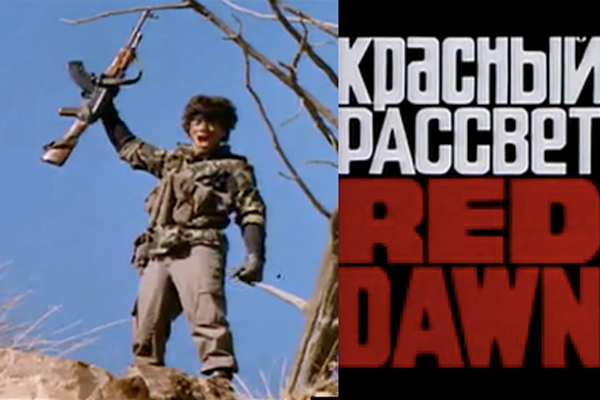
The new “Red Dawn”

Hollywood provides us with a useful demonstration of just how mighty China's influence has become

The new "Red Dawn"
Topics:,

The 1984 film “Red Dawn” fantasized about a group of American teenagers called the Wolverines who valiantly repelled an invasion of foreign communists. For its mix of dystopia and hope, the movie became such an enduring cultural touchstone that U.S. military leaders honored it by naming their 2003 effort to apprehend Saddam Hussein “Operation Red Dawn.” Amid the triumphalism, however, we missed the fact that the invaders started winning — a fact that none other than “Red Dawn’s” 2011 remake underscores.

That’s the subtext of a Los Angeles Times report this week about MGM taking “the extraordinary step” of digitally removing fictional Chinese villains from the $60 million film “lest the leadership in Beijing be offended.” Why the fear of upsetting such an odiously anti-democratic government? Because movie executives worry that a film involving a negative message about China “would harm their ability to do business with the rising Asian superpower, one of the fastest-growing and potentially most lucrative markets for American movies.”

Continue Reading
David Sirota

David Sirota is a best-selling author of the new book "Back to Our Future: How the 1980s Explain the World We Live In Now." He hosts the morning show on AM760 in Colorado. E-mail him at ds@davidsirota.com, follow him on Twitter @davidsirota or visit his website at www.davidsirota.com.  More David Sirota

Friday, Feb 17, 2012 12:00 PM UTC2012-02-17T12:00:00Zl, M j, Y g:i A T

Is China our future?

If we don't want six-day workweeks at rock-bottom pay, we need to rethink how America's free market functions

An employee works at the Yiwu Lianfa clothing factory in Yiwu, Zhejiang province, June 8, 2011

An employee works at the Yiwu Lianfa clothing factory in Yiwu, Zhejiang province, June 8, 2011  (Credit: Carlos Barria / Reuters)

For the last two decades, we’ve heard many myths purporting to explain the loss of American manufacturing jobs. CEOs, for instance, typically say they have sent jobs overseas because they can’t find skilled American workers. Conservative economists say the giant sucking sound is that of technology replacing obsolete workers. And conservative politicians say job loss is the result of high corporate tax rates, even though ours are among the lowest effective corporate tax rates in the industrialized world.

Continue Reading
David Sirota

David Sirota is a best-selling author of the new book "Back to Our Future: How the 1980s Explain the World We Live In Now." He hosts the morning show on AM760 in Colorado. E-mail him at ds@davidsirota.com, follow him on Twitter @davidsirota or visit his website at www.davidsirota.com.  More David Sirota

Tuesday, Feb 14, 2012 9:00 PM UTC2012-02-14T21:00:00Zl, M j, Y g:i A T

U.S., China need a green peace, not a trade war

As Obama meets Xi, the U.S. is investigating China’s practices in the solar and wind sectors

Solar panels in the city of Baoding in China.

Solar panels in the city of Baoding in China.  (Credit: Reuters/David Gray)

Chinese Vice President Xi Jinping’s visit to the United States comes at a contradictory time in clean energy relations between the two countries. On the one hand, significant progress has been made under the clean energy cooperation agreements signed by Presidents Hu Jintao and Barack Obama in the fall of 2009. On the other hand, the two countries may be on the verge of a clean energy trade war. As a result, the positions that Xi and Obama take on these issues over the next week may well set the tone for that relationship’s future, for better or worse.

Continue Reading

Dr Joanna L. Lewis is an assistant professor at the Walsh School of Foreign Serivce, Georgetown University. Her focus is on science, technology and international affairs, especially issues related to renewable energy.   More Joanna Lewis

Friday, Feb 3, 2012 1:00 AM UTC2012-02-03T01:00:00Zl, M j, Y g:i A T

WikiLeaks sheds light on Adelson’s Asia business

Cable describes shutdown of a $100 million Adelson nonprofit in Beijing and refers to "missteps" in China

Adelson and his wife Miriam

Sheldon Adelson, chief executive of Las Vegas Sands Corporation, and his wife Miriam attend the ribbon cutting of the Four Seasons Macao hotel and casino in Macau.  (Credit: Bobby Yip / Reuters)

We’ve learned this election cycle that casino magnate Sheldon Adelson isn’t afraid to throw around vast sums of money to get what he wants — he and his family have given at least $11 million to help the Newt Gingrich campaign.

It hasn’t gotten any notice since Adelson became a player in presidential politics, but it turns out that the trove of diplomatic cables published by WikiLeaks contains an interesting anecdote about how Adelson aggressively promoted his casino and hotel business in the Chinese territory of Macau — and a run-in he had with the central government in Beijing.

Continue Reading
Justin Elliott

Justin Elliott is a Salon reporter. Reach him by email at jelliott@salon.com and follow him on Twitter @ElliottJustin  More Justin Elliott

Friday, Jan 20, 2012 1:00 PM UTC2012-01-20T13:00:00Zl, M j, Y g:i A T

Zbig: Israelis “bought influence” and outmaneuvered Obama

The president "should have stuck to his guns" on Mideast peace, says Zbigniew Brzezinski, former NSC advisor

Former National Security Adviser Zbigniew Brzezinski

The unorthodox Zbigniew Brzezinski  (Credit: AP)

Zbigniew Brzezinski’s new book, “Strategic Vision,” imagines a world without American power. He envisions profound instability, faltering international cooperation and weak states falling prey to their more dominant neighbors. Describing the dystopia that would emerge if America goes under is a trick British historian Niall Ferguson pioneered. Unlike the jingoistic Ferguson, however, Brzezinski is able to envision China replacing America as the stabilizing force in world affairs. “I don’t think liberal states are more restrained or stabilizing,” he says. “The United States’ actions in the last 20 years, especially with the war in Iraq, do not give reassurance on that score.”

Continue Reading

Jordan Michael Smith writes about U.S. foreign policy for Salon. He has written for the New York Times, Boston Globe and Washington Post.  More Jordan Michael Smith

Saturday, Jan 14, 2012 9:00 PM UTC2012-01-14T21:00:00Zl, M j, Y g:i A T

Playing Margaret Thatcher in China

I hoped my acting gig would be a history lesson for the Chinese. But it was a lesson for me in government control

DengXiaopingBiopic-3

I’m teetering in ill-fitting high heels at the top of a flight of cement steps. A stiff wind kicks up, threatening to blow the red wig off my head. Below me, I see a bewildered film crew and its director. He is shouting: “Take a step!”

Behind them, Tiananmen Square stretches out in all directions. I can see Mao’s tomb and swirling crowds of tourists and police and the imposing entrance to Beijing’s ancient Forbidden City. At my back is China’s imposing Great Hall of the People, where the fate of a billion people is routinely determined by a handful of aging men.

Continue Reading

Melissa Rayworth, a writer based in Pittsburgh, lived in China from 2001 to 2004.  More Melissa Rayworth

Page 1 of 123 in China

Other News