
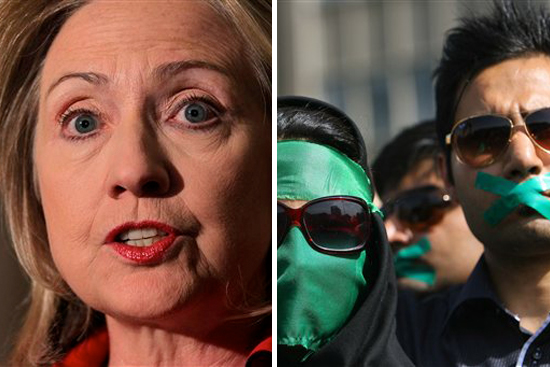

As Tunisians and Egyptians work through their respective political transitions, the Iranian government increasingly detaches itself from the realities of its restive population. The longer it resists meeting public demands, the shorter its lifespan becomes.
At the same time, within the Iranian Diaspora, some have sought to usurp leadership of Iran’s indigenous pro-democracy movement. This has alarmed the leaders of the Green Movement in Iran. Mir Hossein Mousavi warned against “international surfers” seeking to wield their own axe in the furnace of the Green movement in his last communiqué that was issued before he was put under house arrest on Feb. 29.
First and foremost among such groups is Mujahedin-e Khalq (MEK), an organization that has been designated by the U.S. government as a foreign terrorist organization (FTO). But despite its obvious threat to global security, the MEK could be taken off the State Department’s Terror List within the next week. If this happens, it promises to spell disaster for the pro-democracy movement in Iran, and will be a devastating setback in the country’s attempts to move forward.
The MEK has no political base inside Iran and no genuine support on the Iranian street because it was long based in Iraq under Saddam Hussein’s patronage. It lost any semblance of credibility it might have had inside Iran due to its opposition to the Shah’s regime when its troops fought on behalf of Iraq toward the end of the 1980-1988 Iran-Iraq war. Hence, it would behoove U.S. policymakers to be skeptical of the boasts of MEK lobbyists regarding the extent of this group’s popularity inside Iran.
Since Saddam Hussein’s ouster in 2003, the MEK has been depending almost entirely on the uneven enforcement of existing U.S. laws concerning designated foreign terrorist organizations. Surprisingly, the MEK military compound in Iraq enjoys de-facto “protected persons” status, and its activities at the U.S. congress have long been unchecked. It is highly unlikely that other U.S.-designated FTOs, such as al-Qaida, would enjoy this astonishing degree of latitude in the corridors of the U.S. military, and within its executive and legislative branches.
Countless first-rate analysts, scholars and human rights organizations — including Human Rights Watch — have determined that the MEK is an undemocratic, cultlike organization whose modus operandi vitiates its claim to be a vehicle for democratic change.
Most importantly, MEK activities in Washington could be causing irreparable damage to Iran’s home-grown opposition. When post-election turbulence commenced inside Iran, the MEK quickly sought to join the frenzy of brewing opposition to the current government. The Ahmadinejad government promptly connected the Green Movement to the MEK in an effort to discredit the pro-democracy movement. Opposition leaders such as Mir Hossein Mousavi, Zahra Rahnavard and Mehdi Karrubi immediately pushed back. Rahnavard pointedly said, “the Green Movement is a people’s movement that is alive and dynamic and holds a wall between itself and the MEK.” Opposition leaders in Iran have good reason to erect and maintain such a wall. They see the MEK as an organization capitalizing on U.S.-Iran enmity to shed its terrorist designation and subsequently receive U.S. government funding — effectively becoming the Iranian version of Ahmed Chalabi’s infamous Iraqi National Congress.
As Washington policymakers seek new ways to pressure their counterparts in Tehran to yield on nuclear developments, they must refrain from actions that would harm the long-term prospects of trust and friendship between the two peoples.
Removing the MEK from the FTO at this juncture would embolden Iran’s hardliners to intensify their repression and discredit the Green Movement by implying that it is somehow connected to the widely detested MEK terror group. Furthermore, supporting the MEK would provide the Iranian government with the specter of a foreign-based threat that could be exploited to heal key fractures within the system, increase the number of Iranians who would rally around the flag, and facilitate the suppression of the indigenous political opposition.
For all of its mistakes in the Middle East, the Bush administration — even at the height of its aggressive foreign policy — understood that delisting the MEK from the State Department’s terrorist list would be a dangerous gambit. It would trigger a huge loss of U.S. soft power in Iran, damage Iran’s democratic progress and help Iranian hardliners cement a long-term dictatorship. The Iranian people won’t forgive or forget such cynical moves. Bitter memories associated with U.S. policies toward the Shah and Mohammad Mossadegh, the prime minister overthrown with covert American assistance in 1953, continue to linger and poison U.S.-Iran relations to this day. We urge the U.S. government to avoid committing this critical mistake at a time when the democratic aspirations of the Iranian people hang in the balance.
Mohsen Kadivar, a leading figure in the Green Movement, is visiting professor of religion at Duke University. Ahmad Sadri is professor of sociology and James P. Gorter chair of Islamic world studies at Lake Forest College.
