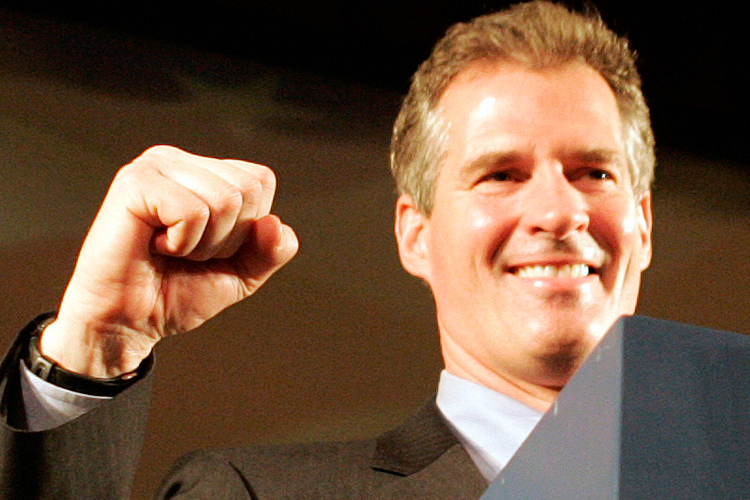

Scott Brown
The unbeatable Republican?
Salon exclusive: Secret Democratic poll finds shocking popularity for Scott Brown
Scott Brown Massachusetts is a deeply Democratic state, one in which barely more than 15 percent of the seats in the state Legislature are held by Republicans and fewer than 15 percent of all registered voters belong to the GOP. So it’s hardly surprising that national Democrats have been making noise about defeating the state’s Republican senator, Scott Brown, when he stands for reelection next year.
“It’s a priority for us,” Guy Cecil, the executive director of the Democratic Senatorial Campaign Committee, told the Boston Globe when he made a two-day trip to the Bay State earlier this month.
But the DSCC received some bad news this week when a poll it commissioned found that Brown’s popularity is soaring. The survey, which has been seen by at least one D.C. insider and was detailed for Salon, measured Brown’s approval rating at 73 percent — easily surpassing the scores for Barack Obama and the state’s two top Democrats, Gov. Deval Patrick and Sen. John Kerry. It also found him running over the magic 50 percent mark against every potential Democratic challenger, and crushing the strongest perceived Democrats (Reps. Michael Capuano and Ed Markey and former Rep. Marty Meehan) by double-digit margins. The results only grew closer when respondents were primed with negative information about Brown.
The findings underscore the success that Brown has had in separating himself from the national Republican Party brand, which remains poisonous in Massachusetts. (Even in the strongly anti-Democratic tide of 2010 — the best climate for Republicans in Massachusetts since 1994 — the GOP failed to win any of the state’s six constitutional offices or 10 House seats and actually lost ground in the Legislature.) Brown has largely been a steady GOP vote in the Senate, but he has broken with his party in several high-profile instances: a jobs bill last February, Wall Street reform over the summer, and ratification of the new START treaty and repeal of “don’t ask, don’t tell” in December. He also made news last week for (sort of) opposing the GOP’s effort to defund Planned Parenthood.
All of this has helped Brown craft an image as an independent senator. That some leaders of the Tea Party — which poured itself into Brown’s victorious January 2010 special election effort — are now openly criticizing him and calling for a GOP primary challenge next year only reinforces this image. Brown’s personal appeal — the whole working stiff with a truck thing — remains a clear asset too.
This is why in a recent Op-Ed for the Boston Globe I likened Brown to William Weld — the Republican who won Massachusetts’ governorship in something of a fluke in 1990, only to build enormous popularity by picking some high-profile fights with his own national party. When he sought reelection in 1994, every big-name Democrat in the state who’d been talked up as a prospect — Paul Tsongas, Joe Kennedy, Ray Flynn, John Silber and on and on — passed. Weld ended up posting a record-shattering 42-point landslide over a hapless state representative.
The endurance of Brown’s popularity is likely to give pause to his strongest potential Democratic foes. Capuano and Markey (and South Boston’s Stephen Lynch, for that matter) would have to give up safe House seats to challenge him next year. Meehan would have to surrender his cozy perch in academia. Running against Brown might not be worth the risk for them — especially with at least one (the 2014 governor’s race, which should be an open seat) and possibly two (John Kerry’s Senate seat, which could open up for a 2013 special election if he is elevated to secretary of state for a second Obama term) other opportunities on the horizon. True, 2012 will be a presidential election year, which will theoretically boost Brown’s challenger in blue state Massachusetts. But it’s easy to overstate the coattail effect, as Susan Collins demonstrated in 2008, when she easily beat a strong Democratic challenger even as Barack Obama comfortably won Maine. In other words, unless Brown’s numbers dip markedly, it’s likely that Democrats will be stuck with a second-tier (at best) challenger in ’12.
The national implications are potentially significant. Democrats are clinging to a 53-47 edge in the Senate now, but they are defending nearly three-quarters of the seats that will be up next year — some of them in very red states. Already, North Dakota — where Democrat Kent Conrad is retiring — is regarded as a near-certain GOP pickup, and the Democrats’ hold on seats in Nebraska, Montana, Missouri, Virginia and West Virginia is shaky at best.
Meanwhile, Massachusetts might be the only logical pickup target for Democrats — especially now that embattled Republican Sen. John Ensign has finally ruled out a reelection campaign in Nevada. Maybe Indiana could emerge as a target, if Richard Lugar is derailed by Tea Party activists in next year’s GOP primary — and if his GOP foe, state Treasurer Richard Mourdock, proves to be a particularly polarizing nominee. Theoretically, Maine could too, with Republican Olympia Snowe sure to face at least one Tea Party-backed challenger next year (although Snowe would likely be unbeatable if she decides to run as an independent).
Thus, ousting Brown would significantly increase Democrats’ chances of holding the Senate. But failing to do so could be the final nail in their majority’s coffin.
Steve Kornacki writes about politics for Salon. Reach him by email at SKornacki@salon.com and follow him on Twitter @SteveKornacki More Steve Kornacki.
Another Massachusetts meltdown?
Elizabeth Warren's recent struggles have some Democratic operatives worried about a Martha Coakley redux
Elizabeth Warren (Credit: Reuters/Jonathan Ernst) The story about Elizabeth Warren’s Native American heritage refuses to die. Today, state Republicans are calling on Harvard to investigate whether Warren used her Native American status to land her teaching post. Some Democrats, haunted by the infamous meltdown of Martha Coakley against Scott Brown two years ago, are wondering if it’s déjà vu all over again.
“The people in Washington are saying, ‘The people in Massachusetts are a bunch of fuck-ups who couldn’t run a race for dog catcher,’” said one veteran Massachusetts Democratic insider. “This is someone they handpicked, filled the coffers with millions and millions of dollars, made it their number one race, and the people who are up here running it with every resource you would ever want are getting killed.”
Continue Reading CloseEdward Mason, former Statehouse bureau chief for the Eagle-Tribune (North Andover) during the Romney administration, can be reached at edward.mason04@gmail.com. More Edward Mason.
Olympia Snowe gives Obama an “F” in “paying attention to Olympia Snowe”
Retiring moderate Republican senator still prizes "bipartisanship" over actually passing legislation
Olympia Snowe (Credit: Reuters/Jessica Rinaldi) Retiring Sen. Olympia Snowe has finished grading the president’s report card. President Obama gets an “F” in bipartisanship, where “bipartisanship” is defined as “constantly stroking the fragile egos of self-important Senate moderates.”
Snowe is not seeking reelection because the Republican Party wholly merged with the conservative movement and then began enforcing much stricter party discipline than it had in the past, and she would likely lose a primary election to a more right-wing candidate. But in her high-minded version of what happened, she is leaving because of “partisanship,” an evil spell cast on the formerly fraternal and cooperative United States Senate by comity-hating wizards.
Continue Reading Close
Alex Pareene writes about politics for Salon and is the author of "The Rude Guide to Mitt." Email him at apareene@salon.com and follow him on Twitter @pareene More Alex Pareene.
Scott Brown’s triumphant makeover
The Massachusetts senator has pulled ahead of Elizabeth Warren in the polls by running away from the Tea Party
U.S. Senator Scott Brown (Credit: Hyungwon Kang / Reuters) The so-called People’s Pledge seemed like a somewhat gimmicky win-win proposition for both incumbent Republican Sen. Scott Brown and his Democratic challenger, Harvard professor Elizabeth Warren, in their race for the seat once held by Ted Kennedy. The idea, proposed by Brown, was to staunch the flow of super PAC money into the race with an agreement of elegant simplicity: If a candidate is attacked by name in an ad, then the one who comes off looking better is obliged to donate half the cost of the ad buy to a charity of the other candidate’s choice. Pretty simple: Why shoot yourself in the foot, right?
Continue Reading ClosePatrick Tracey, author of "Stalking Irish Madness: Searching for the Roots of My Family's Schizophrenia," is a writer in Boston. More Patrick Tracey.
Super PACs not welcome in Massachusetts Senate race
Elizabeth Warren and Scott Brown pledge to discourage independent attack ads. Will it work?
Super PACs beware(Credit: AP/Elise Amendola/Steven Senne) BOSTON—If there’s a lonely glimmer of hope in the gloom and doom over money in politics, it was born this week in Boston with the signing of the People’s Pledge agreement to extinguish the onslaught of SuperPac ads polluting the Massachusetts airwaves, ten months before the nation’s most closely watched Senate race comes to an end.
Continue Reading ClosePatrick Tracey, author of "Stalking Irish Madness: Searching for the Roots of My Family's Schizophrenia," is a writer in Boston. More Patrick Tracey.
The danger of being a talk radio hero
Scott Brown's crude put-down of Elizabeth Warren threatens the image he's tried so hard to create
U.S. Senator Scott Brown (R-MA) (Credit: Hyungwon Kang / Reuters) (Updated)
You’ve probably already heard about Senator Scott Brown’s gaffe this morning. Asked about a statement by Elizabeth Warren, his likely Democratic opponent next year, that she (unlike Brown) hadn’t posed nude to help pay her way through college, Brown replied: “Thank God.”
Needless to say, it’s landed Brown in some hot water, with Democrats blasting him for engaging in “frat house” chauvinism and media outlets across the country picking up the story. This comes at a bad time for Brown, whose once-mighty standing in Massachusetts has eroded and who is now running even with Warren in polls, and could be particularly damaging since it threatens to undermine what has been the key to his popularity in blue state Massachusetts: His personal likability.
Continue Reading Close
Steve Kornacki writes about politics for Salon. Reach him by email at SKornacki@salon.com and follow him on Twitter @SteveKornacki More Steve Kornacki.
Page 1 of 11 in Scott Brown