
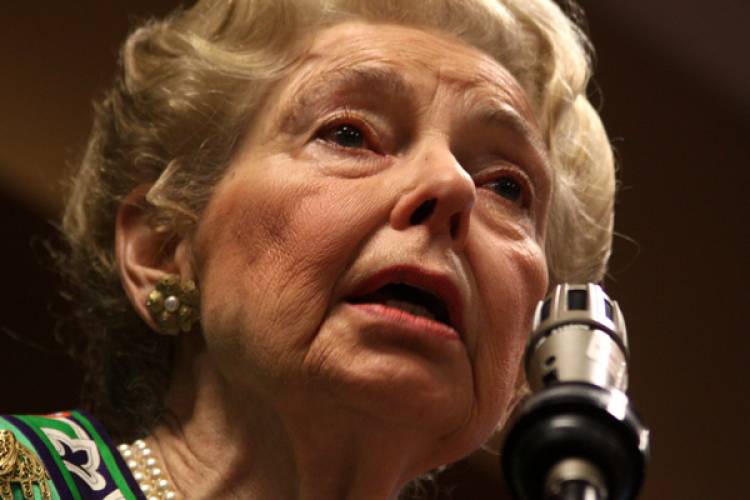
Phyllis Schlafly, the longtime conservative activist and anti-feminist, spent much of her career fighting efforts to increase access to childcare — and even the very concept of parents (specifically mothers) using childcare to allow them to pursue careers. But, according to a new report, Schlafly herself had “domestic help” to help raise her six children, a fact that she has either never mentioned or, at the least, not emphasized in her public rhetoric.
Schlafly is out with a new book, co-written with her niece, called “The Flipside of Feminism: What Conservative Women Know — and Men Can’t Say.” In writing about the book, the Los Angeles Times’ Meghan Daum interviewed Schlafly’s niece, Suzanne Venker. And when Daum asked Venker how Schlafly had managed it all, she surfaced a remarkable piece of information:
How did Schlafly manage to raise all those kids and pursue such a prominent career? Granted, at 25 Schlafly married an older, well-established lawyer, and granted, she herself didn’t go to law school until she was in her 50s, but did she have help? If so, she never seemed to mention it.
Venker seemed to almost despair at the question: “I’m in a pickle because I haven’t been asked this directly before,” she said. “I’m going to say this the best way I can. She had domestic help … She wouldn’t have called them nannies, but she had people in her home. That’s what she chose. Did she mention that fact enough to get her point across to young people about how she managed to do it? No, she did not.”
Indeed, even a cursory search of Schlafly’s public statements show an outright hostility to use of help or childcare. In 1989, when the Senate was considering a Dodd-Kennedy bill to provide day care to poor families, Schlafly fired off an angry letter to one of its Republican sponsors, Orrin Hatch. In it, Schlafly blasts what she calls “stranger care”:
We expected pro-family leadership from you, not surrender to the liberals who want to build a baby-sitting bureaucracy, penalize full-time mothers, and impose federal regulations that will drive low-cost daycare out of business.
The Dodd bill is unjust and discriminatory because it discriminates against mothers who take care of their own children and taxes them in order to subsidize those who use stranger care — because it discriminates against employed mothers whose children are cared for by relatives — and because it encourages and subsidizes institutional care of babies instead of encouraging the care of babies within the family home.
Here is Schlafly in 1980, quoted in Newsweek:
In 1971, Congress approved a $ 15 billion child-development program aimed at making “quality child care” available to all, according to ability to pay. But it was vetoed by President Richard Nixon, who declared that such government interference would threaten family life. That sentiment still prevails among conservatives. It has helped defeat every comprehensive day-care bill for the past nine years, and right-wing delegates promise to make day care a prominent target next month at the White House Conference on Families. Argues conservative activist Phyllis Schlafly: “There’s no real substitute for the care of the real mother.”
Testifying before Congress on another matter in 1981, Schlafly said (via Nexis): “It would be a tragic mistake for Congress ever to adopt any public or tax policy which encourages mothers to assign child care to others and enter the labor force.”
And she’s still not being candid about her own experience. Check out this exchange from an NPR interview this week, in which Schlafly was asked directly how she managed her career and her family:
MARTIN: How did you manage, though? As a mother of six, as your husband was -certainly had a busy career of his own, and being as significant a national figure as you have been, how did you manage?
Ms. SCHLAFLY: Well, politics was my hobby. And I really spent 25 years as a full-time homemaker before I did any particular traveling around. And by that time the children were well along in school or college. And they were very supportive. My husband was very supportive. I told the feminists the only person’s permission I had to get was my husband’s.
What about that domestic help?
(Hat tip: Right Wing Watch) With research assistance from Justin Spees
