
The New York Times
Even Egyptian hotel employees need Thomas Friedman to explain their country to them
The New York Times columnist with the unlimited expense account has another suspicious exchange with a local
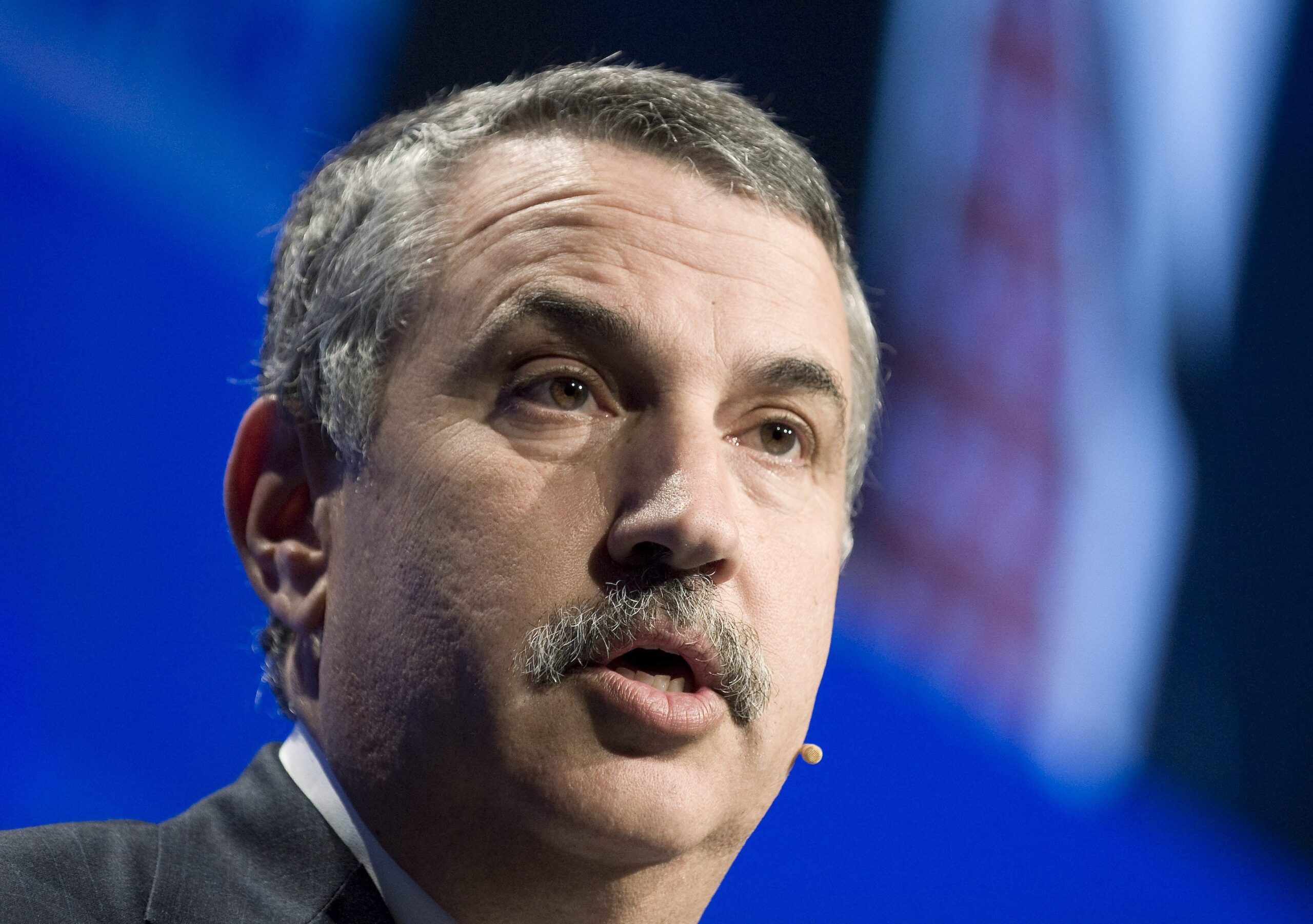
Thomas L. Friedman, NY Times columnist (AP Photo/Keystone/Peter Schneider) (Credit: Associated Press) At some point, not long ago, someone told jet-setting New York Times columnist Thomas Friedman to stop quoting cab drivers in his columns, and he largely has. But sometimes, the urge to explain big, complicated events in faraway lands by going directly to a service industry employee-on-the-street who sounds suspiciously like a fictional character drawn up to introduce a columnist’s argument is too great. And so we we get this, the first paragraph of today’s Friedman column:
When I was in Cairo during the Egyptian uprising, I wanted to change hotels one day to be closer to the action and called the Marriott to see if it had any openings. The young-sounding Egyptian woman who spoke with me from the reservations department offered me a room and then asked: “Do you have a corporate rate?” I said, “I don’t know. I work for The New York Times.” There was a silence on the phone for a few moments, and then she said: “Can I ask you something?” Sure. “Are we going to be O.K.? I’m worried.”
What is your favorite part? The scared foreigner asking the wise millionaire American for his insight and reassurance? The fact that foreign correspondent Thomas Friedman’s method of getting “closer to the action” in the midst of a revolution is by moving to a closer Marriott? (After first “reporting” on the uprising, we must never forget, from Davos, where he was when it began?) To me, the best bit is that Friedman, who practically lives in hotels when he’s not at his hideous mansion, has no clue if he should ask for the corporate rate, I assume because he rarely has to deal with nitty-gritty monetary details like that, thanks to his literally infinite expense account.
All this paragraph is missing is a tortuously mixed metaphor.
Oh, also, Friedman never answers her question! He doesn’t even go back to it at the end or anything.
Alex Pareene writes about politics for Salon and is the author of "The Rude Guide to Mitt." Email him at apareene@salon.com and follow him on Twitter @pareene More Alex Pareene.
We don’t need truth vigilantes
But we do need good political reporting, and the media's rote repetition of Santorum's JFK lies fell short
Rick Santorum and John F. Kennedy (Credit: AP/Wikipedia) New York Times public editor Arthur Brisbane got a lot of grief last month for a blog post in which he asked readers whether the Times ought to be “a truth vigilante.” I didn’t join the pile-on, because truth be told, I kind of understood what he was getting at. Sure, “truth vigilante” is a shrill, easily mocked term: It doesn’t take “vigilantism” to get at the truth, only good reporting. But there can be questions for editors and reporters about how far is too far – what’s good reporting, and what’s hectoring? What’s debunking, and what’s partisan water-carrying? (Also, I don’t like the practice of mocking people for asking questions, even when we think the answer should be obvious. Better that Brisbane ask than to ignore the issue entirely.) I can understand why some cases aren’t clear.
Continue Reading CloseJoan Walsh is Salon's editor at large. More Joan Walsh.
Anthony Shadid, the best of his generation
The NYT reporter, acclaimed for his unparalleled coverage of the Middle East, died in Syria on Thursday
Anthony Shadid, winner of the 2010 Pulitzer Prize for International Reporting with The Washington Post (Credit: AP) WARSAW, Poland — I woke up this morning to the news that Anthony Shadid has died — apparently of an asthma attack — while on assignment in Syria. Whether you knew his byline or not, the loss is incalculable.
I can speak in absolutes about the quality of his work. No one reported the Middle East with greater clarity and nuance than Shadid. No one brought the humanity of the people of the region, people who live in a perpetual state of stress even when they are living in the comparative comfort of Beirut and Tel Aviv, to the wider world with a surer touch than Anthony.
Continue Reading CloseWhat David Brooks gets right about the left
Relying on a mic check to make strategy is a big mistake
David Brooks, philosophe As he often does, in his column Friday New York Times columnist David Brooks offered what looks like a “nonpartisan” analysis. Social movements, he warned, are suffering because everyone thinks they should make up their own belief system. Unless you’re Nietzsche, Brooks advises, this is a guarantee of failure. Every man is not a political genius.
It’s not a hard task to figure out whom Brooks is really criticizing: Occupy Wall Street. But it’s not alone. The democratization of ideology is vastly more tempting to the self-inventing liberal left than to the authoritarian right. Nobody does emotionally consistent talking points like the conservative right. Nobody does “whatever floats your boat” like the liberal left. The belief that every man is a philosopher makes progressives vastly more vulnerable to the destructive dynamic Brooks describes. It is an irony Brooks would appreciate that the left acts more like the right believes (and vice versa).
Continue Reading CloseLinda Hirshman is the author of “Victory: The Triumphant Gay Revolution,” forthcoming in June 2012. Follow her on Twitter @LindaHirshman1 More Linda Hirshman.
The “education crisis” myth
Ignore the media spin. Wages and working conditions -- not skills -- are the real reasons jobs get outsourced
A production line in Suzhou Etron Electronics Co. Ltd's factory in Suzhou, China on June 8, 2010 (Credit: Reuters) Has the term “education” become a code word? And if so, a code word for what?
These are the major unasked — but resoundingly answered — questions to emerge from two much-discussed articles about the future of American manufacturing. One is a cover story in the Atlantic Monthly about why jobs are being shipped overseas. It concludes that “to solve all the problems that keep people from acquiring skills would require tackling the toughest issues our country faces” — the first of those being “a broken educational system.” The second and even more talked about article comes from the New York Times. It looked at why Apple Computer has moved its production facilities overseas, concluding in sensationalistic fashion that “it isn’t just that workers are cheaper abroad” but that America “has stopped training enough people in the mid-level skills that factories need.”
Continue Reading Close
David Sirota is a best-selling author of the new book "Back to Our Future: How the 1980s Explain the World We Live In Now." He hosts the morning show on AM760 in Colorado. E-mail him at ds@davidsirota.com, follow him on Twitter @davidsirota or visit his website at www.davidsirota.com. More David Sirota.
Newspapers, “truth vigilantes” no more
The NYT's fact-checking question was absurd, but the real problem is that the press has lost its credibility
(Credit: Library of Congress/U.S. Farm Security Administration) Time was when newspaper journalists prided themselves on being working stiffs: skeptical, cynical and worldly-wise. “If your mother says she loves you, check it out.” I’ve always preferred the unofficial motto of my native New Jersey: “Oh yeah, who says?”
Fact-check politicians? Here’s how H.L. Mencken saw things in 1924: “If any genuinely honest and altruistic politician had come to the surface in my time I’d have heard of him, for I have always frequented newspaper offices, and in a newspaper office the news of such a marvel would cause a dreadful tumult.”
Continue Reading CloseArkansas Times columnist Gene Lyons is a National Magazine Award winner and co-author of "The Hunting of the President" (St. Martin's Press, 2000). You can e-mail Lyons at eugenelyons2@yahoo.com. More Gene Lyons.
Page 1 of 70 in The New York Times
