
Salon Home
Topic

Drugs

Friday, Apr 15, 2011 6:16 PM UTC2011-04-15T18:16:00Zl, M j, Y g:i A T

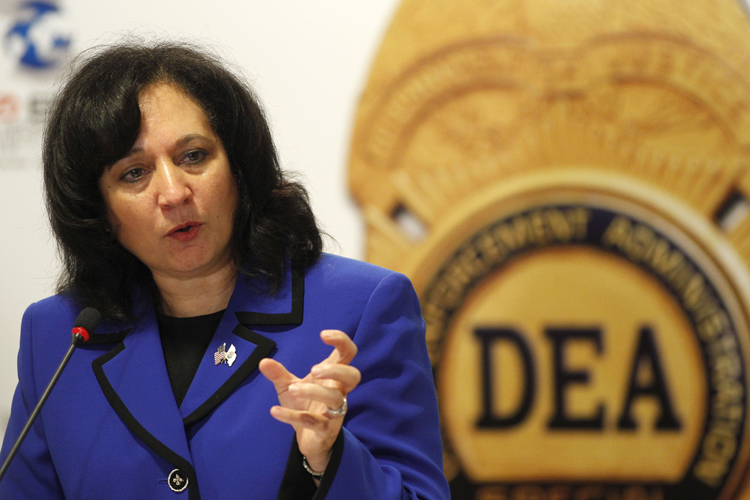
DEA head: A thousand dead children means we’re winning war on drugs

Michele Leonhart, our top drug cop, has a funny definition of victory

Michele Leonhart

Michele Leonhart

Topics:, ,

Producing and distributing illegal drugs is a profitable business, because there will always be a lot of demand and because illegality allows you to charge a great deal of money. That illegality also means that the people who produce and distribute the drugs are generally not responsible corporate citizens. So thanks to our expensive, terribly ineffective and endless war on drugs, lots of people are dying.

The Washington Post recently reported that the victims of Mexican drug cartel violence increasingly include children, who are being specifically targeted in order to terrorize people and intimidate potential business rivals:

The children’s rights group estimates that 994 people younger than 18 were killed in drug-related violence between late 2006 and late 2010, based on media accounts, which are incomplete because newspapers are often too intimidated to report drug-related crimes.
[...]
Government figures include all homicides of people younger than 17, capturing victims whose murders might not have been related to drugs or organized crime. In 2009, the last year for which there is data, 1,180 children were killed, half in shootings.

Continue Reading
Alex Pareene

Alex Pareene writes about politics for Salon. Email him at apareene@salon.com and follow him on Twitter @pareene  More Alex Pareene

Wednesday, Feb 22, 2012 1:00 PM UTC2012-02-22T13:00:00Zl, M j, Y g:i A T

Reefer madness

Middle-school anti-drug campaigns have barely changed in decades. Are they too lame to work with today's preteens?

VIDEO
A still from "Pot, the Party Crasher"

A still from "Pot, the Party Crasher"

Topics:,

It’s a middle-school rite of passage. One day, you’re sitting in class learning about Alexander the Great and wondering how to grab the optimum real estate in the lunchroom. The next, you’re getting the drug and alcohol awareness lesson. For my 12-year-old, that day just arrived. “We saw a movie in school today,” she drawled over dinner recently, eyes already engaged in full eye roll. “It was called ‘Pot, the Party Crasher.’” Then she made a familiar sputtering sound of contempt.

Continue Reading
Mary Elizabeth Williams

Mary Elizabeth Williams is a staff writer for Salon and the author of "Gimme Shelter: My Three Years Searching for the American Dream." Follow her on Twitter: @embeedubMore Mary Elizabeth Williams

Wednesday, Feb 22, 2012 1:00 AM UTC2012-02-22T01:00:00Zl, M j, Y g:i A T

What Whitney’s death should have us talking about

Despite its obsession with the star's demise, the press ignores the real issues behind America's deadliest epidemic

whitney

 (Credit: AP)

This article originally appeared on The Fix.

the fixJust minutes after Whitney Houston was found dead in a bathtub at the Beverly Hilton last Saturday at the age of 48, a caravan of network trucks began slowly encircling the plush hotel, morbidly eager to document her untimely demise. Since then, it’s been nearly impossible to turn on the TV or log on to the Web without witnessing a tribute to the singer, often including depressing video footage of her long, painful decline. Her memorial on Saturday had the pomp and pageantry of a state event—complete with dignitaries, crying onlookers and flags at half-mast.

Continue Reading

Maer Roshan is Founder and Editor of The Fix. Previously he served as Founder and Editor-in-Chief Radar Magazine and Radaronline.com, Editorial Director at Talk, Deputy Editor of New York, and Senior Editor of Interview. He is also Founding Editor of the forthcoming I-Pad publication, Punch!  More Maer Roshan

Wednesday, Jan 4, 2012 4:36 PM UTC2012-01-04T16:36:00Zl, M j, Y g:i A T

How Americans really feel about drugs

A NYT op-ed uses "moderate" double-speak to deny the truth: Most people want marijuana legalized

Carrie Sandoval

Marijuana activist Carrie Sandoval at a protest in Denver on Wednesday, Sept 22, 2010  (Credit: AP/Kristen Wyatt)

Almost exactly eight years ago, I wrote an essay for the Nation magazine looking at how terms such as “centrism” and “moderate” were beginning to be deftly manipulated to shape the parameters of America’s political discourse. In almost every policy debate, these words were being used in with-us-or-against-us fashion to delineate what was — and what was not — acceptable. Through such linguistic propaganda over the last decade, America was gradually taught that anything called “centrist” or “moderate” was Good and Serious because it supposedly represented “mainstream” thinking in America — even as “centrism” was being used to describe policies and politicians that, based on empirical data, increasingly diverged from the actual center of our nation’s public opinion. By contrast, anything positioned in opposition to that branding was wild-eyed “leftist,” “extremist,” “ideological,” “fringe” — and most of all, Evil and Unserious.

Continue Reading
David Sirota

David Sirota is a best-selling author of the new book "Back to Our Future: How the 1980s Explain the World We Live In Now." He hosts the morning show on AM760 in Colorado. E-mail him at ds@davidsirota.com, follow him on Twitter @davidsirota or visit his website at www.davidsirota.com.  More David Sirota

Monday, Dec 5, 2011 5:24 PM UTC2011-12-05T17:24:00Zl, M j, Y g:i A T

Adventures in drug war logic

Laundering money for cartels: Good! Arguing for legalization: A fireable offense

A U.S. Border Patrol agent walks along the U.S./Mexico border fence near San Diego.

A U.S. Border Patrol agent walks along the U.S./Mexico border fence near San Diego.  (Credit: AP/Lenny Ignelzi)

It’s time for an important lesson in proper, civilized behavior. Drug war soldier Gallant launders vast sums of money for the Mexican drug cartels. Drug war soldier Goofus expresses skepticism at the size and scope of this expensive and deadly boondoggle. Goofus gets canned. Gallant is the Drug Enforcement Agency.

Continue Reading
Alex Pareene

Alex Pareene writes about politics for Salon. Email him at apareene@salon.com and follow him on Twitter @pareene  More Alex Pareene

Thursday, Dec 1, 2011 12:45 PM UTC2011-12-01T12:45:00Zl, M j, Y g:i A T

On “Weed Wars,” drug clichés go up in smoke

A new reality show depicts an Oakland, Calif., medical marijuana clinic as just another small business

Small businessman Steve D'Angelo, executive director of Oakland's Harborside Health Center, samples his product in "Weed Wars."

Small businessman Steve D'Angelo, executive director of Oakland's Harborside Health Center, samples his product in "Weed Wars."  (Credit: Discovery)

“I run a family business, and the business is cannabis,” says Steve D’Angelo, a central character in Discovery’s new series “Weed Wars” and the co-founder and executive director of Oakland’s Harborside Health Center, which distributes medical marijuana to almost 100,000 customers. D’Angelo’s matter-of-fact statement sums up the tone of this series, which treats the Harborside Heath Center as just another family-owned (albeit nonprofit) business, ultimately not too different from a veterinary clinic, a hair salon or a tattoo parlor.

Continue Reading
Matt Zoller Seitz

  More Matt Zoller Seitz

Page 1 of 68 in Drugs

Other News