
Nonfiction
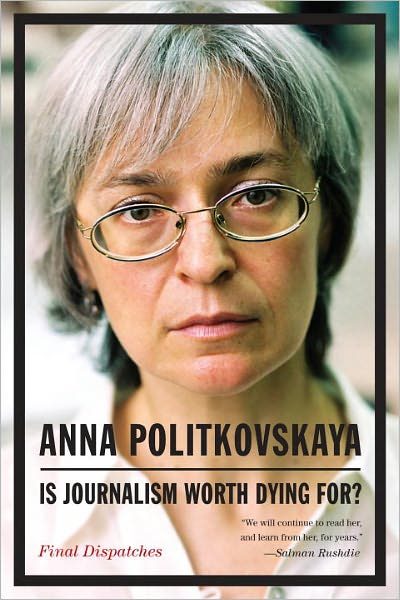
“Is Journalism Worth Dying For?”: One woman’s story
A collection of essays by Russia's murdered Anna Politkovskaya asks the question: Is journalism worth dying for?
For Anna Politkovskaya, Russia was a grim country — a “managed democracy” governed by brutal leaders and craven bureaucrats, policed by violent and extortionist security services, and reported on only by “servants of the Presidential Administration.” Her crusading, obsessive journalism made her many enemies, not least inside the Kremlin; she endured beatings, poisoning, and a mock execution; but she did not back down. Murdered in 2006, her killers never found, Politkovskaya lives on in “Is Journalism Worth Dying For?,” a collection of her “final dispatches.”

Politkovskaya’s greatest and most dangerous work was done in Chechnya, the functionally lawless region that foreign and even Russian journalists refused to enter, but to which she returned more than two dozen times. It is a terrifying place, where anarchic paramilitaries roam the streets with Berettas, politicians hit up citizens for cash, and opponents of the regime are abducted and thrown into jail cells dug into the ground, if they’re not killed with impunity. And there is characteristically fearless reporting on the 2002 siege of a Moscow theater by Chechen terrorists, during which Politkovskaya attempted to negotiate with the militants to release hundreds of hostages before Russian authorities gassed the theater, killing at least 130 people. Politkovskaya argues that federal security services abetted the terrorists, a claim backed up with evidence from the former spy Alexander Litvinenko — who was himself murdered a few months after Politkovskaya, poisoned with polonium at a London sushi joint.
Not all of Politkovskaya’s dispatches make such forbidding reading; there are easier reports from Paris and Sydney, and even a long and surprisingly tender essay on her dog. But her enduring importance derives from her refusal to capitulate despite seemingly unbearable pressure — and, even more basically, her commitment to rigorous on-the-ground reporting when journalists, even when not faced with official intimidation, spend more time with P.R. flacks than sources and victims. Upon her death, Lech Walesa mourned her as “a sentinel for truth,” and Condoleezza Rice called her “a heroine of mine”; for the New York Times, she stood as “a symbol of what Russia has become.” Only Ramzan Kadyrov, the Kremlin-installed gangster president of Chechnya and a key suspect in her murder, was unmoved. “I was not bothered in the slightest by what she wrote,” he insisted, “and I have never lowered myself to trying to settle scores with women.”
Jason Farago is a regular contributor to the Guardian and writes criticism for the London Review of Books, n+1, Frieze and other publications. He is also editor of Art in Common, a blog on art and urban life. More Jason Farago.
“Why won’t you answer me?”
Kids' questions may be annoying -- but they're more crucial to learning than we've ever thought. An expert explains
(Credit: Bonita R. Cheshier via Shutterstock) Children can ask a lot of very annoying questions. Starting at about 2 years of age, they begin barraging their parents with endless queries, from “Are we there yet?” to “Why is the moon round?” — questions that often seem more like desperate ploys for parental attention than anything else. And, to make things worse, cooperative parents are often treated to a relentless barrage of follow-up questions, many of which involve one word: “Why?” Is this process infuriating? Yes. But is it crucial to their development? Far more than most of us think. And furthermore, the frequency and form of those questions can tell us a lot, not only about how children learn but also about cultural and class differences in America.
Continue Reading Close
Thomas Rogers is Salon's Arts Editor. More Thomas Rogers.
“Farther Away”: Franzen on Wallace
In a new essay collection, "Freedom's" author reflects on his best friend's suicide with betrayal, anger and sorrow
Jonathan Franzen wants you to like him. In “Mr. Difficult,” a 2002 New Yorker essay, Franzen identifies two types of authorship: the Status model, devoted to the pursuit of difficult art at the expense of commercial gain, and the Contract model, which privileges the enjoyment and connectedness of the reader. Franzen is, in his own estimation, “a Contract kind of person.” His novels don’t ask more of the reader than she is willing to give in turn. “[T]o build the reader an uncomfortable house you wouldn’t want to live in: this violates what seems to me the categorical imperative for any fiction writer.”
Continue Reading Close“When women were birds”: Reading blank journals
A writer makes sense of the rows of empty cloth-bound diaries her mother left her
If you are a reader who cares about nature, wilderness, our place in nature, writing and nature, how to choose a course of action when something you care about is threatened, the lifelong search for voice, and what it means to be a woman in this world, you will have crossed paths with the work of Terry Tempest Williams. Perhaps you grew up reading Aldo Leopold, John Muir, Edward Abbey, Gary Snyder and Bill McKibben and, loving their work, still felt something missing — that your relationship with these issues was not fully rendered. Then you discovered Williams, and, not unlike Alfred Stieglitz’s famous response when he first saw Georgia O’Keeffe’s paintings, you might have breathed: “At last! A woman on paper!”
Continue Reading Close“Drop Dead Healthy”: A failed addition to “shtick lit”
In a book about one man's "quest for bodily perfection," the author doesn't even bother to try
In “Memoir: A History,” Ben Yagoda defines “shtick lit” as “[b]ooks perpetrated by people who undertook an unusual project with the express purpose of writing about it.” He identifies “Walden” as the earliest example of the genre, which would seem to establish a respectable pedigree, but the word perpetrated leaves little doubt as to Yagoda’s opinion of more recent efforts. He can’t be alone in casting a skeptical eye on shtick-lit superstar A. J. Jacobs, the Esquire writer responsible for “The Know-It-All” (shtick: reading the “Encyclopaedia Britannica” in its entirety), “The Year of Living Biblically” (shtick: following every biblical injunction to the letter for 12 lushly bearded, annoying months), and now “Drop Dead Healthy,” evidently a reboot of Remar Sutton’s out-of-print “Body Worry.”
Continue Reading Close“A Slave in the White House”: James Madison and his slaves
A new biography focuses on an overlooked part of the president's life: His perplexing relationship with slavery
When James Madison died, he still owned about 100 slaves. He freed none of them, not even Paul Jennings, his valet. Jennings could read and write, and in fact published the first White House memoir, declaring that Madison was “one of the best men who ever lived.” Modern biographers of Madison, such as Richard Brookhiser and Jeff Broadwater, have frankly acknowledged the shocking truth that such a politically astute and sensitive founding father utterly failed to address the problem of slavery seriously. But most, including not only Mr. Brookhiser and Mr. Broadwater, but also Kevin R. C. Gutzman, Andrew Burstein, and Nancy Isenberg, treat the issue of slavery as a thing apart, in separate chapters, instead dealing with the place of the “peculiar institution” in Madison’s life in the years after he left the presidency.
Continue Reading ClosePage 1 of 81 in Nonfiction