
Rick Santorum
Santorum: What does McCain know about torture?
The presidential hopeful claims torture survivor John McCain simply doesn't understand how torture works
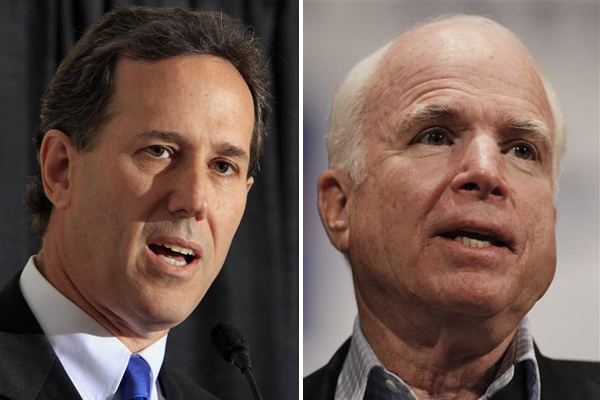
Possible 2012 presidential hopeful, former Republican U.S. Sen., Rick Santorum of Pennsylvania speaks during a We the People candidates forum, Saturday, April 30, 2011 in Manchester, NH (AP Photo/Jim Cole)(Credit: Jim Cole) (UPDATED) John McCain has been on something of a crusade this week on the question of how we found Osama bin Laden, giving speeches and writing Op-Eds outlining his position that it was not torture of detainees that led the U.S. to its man.
Now comes presidential candidate and “enhanced interrogation” supporter Rick Santorum arguing on Hugh Hewitt’s radio show that McCain simply “doesn’t understand how enhanced interrogation works.” Yes, he’s talking about the same John McCain who, in his five and a half years as a prisoner of war in North Vietnam, was interrogated during a program of beatings and torture.
Here’s Santorum:
HH: Now your former colleague, John McCain, said look, there’s no record, there’s no evidence here that these methods actually led to the capture or the killing of bin Laden. Do you disagree with that? Or do you think he’s got an argument?
RS: I don’t, everything I’ve read shows that we would not have gotten this information as to who this man was if it had not been gotten information from people who were subject to enhanced interrogation. And so this idea that we didn’t ask that question while Khalid Sheikh Mohammed was being waterboarded, he doesn’t understand how enhanced interrogation works. I mean, you break somebody, and after they’re broken, they become cooperative. And that’s when we got this information. And one thing led to another, and led to another, and that’s how we ended up with bin Laden.
Santorum is wrong on the facts about Mohammed (more on this below). But what about his assertion about McCain?
Here’s a passage from McCain’s memoir in which he describes being subjected to beatings and telling his interrogators false information in response:
Once my condition had stabilized, my interrogators resumed their work. Demands for military information were accompanied by threats to terminate my medical treatment if I did not cooperate. Eventually, I gave them my ship’s name and squadron number, and confirmed that my target had been the power plant. Pressed for more useful information, I gave the names of the Green Bay Packers offensive line, and said they were members of my squadron. When asked to identify future targets, I simply recited the names of a number of North Vietnamese cities that had already been bombed.
I was occasionally beaten when I declined to give any more information. The beatings were of short duration, because I let out a hair-raising scream whenever they occurred.
In one four-day period, McCain says he was beaten “every two to three hours,” and his arm was broken and ribs cracked. So if nothing else, this is a man who can be said to know how enhanced interrogation works. (Santorum, as far as I can tell, has never been tortured, nor did he serve in the military.)
Khalid Sheik Mohammed, like McCain, also gave bad information after being tortured — a point that McCain himself made in a recent Op-Ed:
“In fact, the use of ‘enhanced interrogation techniques’ on Khalid Sheik Mohammed produced false and misleading information. He specifically told his interrogators that Abu Ahmed had moved to Peshawar, got married and ceased his role as an al-Qaeda facilitator — none of which was true,” McCain wrote. “I know from personal experience that the abuse of prisoners sometimes produces good intelligence but often produces bad intelligence because under torture a person will say anything he thinks his captors want to hear — true or false — if he believes it will relieve his suffering.”
(Hat tip: Elon Green)
UPDATE: Greg Sargent asks McCain’s spokeswoman for a response to Santorum, and she emails a single word: ”Who?”
Justin Elliott is a reporter for ProPublica. You can follow him on Twitter @ElliottJustin More Justin Elliott.
SPIN METER: Rivals airbrush anti-Romney words
After the nastiness of the Republican primary race, former candidates have collective amnesia about Romney disses
FILE - In this Jan. 26, 2012 file photo, Republican presidential candidates, former House Speaker Newt Gingrich and former Massachusetts Gov. Mitt Romney talk during a commercial break at the Republican presidential candidates debate in Jacksonville, Fla. Remember Gingrich calling Romney a liar? Michele Bachmann saying Romney's unelectable? Rick Santorum calling Romney "the worst Republican in the country" to run against Obama? They're hoping you don't. And acting like it never happened _ even though most of their words are just clicks away online. (AP Photo/Matt Rourke, File)(Credit: AP) WASHINGTON (AP) — Remember Newt Gingrich calling Mitt Romney a liar? Michele Bachmann saying Romney’s unelectable? Rick Santorum calling Romney “the worst Republican in the country” to run against President Barack Obama?
They’re hoping you don’t. And acting like it never happened (even though most of their words are just clicks away online.)
One by one — with the exception of holdout Ron Paul — the GOP also-rans have coughed up endorsements of their onetime rival. And as they do, they’re pulling rhetorical backflips to distance themselves from their former harsh assessments of Romney.
Continue Reading CloseKornacki on “Now”
In a late-night email, Rick Santorum endorses Mitt Romney for president. But do endorsements even matter?
Tuesday afternoon, senior political writer Steve Kornacki joined a panel to discuss Rick Santorum’s begrudged “endorsement” of Mitt Romney for president in 2012, arguing that as time goes on, it’s “less and less an issue of Romney unifying the right,” and more an issue of cultural supremacy.
Romney vs. Santorum: What their words reveal
As Santorum exits the race, a look at what his and Romney's speech patterns say about their candidacies
(Credit: Reuters/AP/Salon) Now that the Romney campaign is officially shaking its Etch-A-Sketch, the name “Rick Santorum” will begin to fade from our collective memory. As he exits the national stage, I find myself wondering what kept him from capitalizing on the “anything-but-Romney” attitude that seemed to define many Republican voters’ attitudes. Money, certainly, was a significant and well-documented driver of the outcome. But what if we sought to understand the primary through a data-driven lens?
An interesting question, for sure, but, as anyone who works with data knows, the first challenge is to get your hands on the numbers. Fortunately, there’s one source of data that politicians are eager to provide in limitless quantities: their words.
Continue Reading CloseDan Kozikowski writes about the intersection of data and everyday life at dfkoz.tumblr.com. More Dan Kozikowski.
The GOP candidate who actually hates the media
Mitt Romney hates the press more than Santorum does, he just doesn't have a potty mouth VIDEO
Rick Santorum and Mitt Romney (Credit: AP/Reuters) This weekend, Rick Santorum blew up at New York Times reporter Jeff Zeleny (whose questions for politicians have themselves become national issues of pointless debate before). The whole angry rant, which Zeleny says was largely for the benefit of the cameras, peaked with Santorum saying, “Quit distorting my words. If I see it, it’s bullshit.” The Santorum campaign more or less immediately capitalized on the pseudo-spontaneous outburst with an email blast fundraising off the video. (“A subscription to the New York Times cost approximately $30,” it reads. That’s not really remotely true.) Santorum then went on Fox and Friends to deliver the campaign’s well-crafted line: “If you haven’t cursed out a New York Times reporter during the course of a campaign, you’re not really a real Republican.”
Continue Reading Close
Alex Pareene writes about politics for Salon and is the author of "The Rude Guide to Mitt." Email him at apareene@salon.com and follow him on Twitter @pareene More Alex Pareene.
Rick Santorum’s V.P. leverage
The last GOP nominee to face such deep and lingering intraparty resistance was – believe it or not – Ronald Reagan
Ronald Reagan and George H.W. Bush in 1980 If Rick Santorum is a little frustrated these days, it’s hard to blame him. On Saturday, he scored a resounding primary victory, demolishing Mitt Romney in Louisiana, the 11th state to side with the former Pennsylvania senator so far. The prospects for similarly lopsided Santorum wins throughout the spring are good, but his own party’s leaders and the political world in general just don’t seem to care.
Continue Reading Close
Steve Kornacki writes about politics for Salon. Reach him by email at SKornacki@salon.com and follow him on Twitter @SteveKornacki More Steve Kornacki.
Page 1 of 22 in Rick Santorum


