
Life stories

How cooking gave me purpose

Before I became a food writer for the NYT, the kitchen was where I found confidence -- and took care of my family

  • more
    • All Share Services

Topics: , ,

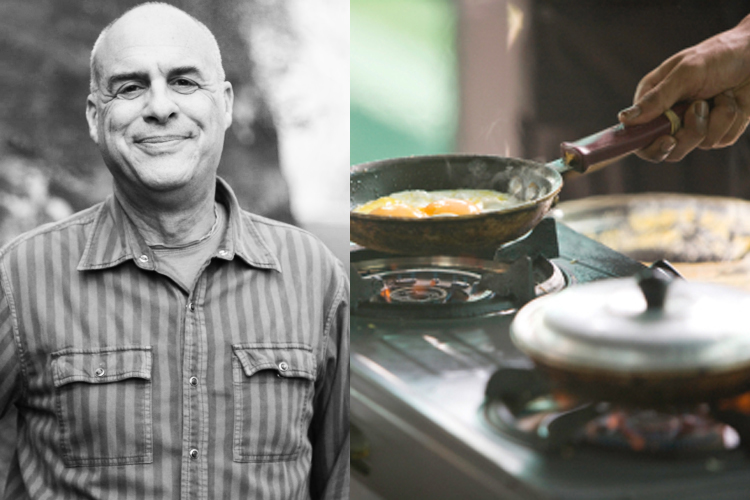
How cooking gave me purposeMark Bittman

Parenthood and the necessities of daily life taught me, as they have billions of others, to cook. And while I was learning to cook, I learned to work (and ultimately to love, corny as that may sound; but that’s another story). I did not, however, set out to teach my kids to cook. I didn’t have to. They figured it out on their own.

My first child, Kate, was born in 1978, when I was twenty-seven. I had been cooking for ten years, but not regularly, and really not in any kind of concentrated fashion. I was curious about the process, but I wasn’t disciplined; there was no need to be, and discipline was not yet a part of my character.

I was self-taught (that is, book-learned) in cooking — as I was in many other things — but I picked it up pretty quickly once I began; it isn’t, after all, very difficult. My dad, of all people — he can barely scramble an egg — showed me how to scramble an egg in 1954, when my mother was in the hospital giving birth to my sister. My mom didn’t directly teach me much, but she set a pretty good example, which is precisely what matters. She cooked daily, and for the most part she started with real ingredients. She wasn’t inspired (you might say she didn’t care), but she got it done, and without fuss.

There was a self-defensive quality to my earliest cooking, the cooking that happened before Kate was born. It began when I was in college, in Worcester, Massachusetts; this was the late sixties. The dining-hall food was unsurprisingly abysmal, even worse than that of the cafeteria in my New York public high school. The differences, however, were stark: In high school, confronted by sliced meat and reconstituted mashed potatoes covered with shiny brown glop, I could bolt out one of the unguarded doors and hit the local greasy spoon (thirty seconds away) or deli (forty-five seconds) or pizza joint (maybe a minute and a half); this was risky — it was rule-breaking — but it wasn’t uncommon. And there was always a real dinner, and there was New York all over the place. Even in the sixties, the city had real food, perhaps more so than now; while there wasn’t the same diversity we see of styles or ingredients, many of those ingredients were of higher quality — they hadn’t yet been industrialized — and much more of the cooking was done from scratch, using truly traditional methods.

In Worcester, the situation was nearly opposite, and grim. All meals were in the cafeteria, which as I’ve said was, um, challenging. There was, nearby, pizza cooked by Greeks (at the time, nearly inconceivable), but because I didn’t own a car, I barely had any other options. When the first McDonald’s opened a few blocks from campus, there was joy. It didn’t last long.

I lived in an apartment with a kitchen my sophomore year. My roommate worked weekends as a short-order cook. We took the rack out of the oven, put it over the range, and invented gas grilling. This nearly destroyed the stove, of course, but it was a rental and we were spoiled, inconsiderate eighteen-year-olds.

The first real change came the following year, when I transferred to NYU. It was the school year of 1969 to 1970, and it was formative. My soul was politicized — everyone I knew was marching in the streets, for good reasons, it seemed, so I joined the crowd. Perhaps more importantly, at least in the long run, I learned how to follow a recipe. The combination of politics and cooking was powerful: having never been especially successful with girls — who practically overnight had become women — I found I could gain, if not sex appeal, at least some modicum of respect (or lack of scorn) by demonstrating that I was someone who was not only willing but eager to participate in kitchen chores. (My mother did teach me how to wash dishes, which has always seemed to me like water play.)

It took a few more years until I realized that there was something about cooking that appealed to me. I didn’t know what it was then, but I do know now: along with child rearing, it gave me a sense of competence that I’d never had before. I had been a terrible student, and in fact I didn’t appear to be good at much of anything. I had been a cab driver, a trucker, an electrician’s gofer, a substitute teacher, and a traveling salesman. I was now married, with a newborn child. My lifelong sense that I would “become” a writer wasn’t working out.

So I became a cook.

When Kate arrived, everything changed. My wife was typically busy and tired, and she soon began medical school. It was clearly incumbent upon me, not to mention easier and more sensible, to lighten household burdens rather than try to nurse the newborn. I enjoyed the cooking. I was providing sound nourishment to my wife and kid, and I liked that. The shopping also appealed to me, especially the oddity of the whole thing. Strange as it may sound to those who did not live through those times, in the late seventies and early eighties there were no men in supermarkets, at least in New Haven, where I was living. Since I was a writer (I didn’t write much, but that’s how I thought of myself), I could wander into Pegnataro’s (now defunct) or Stop & Shop (now a behemoth) at ten thirty in the morning, when there were no crowds. There was just me and a few dozen bewildered housewives.

I was cooking daily, and it lent my life a purpose it hadn’t had before. The morning trips to the supermarket were often followed by travels about town, looking for then difficult-to-find ingredients like Parmesan, good olive oil, and soy sauce (really), and near-daily trips to the fish store, which became a kind of temple to me. In a shop not far from the Yale medical center, we would gather, working- and middle-class women, academics, the nearly poor, the occasional student, and me.

Because I had time, and because I was beginning to write about food, I would stay after I shopped to marvel at the monkfish (my fishmonger called it anglerfish), tuna (rarely seen fresh in those days, and though I know I sound like an old-timer, it’s true), whiting, mackerel, porgies, spots, mako, dogfish, and of course cod, flounder, scallops, and shrimp. I was learning about the wild, vivid, gorgeous assortment that was common in a good northeastern fish shop in those years.

Kate ate this stuff, as she ate the Chinese, Indian, and Italian food I was learning how to cook. I didn’t give her much choice. (Years later, she and her sister, Emma, would tease me publicly about “the month we ate nothing but squid,” or “week after week of pig parts.”)

Do you see? I had to cook; I had taken it on as a responsibility, maybe the first I really owned, the first I generated myself, the first that wasn’t imposed by others. This was becoming my work; I was getting on-the-job training. In part it was sheer joy, and I was lucky as hell: There was urgency and necessity — there was no way around it. My need to develop a career and to get dinner on the table combined to bring me from a mostly undisciplined posthippie pot-smoking politico to what used to be called a responsible member of society better than anything else could have. My antiauthoritarian personality was not uncommon, but my solution — find a skill set that can be useful in daily life, solve two problems at once — was peculiar.

And the crying need to figure out a career while being a responsible husband and father as newly defined in the early postfeminist years pushed me in ways that journalism school or even a newspaper job never could have. I was perfectly capable of showing up in the kitchen every day at five or five thirty, armed to cook, but I was equally perfectly incapable of showing up at an office every morning, armed to listen to a boss’s bullshit. I know, because I tried.

The eighties cooking craze — hello, Paul Prudhomme and Alice Waters — was under way, but I wasn’t much a part of it. I rarely tried anything fancy, and my cooking never became complicated. I was incapable, from the perspectives of both my skill set (limited) and my patience (limited), of spending more than an hour in the kitchen. (In fact I still can’t, and it drives me crazy when I am forced to.) I was cooking for my wife and daughter, occasionally for my friends, and I really wasn’t trying to impress anyone; I was trying to put interesting and decent food on the table.

I laid the foundation of my style of cooking, which is really about the same as that of my grandmother, and probably your grandmother, too (or great-grandmother, if you’re a bit younger than I): spend a little time each day shopping, spend time with other chores, and then, when the day is winding down, figure out dinner.

In retrospect, I went through what I now believe are the four stages of learning how to teach yourself to cook. (If your mother teaches you, it’s a different story.)

First, you slavishly follow recipes; this is useful.

In stage two, you synthesize some of the recipes you’ve learned. You compare, for example, Marcella Hazan’s pasta all’amatriciana with someone else’s, and you pick and choose a bit. Maybe one incorporates Pecorino and the other Parmesan. Maybe one uses less onion, more bacon or pancetta, a hot pepper, a ton of black pepper. You learn your preferences. You might, if you’re dedicated, consult two, three, four cookbooks before you tackle anything.

The third stage incorporates what you’ve learned with the preferences you’ve developed, what’s become your repertoire, your style, and leads you to search out new things. What are the antecedents of pasta all’amatriciana? What’s similar? What have the Greeks or the Turks done that’s related? Are there Japanese noodle dishes that you might like as much? Are there cookbook authors who’ve succeeded Marcella who might have a different approach? This is the stage at which many people bring cookbooks to bed, looking for links and inspiration; they don’t follow recipes quite as much, but sometimes begin to pull ideas from a variety of sources and simply start cooking.

Stage four is that of the mature cook, a person who consults cookbooks for fun or novelty but for the most part has both a fully developed repertoire and — far, far more importantly — the ability to start cooking with only an idea of what the final dish will look like. There’s a pantry, there’s a refrigerator, and there is a mind capable of combining ingredients from both to Make Dinner.

This is not haute cuisine or the culinary arts. This is cooking for a family, and this is the path I went down when Kate was young.

I have directly taught my children none of this; I have set an example not unlike the one my mother set for me, and I have communicated it by deeds, not words. Kate expressed little interest in knowing what was going on in the kitchen, and I had no interest in forcing her, or ability to compel her, to pay attention. Cooking was my thing, and she was welcome to observe or ignore as she chose. She cheerfully accompanied me on my shopping rounds, she set or cleared the table when asked, but if there is a mystery or a romance to the kind of cooking I do, these did little to attract her, and that didn’t bother me.

She is now a terrific cook, well into stage two.

Emma was a different story. As is often the case with second children, she had the benefit of the wisdom (or, if you prefer, experience) I’d gained in raising her sister. She also had the good fortune to be born to a practiced and dedicated cook. She, however, did spend time in the kitchen, and when she was ten she insisted that we cook together one night a week. She actually worked at it.

She is barely cooking at all right now, largely because she’s working in a restaurant. But I’m quite sure that whenever she picks it up it’ll come easily. You don’t need to teach them, really, for two reasons: one, it’s easy enough to figure out by yourself; and two, if you’re cooking, they’re learning. It just happens.

From Man With a Pan: Culinary Adventures of Fathers Who Cook for Their Families, edited by John Donohue. © 2011 by John Donohue. Reprinted by permission of Algonquin Books of Chapel Hill. All rights reserved.

Mark Bittman has been writing and speaking about food for 30 years, much of that time for the New York Times. He is a regular on the “Today” show, a star on three PBS food shows, and the author of three blockbuster cookbooks, including “How to Cook Everything,” which won three international cookbook awards, the IACP Julia Child Award, and the James Beard Foundation Award — twice — and is now the bible of cooking for millions of Americans.

Continue Reading Close

But I’m a good Mormon wife

Sean and I had the perfect life. Then his faith started to crumble -- and mine did, too

  • more
    • All Share Services

Topics: , , , ,

But I'm a good Mormon wifeA photo of the author with her husband

“I don’t believe in God,” my husband whispered in the darkness of our bedroom.

My breath caught, and I was afraid to look at him, this boy I met and married eight years ago.

I was only 19 on the day we were sealed for eternity, the wet snow blowing into our faces as we exited the Portland, Ore., temple. I imagined a life of Church service, my husband at my side as we finished our BYU degrees, raised our children, and served missions together in our old age. On the night we got engaged, we struck a deal. “I’ll get you to heaven,” I said. “But you have to keep me here on earth.”

Now his confession hung over our nuptial bed. And though I’d known this was coming — he’d been struggling with his faith for at least two years — I’d never considered what I’d say. Sean had always been the rational one, a brilliant computer scientist who spoke sense when I was in the throes of clinical depression. Now, my thoughts went still as I groped for his hand. Before I could process what I was saying, forbidden words slipped off my tongue. “You are more important to me than the Church,” I said.

I wondered what my pioneer ancestors would say if they could hear me, these grandparents so faithful that they abandoned their East coast relatives for a life here in this Utah desert. Some of their graves stood a few blocks from where I whispered my betrayal, but I didn’t care. I loved Sean, and that had to be enough.

But in the weeks that followed, there was a distance between us. We stepped lightly around conversation, kept talk to the kids, work and the mundane. Our friendly touches in the kitchen disappeared. My acceptance shifted to bitterness and anger.

I spent my morning runs worrying about what was being said around my Mormon neighborhood. We lived 20 minutes south of BYU’s desert campus, and most of my running partners had husbands high up in the Church hierarchy. I waited anxiously for them to mention my heathen family, wondered if they’d heard that my eternity with my husband was now in jeopardy, that in the hereafter I’d likely be pawned off to some other righteous man as a plural wife — probably my ex-boyfriend; hopefully not Brigham Young. And all the while I couldn’t stop thinking. Why, Sean? I didn’t sign up for this. You promised me we’d spend eternity together, and now you might as well be gone.

That sinister word flickered around in my head: divorce. It manifested itself onto my notebook paper as I scribbled out my daily morning pages. I didn’t want it, but sometimes I thought both of us would be happier if we said good-bye.

Sean and I spent our time in the usual way, taking long summer walks along Hobble Creek. While our two eldest sons raced ahead on their bicycles, we followed with the baby (okay, the two-year-old) in the stroller. Sean obsessed about death. “I’m so terrified of losing you and the boys,” he said one day after waving hello to our neighborhood women’s leader. He looked over at me and said, “I couldn’t bear it.”

Confused sadness flickered in my eyes. His fears were utterly foreign to me. We’d both been taught from an early age that death was simply the gateway back to God. How could he not see — as I did — that this was true? I know we’ll be together again, I wanted to say. Instead I said gently, “I hope for your sake that you die first. Then you won’t have to deal with the grief of losing us.”

Sean was as supportive as an atheist could be. He even went with me for the first hour of church to help with the Squirmy Ones. But when he’d leave early, I’d cry in the bathroom, feeling completely alone. I never said that word aloud: Atheist. My heart clenched just thinking it.

We rarely talked about religion, yet it consumed us. When Sean replaced his temple garments — the sacred underwear he’d promised to wear day and night — with boxers, I couldn’t take it anymore. It was too much betrayal. I called up a neighbor with a husband like mine and cried. But instead of empathy, she offered questions that stunned me into silence. Was Sean addicted to pornography? Watching R-rated movies? What sin had brought him to this terrible place?

My tears stopped. Her questions were so off-base that they seemed absurd. She was sincere, and trying to help, but she believed what the Church teaches — that a man would only leave because he’s disobeying the commandments. She couldn’t understand this was a rational inquiry. She saw everything as the result of sin.

This started my brain twitching. I knew Sean was still a good person, that he still maintained the same moral standards he had when he married me. The Church was wrong about him. What else might they be wrong about? I shoved the thought away.

But I wanted to understand him. This was Sean, the man who stood by me during years of clinical depression. The man who pretended to be a dinosaur while he chased our shrieking sons around the room. He wasn’t some heathen. I couldn’t believe that. I wouldn’t believe it. He’d always been a skeptic, and even though I didn’t agree with him, I knew intellectually that he’d never make this decision without careful consideration of the facts.

As summer shifted to fall, I often found him hunched over his iPad reading everything he could find on Mormon origins. I started to join him in his nightly bath, and the information would seep out. He’d pause from our usual safe topics and bite his lip. “I’m sorry, but I just have to tell you. Did you know that …” and then he’d tell me what he’d been reading. About how Joseph Smith mistranslated some Egyptian hieroglyphics that are part of our canonized scripture. About how he translated the Book of Mormon while looking at a stone inside of a hat.

I listened half-heartedly, questioned his sources, though I wasn’t about to go looking at them myself. Our prophets had made it clear that anything written outside church documents was suspect and anti-Mormon, fabricated for the sole purpose of destroying faith. Yet Sean continued, until one night it was about polygamy, my archnemesis.

“Did you know that Joseph Smith married a 14-year-old girl against her will? Did you know that he’d send men on missions and marry their wives in secret when they were gone?” I sat there silent as he kept talking, a horror growing in my gut. I knew that if Sean was right, then Joseph Smith was a fraud. I saw no difference between his acts and the modern-day acts of Warren Jeffs, whom I abhorred. And if Joseph Smith was a fraud — then what did that make the Church?

I left the bath early and went straight to bed, feeling a magmic pressure building inside me. The scholar in me couldn’t let it go. I had to know.

I already did know.

When I finally broke down a few weeks later, Sean was the one to hold me as I wept into my pillow and traipsed down the familiar road to despair, wondering what my life even meant if the Church wasn’t true.

“It’s OK, Maren. It’s OK. I’m here,” he said as he stroked my hair, whispering into the darkness. What felt like an end, though, slowly opened up into something else.

Over the next few days our usual mile walk turned to four as my brain tornadoed through discovery, my conversations stopping mid-sentence with “Whoa, then that means …” Whoa, we suddenly have 10 percent more income. Whoa, our weekend free time just doubled. Whoa, we can try alcohol, coffee and tea — the trifecta of forbidden drinks.

The sad whoas came, too. Whoa, will my father ever talk to me again? Whoa, what will my friends say? Whoa, we are going to die.

My transformation consumed me for the next month, and we stayed up late talking every night. When I shed my garments for slippery Victoria Secret panties, my self-esteem skyrocketed, and our late nights shifted to other things. We were finally adults, taking our firsts together, learning about each other without barriers.

Ironically, the Mormon Church teaches that marriage can only thrive if God is an equal part of it. But when we left God out of it, we were free to love each other completely, to share the burden of our grief as two individuals with no one else.

It’s been seven months now, and I don’t know what the future holds. I have never been more uncertain in my entire life. But one thing is clear to me. Whatever happens, wherever we go, Sean will be at my side, holding my hand as we face it together — and alone — for the first time.

Continue Reading Close

How to stop the bleeding

A year after Chris died, I was still shocked by how little I knew about being in combat zones. It was time to learn

  • more
    • All Share Services

Topics: , , ,

How to stop the bleeding The author with his friend Chris Hondros, right, who died in Libya in 2011. (Credit: Nicole Tung)

A tourniquet is a simple tool, but I found it practically impossible to deal with when I needed it the most. Slickened with blood, the inch-wide Velcro-backed webbing slid through my gloved hands like a wet snake when I tried to pull it tight. In an adrenaline panic fueled by the sound of gunfire and explosions, I hadn’t noticed that it had twisted under Darryl’s heavily bleeding leg, giving the Velcro nothing to grab when I was finally able to cinch it down. I needed to sort it out fast, or my colleague was going to die.

Darryl was severely injured. Both legs had been blown off at the knees and he lost his left arm at the elbow. Another journalist, freelance reporter Carmen Gentile, was working to stop the bleeding from the arm, fumbling with a tourniquet of his own and appearing to have a better go of it.

“How are you doing?” he shouted to me over the din of battle.

I took a deep breath and forced myself to focus. I ripped off my already tattered rubber gloves to get a better grip and started over, willing myself to be calm.

It was April 20, and although my heart was pounding like I was back in Libya, Carmen and I raced to save the life of our fallen colleague — who was really a 185-pound medical dummy clad in camo fatigues — on the back patio of the Bronx Documentary Center in New York. Next to us, two other freelancers, photographers Liam Maloney and Nicole Tung, worked on another victim. The realism was provided by stage blood (a lot of it), helmets and body armor, smoke bombs and recorded sounds of combat. Hovering over our frenzied work and making sure we didn’t miss anything fatal were medical professionals from Maine-based Wilderness Medical Associates.

“Did you flip him over? Does he have any wounds on his back?” shouted Sawyer Alberi, a spitfire of a former Army Reserve medic. Then to me: “You need to stop that bleeding.”

If there was a theme to what I’d been doing for the past three days, along with 23 other freelance reporters and photographers from around the globe, that was it — to stop the bleeding. Exactly a year before, on April 20, 2011, two of the world’s best conflict photographers — Tim Hetherington and my best friend since freshmen year of high school Chris Hondros — laid dying in the rubble of Tripoli Street in the besieged city of Misurata, Libya. A mortar round fired by Gadhafi forces had landed in their midst, and Chris had been hit in the head with shrapnel, just under the brim of his helmet, inflicting a massive brain injury from which he would die after languishing in a coma for several hours. Tim had been hit high on his leg, his femoral artery severed. It might not have been a fatal wound, but no one around him knew how to stop the bleeding. He bled to death within minutes.

The journalists in my squad stabilized Darryl and prepared him for medevac. We stripped off our bloody body armor and rotated to another exercise — stuffing absorbent gauze into a chicken carcass that was being pumped through with a continuous stream of fake blood. This was meant to simulate a wound to the groin or armpit, where the bleeding artery is too deep in the body to easily pinch off using well-aimed direct pressure. It was the sort of wound Tim had died from.

Our friends were certainly not the first reporters to be killed in combat, but they were among the first of what became a wave of deaths among highly experienced journalists in the year that followed. New York Times reporter Anthony Shadid died during a severe asthma attack while leaving Syria. Marie Colvin of the Sunday Times was killed alongside French photographer Remi Ochlik in an artillery barrage in Homs. South African freelancer Anton Hammerl, thought for weeks to have been captured and missing in Libya, was later confirmed shot and killed. Scores of journalists were captured by repressive regimes. It was, in short, a terrible year.

Especially for people who were close to those who died. A week before Chris and Tim were killed, I worked alongside them on Libya’s eastern front around Ajdabiya and Benghazi. It was extremely dangerous. We were caught in firefights, targeted by mortar fire and, in one instance, stuck for half an hour between Gadhafi forces and rebel soldiers who pounded each other with heavy artillery and machine gun fire, the shells streaking in both directions overhead. But — foolishly, in retrospect — it never occurred to me to be scared for my own well-being or that of my friends. When I left them to return home to Colorado a week before their deaths, they plotted their trip to Misurata, and I did not even consider the possibility that they wouldn’t return.

So the news, which I learned from a stranger’s Twitter post just 30 minutes after I sent Chris an email, blindsided me. Complete disbelief was my dominant emotion, mixed with a combination of guilt and shame. I’ll always wonder what would have happened if I’d stayed, if I would have changed the equation that led them to that fatal spot on Tripoli Street. Would I have talked them out of returning to a very dangerous scene that they’d been lucky to survive earlier in the day? Or would I have gone with them and been killed myself? There was nothing to be done about Chris’s injuries. But would I have known what to do to save Tim’s life?

The answer was no.

I was dangerously unprepared for the environments I’d put myself into throughout my career as a journalist, and I wasn’t alone. Most freelancers don’t have the first clue what to do if one of us is gravely wounded. We arrive in war zones fully stocked with memory cards, extra camera bodies and battery chargers, but with no knowledge about how to save our own lives or the lives of our colleagues. The first-aid kit I brought to Libya was filled with items that would have been useless in an acute trauma situation—Band-Aids and Pepto Bismol. I didn’t even know my blood type. My plan for a medical emergency was simply to hope for a quick death.

“There’s a bit of fatalism to people,” said author Sebastian Junger when we discussed this last month, marveling, as many conflict journalists have in the past year, at the vast scope of all we don’t know about how to render aid to our friends in situations where we should expect to need to do so. “There certainly was for me.”

Sebastian and Tim were close friends. The two had co-directed the documentary “Restrepo” about a group of U.S. soldiers manning a remote and dangerous outpost in Afghanistan. He was affected by Tim’s death the same way I was affected by Chris’s — although he and Tim had had a day’s worth of informal medical training from one of the “Restrepo” medics while shooting their film, he admitted that he knew next to nothing about the human body or what to do for injuries sustained in combat.

“It just occurred to me,” he said, “that it doesn’t have to be this way.”

When he learned that Tim’s injury might not have been fatal if someone had known how to apply pressure to slow his bleeding, Sebastian founded Reporters Instructed in Saving Colleagues (RISC), an organization that offers an intensive three-day combat medicine training course at no cost to participating journalists. Priority is given to freelancers, who compose an ever-increasing percentage of the foreign press corps in dangerous areas. Freelancers take the biggest risks in journalism, but they have the fewest resources to afford this sort of training. Most can barely afford body armor.

When I was asked to participate in the inaugural course, I wasn’t sure how I would handle it. The previous year had been spent in a daze that combined denial, grief and inertia in roughly equal proportions. I simply couldn’t get my head around the fact of Chris’s death, even though I’d seen him in his casket and helped carry him to his grave. It was as if the clock had stopped on April 20, and I was eternally stuck in the horror of that first moment of realization and disbelief. I coped by piling on more work than I could handle to avoid having to think about a future without him. I clung to the past and replayed memories incessantly, as if trying to fuse them into my brain. I was afraid of moving forward and forgetting. I started smoking again. I ignored my friends and family.

I was a wreck, and I morbidly ticked off the milestones counting down toward the one-year anniversary of his death: The day Chris texted me and asked me to go to Libya with him; the last day we were together in his Brooklyn apartment and he lectured me — almost as if he’d had some presentiment — about the trajectory of shrapnel and how small pieces can find their way into your brain even if you’re wearing a helmet; the last thing he said to me as we said goodbye in Benghazi, “We got you out of here unscathed.”

The RISC training promised to at least stop the spiraling orbit that made me feel like I was circling a drain as April 20 approached. I wasn’t the only one coping with memories and close calls. My classmates included Nicole Tung, who held vigil by Chris’s bedside in Misurata until he passed and helped get his remains on a ship bound for Benghazi; Mike Brown, who had been wounded in the same mortar blast; Jim Foley, who had been captured by Gadhafi forces with two other colleagues during the incident in which Hammerl was shot and killed; and Carmen, my partner in rescuing Darryl, who had miraculously survived being shot in the face by an RPG in Afghanistan (the warhead didn’t detonate, which is the only reason he’s alive).

I’m sure there were many other war stories I didn’t hear. There simply wasn’t time. The three-day crash course in emergency medicine didn’t leave much time for reflection. We learned how to stabilize broken limbs and how to assess for internal bleeding. We practiced “un-pretzeling” people who’ve been blown into a heap by a concussive force without further damaging their spinal columns. We were taught to recognize the signs of shock and hypothermia (even in warm climates, hypothermia is the fourth leading cause of preventable death on the battlefield). We learned how to stop arterial bleeds, apply a tourniquet and seal a sucking chest wound. We practiced CPR and rescue breathing by taking turns playing victims and rescuers in a variety of scenarios. We took the 6 train back to our Chelsea hotel sticky with fake blood and worried that the sheer volume of information being crammed into our heads would evaporate by morning.

Graduation was purposely scheduled for April 20. I expected to be more grief stricken than ever, but I found myself unexpectedly calm and energized. For the first time in a long time, I was unwilling to let grief overtake me. It is one of the primary lessons of RISC training, actually, that to dwell on the immutable past is to create peril for yourself and others. You must always be reacting to the present and preparing for the future.

At its heart, our training was about coping with wounds. I didn’t expect to bandage my own.

Continue Reading Close

Greg Campbell's new book is called "Pot, Inc.: Inside Medical Marijuana, America's Most Outlaw Industry." He is the author of "Flawless: Inside the Largest Diamond Heist in History," "Blood Diamonds: Tracing the Deadly Path of the World's Most Precious Stones" (the source material for the Leonardo DiCaprio movie of the same name) and "The Road to Kosovo: A Balkan Diary." Campbell is also an award-winning journalist whose his writing has appeared in The Wall Street Journal Magazine, The Economist, The San Francisco Times, Paris Match, and The Christian Science Monitor, among others. He lives in Fort Collins, CO.

My home, ripped apart

As I watch the Bosnian war crimes trial, I wish I could explain the horrors I saw as a boy, and how much we lost

  • more
    • All Share Services

Topics: , ,

My home, ripped apartA photo of the author examining bullet holes near the cemetery where his family is buried in Bosnia. (Credit: Eldin Trebincevic)

My American friend James and I were watching soccer at a restaurant in Queens, but I couldn’t stop reading a story about Ratko Mladic’s trial at the Hague. There were two pictures with the story: One showed him smiling as he listened to his indictment at a pretrial hearing, and another of a mass grave he created.

“What’s that?” James asked.

I wanted to tell James how personal this was. It made me crazy to watch for 16 years as this monster responsible for killing what might be as many as 250,000 of my countrymen eluded authorities. “It’s the modern-day Nuremberg trial,” I said, wishing I could explain better.

I grew up in Bosnia, and fled to America in 1993, at the age of 13, after my family was exiled. A 31-year-old survivor of the war, I am one of the 5,000 Bosnians living in Astoria, Queens. Not long ago, I went back to visit my hometown for the first time since we fled. Vacation for other guys my age means partying, or hanging out with old friends. I spent two weeks visiting graveyards.

On the runway at JFK, I sat between my brother Eldin and my 72-year-old father, Senahid, nervous to return to the land after so many years.

“Which day are we going to the cemetery?” my father wanted to know.

“Which cemetery?” I asked as the plane took off.

The next morning in Brcko, the town of my birth, I climbed into the back seat of our rented car wearing a tank top, jeans and sneakers. My brother Eldin shook his head. “You’re not going like that, exposing your tattoo.” He gestured to the bright blue and yellow coat of arms of the historical Bosnian Flag on my arm. He did not want any trouble.

We were going to see the karate coach, Pero, who betrayed us. Our goal was not to pay respect. It was to see for ourselves that the bastard was dead.

But I’d waited 20 years for this; I would not back down so fast. “Let’s stop so I can get two bottles of water,” I said.

“Why?” my brother asked.  “So you can piss on Pero’s grave?”

Eldin knew me too well. As we parked, I felt his body temperature rise, along with his anxiety.

This was a Serb cemetery. We didn’t belong here. As I walked by the black marble markers and crosses amid the bitter scent of candle wax, I was conscious of sour looks and muttered profanities. How dare I walk over their sons’ graves with that ink on my left shoulder. In 1992, I would have been shot dead.

As I stood over Pero’s grave, I recalled how my brother and I were his favorites in the karate club.  He helped me become the youngest brown belt there.  One happy evening, my mother invited him over for stuffed peppers.

After the war broke out, Pero was put in charge of the city’s special-police unit. I was shocked when he arrived in front of our building in an army van to cleanse the building of non-Serbs like us. We were given an hour to leave, or be killed. My father and brother were thrown in a concentration camp while my mother and I stayed behind.

Pero turned my second home, the sports complex hall where he’d once coached me in karate, into a torture center where corpses of my neighbors were dismembered and stored, my father learned from fellow inmates. Five months later, I passed by Pero standing with a girl holding an AK-47. He pointed his finger at me and laughed. We later heard he was killed by one of his own, a Serb soldier, over a different girl.

“He’s gone, we’re alive and they still have to live next to us,“ my brother Eldin tried to console me at Pero’s grave. His time came before ours.  At least he had a funeral, unlike many of his innocent victims.

The second cemetery, for Bosnian Muslims, was located on the other side of the city. My Grandpa Suljo was buried there. The hatred and bitterness in the city spread to gravesites: Even the dead were split among ethnic groups. When the fighting began, the burial ground became the frontline, and the place was pummeled in order for Serb soldiers to have an unobstructed view. Horses and tractors ripped up and carried away the remaining headstones. Suljo’s tombstone was sliced in half. Reconstructed, it was glued back together at its base, just like we were.

I also found the grave of my great Uncle Sabit. He passed away a few months before our arrival. I had been hoping to go trout fishing, like we used to.

When the Serbs stormed his apartment, he hid behind a bookshelf. His sister, my Great Aunt Fatima, lay in the grave next to him. She sacrificed herself in 2003, jumping in front of a cab to save her granddaughter. Her husband, Smajl, mysteriously died in the hospital during the war. We never found out what really happened. In my final memory he was offering himself to the military police to distract them from finding Sabit and my father, who were hiding.

Last, we visited my Grandmother Emina, who passed away after holding services for the sixth month anniversary of my mother’s death. Heartbroken, it was a no-brainer that she’d go into cardiac arrest.

“Your tattoo looks amazing,” the undertaker said, waving as he walked away.

We belonged here.

We visited two more cemeteries. One contained 556 fighters from our side. Another was a burial ground for both Bosnian soldiers and civilians, a six-hour car ride away.

“Hey, you have to see this guy, he’s not one of us,” I yelled to my brother as I read the Serb name of a soldier buried there: Goran. He was a Serb who fought in the Bosnian Army against his own people; he fought for the good side, despite what he had been born into, and his family put him to rest among his Muslim neighbors. In my book, Goran deserved the most respect.  His ethnicity didn’t matter because he saw the war through the same eyes as everyone else who landed here.  If I’d died in my homeland, this would be the place I’d want to lay.

“You’ll never catch me dead flying over Bosnia,” my mother Adisa used to say after we’d escaped to the United States.

It had been four years since we’d been to see her in Enfield, Connecticut, where we’d promised to spread crushed marble stones on her grave.

“We have to visit mom,” my brother said.

“I know. But it’s too cold. Let’s wait until spring,” I told him.

“That’s what you said last time, “ Eldin said.

I blamed conditions of the war for the disease that killed her. The leading cause of death for Bosnian women who survived was breast cancer, with high malignancy and mortality rates. Ironically, my mom’s cemetery, just a few hours from where we lived in the United States, was the one grave I couldn’t bear to see.

I couldn’t explain all of this to James – the loss and the unbearable grief. Instead, I just remain glued to Ratko Mladic’s trial in a public viewing gallery in the courtroom, hoping that Ratko will be convicted before he dies in a country-style prison and is given a hero’s funeral, like Slobodan Milosevic.

As my family I wait for a semblance of justice to close the 20th century’s bitter chapter called Bosnia, forgiveness is not an option.  It’s hard not to feel that all the wrong people are dead.

Continue Reading Close

Kenan Trebincevic’s work has appeared in the New York Times and on American Public Media radio. He is finishing a memoir about surviving the war called “The Bosnia List.”

My bully, my best friend

At first, I thought it was a joke when John called me "gay." By the time the school intervened, no one was laughing

  • more
    • All Share Services

Topics: , , ,

My bully, my best friend (Credit: Tad Denson via Shutterstock/Salon/Benjamin Wheelock)

The first time someone called me a “faggot” I didn’t hear it at all. That’s because my head was being slammed against a locker, the syllables crashing together like cymbals in my ear.

When I arrived at this new private school in seventh grade, after my mom got a job teaching, I hoped Fred and I might be friends. We were both faculty brats, and the school catered to elite students from wealthy families.

But our similarities ended there. Fred was tall for an eighth grader, and he was clear-skinned and golden, with hair so light it seemed more than blond. I was short, stocky and pale. He wore clothing emblazoned with Hilfiger and Klein. I was perpetually clothed in hand-me-downs. People whispered that he smoked pot and felt up girls after school. I had changed schools so often I’d forgotten how to make friends.

Something about my incompetence made Fred furious. In the locker room after lacrosse, he would snap at my ankles with his stick until they turned bright red. One day during practice, he dropped any pretense of chasing after the grounded ball and simply rammed into me with all his force. My helmet disappeared; my sweaty gloves flopped on the ground.

“Are you OK?” asked the assistant coach, a tall, heavy-set man who was also the head of the upper school we would both be joining next year.

I nodded, trying to breathe and pretending I wasn’t about to cry. But I lived the next months in fear. That August, before the start of high school, I walked into my brother’s room and asked him, with the most serious face I could muster, if he could teach me how to punch somebody.

But I didn’t have to learn. Fred left our school. I heard his dad was seen screaming in the office about what a screw-up his son was, a detail I relished with a grim smile. Mostly, I was relieved Fred was gone, and I could stop jumping every time I heard a locker slam.

Life was good. It got even better when I met John during soccer practice. He was quirky; he wore the same pair of purple sweatpants to school every day, and he joked about how much he masturbated.

“One time I did it 10 times in one day,” he said at practice, both of us standing at the end of the field waiting for the coach’s call.

“How does that even work?” I asked.

“I guess it was more just to prove that I can.” He shrugged. “By the end nothing was coming out.”

We became best friends.

I was happy to have someone to sit with at lunch, but eventually John started to do something I didn’t understand — he would constantly tell me I was gay. He wrote it on my textbook in biology, where we sat together, and he would whisper it while pointing at me. At that point, I had only had the most fleeting of interactions with girls. I was 14 and barely knew what sex was beyond the definitions I’d gleaned from health class and pornography. But I knew that “gay” meant more than having sex with men. “Gay” was a word that boys tossed around like hot potato, everyone hurling the insult in the vain hope it wouldn’t stick to them. It was a word to be feared, but still buoyant enough not to always be taken seriously. I figured John was using it playfully, among friends, the way he would also call me “Jew.”

A few weeks later, John invited me to join an online conference using our school’s in-house email system for a movie he wanted to make. The film was about one of our heavier friends, Drew, escaping from fat camp. (Fat. Gay. Jew. The words were piling up, but I didn’t care. I had finally wedged my foot in the door.) We went over to John’s house to mess around with a camera one Saturday, but all we ended up filming was Drew chasing a line of bagels rolling down the street while chanting “donut, donut, donut!” Instead, the conference became a place to jab at each other while sitting on school computers. Eventually, John started making more of his gay jokes.

At first I was flattered. This was still a form of attention. And, frankly, I craved attention. But things got weird around spring break. John wrote stories about me taking little boys and animals into the woods to have sex with them. Stories about me being molested by priests and loving it.

Finally, I asked him to stop. The insults meant nothing, I told him in an email, but I agreed to bow out of the group. Still, I would stay up late at night at the family computer, reading and re-reading more elaborately crafted insults and waiting for the page to refresh.

“Since Yannick isn’t reading any more,” he posted, “I can now say: Yannick is GAY GAY GAY GAY GAY GAY GAY GAY . . . ”

It went on like that for a while. The other boys just laughed.

Then one morning, I checked my email in the school library and saw a note from our IT adviser. He had discovered the online conference. The news spread quietly through the administration, which did its best to stop any further damage. A faculty member reminded kids during Monday announcements to be mindful of the correspondence we keep on the school’s email. John was identified as the ringleader and quietly whisked away for probation. Drew was called out for a note saying he was going to kill me (something I again took in jest).

I was rushed in to meet with the head of the upper school, my old lacrosse coach. Again he asked me that bland, unanswerable question: Are you OK?

I thought back to that sunny day on the lacrosse field when he looked down at me with concern while the other boys milled around idly, waiting for the drill to restart. It was all too familiar. Again he towered over me with concern, again the rest of the students milled around idly, having no idea what just happened right next to them. Only this time, the tears were in his eyes as he apologized for what the school had let happen to me.

There’s a weird tension once authorities become involved in teenage arguments. The “can you take it?” approach to maleness sees running to grown-ups as an act of cowardice, which is the very reason I never told anybody outside the email circle what was happening in the first place. In that way, it was a relief that someone finally made it stop. But it was equally bizarre to hear our conversations reinterpreted by adults who were trying to determine the arbitrary moment when a cruel jest slid into unacceptable hatred.

I sat with my mother and the school counselor as they flipped through pages of our correspondence. Read aloud, they sounded different than the jokes I’d convinced myself they were.

The night the news broke at school, John’s mother called me. She was livid with him, she said, and didn’t understand why someone would do something like this. She couldn’t say she was sorry enough. I stammered out the same response I would learn to tell everybody.

“It’s OK, I’m fine.”

Then she put John on the phone. It was the first time we’d spoken since an army of adults swarmed around us. It was the last time we would really speak for almost three years.

“Yannick?” John’s voice was frail, as if he was barely finished crying. I thought about his parents standing above him as he sat on the couch in his living room, face buried in his palms, trying to explain things he couldn’t and didn’t want to. It was the same position I was in earlier that day, the same position I would be in many times in the coming weeks. “I’m really sorry.”

“It’s OK,” I said. “I’m fine.”

“I really don’t know why I did that. I don’t know what I was thinking — I wasn’t really thinking, was I?” he asked to his mother. “Still friends?” he asked me.

“Still friends.”

We both knew the words were hollow. I switched seats in biology. One day, John and I got trapped walking down the same hallway. We joked weakly until my mother rounded the corner. An hour later, she yanked me into her office with my brother. This man is a monster, she said, and now you’re walking down the hall laughing with him? My brother fumed about how the school needed to expel him, to call the police. I sat with my face in my hands, telling them that everyone wanted me to be angry, but all I wanted was to have my friend back.

Hating Fred was much simpler. The violence of getting your head kicked into a locker is so obvious— I could either let it fester within me or redirect it. At night during that spring lacrosse season, I would stare at the knife rack in my kitchen and wonder what it would be like to make one of us bleed. I don’t think I really wanted to hurt him, or even myself. I just wanted him to go away. But John hadn’t hurt me in a way I understood. The standard call-and-response of bullying was gone.

So I did my best to disappear. I spent days down in the photo lab, bringing my lunch there to avoid the cafeteria. I took as many classes as I could. Empty space and time were to be feared. I pretended to search through my locker until the hallway was empty so I could walk to class alone. I tied and retied my shoes.

The next fall I dropped out of soccer. The coach didn’t ask why. John went to the varsity team and became class president. Every time he did something remotely public, someone would whisk me into an office and ask how I felt.

“It’s OK,” I would say. “I’m fine.”

By the end of senior year, my classmates would ask me periodically if I still went to school there.

The last time John and I spoke about what happened was senior spring. Each student was asked to give something called a “focus speech” to reflect on their time in high school. I emailed him that week to let him know I’d be talking about what happened between us.

“You were my best friend at the time,” he wrote back. “I can’t believe I messed that up so much.”

John wasn’t in the room when I gave the speech, but three of the other guys were. Afterward, one of them stood up and said he wanted to publicly apologize for what he participated in. The other two came to me later. Apologies are always awkward, and these were no exception. Our eyes never met.

For a long time, I didn’t hate the people in high school so much as I loathed the school itself for forcing me into this situation. The irony of our cultural anxiety over homophobic bullying is how people deplore it in teens even as it mimics the very policies of our most respected cultural and political institutions.

In that way, bullying isn’t a disease but a symptom of a larger social problem. We can gaze aghast at the horror of bullies every time a new tragedy surfaces, but asking where this violence truly comes from is much more difficult. The year after my school recorded its first case of cyber-bullying, the same administrator who cried in front of me in his office did his best to stop the school’s Gay Straight Alliance from hosting a queer prom. Lower-school parents, he explained to my friend who was planning the event, had seen posters in the high school hallways and didn’t want their children to be affected. I wonder if he ever questioned why there wasn’t a single openly gay teenager walking down those halls.

I’m grateful for one thing my school did, though. They forced all of us boys out of a little world where “gay” could mean anything and everything and into one where we had to look at each other and ask what we were doing. They were trying to foster our empathy.

But did it work? I still don’t know what the answer is.

One summer during college, I logged on to Facebook and saw one of the boys’ statuses unfold down my newsfeed. “Max is gay,” it read. Then a moment later, “Max is really gay,” followed by “Max is super hella gay.” Finally, it ended: “Thanks Dan for updating my status.”

I don’t know if John would still do the same. But I doubt it.

Continue Reading Close

Yannick LeJacq is a freelance writer and photographer living in New York City. His work has appeared in Kill Screen, The Wall Street Journal, The Atlantic, and other publications. You can follow him on twitter @YannickLeJacq.

A death that was also a birth

As a midwife, I've spent the last 30 years taking care of women in pregnancy. But nothing prepared me for this

  • more
    • All Share Services

Topics: , ,

A death that was also a birth (Credit: Clara via Shutterstock)

The call came early in the morning. The 3-month-old granddaughter of my neighbor had finally succumbed to the illness she was born with. I am a midwife, but this call wasn’t about a birth. This time the call was from the mortuary.

I have spent the last 30 years taking care of women in pregnancy, birth and beyond. I use my hands to help bring life into this world. Over the past few years, however, I found myself using those very same hands in the performance of a Taharah, a Jewish ritual that prepares a dead woman for burial. Birth, life, joy, beginnings vs. death, decay, finality. Such a contrast! What could be more different? And yet, somewhere in my consciousness, there was a commonality. Caring for a woman in her life, preparing a woman for birth had a parallel in preparing a woman for burial. The act of helping a woman and her baby through their many transitions seemed analogous to helping the soul transition from this plane of existence to the next.

“Taharah” means “to purify.” Particular prayers are said and simple hand-sewn white linen garments dress the body. All this is identical for everyone, no matter how old, how young, how rich, how poor. During a Taharah, all are treated the same.

I performed my first Taharah, and it was more than I expected – more silence, more depth, more sensitivity. The concern of being with and touching a dead body left as soon as I entered the room. The midwife in me took over. The four members of our team worked quietly, with tenderness. The peace in the room was tangible and present, and our lady seemed to reflect that. Her entire body, as well as her face, seemed to relax as we completed the ritual, intoning the prayers. And the energy, amazingly, felt the same as at a birth — a feeling of completion, a palpable sense of the soul transitioning and a humble appreciation of the privilege of being there.

To perform the Taharah when a woman has lived out her life, has seen her children grow and have their own children, seems part of the natural logic of life. The first Taharahs I took part in were just that. This next Taharah, however, involved someone who had not lived a long life, had not lived to see her children grow, and this time, I was to be alone.

The call stunned me. I knew she was sick, but this wasn’t expected. Now the mortuary was asking, could I be the one to take care of her? I had never before performed a Taharah on a baby. My experiences with babies were of life, not of death. There was always joy, a new beginning. Here was unimaginable sadness, an ending.

As I looked at the tiny garments, it became real, and I worried about how I would react. My mind remembered my nursing training, when we were doing a rotation in the NICU and how I just couldn’t bear to be with sick babies. All I could think about were my own babies and I had cried to my instructor, “Just get me out of here!” Now I was going to be with this fragile body, with this baby who was no longer sick, but was actually gone.

I entered the room alone. I washed my hands in the correct ritual way, pouring water first over my right hand, then my left, right, left, right, left. I retrieved her body. She was so small, so light, wrapped in a clean sheet. It was time for the first prayer. “Master of the world! Take pity upon the present deceased for she is the daughter of Sarah, Rivkah, Rachel and Leah. May her soul rest among the righteous women.” I didn’t know what to expect as I began the unwrapping. She had been so sick, she had had so many invasive procedures and devices. What would she look like? I uncovered her slight form, and she simply looked as if she was sleeping. Did I detect the barest hint of a smile on her face?

I removed the IVs, the bandages and washed her carefully, talking softly to her and caressing her the whole time. I worried about her delicate, almost transparent skin. And then it was time for the ritual immersion. I would submerge her in the pool of water known as the mikvah, a symbolic act of purification, representing the body’s return to the womb, to the bath of the amniotic fluid, and the soul’s return to the original waters of Creation. I cradled her body, continuing my dialogue and immersed her in the ritual bath. Tears streamed down my face, falling into the water, as I repeated the prescribed words, “Tahorah he, tahorah he, tahorah he” … “She is pure, she is pure, she is pure.” The silence was piercing; time seemed irrelevant.

Finally the dressing. These garments, though they were the smallest ones, overwhelmed her tininess. I continued the ritual, placing her in the casket, then covering it. I ended with the ceremonial asking of forgiveness from her, just in the event that anything done was humiliating or disrespectful to her or had deviated from the tradition. I left the room and her.

Driving home in silence, my mind spun with the images of this Taharah. At the same moment I parked in front of my home, her grandfather pulled up across the street. Most of the time, the mourners don’t know who performed the Taharah and unless they ask, nothing is said. But as I looked at him, at the visible unspeakable grief on his face, I knew that I had to tell him. “I took care of her,” I said. His face and body seemed to dissolve. Recovering, he asked me to come across the street to his home, to talk with his wife and daughter. They needed my reassurance, he said.

The baby’s mother, his daughter, only wanted to know if her baby looked frightened. I told her how peaceful she looked, with that almost-smile I thought I had seen. That seemed to comfort her. Then there were a few more questions, many tears, and expressions of gratitude. It was clear that it was time for me to leave. They needed to do their mourning without me.

So why had I been drawn to participate in this ritual? Death carries with it such pain, and whether the death is that of a young person or an elderly one, there is great sadness. However, having watched women in birth, it’s so clear that pain is transitory. There is so much more than just the pain. And with death I believe that there is more than sadness. The process of the Taharah is perhaps a metaphor for what is left — the dignity and integrity of the person, the love that she experienced during her life and leaves as an inheritance to the ones close to her.

I find myself grateful to be part of a tradition that recognizes this and expresses our connection to the Creator, which treats everyone, even in death, with respect and caring. I feel privileged that I am able to participate in this final act for a woman, that I can be midwife to her spirit.

Continue Reading Close

Tova Hinda Siegel is a writer who lives in Los Angeles.

Page 1 of 91 in Life stories