
Game of Thrones

In defense of HBO’s “unnecessary” nudity

Why a newspaper editorial about the naked bodies on the pay cable channel is a remnant of the Puritan mentality

  • more
    • All Share Services

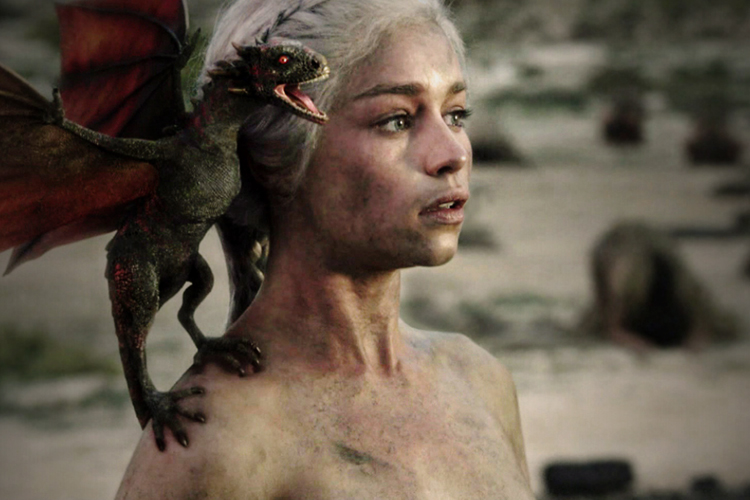
In defense of HBO's Ah, motherhood: According to the L.A. Times' TV critic, this scene with Daenerys Targaryen (Emilia Clarke) is an example of acceptable nudity on "Game of Thrones."

“Maybe it’s time to tone down the tits,” writes Mary McNamara, TV critic of the Los Angeles Times.

She’s talking to HBO, a cable channel that she says is “once again in full stride…with Emmy-winning movies, a panoply of well-done documentaries, successful comedies and dramatic hits both popular — ‘True Blood’ — and critical — ‘Boardwalk Empire,’ ‘Treme.’” And now it has another hit, “Game of Thrones” — a series based on George R.R. Martin’s fantasy fiction that happens to include female nudity.

No operation that’s producing this much good TV needs to be airing so much female nudity; that’s the specious starting point of McNamara’s column, the notion that nudity is not one ingredient in an R-rated stew of elements on HBO series — “Game of Thrones” in particular — but something that a cable channel shows because the programs themselves aren’t interesting otherwise. Really, now, HBO, you’re better than this, she’s saying — conveniently disregarding the fact that HBO has been showing sex and nudity, along with graphic violence and profanity, since its creation in 1975.

McNamara’s editorial is not the first strike against unclothed feminine pulchritude on cable dramas, and against HBO’s “Game of Thrones” in particular. The series has sparked debate about nudity and sex on cable TV, and especially what some critics have termed “sexposition” — a term coined by TV critic Myles McNutt that refers to the delivery of supposedly routine plot information while characters are getting dressed, taking a bath, having sex, etc. “Game of Thrones” had several scenes like that during its ten-episode run. Vulture ran a half-cutesy, half-censorious slide show highlighting them.

“This oft-discussed criticism is a valid one, in my opinion,” wrote Winter is Coming, blogging about the first season of “Game of Thrones.” “It’s not just the use of sex and nudity while giving exposition that is the problem. It is the fact that the writers went to that well a few too many times. And some of those scenes worked better than others.”

But McNamara’s piece is easily the highest-profile strike against nudity on HBO. The Los Angeles Times is the dominant daily newspaper in the industrial capital of popular culture, the metro area where the majority of U.S. TV shows are made. Her tone seems measured and her complaints reasonable. And yet when you examine her arguments closely, a different agenda reveals itself. McNamara distinguishes between supposedly necessary and unnecessary nudity, and it’s interesting, to put it sarcastically, which examples she chooses to put in which category. 

“Breasts,” she writes, “are what you see on cable during a lovemaking scene or when a character is caught unawares or when, as in the season finale of ‘Game of Thrones,’ the last of the Targaryen [family, Danerys Targaryen], rises, naked and miraculous, from her husband’s funeral pyre with three baby dragons clinging to her….Tits are what you see in a strip club or a brothel, when conversations or action between men, which usually have nothing to do with said strip club or brothel, are surrounded by nameless and silent women lounging or gyrating about in various stages of undress…In one episode of ‘Game of Thrones,’ the upper frontals got so gratuitous — two women teaching themselves the tricks of prostitution while a male character, fully clothed, muses about his personal history and definition of power — that fans took to Twitter to complain. Even the fine finale included a young nude woman washing her particulars while her elderly john monologued about the nature of kings.”

Let’s start by admitting that not every single bit of nudity on “Game of Thrones” was so necessary that the show couldn’t have done without it. There were indeed moments where the director of an episode cut away to a shot of some giggling half-naked woman during a scene set in a brothel, or had a semi-nude woman wander through the foreground or background of a shot while a couple of characters were conversing about whatever subject.

But for the most part, I would defend the vast majority of the nude and partly nude shots on “Game of Thrones” as, if not absolutely, totally integral to the plot, then at least imaginative enough pass muster as drama — just not a drama that kids should be allowed to watch. Oh, hell, let’s just go ahead and say it: most of them were as integral as TV scenes get.

The scene between Theon and the prostitute Ros, for example, starts by showing the final 30 seconds of their copulation, then quickly moves to Ros and Theon in conversation, with Theon carrying most of the scene’s skin quotient; the point of the scene is to establish that they have a relationship founded entirely on sex and a power imbalance (he has power, she has none) and to deliver information about Theon’s relationship to other characters. But the scene also reveals character. You can tell by their body language, facial expressions and tones of voice that Ros actually holds the upper hand in the relationship because, macho bluster aside, her john is smitten with her, and she’s just doing what she needs to do to survive and get ahead. In a subsequent scene where Theon says goodbye to Ros as she’s leaving the territory in a wagon, he seems to be trying hard to hide how bummed he is.

Another scene — singled out by McNamara and other writers as gratuitous — strikes me as one of the cleverest and most useful deployments of nudity on the series. It shows the character of Littlefinger, a brothel owner and power broker who still carries a torch for the widowed Lady Catelyn Stark, instructing Ros and another female prostitute on how to fake interest and enthusiasm during a tryst. Littlefinger’s whole life is based on deception, on making people believe in whatever lie he’s selling; he’s also a personally very seductive character whose fortune is built on the flesh trade. Littlefinger is a fascinating yet ultimately pathetic man, and as I look back on this scene, I would say that it tells us more about him than any other single moment in season one of “Game of Thrones.”

McNamara, however, looks at the scene and sees only “tits.” And she finds it indefensible compared to the final shot of the season — the slow pullback that shows the naked, symbolically “reborn” Danerys with the baby dragons, a shot that is deliberately framed and lit to evoke the decidedly non-carnal glory of a Renaissance painting of the Virgin Mary.

The other scene McNamara singles out as problematic  — the scene where “a young nude woman wash[es] her particulars while her elderly john monologue[s] about the nature of kings” — is even more defensible as drama. The character, Maester Pycelle, was set up with Ros specifically so that Littlefinger could glean where he stood on the issue of the young king Joffrey taking the throne. He tells Ros not what he actually thinks, but what he wants Littlefinger to hear — that he thinks Joffrey will make a great king — and when she leaves, he does a series of energetic squats which reveal that he’s not the doddering, hapless old man others think he is.

Also: Littlefinger is a brothel owner (as in the literary source), and he is therefore ideally suited to dole out sexual favors and get information (his stock-in-trade) in return. McNamara’s complaint that the “GOT” scenes set in brothels didn’t need to be set in brothels doesn’t track. So the brothel owner should have more conversations outside his place of business, the place where he feels most comfortable and is most in control?  The critic wonders if there is “some sort of private office where madams and menfolk could talk. I also wonder about all this free nudity — doesn’t money have to exchange hands before the clothes come off?” Er, no and no — not in the sort of establishment that Littlefinger runs. Her gripe also misses an important point, that Littlefinger is betting that the combination of liquor and carnal pleasure and flattery of heterosexual male fantasy will loosen visitors’ lips and reveal information that he can use elsewhere — and he’s often proved right.

The fact that McNamara approves of the nudity in the dragon scene but not the Littlefinger “faking it” scene or the scene with old Maester Pycelle is telling. It’s of a piece with a tediously moralizing strain in American criticism, one which insists that all sex and nudity must be dramatically “justified,” even if it occurs on a TV series based on a highly sexual series of fantasy novels that take place in a male-dominated world in which women fight tooth and nail for power, and achieve it.

The phrase “sexposition,” however catchy and cute, is a loaded one, and maddening. It concedes that the makers of a particular R-rated TV series have gone out of their way to blend theoretically prurient sex and nudity with actual storytelling, but are being taken to task anyway. Not once in any scene of the show’s first season did the filmmakers show unclothed or copulating characters without some kind of necessary plot movement happening at the same time, always giving the narrative element prominence. And when you look at the total running time of season one of “Game of Thrones” — somewhere around 600 minutes — less than five percent of its running time featured sex or nudity of any kind. Viewed in its totality, “Game of Thrones” is a chaste show.  And yet the sex and nudity are constantly being scrutinized and judged for being “necessary” or “unnecessary.”

Meanwhile, as I have noted elsewhere, neither McNamara nor other critics editorializing about supposedly excessive nudity and sex on “Game of Thrones” ever say so much as one measly word about the intensely graphic violence and raunchy language on the series.

For the record, I don’t have a problem with any of the violence or language on “Game of Thrones,” either; it’s set in a Dungeons and Dragons-flavored version of Hobbes’ State of Nature, and as such, we should expect to see elemental human activities depicted often, and with gusto, and if we have a problem with that, we shouldn’t be watching. I just find it grimly amusing that, for whatever reason, sex and nudity must be handled with special care, and must always be “necessary” and utterly unimpeachable in their presentation, yet profanity and violence are rarely held to such such standards. This is America’s Puritan mentality coming home to roost in criticism. Closeups of throats being slit and limbs being lopped off are an expected part of R-rated entertainment aimed at adult viewers, and not even worthy of comment. But nudity and sex must be “justified.”

There’s a useful discussion to be had here about the dominance of the male gaze and how it informs the programming choices of HBO and other cable channels. I agree with the implication — and that’s unfortunately all it is in the L.A. Times piece, an implication — that HBO dramas such as “Game of Thrones” and “Boardwalk Empire” are too often set in a “man’s world” filled with crime, violence and various sorts of exploitation, and that the producers’ decision of whom to show in coitus and when tends to confirm that popular culture is still run by straight, white men, with every other sexual point-of-view getting served as an afterthought, if at all.  (Where are the editorials complaining about excessive sex and nudity on HBO’s vampire soap “True Blood”, by the way? Are copious amounts of sex and nudity OK on a series as long as it’s not trying to be “serious”?)

As I said before in Salon, there is nothing wrong with the heterosexist-centered nudity on “Game of Thrones” that more male nudity and same-sex couplings wouldn’t balance out. But that holds true only if that is, in fact, the problem that a viewer has with a series — too much female nudity in heterosexual contexts, not enough nudity of other sorts.

If, however, the problem is that the viewer is “taken out” of the show by seeing naked people in general — or that the sight makes him or her uncomfortable compared to graphic violence and language — well, that’s a whole other discussion, and probably not a productive one, because then we’re getting into subjective matters of sensibility.

This whole argument is misdirected and misses the larger, more important picture: Whose fantasy is HBO indulging, why is it indulging it, and what other sorts of fantasies could it cater to? 

But that’s not the takeaway from McNamara’s piece. The takeaway is another remnant of America’s Puritan mentality, which holds that female nudity is dramatically “unnecessary” and unacceptable unless it’s divorced from sex.

It all reminds me of a Jack Nicholson quote from the 1970s, complaining about the hypocrisy of the MPAA ratings system: “Cut off a woman’s tit with a sword, they give you a PG. Kiss it, and it’s an R.”

TV’s best villain

"Game of Thrones'" teen ruler Joffrey Baratheon is the rare bad guy who can make you viscerally, physically angry

  • more
    • All Share Services

TV's best villainJack Gleeson in "Game of Thrones"

“Game of Thrones’” Joffrey Baratheon (Jack Gleeson) looks like he could be in a boy band. His blond hair is brushed forward over his forehead, in the current Justin Bieber-inspired, fear-of-the-forehead style. His deep-set, hooded eyes and fair skin give him that sleepy, growing-is-exhausting, pillowcase-still-imprinted-on-the-cheek look of late adolescence. His anodyne features, bunched a little too closely around his snub nose, could easily make him the third-cutest member of a group featured in a Tiger Beat poster. Except Joffrey Baratheon is TV’s most noxious, unredeemable villain, and if he belongs on any poster, it’s a Most Wanted one, preferably defaced with devil’s horns, an eye patch, nasty scars, boogers, fangs, drool, and then — why stop there — ripped to shreds.

When “Game of Thrones” began, Joffrey was a sniveling brat, the heir to the throne and scion of incest, a distasteful, spiteful, whiny character, dangerous in his weakness, but one who did the bidding of others.  That all changed when Joffrey became the king of Westeros and ordered Ned Stark decapitated in a show of authority that was his coming-out party as the worst person on your television. Since then, Joffrey has done one sadistic, vile thing after another: He forced his fiancée Sansa to stare at her father’s head on a spike, had her smacked around, arranged duels to the death for his pleasure, and showed a willingness to kill a man by forcing wine down his throat until he exploded.

Last week he went further. Hoping to get his despotic nephew to stop threatening his fiancée in public, Tyrion (Peter Dinklage) hired Joffrey two whores. Instead of having sex with them, Joffrey forced one of the women to physically abuse the other in a horrifying scene that ended with Joffrey handing a large, tapered wooden object to one of the women and forcing her to use it on the other, while he watched, crossbow in hand, ready to kill either should they disobey his orders. Tyrion, who knew Joffrey to be an insecure, status-conscious fascist, had underestimated his nephew, who is all those things and a sociopath as well, devoid of empathy and aroused only by power.

“Game” contains scores of characters who toe the line between good and bad, who trigger the audience’s disgust and sympathy. We understand why Stannis and Renly prefer fratricide to an alliance, why Theon would betray the Starks, why Tyrion tries to help his beastly nephew succeed, why the Hound murders at Joffrey’s behest.  Joffrey, however, is not nearly so nuanced a figure, even though he has a theoretically mitigating backstory. Joffrey’s biological parents are brother and sister. The king who raised him as his son never had much time for him. His mother is a self-serving bitch who spoiled, coddled and manipulated him, giving him a hugely inflated sense of self and none of the basic ethics or self-reliance to do things well or right. From the most sympathetic angle, Joffrey is the nightmare-inducing result of helicopter parenting gone not just wrong, but psychotic.

And yet “Game” is not interested in sympathy when it comes to Joffrey, doing nothing to redeem him. He is just a villain, served straight up. In a lesser show than “Game,” having such a simply detestable straw man might seem a cheat, a cheap way to get the audience’s blood up. (Starz’s “Magic City” has got exactly such an ultra-violent, nut-job gangster, and he seems wholly preposterous and clichéd.) But “Game” doesn’t rely on any one character to supply the blood, and in the show’s vast spectrum of villains and heroes and everyone in between, Joffrey not only seems plausible — how can a show contain every shade of good-to-bad guy and not a truly evil one?— but also downright invigorating.

“Game” is a show full of so many complications, so many plots and characters, each with their own struggle and story and ethical compromises, that watching is a sort of mental and emotional jujitsu. Compared with all of these messy, draining human characters, the one-note Joffrey plays like a brilliant blast of pure, keening, clarifying hatred. If, during the scene in last week’s episode, my TV screen had melted away and I had found myself standing in Joffrey’s over-decorated bedroom, I would have made a mad rush to tear his smug, squishy face off, like some deranged, insensible, bloodthirsty character from, well, “Game of Thrones.”

“Game” consistently encourages its viewers to adopt the mentality of its characters. It chops off heroes’ heads so we, too, harden our hearts and learn to prize cagey realism over something more noble. It shows blood, guts and bones until we too become insensible to them. It puts a maniacal sadist on the throne, so we too wish someone, anyone, would take it from him, and are ready to punch, slash, find a dragon or birth a smoke monster — or at least condone such behavior — to make it so. If and when Joffrey gets what’s coming to him, I’ll probably stand on the couch and cheer, cackling over the painful death of a psychologically disturbed and dangerous teenager. When the rush passes, unlike the  characters on “Game of Thrones,” I’ll have time to worry about exactly what that means.

Continue Reading Close
Willa Paskin

Willa Paskin is Salon's staff TV writer.

TV’s best show about women

"Game of Thrones" is filled with strong female characters that -- surprise! -- have lots to say about modern sexism

  • more
    • All Share Services

TV's best show about womenEmilia Clarke in "Game of Thrones"

The second season of HBO’s “Game of Thrones,” which premiered last Sunday, is based on a novel — the second in an ongoing saga — called “A Clash of Kings.” But fans of the bloody, battle-scarred show know that’s a misnomer: There are more than a few queens throwing down in this brawl — not to mention a passel of noblewomen, priestesses, grizzly mamas, and badass, sword-wielding soldiers of the distaff variety.

This may be the Year of the Sitcom Woman, but the biggest, most vibrant group of women on TV today can be found in a brutal, self-serious war drama set in a made-up medieval world — just the kind of story, it so happens, that’s often assumed to be the sole dominion of dudes.

For George R.R. Martin, the novelist who created this world in his “Song of Ice and Fire” series, the medium is the message. The things that make the story so daunting and so off-putting to some — its sheer massiveness and its huge cast of characters — are part of what makes it so thrilling to me, as a woman who likes to see other women on-screen. It’s not just that the women in “Game” are strong — and the primary females are, in both figurative and literal senses — but that there are so goddamn many of them, each one fighting to exercise power over the world and her own life. They’re far from a sisterhood (one of the main themes of the show is that trusting others is a rube’s game) but as a collective, they make an unavoidably huge impression.

Fantasy stories, like all genre narratives, are built on archetypes, and “Game of Thrones” seems to leave no trope of feminine power unexplored. There are mothers, like the noblewomen Catelyn Stark and Cersei Baratheon, who are driven by their fierce, lioness-like love for their children. There are a wide variety of warrior princesses and any number of women who use their sexuality to get ahead. There are at least two witchy women (mysticism being a kind of power reliably granted to female and minority characters): Mirri Maz Duur, the Lhazareen who uses “blood magic” to destroy her people’s conquerors, and Melisandre, the priestess who brings a fiery new religion to Westeros and becomes the force behind a fearsome army in the process. These women don’t always win the games they’re playing — they get slapped down as brutally and as often as the male characters do — but they sure know how to fight, week after week.

In a way, “Game of Thrones” reminds me of that other big Sunday night drama: “Mad Men.” In both of these large, multi-character shows, the women are constantly defining themselves against, and through, rigid societal constraints. The stakes are higher in “Game of Thrones”: Many of the major female characters have been or are poised to be traded in marriage, like human chess pieces, among the Great Houses of Westeros, and sexual violence is an ever-present threat. But both shows feature a number of very different women, who we’re invited to read against one another and whose primary relationships are nearly always with men — a condition that’s shaped partly by the setting and partly by the writers’ narrative choices. And on both shows, everyone knows it’s each woman for herself.

In “Game of Thrones,” we’re treated to myriad strategies for how to make it in a man’s world. In Season 1, viewers met Daenerys Targaryen, a teenage girl who was given by her slimy older brother to a burly barbarian warlord, and who has since gone from a passive, victimized child to an awkward but passionate and often forceful ruler. (Add another trope to the mix: the I-found-strength-from-my-trauma woman.)

Both slimy brother and burly husband are gone by the time Season 2 begins, as is the son who, it was prophesied, would grow up to be “the stallion that mounts the world.” (He arrived stillborn and deformed at the end of last season.) Even with the world’s only living dragons at her side, it seems likely that Daenerys will, again and again, have to prove herself worthy of ruling. “They don’t like the idea of a woman leading a khalasar,” her male advisor tells her in Episode 2 of this season, after a rival tribe sends her the decapitated head of one of her riders. Whatever you think about the casting of Emilia Clarke, the lovely Brit who plays Daenerys (personally, I vacillate), it’s fun to watch her learn how to access the queenly yawp inside her.

The second and third episodes of this season bring us two warrior women who are both familiar to anyone who’s read Martin’s epics: Yara Greyjoy (known as Asha Greyjoy in the books) and Brienne of Tarth, who add a new female trope to “Game of Thrones” while deepening the show’s engagement with questions of female strength and of male-female dynamics.

Yara is one of two surviving children of Balon Greyjoy, a minor lord whose rebellion for independence was brutally put down by King Robert nine years before the action of the show. In this Sunday’s episode, [mild spoiler alert] Yara’s younger brother Theon returns to their homeland — a bleak, salt-stained outpost known as the Iron Islands — after having spent more than half of his life as a ward of Ned Stark, the king’s closest supporter, in the relatively glamorous northern kingdom of Winterfell. (If you’ve watched Season 1, the comparison should give you as sense of just how grim the Iron Islands really are.) Theon expects to receive a hero’s welcome when he arrives. In Winterfell, he was a boy without a father and thus, without rank; on the Iron Islands, Theon will finally be a son and heir.

“They say hard places breed hard men,” Theon says, with a boy’s overweening pride, to a ship-girl just before he screws her. “And hard men rule the world.” (No one said “Game of Thrones” was especially subtle in its deployment of penis humor.)

But instead, Theon finds that while he’s been gone, his cocky sister has become the hard young man of the Iron Islands. Yara doesn’t just sexually one-up her swaggering little brother (in a scene that plays like an outtake from a particularly filthy Shakespeare comedy); she usurps his place at his father’s side. Yara has commanded men and killed them; unlike Theon, she would never wear jewels she hadn’t “paid the iron price” for — i.e., liberated from fresh corpses she’s made. When the Iron Islands eventually head to war, Balon tells a sputtering, incredulous Theon that Yara will command a fleet of 30 ships. Theon will get one. Its name? The Sea Bitch. “We thought she’d be perfect for you,” his sister smirks. The Yara/Theon scenes play a bit like a fantasy version of a high-school sports drama, with the football field swapped out for a battlefield. “But … but … you can’t let her play, coach, she’s a GIRL!” (Theon actually yells something like this at his father, as Balon and Yara make fun of his sissy clothes.)

Brienne of Tarth, on the other hand, couldn’t muster a smirk if her life depended on it. The martial maid, a major character whom we meet in Episode 3, cuts a striking figure on-screen: stolid, lumbering, able to bring down one of the finest knights in the realm with a charging body tackle. As played by the 6-foot-4 Gwendoline Christie, Brienne comes off as a little priggish, a little too invested in the postures and poses of knighthood, as if trying to compensate for both her ungainly body and the fact that she’s a woman.

Whereas most of the women in “Game of Thrones” orbit around their lovers or the men in their families, Brienne has eyes only for her gay, or at least bisexual, king, Renly Baratheon. “You fought bravely today, Lady Brienne,” says a positively shrimpy-looking Catelyn Stark after witnessing the aforementioned throwdown. “I fought for my king,” Brienne says stiffly. “Soon I’ll fight for him on the battlefield. Die for him, if I must.”

Behind the proud, out-thrust chin, you can sense the romantic zeal that drives Brienne. In her eyes, dying for her king would be a fitting consummation to their relationship. The women’s brief exchange ends with a terse correction from the newly minted member of Renly’s personal guard: “If it please you, ‘Brienne’ is enough. I’m no lady.” Christie delivers the last line, which could have been a clunker, in a way that’s satisfyingly difficult to parse; I can’t tell if she’s ashamed to say that out loud or disgusted that she has to bring up her sex at all.

Brienne would be an arresting character no matter what story she appeared in. But it’s the fact that she’s just one of a multitude of rich, sharply drawn female characters that makes her — and the show — so compelling.

“Game of Thrones” persuasively demonstrates why some of us are always yammering on about the need for increased representation of women (and minorities) on television: Through the relatively simple process of upping the numbers, the burden on any individual woman magically lightens. No single character in “Game of Thrones” has to be the show’s final word on womanhood, and that’s a freeing prospect. I can find Melisandre a dinner-theater-esque take on the sorceress archetype; you can find Daenerys an appalling victim of untreated Stockholm syndrome. But it’s OK. With the women of “Game of Thrones,” you don’t have to put all your dragon eggs in one basket.

Continue Reading Close

Nina Shen Rastogi is a writer whose work has appeared in Slate, the Washington Post, the International Herald Tribune and Vulture, where she recaps "Game of Thrones." She is the head of content at Figment, the online reading and writing community for teens and young adults.

The real-life inspirations for “Game of Thrones”

Mischief and murder --medieval-style -- inspired the epic series

  • more
    • All Share Services

The real-life inspirations for Lena Headey in "Game of Thrones"

Yes, “Game of Thrones” has dragons and ice zombies and giant clairvoyant wolves, but for every viewer (or reader) who climbed onto George R.R. Martin’s epic fantasy bandwagon for the magical stuff, I suspect there are two of us who are in it for the palace intrigue. Velvet sleeves concealing jewel-encrusted daggers, scheming eunuchs with networks of spies, parvenue commoners outwitting the supercilious aristos and totally, utterly ruthless power plays — what’s not to love?

Martin has always maintained that he’s been influenced at least as much by history and historical fiction as by the traditional epic fantasy of writers like J.R.R. Tolkien. Aficionados know that his novels (collectively called “A Song of Ice and Fire”) are loosely based on the Wars of the Roses, a vicious series of battles of succession that took place in 15th-century England. Martin has also listed Maurice Druon and Thomas B. Costain as models, two mid-20th-century historical novelists who wrote about medieval France, and you can see echoes of that material in his fictional universe, as well.

It would probably surprise several generations of British schoolchildren to learn that the dynastic politics of the late 1400s could be transformed into anything coherent, let alone entertaining. (“It’s worse than the Wars of the Roses!” Lucy Pevensie cries in dismay when someone tries to explain a particularly complicated bit of Narnian history in “Prince Caspian.” She speaks for many.) This, however, hasn’t kept many novelists and historians from trying.

It’s not that there aren’t fabulous characters and nefarious doings in the Wars of the Roses — Secret marriages! Mad monarchs! Vanishing princes! This is a story that concludes with one of the players being drowned in a barrel of wine, after all. But keeping the Wars’ family trees, convoluted legalistic arguments and perpetually shifting allegiances straight is enough to give anyone a headache. It certainly doesn’t help that all the male principles seem to have the same three names (Henry, Richard or Edward) or that they are forever gaining or losing and then gaining again the titles that serve to distinguish them from one another.

For fans who wish to investigate further into the real-life inspirations for Martin’s characters, one of the most lucid popular histories of the conflict is Alison Weir’s “The Wars of the Roses” (originally published as “Lancaster and York”). Some of Martin’s references to the Wars are easy to pick up. For example, the two dueling clans in “Game of Thrones,” the Lannisters and the Starks, have names that resemble those of the two sides in the Wars of the Roses. Like the Yorks, the Starks are northerners, while the Lannisters, like the Lancasters, are famously rich.

Both English families were branches of the House of Plantagenet who vied for the throne after the deposition of the last Plantagenet king, Richard II, in 1399 and before the establishment of the Tudor dynasty in 1485. There’s no one-to-one correspondence between the characters in “Game of Thrones” and actual historical figures, but Martin was clearly inspired by Edward IV in creating, say, Robert Baratheon, the great, strapping warrior who became a stout, ailing king. There’s a dash of Edward, too, in Rob Stark, a brilliant commander who makes an impetuous, disadvantageous marriage.

Cersei Lannister, Robert’s ambitious, conniving widow, is thought by many to have been inspired by the hot-headed Margaret of Anjou, wife of Henry VI, the king Edward IV helped depose. Henry’s bouts of insanity left him frequently unable to rule, and Margaret, a leading Lancastrian, fought ferociously against those she saw as threatening her family’s hold on the crown. Historians view her as a prime driver in the Wars of the Roses, just as Cersei is substantively responsible for the War of the Five Kings in “A Clash of Kings.” Cersei also resembles Isabella of France, an earlier medieval English queen, who conspired with her adulterous lover to dethrone, and possibly to murder, her (bisexual) husband, Edward II, in the 1300s.

Cersei is a crude, incompetent politician, however, which cannot be said of Isabella. Although unpopular in England, where she was nicknamed “the She-wolf of France,” Isabella has acquired some sympathizers over the years, including the indefatigable Alison Weir, who wrote a contrarian biography of her in 2006, “Queen Isabella: Treachery, Adultery, and Murder in Medieval England.” Weir has also written novels about various women in the Tudor era, no doubt aspiring to the success of Philippa Gregory, whose romantic historical novels routinely land on the New York Times Bestseller List.

For her own part, Gregory has already published three books in a series set during the Wars of the Roses, “The Cousins’ War” (an apt title, given the intricate blood relationships among the many combatants). The most recent of these, “The Lady of the Rivers,” may even be infused with enough magical elements to appeal to some “Game of Thrones” readers: In it, the character of Jacquetta, Duchess of Bedford, possesses psychic abilities (the real duchess was tried for witchcraft by her political enemies) and is initiated into the mysteries of alchemy by her first husband. For those who prefer a more grounded view, Gregory collaborated with two historians, David Baldwin and Michael Jones, on a nonfiction book, “The Women of the Cousins’ War: The Duchess, the Queen, and the King’s Mother,” published last year.

You may have noticed that most of these books are about women, despite the fact that, with very few exceptions, the women of the Middle Ages had little power. Much of today’s popular historical fiction about the rulers of the Middle Ages is read by women who are primarily interested in the lives and problems of women. Since the historical record contains next to no information on this topic, fiction has stepped in to fill the breach.

Another, more manly, popular contemporary historical novelist, Bernard Cornwell, has set a series of novels, “The Grail Quest,” during a slightly earlier period. His hero, an archer named Thomas of Hookton who gets caught up in the Hundred Years’ War, is an entirely fictional commoner in search of that fabled relic. What Cornwell’s novels lack in historically based, Machiavellian aristocrats they make up for in action-packed, blood-soaked battle scenes.

For the ultimate in medieval scuttlebutt, however, you can’t do better than Barbara Tuchman’s prizewinning 1978 history, “A Distant Mirror: The Calamitous 14th Century.” This account of the Hundred Years’ War centers around the life of a French nobleman who married an Englishwoman, but it’s more expansive than any novel, taking in such fascinating details as the bizarre fashion for long-toed shoes in court (so long, they had to be tied up with strings and were inveighed against by puritanical clergymen) to the legendarily brutal rampages of British mercenary John Hawkwood through Italy. If you really want to know how the peasants fared while their rulers skirmished, the peculiar challenges of sewage-management in a stone castle, what the real agenda was behind the Crusades, or just how dastardly the highborn and royal can behave when it suits them, then look no further.

Continue Reading Close
Laura Miller

Laura Miller is a senior writer for Salon. She is the author of "The Magician's Book: A Skeptic's Adventures in Narnia" and has a Web site, magiciansbook.com.

Is “Game of Thrones” too white?

Fantasy fiction might have racial problems, but they're just a reflection of America's broader battles

  • more
    • All Share Services

Is Nonso Anozie, Lena Headey and Jason Momoa in "Game of Thrones"

Ser Jorah’s face grew thoughtful as their horses trod together down the godsway. “When I first went into exile, I looked at the Dothraki and saw half-naked barbarians, as wild as their horses. If you had asked me then, Princess, I should have told you that a thousand good knights would have no trouble putting to flight a hundred times as many Dothraki.”

“But if I asked you now?”

“Now,” the knight said, “I am less certain.”

– George R.R. Martin, “A Game of Thrones”

Epic fantasy — sprawling stories full of swords, castles, magic, kings and lots and lots of white people – is slowly finding its way into America’s cultural mainstream. In the age of the anemic box office, Peter Jackson’s films of J.R.R. Tolkien’s Lord of the Rings trilogy remain a gold standard of blockbusterdom – and his forthcoming version of “The Hobbit” will almost certainly follow suit. Newer writers like Brandon Sanderson and Patrick Rothfuss have sold hundreds of thousands of their “door-stopper” tomes of wizardry and courtly intrigue. And tonight, countless viewers will be glued to their sets for the return of what is arguably the hottest show on television, “Game of Thrones,” HBO’s adaptation of George R.R. Martin’s A Song of Ice and Fire fantasy novels.

This is all a bit odd for those of us who grew up with – maybe even got beaten up for – an obsession with these sorts of books. Accustomed to being mocked for our profoundly uncool fixations, many fantasy nerds, myself among them, have an almost nurtured notion that our love of the fantastic and the pseudo-medieval is something that the rest of the world Just. Doesn’t. Get.

But now, as our beloved genre finds its way into “normal” people’s hearts and minds, fantasy fans are increasingly confronted with an inversion of this notion – a question that I, as an Arab-American fantasy fanatic, have been wrangling with for years: If the mainstream doesn’t get fantasy, just how well does epic fantasy, with its lily-white heroes, get the multicultural real world of 21st-century America? As some of the most popular works in the genre’s history – works that shed any pretension of being children’s fare – A Song of Ice and Fire and its wonderful TV spawn are particularly useful springboards for this question.

When it comes to inherited conventions regarding race in epic fantasy, “Game of Thrones” is, in a sense, standing on the shoulders of dwarfs. The Lord of the Rings is the most obvious predecessor to Martin’s work, and it’s not hard to find subtle rhetorical responses to Tolkien in his books. When Time magazine dubbed Martin “the American Tolkien,” it highlighted not only Martin’s rather astonishing genius in world-building and narrative scope, but also the ideological baggage that all of us writing in the genre have inherited from our shared progenitor.

And it’s heavy baggage indeed, however much we love Tolkien’s creation. His half-sublimated wranglings with race are more complex and fraught than either his shrillest detractors or his most fawning defenders would have us believe. But there is some irreducible ugliness in his masterpiece that really can’t be convincingly redeemed. The men of the global East and global South (“black men like half-trolls with white eyes and red tongues”) are monstrous and evil, naturally and culturally inclined to bow to Sauron, and to make war on the good men of the North and West. The bestial visages of orcs bear a striking resemblance to racist caricatures of African and Asian facial features. Above all, to be dark-skinned in Middle Earth is to be part of a savage horde – whether orcish or human – rather than to be a true individual.

The savage hordes described by Tolkien have been imported by his dozens of imitators over the years, becoming a mainstay of fantasy in books, movies and video games. It’s a convention that Martin both takes up and departs from in depicting the Mongol-inspired Dothraki. As a people en masse, the Dothraki value only their horses, treating life cheaply, and reveling in violence:

Across the road, a girl no older than Dany was sobbing in a high thin voice as a rider shoved her over a pile of corpses, facedown, and thrust himself inside her. Other riders dismounted to take their turns. That was the sort of deliverance the Dothraki brought the Lamb Men.

The HBO production – which has been so remarkable on so many fronts — has exacerbated this hard-R-rated cartoonishness, bringing out some of the novel’s more unfortunate tendencies. The show’s depiction of the Dothraki has been positively cringe-inducing. In the novels, Martin’s quasi-Mongol warrior culture is depicted in a problematically essentialist, but still complex fashion. But HBO has nudged Martin’s creation fully into racial caricature by casting a seemingly random variety of colored people, and apparently raiding productions of both “Hair” and “Braveheart” to clothe them.

Even so, by skillfully replicating the juxtapositions posed by Martin’s back-and-forth POV, the show has managed also to replicate his ultimate, rather un-Tolkienish subtext: There is nothing unique about the savage horde’s savagery. If Dothraki society is depicted as violently perverse, so is Westerosi (i.e., quasi-European) society, which bows to the whims of the Aryan-featured boy-monster King Joffrey, and which has knighted mass murderers and rapists like Ser Gregor Clegane, one of the most horrifying minor characters in all of fantasy. Every culture is savage in “Game of Thrones,” and that’s a very different view of the world than what Tolkien gave us.

- – - – - – - – - – - – -

Sunday’s Season 2 premiere begins HBO’s adaptation of “A Clash of Kings,” the second book of A Song of Ice and Fire. Book II is even more wide-ranging in terms of setting and scope than Book I was, so viewers can expect brief glimpses of characters from other parts of the world, including the Summer Isles, Martin’s analogue for Africa.

Unfortunately, some of these depictions partake in some pretty familiar stereotypes about African sexuality. It will be interesting, for example, to see what the show does with Chataya, an associate of Tyrion’s from the Summer Isles, and an upscale brothel madam. Chataya blithely sends her own 16-year-old daughter into prostitution at her “pillow house.”

Chataya continued, “My people hold that there is no shame to be found in the pillow house. In the Summer Isles, those who are skilled at giving pleasure are greatly esteemed. Many highborn youths and maidens serve for a few years after their flowerings, to honor the gods.”

“What do the gods have to do with it?”

“The gods made our bodies as well as our souls, is it not so? They give us voices, so we might worship them with song. They give us hands, so we might build them temples. And they give us desire, so we might mate and worship them in that way.”

“Remind me to tell the High Septon,” said Tyrion. “If I could pray with my cock, I’d be much more religious.”

Again, an entire nonwhite culture is presented as holding skewed values. But this wince-inducing depiction is tempered by some interesting implied questions about sex and commerce and spirituality and culture and power. Here’s hoping there’s a hint of this in the show’s version of things as well.

Part of the challenge of adapting Martin’s novels for television has to do with honoring his skill in constructing jaw-droppingly epic sweeps of plot and setting from beautifully rendered small details. If there’s a saving grace for the racial imagery in A Song of Ice and Fire, it’s in some of these little glimpses and hints that appear throughout – skillful deployment of which on”Game of Thrones” could help make an already good show great.

As an example, the only black character in the first novel is the barely mentioned, but deeply intriguing Jalabhar Xho, “an exile prince from the Summer Isles who wore a cape of green and scarlet feathers over skin as dark as night.” In the first novel, Xho’s most notable act is to frighten one of Sansa Stark’s fellow court ladies with his exotic appearance. So the first black guy to show up in A Song of Ice and Fire basically scares a white girl and then disappears. (He also ties for second place in an archery competition.) Not exactly marquee stuff, but – if online reader reactions are any measure – tantalizing. Yet the character didn’t appear at all in Season 1 of “Game of Thrones” – an understandable enough choice, given that Xho is essentially court furniture, but still a disappointing one for those of us who notice such things.

Another minor character who might have been used a bit more effectively to add a smidge of color to the screen in Season 1 is Syrio Forel, Arya Stark’s vaguely Mediterranean “dancing master” (a gender-acceptable euphemism for “sword-fighting teacher”). Forel is a fan favorite among readers, much more than one might guess from his brief appearances. The show could certainly have added a scene or two more of the wonderful actor Miltos Yeromelou, giving us just a bit more of his character training Arya in the deft swordsmanship of the East. All the more so because Arya’s POV on the show has thus far felt a bit diminished from the books. One supposes training flashbacks are always possible …

Of necessity, turning 1,000 pages of prose into a relatively few hours of screen time involves dropping, combining and retooling elements of a novel. “Game of Thrones” has already taken a few liberties with Martin’s books – cutting minor scenes, combining some characters and eliminating others, and (most notoriously) signposting plot points and character motivations through clumsy new “sexposition” scenes. It would be nice if, moving forward, the writers and producers chose as well to keep an eye on these sorts of promising moments of cultural variety and — dare I say it? — color in Westeros. But, given the contempt our culture currently holds for anything smacking of the much maligned (if chimerical) “political correctness,” I’m not holding my breath.

- – - – - – - – - – - – - -

As an Arab-American writing fantasy fiction, I’ve been asked more than once whether fantasy’s race problem is in a better place now in the Age of Martin than it was in the Age of Tolkien. My short answer is yes, but honestly, I think such questions are almost beside the point.

Ultimately, A Song of Ice and Fire, like the Lord of the Rings, is the work of a brilliant and conscientious writer who is nonetheless writing in his own time and place. The United States in 2012 is, far too often, and even with a black president, still a culture rich in racist stereotypes and xenophobic fear-mongering. Expecting a writer to remain entirely unstained by this is expecting a person to live underwater without getting wet. If we still find troubling racial assumptions and caricatures in fantasy – whether on the page, or on the big or small screen — this probably tells us more about our culture-wide problems than it does about a single writer’s, or a single show’s issues. A Song of Ice and Fire is indeed our American Lord of the Rings, and if Westeros has its race problems, they are simply a powerful reflection of America’s.

Continue Reading Close

Saladin Ahmed has been a finalist for the Nebula Award for Best Short Story and the Campbell Award for Best New Science Fiction or Fantasy Writer. His fantasy novel "Throne of the Crescent Moon" was recently published to wide acclaim.

“Game of Thrones” parenting lessons

The HBO show is violent and sexually graphic -- and it's filled with wisdom about being a dad

  • more
    • All Share Services

“Game of Thrones” isn’t the most likely parenting guide: Season 1 is bookended with beheadings and chock-full of incest. But when you’re about to be a dad you can find inspiration in unlikely places, and last April I had already maxed out my library renewals on “Your Baby’s First Year for Dummies.”

I didn’t freak out when I found out my wife and I were going to have a son. But as the day approached, I had a crisis of confidence. We were living in a studio in Los Angeles, sleeping on a mattress that smelled like pumpkin beer from the previous fall, driving a two-door, 30-year-old car. How were we supposed to do this?

It turns out I was asking the right questions. We needed a new car and a new house; we got Ford’s least-monstrous SUV and a three-bedroom rental that cost as much as my old Brooklyn one-bedroom. And then, in the final weeks before our son arrived, we started watching “Game of Thrones.” By the time our boy was born, I didn’t want to swaddle him; I wanted to thrust him to the heavens on top of a parapet and declare, “All this will be yours!”

“Game of Thrones” cares about children. Children are heirs. There’s no hemming and hawing about how they’re desensitized to violence or they cost too much to send to college. They’re a blessing — in many ways the only blessing — and even the evil ones have parents who love them.

I tried to remember this as I changed my son’s diapers with the DVR paused and him screaming his head off. If I were Ned Stark, right-hand man to the king and Season 1′s exemplary patriarch, I wouldn’t dare to complain about him. You’re so strong! I thought as he kicked me. A hale and hearty lad! A darling babe at the breast! If Wildlings ransacked the house, they wouldn’t kill you. They’d raise you up to be King-beyond-the-Wall! It helped, and when I unpaused with my wife, I attempted to learn some lessons from “Game of Thrones” about being a dad.

1. If you’re not kicking ass for your family, your son should do it for you.

“Your Baby’s First Year for Dummies” (which is a great book) explained that no matter what I did, I could never prepare for the moment when I brought home a little creature who was completely dependent on me. That’s true, but the good news is it goes the other way. When Ned Stark is shamefully ambushed in King’s Landing, Theon Greyjoy urges his son Robb to take revenge: “It’s your duty to represent your house when your father can’t.” I fully intend to use this line on my son if I ever get arrested.

2. Wean your kid.

Young Robin Arryn’s breast-feeding was voted “Most WTF Moment in GOT” at Fanpop, and it’s easy to see why. There’s something unnerving about breast-feeding to begin with. Oh sure, it’s beautiful and natural and it saves money on formula, but it’s a fundamental repurposing of a woman’s body: What was once A is now B (and maybe a little bit of A if the kid’s asleep). The hijacking that starts in pregnancy continues until — well, for Robin, it appears to have gone on way past my wife’s rule: “If he’s old enough to ask for it, he’s too old for it.”

3. The bigger the family, the better.

Once you have a kid, it’s amazing how quickly people ask, “So are you going to stop at just one?” (It’s the third question they ask, after “How’s he sleeping?” and “Are you breast-feeding?” Kids are like privacy repellent.) My simple answer is “no,” because there’s balance in my life right now between the time I spend with my son and the time I spend being me, but “Game of Thrones” has shown me that it’s good to keep an open mind. On the show, you have as many kids as you can. Your kids protect you. They run the castle when you’re away or dead. Little Bran Stark can’t shoot an arrow to save his life, but his sister Arya can. Father Ned smiles: insurance.

4. Give your kid a dog.

I have an issue with dogs — I can’t pick up after them. It’s nothing personal; it just makes me feel like a servant. I limit my janitorial duties to my son, but after seeing the Stark family’s dogs, or direwolves, rip into anyone who threatens their keepers, I’m thinking it might be worth changing my policy. Still: I’m only getting a dog if it’s telepathic and can sense when my son is being menaced by a home invader.

5. It’s supposed to be embarrassing when you introduce people to your father.

Tywin Lannister, father of Tyrion (the antihero dwarf played by Peter Dinklage), is one of the unheralded dads of “Game of Thrones.” He’s fiercely loyal to his children and apt to say things like, “Family is all that lives on.” But he’s tough to love — filthy rich and scary stern — so when Tyrion shows up with his running buddies Shagga and Bron, it’s not a comfortable moment. But you know what? It shouldn’t be. My father would always answer the phone in a Vincent Price voice to scare off my friends. I intend to do the same. I am not my son’s friends’ bro. I am to be feared.

6. Child-proof your house.

OK, if I had more kids, chances are pretty slim that they would fight near a fireplace and one would shove the other’s head into the flames. But those chances are a lot slimmer if I don’t have a fireplace. This is why Sandor Clegane, the fighter whose scarred face is evidence of such an injury, teaches us not only about the emptiness of chivalry, but also child safety. My wife and I noticed quickly after our son was born that there are a ton of rip-off child-safety products out there, including fences that will fall on kids and drawer latches they will choke on. The easiest way to keep your home safe is just to not have things. No pool, no fireplace, no dining-room table, not even a dining room. No scars yet.

7. Don’t cheat.

Cheat on your girlfriend and get in trouble. Cheat on your wife and end up in arbitration. Cheat on the mother of your children, though, and you’re creating a world of hurt for innocent kids — including the bastards you might sire. Jon Snow, illegitimate son of Ned Stark, is so alienated from his half-siblings that he joins the military order of the Night’s Watch, and before he enlists he cuts short his last chance to make love to a woman so he won’t sire an unwanted child like himself. Tragic! Ned tries to reassure him, “You might not have my name, but you have my blood,” but it’s really a father’s responsibility to provide both.

8. Lead by example.

Samwell Tarly, the cowardly whipping boy of the Night’s Watch, confesses that he was told by his father, “You’re not worthy of my land and title” before he was stripped of his inheritance and sent into service. Now, Sam can’t fight, he has bad eyesight, and he hasn’t really been taking care of his body — but I’d like to see his dad. I bet the man isn’t a paragon of courage or self-control. Kids learn by example, and it starts early. When it comes to food, for instance, I thought my wife’s pregnancy would let us both load up on pickles and ice cream, but she said that her condition was no excuse to turn her body into a garbage dump, and she kept me on the straight-and-narrow, too. Now our son eats Brussels sprouts and mackerel. If I go up a pant size, I feel like I’m letting him down.

9. Whatever you do for your family, it won’t necessarily be enough.

“Game of Thrones” is going to have to work hard to top the heart-wrenching death of Ned Stark, but even crueler than his beheading is the lesson behind it. Ned has a chance, when he’s brought before Joffrey the false king, to speak truth to power. He lies to save his family — and gets executed anyway. No matter what I do to keep my family safe, I could end up with my head on a spike (or, more likely, crushed under a bus), so I really should have life insurance.

10. Love all your kids, no matter what.

My favorite father-son moment in “Game of Thrones” is when Tywin Lannister says of his dwarf son Tyrion, “He might be the lowest of the Lannisters, but he’s one of us.” Of course this is a lesson about loving your children no matter how they come out, and I’d like to think my wife and I have the courage to welcome any future additions no matter what prenatal testing reveals, but it’s that “one of us” that gets me. The best part about having a kid, so far, is that I’m an “us.” I’ve managed to go from being alone to helping pilot a unit. It’s like going from private to general, from the mailroom to CEO, but oddly enough I’m less anxious than I was before. Instead of worrying about a lot of little things, I worry about one.

Continue Reading Close

Ned Vizzini is the author of It's Kind of a Funny Story, Be More Chill, and Teen Angst? Naaah..., as well as a writer on Season 2 of MTV's Teen Wolf. His work has been translated into seven languages. His next novel, The Other Normals, will be published on September 25, 2012. Follow him on Twitter @ned_vizzini or visit his website at www.nedvizzini.com.

Page 1 of 4 in Game of Thrones