
How the World Works
The final nail in the supply side coffin
Broken recovery: Taxes are low and corporate profits are high, but nothing is trickling down to the American worker
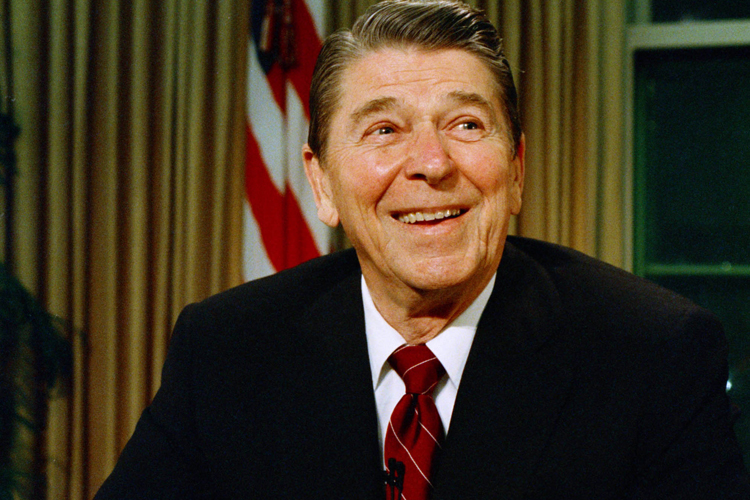
President Ronald Reagan smiles as he poses for photographers after delivering a speech on television, in this Dec. 11, 1987 file photo.
The theory of supply-side economics tells us that if you cut taxes on rich people and corporations, the newly liberated moguls and businessmen will take their windfall and invest it, creating jobs and accelerating the rate of economic growth. The benefits of a light hand on the upper class, therefore, will “trickle down” to the working man and woman.
Ever since Ronald Reagan first attempted to make supply-side economics a reality and proceeded to inaugurate an era of persistent government deficits and growing income inequality, it has become harder and harder to make the trickle-down argument with a straight face. But we’ve never seen anything quite like the disaster that’s playing out right now.
The Wall Street Journal reported on Tuesday that corporate profits are looking quite strong for the second quarter of 2011. Even the Journal can’t sugarcoat the basic facts:
While the U.S. economy staggers through one of its slowest recoveries since the Great Depression, American companies are poised to report strong earnings for the second quarter — exposing a dichotomy between corporate performance and the overall health of the economy.
But that’s just the tip of the nightmare. A newly released study from the Center of Labor Market Studies at Northeastern University, “The ‘Jobless and Wageless’ Recovery From the Great Recession of 2007- 2009,” lays out some extraordinary statistics. (Hat tip: The Curious Capitalist.)
In the first quarter of 2011, aggregate U.S. GDP — the total value of all the goods and services produced in the United States — was higher than the peak reached before the recession began in 2007. During the six quarters since the recession technically ended in the second quarter of 2009, real national income in the U.S. increased by $528 billion. But the vast majority of that income was captured as profit by corporations that failed to pass on their happy fortunes to their workers.
Over this six quarter period, corporate profits captured 88% of the growth in real national income while aggregate wages and salaries accounted for only slightly more than 1% of the growth in real national income. The extraordinarily high share of national income (88%) received by corporate profits was by far the highest in the past five recoveries from national recessions … In the first six quarters of recovery from the 1990-91 recession, corporate profits experienced no growth whatsoever, and they generated on average only 30 per cent of national income growth during the recoveries from the 1981-82 and 1973-75 recessions.
What makes this “recovery” so different? Perhaps the simplest answer is that labor has been broken as a force that can put pressure on management, so there’s little incentive for employers to turn profits into wage hikes or new jobs. Instead, employers are squeezing more out of the workers that they’ve got, and investing in equipment upgrades and new technology instead of human assets — labor productivity has risen sharply since the end of the recession.
Globalization also plays a potent role — and not just as a source of cheap labor to undermine the bargaining power of American workers. The Journal notes that many companies “are benefiting from demand from emerging markets, where they are deriving an increasing share of their sales.” Job creation is probably following the sources of new demand. If the Chinese and Brazilians and Indians are the ones buying American goods and services, then it makes sense to staff up overseas. But with American consumers still shellshocked by the economic crash and dutifully obsessed with paying down their debts while trying to hold on to their homes, domestic demand is hardly a force to be catered to.
Wages are moribund, unemployment is stuck at 9 percent, and the corporate bottom line is doing just fine. You could be excused for thinking that if ever there was time to put the stake through supply-side economics, it would be now. Wall Street and big corporations are doing just fine, but absolutely nothing is trickling down. And yet Republicans are still pushing the same old song and dance, passionately holding the entire creditworthiness of the United States hostage in return for even lower taxes on corporations, adamantly refusing to countenance even the slightest revenue increase to help cushion the hard times for the Americans who are getting a raw deal out of the current recovery.
Democrats come in for their share of the blame, too. The worst economic recovery for American workers in history has happened on Obama’s watch, and he appears remarkably oblivious to it. He may live to regret this oversight.
Andrew Leonard is a staff writer at Salon. On Twitter, @koxinga21. More Andrew Leonard.
A farewell to How the World Works
Coverage of politics, the economy, and globalization will continue, but the branded blog will not
Not quite six years ago, Salon encouraged me to launch How the World Works, a hybrid blog/column originally envisioned as “a conversation about globalization.” Some umpteen zillion posts later, the experiment is coming to an end, as part of larger changes at Salon you’ll be hearing about soon.
No, I’m not going anywhere, and yes, I’ll still be writing about most of the same things I currently cover (though maybe with a little bit less emphasis on Washington horse-race politics). There are interesting projects in the works, some of which will incorporate more honest-to-goodness reporting than I’ve been doing for a while. There’ll still be an RSS feed for everything I write, but it’ll be hooked to my byline rather than the title “How the World Works.”
Continue Reading Close
Andrew Leonard is a staff writer at Salon. On Twitter, @koxinga21. More Andrew Leonard.
Operation treason?
Why markets are tanking: The Fed's new plan admits the economy is in trouble but doesn't come close to fixing it
U.S. Federal Reserve Chairman Ben Bernanke testifies before the Senate Banking, Housing and Urban Affairs Committee hearing on Enhanced Oversight After the Financial Crisis: The Wall Street Reform Act at One Year on Capitol Hill in Washington, July 21, 2011. REUTERS/Yuri Gripas (UNITED STATES - Tags: POLITICS BUSINESS HEADSHOT)(Credit: © Yuri Gripas / Reuters) If the stock market reaction is any indicator, the early reviews of Ben Bernanke’s latest scheme to juice the economy, “Operation Twist,” are negative. At 1 p.m. ET, the Dow Jones industrial average was down nearly 360 points.
Deciphering investor psychology is never straightforward, and particularly so recently, when there are so many potential reasons for fear and panic: our amazingly dysfunctional U.S. Congress, the ongoing European drama, and the steady drumbeat of negative economic indicators. But today’s tremors can be tied to the Fed’s announcements on Wednesday fairly easily.
Continue Reading Close
Andrew Leonard is a staff writer at Salon. On Twitter, @koxinga21. More Andrew Leonard.
Facebook’s enraging status update
The social media network annoys its users, again, with a confusing revamp. There must be an agenda here, somewhere
Like, oh, around 750 million other users of Facebook, I logged on to the world’s biggest social media network this morning and was immediately annoyed. Facebook had changed its user interface, again. Gone was the “Most Recent” button, which allowed users to see what their friends have posted in a simple, straightforward, chronological order. Now Facebook was indulging, again, in outright effrontery: employing its own secret algorithmic sauce to highlight what it considered the most important “top stories,” while mixing in other recent posts far below.
Continue Reading Close
Andrew Leonard is a staff writer at Salon. On Twitter, @koxinga21. More Andrew Leonard.
Does Google deserve the Microsoft treatment?
The search engine giant is feeling the antitrust heat. Not all of it is justified -- but some is
Eric Schmidt Here is what happens when one company controls 40 percent of the $30 billion U.S. online advertising market and 65 percent of online search. The knives come out — and they’re sharp.
It’s been a long year for Google. In February, European antitrust regulators launched an investigation into whether Google was using its search results to privilege its own services over those of competitors. In June, the Federal Trade Commission started looking into whether Google’s relationship with handset manufacturers using the Android operating system improperly promoted Google search. In August, Texas’s state attorney general joined the fun. And on Wednesday, Google Executive Chairman Eric Schmidt will testify before the Senate Judiciary Committee’s subcommittee on Antitrust, Competition, and Consumer Rights. The name of the hearing: “The Power of Google: Serving Consumers or Threatening Competition?”
Continue Reading Close
Andrew Leonard is a staff writer at Salon. On Twitter, @koxinga21. More Andrew Leonard.
Jennifer Granholm’s plan to fix America
The former Michigan governor bears globalization's worst scars, but still itches for a fight. Watch out, Rick Perry
Michigan Gov. Jennifer Granholm speaks during a Ford Motor Company news conference at the Ford Van Dyke Transmission Plant in Sterling Heights, Mich., Monday, Oct. 25, 2010. Ford said Monday it will invest $850 million in several Detroit-area plants to build its new six-speed transmissions and improve facilities. (AP Photo/Paul Sancya)(Credit: Paul Sancya) Jennifer Granholm, the former governor of Michigan, has a story she likes to tell about the Chinese. Granholm visited China in March. At one meet-and-greet, a Chinese official buttonholed her and asked when the U.S. was going to implement a national energy policy. By her own account, Granholm hemmed and hawed, mentioning the rise of the Tea Party and the inability of the current Congress “to get its act together.”
Granholm and I are sitting in a corner office of a building on the University of California at Berkeley campus, where Granholm is spending a year of “sabbatical.” She leans over her desk, looks me in the eye, and demonstrates how the the Chinese official rubbed his hands together like a kid unable to contain his glee right before unwrapping Christmas presents. “‘Take your time,’ he tells me,” says Granholm. “‘Take your time.’”
Continue Reading Close
Andrew Leonard is a staff writer at Salon. On Twitter, @koxinga21. More Andrew Leonard.
Page 1 of 605 in How the World Works