
Fiction
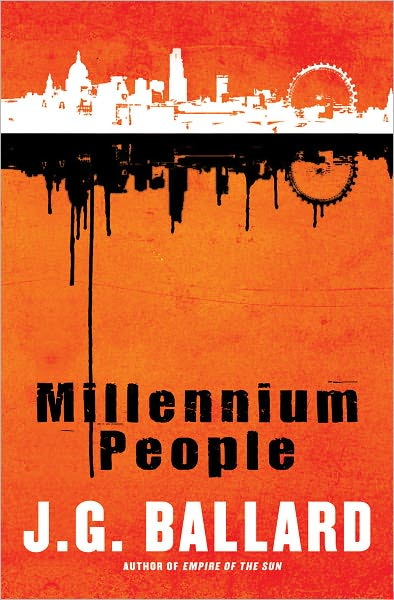
“Millennium People”: J.G. Ballard’s last hurrah
The dystopian author's final novel gives us a prescient reflection of modern horrors
In this, his last novel, the darkly comic “Millennium People,” J.G. Ballard returns to many of the themes that have established him as one of the 20th century’s principal chroniclers of modernity as dystopia. Throughout his career Ballard, who died in 2009, wrote many different variations on the same theme: A random act of violence propels a somewhat affectless protagonist into a violent pathology lurking just under the tissue-thin layer of postmodern civilization. As in “Crash” (1973) and “Concrete Island” (1974), the car parks, housing estates, motorways and suburban sprawl of London in “Millennium People” form a psychological geography. At its center, Heathrow Airport — a recurrent setting for Ballard — exerts its subtly malevolent pull on the bored lives and violent dreams of the alienated middle class.

“Millennium People” begins with the explosion of a bomb at Heathrow, which kills the ex-wife of David Markham, an industrial psychologist. The normally passive Markham sets out to investigate the anonymous bombing and the gated community of Chelsea Marina, a middle-class neighborhood that has become ground zero for a terrorist group and a burgeoning rebellion of London’s seemingly docile middle class. Exploited not so much for their labor as for their deeply ingrained and self-policing sense of social responsibility and good manners, the educated and professional residents of Chelsea Marina regard themselves as the “new proletariat,” with their exorbitant maintenance and parking fees as the new form of oppression, their careers, cultured tastes and education the new gulag.
In the company of a down-and-out priest and a film professor turned Che Guevara of the Volvo set, Markham quickly discovers that the line between amateur detective and amateur terrorist is not so clear, as he is drawn deeper into acts of sabotage and violence against the symbols and institutions of his own safe and sensible life. Targets include travel agencies, video stores, the Tate Modern, the BBC and National Film Theater — all “soporifics” designed to con people into believing their lives are interesting or going somewhere.
Like “Crash” — in the person of Vaughn, the deranged prophet of auto-Armageddon — “Millennium People” features a messianic and charismatic leader who acts as Virgil to the protagonist’s Dante. Here, the psychotic pediatrician Dr. Richard Gould emerges as the dangerous mind behind the Chelsea Marina rebellion and its parallel bombing and vandalism campaign, a new form of terrorist violence that draws its power from the absence of any real motive. Rather than shocking the middle classes out of their complacency, with these attacks Gould desires nothing less than the destruction of the 20th century itself, which he sees as a black hole in history pulling Western civilization ever closer to absolute zero. Culminating with a senseless killing that that closely mirrors the real-life murder of British TV presenter Jill Dando, these spasmodic destructions are emblematic of a perverse collaboration of terrorist and victim, in which “the most pointless acts” are the only way to “challenge the universe at its own game.”
In his work Ballard has depicted a future — and now a present — with disturbing prescience and clarity. Posthumously released in America, “Millennium People” arrives at a time when the foundations that support our own middle classes feel more unsettled than ever, and the specters of apocalyptic obsession and the nihilism of consumer culture all bear an increasing resemblance to the world Ballard has been creating in one fiction after another — or perhaps warning us about.
50 shades of Shutterstock
Slide show: Everyone's favorite light-bondage bestseller illustrated by inexplicable stock photography SLIDE SHOW
This week, for roughly the millionth time, E.L. James’ romance-bondage trilogy “50 Shades” nabs the No. 1, 2 and 3 spots on the New York Times bestseller lists. We don’t get it either. Every page of that book, which famously began as “Twilight” fan fiction, elicits a sigh of confusion and weird secondary embarrassment. The question is: Who would read this? (The answer is: Apparently everyone.) It’s the same baffled, helpless feeling we get when we sort through stock photos on a daily basis. Stock photos – which have been the subject of recent outstanding Internet satire – are used by this site, and many others, to illustrate our flood of content. Many are plain and simple, but a good portion are flat-out mind-blowing. Why did anyone think that photo was a good idea? It only made sense to join these forces. And so, we present to you passages from the most head-scratching bestseller of our time, illustrated with the assistance of inexplicable stock photography.
Megaphone by Natalie Bakopoulos
Miracles happen, even in an Athens crippled by a garbage strike, to a young mother unsure of her ability to love
(Credit: iStockphoto/caracterdesign) It’s the third week of the garbage strike and Athens has begun to smell. Bright-colored trash bags fill the curbs and alleyways, and we have learned to step over the rubbish and avoid the blocks that had become unnavigable. We know which stretches are particularly foul — a stretch along Mavili Square, or the entire top end of Monastiraki. Odos Athinas is a sea of trash, and Omonia is ghastly but we don’t go there anyway. May has gone from unseasonably cool to raging hot, and the garbage seems to be melting. In front of the museum it’s like yet another installation project. When I arrive each morning I want to wretch.
Continue Reading CloseNatalie Bakopoulos's first novel, "The Green Shore," will be published by Simon & Schuster in June 2012. Her work has appeared in Tin House, Ninth Letter, Granta Online, and The O. Henry Prize Stories 2010, and she is a contributing editor for the online journal Fiction Writers Review. More Natalie Bakopoulos.
Almost by Chris Pavone
She never thought of herself as ambitious, until motherhood and career collided in one horrifying hospital ride
(Credit: iStockphoto/caracterdesign) It’s just before dawn when Isabel puts the final page down on the fat stack of paper that sits on the rumpled bedspread, next to an overflowing crystal ashtray and a crumpled soft-pack of cigarettes. She’d tried Wellbutrin and Xanax; she’d used patches and gum. In the end, the only thing that made her quit smoking was being pregnant.
But then, after everything, she couldn’t help but start up again. At first it was just a single cigarette per day, or two. Then it became a few, and within months she was back to full-throttle. Over the past couple of years, she’s tried to quit a few times, but not seriously. She anticipates — she accepts — failure. Because she doesn’t want to quit, not really. She wants instead to try, and fail.
Continue Reading CloseMemorial Day fiction: Are we there yet?
Salon exclusive: At the start of the summer fiction season, new stories from Chris Pavone and Natalie Bakopoulos
(Credit: iStockphoto/caracterdesign) “Are we there yet?”
It’s a dreaded sentence. When it’s spoken by an anxious child from the back seat, it’s enough to make stressed-out parents wish they’d never taken a family vacation in the first place. And even if it’s delivered as a sing-songy punch line, from an impatient partner or spouse on a long road trip, it’s an irritating eye-roller of a joke.
So this Memorial Day weekend — the unofficial start of the summer vacation season, and therefore the summer fiction season — we asked two novelists to reclaim the sentence in a new and adult context. For our latest fiction project, there was only one simple rule: Each story had to include the line “Are we there yet?” in a fresh and surprising way.
Continue Reading CloseDavid Daley is the senior culture editor of Salon. More David Daley.
“Frankenstein” remixed
This masterful new adaptation of Mary Shelley's classic novel may be the best interactive fiction yet
Whatever interactive fiction is (and we’re still figuring that out) it suffers from all the problems of traditional fiction and then some. The vast majority of novels and short stories aren’t much good, but when a branching fiction — along the lines of the old “Choose Your Own Adventure” children’s books — fails to engage, the first impulse is to blame the form rather than the content. Let “Frankenstein,” just released by Inkle Studios and Profile Books, serve as a reproach to that reflex. The app is a creative, subtle and sensitive adaptation of Mary Shelley’s classic novella, and it has singlehandedly renewed this critic’s hopes for interactive fiction.
Laura Miller is a senior writer for Salon. She is the author of "The Magician's Book: A Skeptic's Adventures in Narnia" and has a Web site, magiciansbook.com. More Laura Miller.
Page 1 of 130 in Fiction


