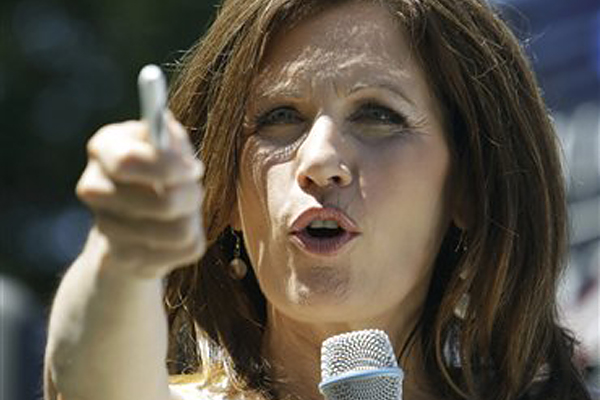

Michele Bachmann, R-Minn.

Actual good Michele Bachmann profile explains how incredibly radical her background is

The New Yorker explores the spiritual mentors and ideology of the Tea Party queen

  • more
    • All Share Services

Actual good Michele Bachmann profile explains how incredibly radical her background isFILE - In this July 25, 2011, file photo, Republican presidential candidate Rep. Michele Bachmann, R-Minn., speaks during a rally at the Delaware County fairgrounds in Manchester, Iowa. Same-sex marriage might seem like a straightforward issue: You're for it or against it. Yet for the field of Republican presidential hopefuls, it's proving to be an awkward topic as public attitudes change and more states legalize gay unions, the latest being New York. (AP Photo/Charlie Neibergall, File)(Credit: Charlie Neibergall)

The New Yorker’s Ryan Lizza got what appears to be phenomenal access to the Michele Bachmann team and came away with a very good profile that goes beyond “Bachmann says nutty things” to a far more useful explanation of the nutty things Bachmann believes.

Bachmann’s spiritual gurus include 1970s evangelical thinker Frank Francis Schaeffer, who was opposed to the Renaissance and went sorta nuts after Roe v. Wade, advocating for violent overthrow of the government and claiming that the elites were poisoning the populace with psychotropic drugs in the water supply.

Sara Diamond, who has written several books about evangelical movements in America, has succinctly defined the philosophy that resulted from Schaeffer’s interpretation: “Christians, and Christians alone, are Biblically mandated to occupy all secular institutions until Christ returns.”

Bachmann was approvingly mentioning the “profound influence” Schaeffer had on her as recently as this spring, and she told the Star Tribune in 2005 that she was reading a “wonderful” book called “Total Truth,” by a Schaeffer follower and prominent creationist named Nancy Pearcey.

And there is her Oral Roberts University professor John Eidsmoe, with whom Bachmann  collaborated on a book about how America is a Christian nation founded by Christians:

When Biblical law conflicted with American law, Eidsmoe said, O.R.U. students were generally taught that “the first thing you should try to do is work through legal means and political means to get it changed.”

Sounds a bit like Shariah?

Eidsmoe later got in trouble for addressing a white supremacist organization and celebrating “Secession Day” in Alabama and arguing that “Jefferson Davis and John C. Calhoun understood the Constitution better than did Abraham Lincoln and Daniel Webster.”

Then, in the late 1990s, Bachmann began reading David A. Boebel, an actual John Bircher Society member and minister who wrote in insane pamphlets for crazy people with names like “Communism, Hypnotism, and the Beatles.”

Plus, Bachmann recommended a Robert E. Lee biography by a guy named J. Steven Wilkins, who … well, he defends the Confederacy, and slavery, because the South loved God and the North didn’t.

In his chapter on race relations in the antebellum South, Wilkins writes:

Slavery, as it operated in the pervasively Christian society which was the old South, was not an adversarial relationship founded upon racial animosity. In fact, it bred on the whole, not contempt, but, over time, mutual respect. This produced a mutual esteem of the sort that always results when men give themselves to a common cause. The credit for this startling reality must go to the Christian faith. . . . The unity and companionship that existed between the races in the South prior to the war was the fruit of a common faith.

For several years, the book, which Bachmann’s campaign declined to discuss with me, was listed on her Web site, under the heading “Michele’s Must Read List.”

So! That’s just the bits of the profile dealing with Bachmann’s spiritual and ideological mentors and influences. I didn’t even paste the amazing Marcus Bachmann color or the tale of her horrible religious charter school or the many stories of how much Bachmann lies about her own background — go read the whole thing!

Even in a post-Glenn Beck world where far-right extremism has become fairly normalized and occasionally embraced by a Republican Party that used to at least act embarrassed about its neo-Confederates and John Birchers and straight-up theocrats, Bachmann’s ideological background is both radically anti-American (in the sense that America is a pluralist nation founded on Enlightenment values and not a pro-slavery Christian theocracy) and way, way outside the “mainstream.” She’s not just a hard-right-winger — and not just a slightly dim “nut” — but a full-on fringe character, a bigot following a bizarre strain of born-againism that even your average American evangelical would find too conspiracy-obsessed and ahistorical to be palatable.

Meanwhile, Newsweek puts this incredibly, incredibly generic Bachmann piece on the cover (the entire thing, summed up: Michele Bachmann is doing well in Iowa but sometimes she says funny things and her critics say she is extreme) with the crazy-eyes photo, but the NewsBeast actually ran a much more illuminating story on Bachmann’s ideology by Michelle Goldberg — the piece where I first read about Bachmann’s links to Schaeffer and Eidsmoe — back in June, and I don’t think that one was even in the print magazine?

Alex Pareene

Alex Pareene writes about politics for Salon and is the author of "The Rude Guide to Mitt." Email him at apareene@salon.com and follow him on Twitter @pareene

The HPV vaccine should not be controversial

The national debate is dominated by myths. The vaccine works -- and doctors need to encourage teens to get it

  • more
    • All Share Services

The HPV vaccine should not be controversial

Here’s a hypothetical question: As your daughter’s doctor, what if I could prescribe a drug that could protect her from cancer? What if I told you that this drug has no known severe side effects, and that she can get it free of charge? The only thing that I would need from you is to show up in my office three times to give your child the entire course of this medicine.

If you believe me, I’m guessing that this is an offer you can’t refuse. On the other hand, we know U.S. Rep. Michele Bachmann’s answer to my question is “no.” That’s because I really do have this drug. It’s called the HPV vaccine, which prevents cervical cancer. I administer it to teens (mostly girls, but increasingly boys) in my practice every day.

I won’t waste words refuting Bachmann’s ridiculous (and campaign-killing) claim that the HPV vaccine causes “mental retardation.” But here are the facts: The American Cancer Society estimates that about 4,000 women die from cervical cancer in the United States each year. Approximately $4 billion is spent annually on these conditions. The HPV vaccine is virtually 100 percent effective in preventing infection by strains of the virus associated with 70 percent of cervical cancers. A second HPV vaccine is also highly effective, preventing more than 90 percent of infections. Researchers estimate that if widespread vaccination is achieved, cervical cancer could drop by as much as 77 percent. That’s as close to a cure for cancer as we’ve ever had.

Yet even before Bachmann’s statements, the HPV vaccine has struggled to gain traction. A recent survey by the Centers for Disease Control showed that less than half of teen girls started the vaccine series, and less than one-third of those girls completed it. That leaves the promise of a cure for cervical cancer well out of reach. The question is why?

One myth to dispel right away is that parents believe the HPV vaccine will encourage sexual activity. Studies have never demonstrated this is a major factor that prevents vaccination. Parents do hesitate to give their teens the vaccine because they think it’s too new and needs more time in the marketplace (the vaccine was first licensed in 2006). Others worry their children are too young for this vaccine, though the vaccine is most effective before people become sexually active (on average, at age 15 in the U.S.). Education and time will help sort this misinformation out.

That out of the way, the common barriers — and solutions — to getting kids vaccinated are practical ones. First, the vaccine is primarily targeted toward teenagers. They’re healthy and busy — and hard to get into the doctor’s office. At best, we can get them in once a year for a checkup and immunize them there. But this vaccine is a three-dose series, and getting this group of kids — who go between home, school, friends, extracurricular activities, etc. — back isn’t so easy. Most teens also don’t feel physically vulnerable to illness, let alone a chronic or life-threatening disease. How do you motivate one to come in to stop a disease that might be three or four decades away?

If and when teens do come to the office, doctors present our own barriers to vaccination. First, we miss a lot of opportunities. While teens don’t usually develop devastating illnesses, they frequently come in with a cough, a sore throat or some other minor problem. If we’re not taking that opportunity to offer to vaccinate them, we’re missing the chance to save their lives. My practice uses something called the “Preventive Health Prompt,” which lists all vaccines a patient is due for. Our hope is that if the doctor doesn’t catch that the teen in front of him or her needs HPV, the parent or child will ask for it themselves, since we provide that list at every visit and online.

But there are also missed opportunities during routine visits. We know, for example, that it’s a strong influence when a doctor urges a patient to get the vaccine. Yet this doesn’t seem to happen as often as it ought to: In one study, among girls and young women who had planned to get the vaccine, a third who didn’t said that the most common reason was that their doctor did not offer it to them. Similar findings show up in other research.

When we do offer the vaccine, how we frame it can backfire. In many cases. the discussion of preventive HPV vaccination focuses on sex. That can be unsettling for parents and time-consuming for doctors. If it doesn’t go right, the myths of a child’s being too young for the vaccine or that it’s a ticket to sexual activity can easily surface. Finally, the vaccine’s cost is a major barrier, though not to patients. Rather, it’s doctors who get burned. The HPV vaccine is the most expensive of all recommended children’s vaccines. It costs $360 to vaccinate one child ($120 per dose). By comparison, most other recommended vaccines cost less than $50. Doctors have to pay the upfront costs, hoping that insurers will reimburse them. In some cases, doctors have only received $2 above the cost of the vaccine. This, and the tepid demand for it, makes it bad business to stock up.

The good news is that most of these barriers have solutions. Simple, straightforward education is a sure bet. In one study, the intent to vaccinate rose from 49 percent to 70 percent after doctors gave families educational literature about the vaccine. Making sure doctors frame the discussion about the HPV vaccine in terms of cancer prevention –  instead of sexual activity — has been shown to help improve uptake.

One way to get teens to come back for the full series is to reach them on their cellphones. In a recent study, researchers sent a group of patients text message reminders to come in for their HPV vaccine booster, and compared the results to a group that did not. The group that was texted was significantly more likely to return. Given that teens send an average of 3,000 text messages each month, the results are a good sign that this is one of the best channels to connect doctors and teen patients.

Then there are some more old-fashioned ways to get kids vaccinated. The first is to make them. In the U.K., rates of HPV vaccination hover around 80 percent. The reason for this staggering success is that the vaccine is mandated through a school-based program. School nurses get and administer the vaccine (if parents don’t want their child to receive it, they must opt out).

Yet, as the Republican debate highlighted, political and legal mandates are very divisive. Instead, we can also rely on some good old-fashioned “mandate” from Mom. It turns out a mother-daughter discussion can increase the rate of vaccination, even if the daughter is over 18 and no longer requires parental consent to get vaccinated. So moms, please help your kids to grow up cancer-free.

(Note: Dr. Parikh has no relationship, financial or otherwise, with the manufacturers of the HPV vaccine.)

Continue Reading Close
Rahul Parikh

Rahul K. Parikh is a physician and writer in the San Francisco Bay Area. He wrote the Vital Signs column on Salon in 2008-2009. His pop culture-medical column, PopRx, runs on alternate Mondays.

The incredible vanishing Michele Bachmann

Her demise following her HPV blunder shows how consent gets manufactured on the pseudo-populist Republican right

  • more
    • All Share Services

The incredible vanishing Michele BachmannMichele Bachmann

Look, Michele Bachmann was never going to be the Republican presidential nominee anyway. Surely even she knew that. Her political celebrity begins and ends with her wide-eyed beauty and penchant for making absurd, faith-based pronouncements on cable TV.

OK, so Bachmann won a meaningless straw poll in Ames, Iowa — where old duffers get a free lunch and a bus ride to the state fair in exchange for their votes. Fellow no-hope candidate Ron Paul finished a close second. Even so, the unanimity with which GOP savants turned against the fair Michele after she got in Texas Gov. Rick Perry’s face demonstrated how consent gets manufactured on the pseudo-populist Republican right.

She ought to have known better than to have heeded this column. “If Michele Bachmann can’t make an issue of [Rick Perry's] ill-fated executive order requiring sixth-grade Texas girls to be vaccinated against sexually transmitted diseases,” I had written, “she’s got no business running.”

The Texas governor’s political misstep was made-to-order for any self-styled Christian conservative. Ordinarily, it’d be easy to agree with former George W. Bush speechwriter Michael Gerson, writing in the Washington Post: “If Republican presidential candidates want to debate sexual health and hygiene, it would be nice if they displayed more collective knowledge and judgment than your average eighth-grade family-life class.”

Or with Gov. Perry himself, explaining that his motive was to protect women against a potentially fatal form of cervical cancer.

“We instigated, with HPV, a national debate, and I think appropriately,” Perry told Texas Monthly in 2007. “As a matter of fact, the more I know about this disease, the more I know that we are absolutely, unequivocally correct.” He added that Texas Medicaid spends $175 million per year on cancer treatments and hysterectomies.

Ah, but nothing’s ordinary where sexuality is concerned. Never mind that sexual intercourse comes close to being a human universal — ponder that next time you’re meandering through Walmart — nobody’s eager to popularize the practice among 12-year-old girls. Social conservatives resent the government taking over a solemn parental responsibility.

Or, as Bachmann said during the recent CNN/Tea Party debate, “To have innocent little 12-year-old girls be forced to have a government injection through an executive order is just flat-out wrong.”

Public health experts say waiting any longer risks being too late. Even so, Perry acknowledges he should have asked the Legislature.

Things got tricky for the Texas governor when Bachmann brought up payola. “The drug company gave thousands of dollars in political donations to the governor,” Bachmann said. “And this is just flat-out wrong.”

She flat likes that phrase.

“The company was Merck, and it was a $5,000 contribution that I had received from them,” Perry said with bemused condescension. “I raise about $30 million. And if you’re saying that I can be bought for $5,000, I’m offended.”

“Exactly what is your price?” Bachmann might have asked. Merck had actually given Perry $30,000. Not to mention that his former chief of staff and other aides had remunerative ties to the pharmaceutical company lobbying to have its Gardasil vaccine adopted nationally.

But that barely scratches the surface. Even in Texas’s pay-to-play political culture, Perry’s brazenness is a wonder to behold. His campaign donations from contributors seeking everything from nuclear waste dump permits to seats on the Texas A&M board reach into the tens of millions.

“When you are trying to figure out Rick Perry, you need to do two things,” Denton (Texas) Record-Chronicle‘s Mike Trimble advised out-of-state reporters. “Find the lowest common denominator and follow the money.”

Unfortunately, Bachmann got distracted by the innocent little girl issue, turning it into a characteristic blunder. On the “Today” show, she told about a crying mother who approached her after the debate.

“She told me that her little daughter took that vaccine, that injection, and she suffered from mental retardation thereafter. It can have very dangerous side effects … This is the very real concern.”

Needless to say, there’s no medical evidence whatsoever for this madly irresponsible statement. For religious zealots like Bachmann, the world is made of words. She’s made a career of crackpot pronouncements for which her sole authority is the last person she talked to. On the medical front, to cite one example among many, Bachmann once blamed a 1976 swine flu epidemic on Jimmy Carter. (Gerald Ford was president, not that it was his fault.)

But this time, conservative commentators turned against Bachmann as one. Not only Gerson, but the Wall Street Journal, Rush Limbaugh and her former campaign director Ed Rollins suddenly discovered that Bachmann’s a wackjob. “This is the nail in the coffin in her campaign,” a former Republican National Committee official told the New York Times.

In the New Republic, Walter Shapiro reported that on Fox News “Bachmann was almost entirely absent, like a Red Army general excised from the Great Soviet Encyclopedia after being purged by Joseph Stalin.”

I wonder if she’s gotten the message.

Continue Reading Close

Arkansas Times columnist Gene Lyons is a National Magazine Award winner and co-author of "The Hunting of the President" (St. Martin's Press, 2000). You can e-mail Lyons at eugenelyons2@yahoo.com.

Bachmann: It’s ok to spread lies about vaccines because I never said I’m a doctor

After claiming that the life-saving HPV vaccine causes "mental retardation," the candidate declines to apologize

  • more
    • All Share Services

Bachmann: It's ok to spread lies about vaccines because I never said I'm a doctorRepublican presidential candidate, Rep. Michele Bachmann, R-Minn., speaks during a rally in Costa Mesa, Calif., Friday, Sept. 16, 2011. (AP Photo/Chris Carlson)(Credit: Chris Carlson)

The other day, Michele Bachmann said that the HPV vaccine made someone “mentally retarded,” which is not only untrue but also the sort of remark that leads to parents denying their children vaccines that could save their lives.

When confronted on this, after a few days of both liberals and conservatives decrying her, Bachmann did not really apologize or correct the record. Instead, she said it’s OK for her to say things like that because she never told anyone she’s a doctor. As long as you don’t lie about a doctor, you can claim anything you like about medical matters, on TV, and it’s OK! (I’m not a doctor but I heard that if you make your baby wear a onesie with a “funny” slogan on it your baby will die.)

From the San Francisco Chronicle:

“I didn’t make any statements that would indicate I’m a doctor, I’m a scientist, or making any conclusions about the drug one way or the other,” she said, adding she was merely relating the concerns of a woman who was “very distraught” and who supported her view that Perry’s actions were wrong.

Asked specifically if she would apologize for the HPV comments, Bachmann said, “I’m not going to answer that question.”

So, no, she will not apologize for that. She won’t apologize because she still needs the HPV issue to hammer Rick Perry, which she is still attempting to do.


No more “retardation” talk! Just “mandates” and crony capitalism.

Michele Bachmann, by the way, did used to campaign around Minnesota as “Dr. Michele Bachmann.” Bachmann called herself “Dr.” because she has a J.D. from Oral Roberts University. (While some lawyers argue the point, “Dr.” is generally reserved for medical doctors and people with Ph.D.s.) But she hasn’t called herself “Dr.” recently, so make sure not to take any medical advice from her.

Continue Reading Close
Alex Pareene

Alex Pareene writes about politics for Salon and is the author of "The Rude Guide to Mitt." Email him at apareene@salon.com and follow him on Twitter @pareene

Joe Lieberman loves Rick Perry and Michele Bachmann

The outgoing senator trolls liberals once more by lavishing praise on two of the GOP's most extreme

  • more
    • All Share Services

Joe Lieberman loves Rick Perry and Michele BachmannRep. Michele Bachmann and Sen. Joe Lieberman

Joe Lieberman is retiring from the U.S. Senate, because he’s a widely hated troll with no chance of winning another term, but before he goes he’s going to take every opportunity possible to do what he feels G-d Himself sent him to Congress to do: Annoy liberals. Today, he gives an interview to the National Review in which he lavishes praise on two Republican presidential candidates.

Lieberman, the “model purple senator” and avowed champion of moderation, is surely praising centrist Republican Jon Huntsman and pragmatic former blue-state governor Mitt Romney, right? Nope. Lieberman instead has kind words for Michele Bachmann and Rick Perry, the 2012 race’s two most outspoken conservatives.

Why does Joe Lieberman, former Democratic candidate for vice president, like Bachmann and Perry so much? (I mean besides because those two are the ones who inspire the more liberal fear and loathing?) Because Bachmann and Perry share Joe Lieberman’s love of constant sanctimonious religious moralizing, of course.

Lieberman respects Michele Bachmann and Rick Perry, two Republican presidential contenders who have spoken up about their faith on the trail. “I know this got controversial recently, with Governor Perry and Congresswoman Bachmann. But they didn’t give up their First Amendment right to free expression and freedom of religion when they decided to run for president,” he says. “I like it when a candidate, if they feel comfortable, talks about their faith. It’s very interesting to me; it tells me more about the candidate, giving me one more factor to evaluate about what kind of president they would be.”

“Others may be turned off by it, even by the very fact that you’re talking about it, or the way you’re articulating it,” Lieberman says. “That’s the risk you take.” But he emphasizes that while some may find Perry’s public prayers troubling, or Bachmann’s Christian declarations strange, many Americans find such words “reassuring.” In this sense, he urges all politicians, if they are so inclined, to speak up, even if they are not religious experts, in order to make politics more hospitable to religious discussions.

Yes, a lot of work still needs to be done to make politics more hospitable to constant pious invocations of The Lord. It is a good thing Joe Lieberman is standing up for the First Amendment right of all politicians everywhere to be an outspoken evangelical Christian who uses religious arguments to justify political decisions.

“This is classic America,” Lieberman says. “The Constitution promises freedom of religion, not freedom from religion. The whole history of the country is intertwined with religion. The founding documents are premised on a world view, actually a very creationist world view.” Since then, “We have found a way to invite religion into the public square without pushing all but one religion out. It’s remarkable.”

Classic America.

The Constitution actually “promises” that the government “shall make no law respecting an establishment of religion,” which is arguably closer to “freedom from religion” than the other way around, but that’s splitting hairs. What’s important is that we all agree that the Constitution is “creationist” (?!) and Rick Perry and Michele Bachmann are Classic America.

(Does Joe Lieberman know that there are actually a couple members of a religious minority in the GOP race, by the way? Wouldn’t the Mormon candidates be a better example of America “inviting religions into the public square without pushing all but one religion out” than the dominionist Protestants?)

Continue Reading Close
Alex Pareene

Alex Pareene writes about politics for Salon and is the author of "The Rude Guide to Mitt." Email him at apareene@salon.com and follow him on Twitter @pareene

Michele Bachmann moves to the left (on crazy conspiracy theories)

The suddenly flailing 2012 candidate adopts the popular liberal myth that injections are dangerous

  • more
    • All Share Services

Michele Bachmann moves to the left (on crazy conspiracy theories)In a Thursday, Sept. 8, 2011 photo, Republican presidential candidate Rep. Michele Bachmann, R-Minn., delivers the Republican response to the speech by President Barack Obama to a joint session of Congress at the Capitol in Washington. Starting this weekend, Bachmann plans to campaign almost exclusively in Iowa as she tries to reassert herself in a race that's become a two-candidate contest between Texas Gov. Rick Perry and former Massachusetts Gov. Mitt Romney. (AP Photo/Cliff Owen)(Credit: Cliff Owen)

Michele Bachmann said that the HPV vaccine makes babies “retarded.” This is easily the dumbest, most irresponsible and inflammatory comment she’s made in years. It began at Monday’s debate, when she attacked Rick Perry for his now infamous decision to require that girls receive the vaccine. “Little girls who have a negative reaction to this potentially dangerous drug don’t get a mulligan.”

She accused Perry of only supporting the policy for money:

What I’m saying is that it’s wrong for a drug company, because the governor’s former chief of staff was the chief lobbyist for this drug company. The drug company gave thousands of dollars in political donations to the governor, and this is just flat-out wrong. The question is, is it about life, or was it about millions of dollars and potentially billions for a drug company?

She got worse after the debate, on Fox and the “Today” show, when she said an unnamed mother told her that her daughter became “retarded” after receiving the vaccine.

Obviously there are no cases of kids becoming “retarded” after receiving the HPV vaccine. I am pretty sure Bachmann meant to reference the popular myth that vaccines (usually the common MMR vaccine) cause autism, but she got confused.

So she either repeated some hearsay some random person told her as factual at a nationally televised presidential debate and then twice more on television because she’s an imbecile, or she is cannily reaching out to the sizable number of paranoid parents with misguided concerns about vaccines. She has a very good ear for the sort of scary story people half-hear on the news or get the gist of third-hand from a friend — her first school board run was built on horrible tales of what the government was secretly doing to your children.

So, in that sense, this is completely unsurprising. Bachmann is an avowed enemy of science, running to represent a party that of late has decided that scientists are untrustworthy liberals. She has a long history of parroting conspiracy theories and believing and repeating anything she hears or reads that reflects her biases.

But this isn’t your typical right-wing conspiracy theory, about climate scientists plotting to destroy capitalism, or the U.N. using bike-share programs to institute a world government. This, this is a liberal conspiracy theory.

The “vaccines cause autism” lie is as liberal as conspiracy theories get. Crunchy coastal elites, panicky about the health of their babies in a world full of “toxins,” are the ones not getting their kids vaccinated these days, because of something they read on the Internet (or saw on “Oprah”). The story has traction in part because it’s anti-corporate. It insinuates collusion between the government and those damned pharmaceutical companies that are only out for profit. (The scientists, too, are in the pockets of big pharma!) This stuff doesn’t get much play on the right, because it doesn’t tap into the foundational myths of the conservative movement or play on their tribal fears. Right-wingers are more concerned about their babies being exposed to the mental toxins of liberal indoctrination than, say, mercury.

This is why Ace of Spades is mocking her. It’s why Rush Limbaugh said she “jumped the shark.” It’s why the Corner featured multiple posts strongly decrying Bachmann’s “dangerous flirtation with the anti-vaccine movement.” Conservatives oppose giving girls the HPV vaccine because they want premarital sex to have (potentially deadly) consequences, not because they think vaccines are inherently dangerous.

But vaccine panic is big. It’s specifically big with mothers. With Rick Perry sucking up Bachmann’s support, she needs to branch out a bit. This is her version of “moving to the center.” Michele Bachmann moderates her message by adding liberal conspiracy theories to her repertoire.

What is actually funny is that Perry only ever did the right thing in the first place for the wrong reasons. Everything Bachmann said about the Gardasil deal being an example of crony politics is totally true! A drug company hired Perry’s former chief of staff to lobby him to do something that would make them money. But sometimes the special interests looking to maximize their profit are maximizing their profit by doing something good. (Like, say, Internet companies fighting for net neutrality.) The lesson here is that Planned Parenthood should give Rick Perry a couple thousand dollars and watch him turn pro-choice.

So Bachmann, in going after Perry for coziness with industry lobbyists while also latching on to vaccine toxin panic, is now the Republican Party’s most liberal 2012 candidate. (She did already go after Obama on the African-American unemployment rate. Maybe she’s been a leftist this whole time!)

Continue Reading Close
Alex Pareene

Alex Pareene writes about politics for Salon and is the author of "The Rude Guide to Mitt." Email him at apareene@salon.com and follow him on Twitter @pareene

Page 1 of 27 in Michele Bachmann, R-Minn.