
Afghanistan
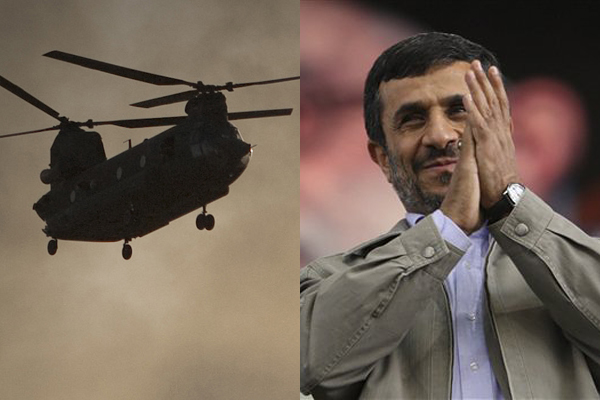
The campaign to blame Iran for downed U.S. chopper
Two media outlets air the baseless claim that Iran helped shoot down the SEALs' helicopter over the weekend
In front of a portrait of the Iranian supreme leader Ayatollah Ali Khamenei, President Mahmoud Ahmadinejad, gestures, in a gathering of recovered drug addicts for a ceremony commemorating International Day Against Drug Abuse, at the Azadi (Freedom) sport complex, in Tehran, Iran, Sunday, June 26, 2011. (AP Photo/Vahid Salemi)(Credit: Vahid Salemi) Twice in the past few days important media outlets have aired the claim — for which there is apparently no evidence — that Iran was behind the downing of a U.S. helicopter in Afghanistan over the weekend which killed 38.
First, this item appeared on Sunday in Mike Allen’s daily Playbook email newsletter:
EMAIL DU JOUR: “My immediate reaction is which foreign intelligence agency is training and equipping the Taliban to do this. I suspect Iran.”
I asked Allen about this Sunday, and he emailed that the next day’s would have “an alternative view.” This appeared in Monday’s edition:
EMAIL DU JOUR, responding to yesterday’s EDJ, on the insurgents’ strike on the SEALs: “Wow someone is trying to blame Iran! Iran had nothing to do with this. It happened in Wardak. Like 99% of fighters and weapons there likely all came from Pakistan. I know everyone wants to hate on Iran. But the enemy in Afghanistan is Pakistan, not Iran.”
The alternative view was helpful. But it’s still not clear why it’s worthwhile (or responsible) to air this sort of inflammatory, and baseless, claim in the first place.
We heard the claim again on CNN Monday night, this time from the paperback thriller author Brad Thor, who was for some reason invited on as a foreign affairs analyst. He told host John King:
I’d like to add that there’s word out that what took down this helicopter might be what’s known as an IRAM, an improvised rocket assisted mortar. We first saw these with Shiite extremists in Iraq with Iranian fingerprints all over them and that’s why I’m so concerned.
They call these things in the military flying IEDs and we don’t have confirmation of what brought the helicopter down, but that and the fact that the Iranians have so penetrated not only the Afghan government, but a lot of our indigenous support and our forward operating bases and around the country of Afghanistan — you know, it makes me wonder, the Taliban, they’re good, but, man, I don’t think they’re this good, John.
I really think this thing is the fingerprints of Iranian cooperation on it.
There are a few problems here. First, the idea that an IRAM rocket was used in this attack was knocked down by a NATO spokesman a few days ago. In addition, even if this type of rocket was used, Thor doesn’t cite any actual evidence that it was supplied by Iran. As for whether the Taliban are not “this good,” consider the fact that plenty of other American choppers have been shot down by Afghan insurgents in the past decade.
Meanwhile, the Obama administration, which has hardly been shy about going after Iran in recent months (for its alleged arming of insurgents in Iraq and alleged links to Al Qaeda), described the attack as merely a “lucky shot.”
Actual journalist Jeff Stein summarizes: Thor “offered CNN host John King a convoluted explanation of the weapon suspected of downing the helicopter, which seems to have been a rocket-propelled grenade, as something uniquely Iranian (as opposed to the Pakistan-supplied weapons they’ve been using for years).”
Now, it’s clear that Iran is playing some kind of role in Afghanistan, its neighbor — but the politics of the matter are far more complicated than Thor and former Bush aide Fran Townsend suggested on CNN. There have been Western allegations of Iran providing weapons to insurgents; though in 2010, Bob Gates called Iranian support for the Taliban “pretty limited.” There have also been reports that Iran is providing money to America’s own man in Kabul, Hamid Karzai. And Karzai has a working relationship with none other than Mahmoud Ahmadinejad.
If there’s any actual evidence that Iran was involved in downing the helicopter, or providing the weapons that did, let’s air it and discuss what it means. If not, stop inviting people on TV to repeat politically motivated innuendo.
I’ve reached out to Thor through his agent for comment, and I will update this post if I hear back. Here is video of the CNN segment (the Iran discussion starts around 3 minutes in):
Justin Elliott is a reporter for ProPublica. You can follow him on Twitter @ElliottJustin More Justin Elliott.
Memorial Day’s lessons in amnesia
If nothing else, the holiday allows us to reflect on our commitment to forgetting bloody conflicts
(Credit: Carly Rose Hennigan via Shutterstock) It’s the saddest reading around: the little announcements that dribble out of the Pentagon every day or two — those terse, relatively uninformative death notices: rank; name; age; small town, suburb, or second-level city of origin; means of death (“small arms fire,” “improvised explosive device,” “the result of gunshot wounds inflicted by an individual wearing an Afghan National Army uniform,” or sometimes something vaguer like “while conducting combat operations,” “supporting Operation Enduring Freedom,” or simply no explanation at all); and the unit the dead soldier belonged to. They are seldom 100 words, even with the usual opening line: “The Department of Defense announced today the death of a soldier who was supporting Operation Enduring Freedom.” Sometimes they include more than one death.
Continue Reading CloseTom Engelhardt, co-founder of the American Empire Project, runs the Nation Institute's TomDispatch.com. His latest book, "The United States of Fear" (Haymarket Books), has just been published. More Tom Engelhardt.
Where the wounded are
Wars don't just cause casualties among soldiers, they drain medical staff. I traveled to see the costs firsthand
A soldier is prepared for an operation at Landstuhl Regional Medical Center. (Credit: Reuters/Kai Pfaffenbach) The weather’s getting warmer in Afghanistan and the war there is heating up again. That means – as it has meant every year for more than a decade — that the pace will quicken at the Landstuhl Regional Medical Center in Germany. More casualties will be brought to this largest American military hospital outside the United States. The Critical Care Air Transport teams and their C-17 Globemasters will fly in from “downrange,” as they call the Afghan battleground, and the injured will be brought by ambulance bus from nearby Ramstein Air Force Base to the hospital front door.
Continue Reading CloseMichael Winship is senior writing fellow at Demos and a senior writer of the new series, Moyers & Company, airing on public television. More Michael Winship.
NATO invites Pakistan to summit
A sign that Islamabad is ready to reopen its western border to NATO troops on their way to Afghanistan
Oil tankers, which were used to transport NATO fuel supplies to Afghanistan, are parked at a compound in Karachi, Pakistan, Tuesday, May 15, 2012. NATO on Tuesday invited Pakistani President Asif Ali Zardari to the alliance's summit in Chicago, after signs that the country could be moving to reopen its Afghan border to NATO military supplies. (AP Photo/Shakil Adil)(Credit: AP) ISLAMABAD (AP) — NATO on Tuesday invited Pakistan’s president to the upcoming Chicago summit on Afghanistan, the strongest sign yet that Islamabad is ready to reopen its western border to U.S. and NATO military supplies heading to the war in the neighboring country.
Pakistan blocked the routes in November after American airstrikes killed 24 of its troops on the Afghan border. The attack sent ties between Washington and Islamabad to new lows, threatening regional cooperation needed for negotiating an end to the Afghan war.
Continue Reading CloseAfghanistan, I can’t quit you
My mom pushed me to join the Marines. Now that she's gone, I'm still drawn to war zones
A child flies a kite in Kabul on Tuesday Mar. 27, 2012. (Credit: Geoffrey Ingersoll) The heat. That’s what I remember most. Shimmery and bright. Blinding. Stifling. Heeee-eeaat.
The kind that’s not just on you, wrapped around you, but balled up and pulsing inside you — a desert blanket with teeth. It’s a type of heat that makes your skin cry and your eyeballs sweat, even in the shade; heat like a predator you can’t run away from.
I notice it right as I get off the plane — not just the degrees but also the dust. Dust you can smell, kicked up by a thousand years of struggle. In a region this old, I’m sure each breath carries a dose of unintended history: Inhale, Alexander the Great; exhale, the Ottoman Empire; inhale, the USSR; exhale, the Taliban.
Continue Reading CloseGeoffrey Ingersoll is a freelance journalist, documentarian, writer, photographer, and veteran of Operation Iraqi Freedom. He is the recipient of the Sam Stavisky Award for Combat Reporting. More Geoffrey Ingersoll.
What Obama didn’t mention in Kabul
Just outside the Afghan capital, the Taliban is in control and preparing for a wider war
President Barack Obama addresses troops at Bagram Air Field, Afghanistan, Wednesday, May 2, 2012. (AP Photo/Charles Dharapak)(Credit: AP) MAHMUD RAQI, Afghanistan — The office of Kapisa’s governor sits high on a hilltop overlooking the provincial capital, Mahmud Raqi. It has a beautiful view of the river below and the mountains, trees and fields that stretch into the distance.
Beneath the tranquil surface, however, lies a grim truth. Just outside town roadside bombs are planted to target NATO convoys.
Page 1 of 122 in Afghanistan