
Pakistan
Study: CIA drones strikes have killed 168 children
The Obama administration says a year of drone strikes in Pakistan killed zero civilians; outside experts disagree
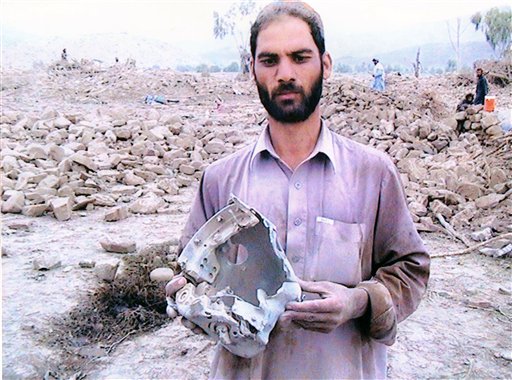
In this Aug. 23, 2010 photo provided by photographer Noor Behram, a man holds debris from a missile strike in North Waziristan, Pakistan. A gallery in London is staging an exhibit of photographs taken by a Pakistani photographer allegedly showing innocent civilians killed by U.S. drone missile strikes in Pakistan's tribal region along the Afghan border, the organizers said Monday. Noor Behram, a 39-year-old photographer who has worked with several international news agencies, has spent the last three years photographing the aftermath of drone strikes in North and South Waziristan, important sanctuaries for al-Qaida and Taliban militants in Pakistan. He said he has managed to reach around 60 attack sites, and the exhibit that opens Tuesday at the Beaconsfield gallery in London features photographs from 28 of those strikes. (AP Photo/Noor Behram,HO)(Credit: AP) Based on international and Pakistani news reports and research on the ground, the London-based Bureau of Investigative Journalism has issued a new study on civilians killed by American drones, concluding that at least 385 civilians have been killed in the past seven years, including at least 168 children.
Here’s a taste of the report, which can be read in full here (warning: graphic images):
Pakistani father Din Mohammad had the misfortune to live next door to militants in Danda Darpakhel, North Waziristan. His neighbours were reportedly part of the Haqqani Network, a group fighting US forces in nearby Afghanistan.
On September 8 2010, the CIA’s Reaper drones paid a visit. Hellfire missiles tore into the compound killing six alleged militants.
One of the Hellfires missed its target, and Din Mohammad’s house was hit. He survived. But his son, his two daughters and his nephew all died. His eldest boy had been a student at a Waziristan military cadet college. The other three children were all below school age.
An Obama administration official told ABC that these numbers are “way off the mark” — but, tellingly, did so on the condition of anonymity, meaning he or she will be protected from any accountability.
Meanwhile, the New York Times’ Scott Shane has an important article reviewing the same issue and in particular Obama counterterrorism adviser John Brennan’s claim in June that for the previous year CIA drone strikes hadn’t caused “a single collateral death because of the exceptional proficiency, precision of the capabilities we’ve been able to develop.” Shane finds that basically every outside observer — including those of all ideological stripes — finds this claim to be preposterous:
Others who question the C.I.A. claim include strong supporters of the drone program like Bill Roggio, editor of The Long War Journal, who closely tracks the strikes.
“The Taliban don’t go to a military base to build bombs or do training,” Mr. Roggio said. “There are families and neighbors around. I believe the people conducting the strikes work hard to reduce civilian casualties. They could be 20 percent. They could be 5 percent. But I think the C.I.A.’s claim of zero civilian casualties in a year is absurd.”
Brennan issued a new statement to the Times suggesting that the CIA has merely “not found credible evidence of collateral deaths” from the drone strikes:
“Fortunately, for more than a year, due to our discretion and precision, the U.S. government has not found credible evidence of collateral deaths resulting from U.S. counterterrorism operations outside of Afghanistan or Iraq, and we will continue to do our best to keep it that way,” Mr. Brennan said.
Given that the drones are operated remotely, it’s far from clear how the CIA even knows who is being killed in many of these strikes.
Justin Elliott is a reporter for ProPublica. You can follow him on Twitter @ElliottJustin More Justin Elliott.
NATO invites Pakistan to summit
A sign that Islamabad is ready to reopen its western border to NATO troops on their way to Afghanistan
Oil tankers, which were used to transport NATO fuel supplies to Afghanistan, are parked at a compound in Karachi, Pakistan, Tuesday, May 15, 2012. NATO on Tuesday invited Pakistani President Asif Ali Zardari to the alliance's summit in Chicago, after signs that the country could be moving to reopen its Afghan border to NATO military supplies. (AP Photo/Shakil Adil)(Credit: AP) ISLAMABAD (AP) — NATO on Tuesday invited Pakistan’s president to the upcoming Chicago summit on Afghanistan, the strongest sign yet that Islamabad is ready to reopen its western border to U.S. and NATO military supplies heading to the war in the neighboring country.
Pakistan blocked the routes in November after American airstrikes killed 24 of its troops on the Afghan border. The attack sent ties between Washington and Islamabad to new lows, threatening regional cooperation needed for negotiating an end to the Afghan war.
Continue Reading ClosePakistan’s War on Terror con
The U.S. "ally" continues to receive billions in aid despite protecting dangerous Islamist jihadis. Here's why
Hafiz Mohammad Saeed, right, chief of Jamaat-ud-Dawwa and founder of Lashkar-e-Taiba, addresses a news conference with anti-American cleric Sami ul Haq in Rawalpindi, Pakistan on Wednesday, April 4, 2012. (Credit: AP Photo/B.K. Bangash) The following ingredients should go a long way to produce a political thriller. Mr. M, a jihadist in an Asian state, has emerged as the mastermind of a terrorist attack in a neighboring country, which killed six Americans. After sifting through a vast cache of intelligence and obtaining a legal clearance, the State Department announces a $10 million bounty for information leading to his arrest and conviction. Mr. M promptly appears at a press conference and says, “I am here. America should give that reward money to me.”
Continue Reading CloseDilip Hiro is the author of Secrets and Lies: Operation "Iraqi Freedom" and, most recently, Blood of the Earth: The Battle for the World's Vanishing Oil Resources, both published by Nation Books. More Dilip Hiro.
Our immoral drone war
Media coverage of unmanned attacks -- and the resulting civilian deaths -- miss mounting anger within Pakistan
The site of a drone attack near Miranshah, Pakistan, in October 2008. (Credit: Reuters/Haji Mujtaba) One news story last month generated two distinct headlines: “AP investigation Finds Drones Kill Far Fewer Civilians Than Many Pakistanis Are Led to Believe” and “Fresh Evidence of CIA Civilian Deaths in Pakistan Revealed.”
Continue Reading CloseHypnotized into an endless dirty war
America has decided it has the right to kill whoever it wants, whenever it wants.
If in the year 2000 the U.S. president had told the American people that the government would soon begin using robot planes to track people, including U.S. citizens, all over the world, and would reserve to itself the right to kill them without trial, it is safe to say there would have been an enormous uproar. But that is exactly what is happening today, and nobody cares. The majority of Americans, including those who were opposed to the war in Iraq, have no problems with their government killing at will, so long as the killing is done in the name of “national security.”
Continue Reading CloseGary Kamiya is a Salon contributing writer. More Gary Kamiya.
America: The ally from hell
In Washington, the Pakistan-bashers are having a field day avoiding U.S. responsibility
Protesters hold up a burning mock drone aircraft during a rally against drone attacks in Pakistan. (Credit: Reuters/K. Pervez) If there is one thing Republican presidential candidates agree on, it’s the treachery of Pakistan. Rep. Michele Bachmann leads the pack. At last week’s GOP debate, she called Pakistan “violent” and “more than an existential threat” to the United States, because it is “a nation that lies, that does everything possible that you could imagine wrong.” Texas Gov. Rick Perry said Pakistan has “shown us time after time that they can’t be trusted.” He called for a cutoff of aid, a line that drew applause from the audience. Former Utah Gov. Jon Huntsman said on Sunday that America might have to “look for a new partner in the region” and also suggested a cutoff in aid might be in order.
It is not only GOP leaders who are obsessed with Pakistan. “The Ally From Hell,” screams the cover of this month’s Atlantic. New York’s Democratic Rep. Gary Ackerman called Pakistan “perfidious” recently, saying the country was not an ally, a friend, a partner or a teammate. “Pakistan is on its own side, period,” Ackerman said at a House Subcommittee Hearing on Afghanistan and Pakistan.
One would think from all this talk that America’s behavior vis-à-vis Pakistan has been pure and good. But the reality could not be further from the self-righteous claims persistently emanating from Washington’s complainers. America has acted no better than Pakistan in the relationship, and may even have been the worse partner. Understanding the fury over NATO’s recent killing of 24 Pakistani soldiers requires a deeper look at the relationship.
Let’s begin near the beginning. Within days of the 9/11 attacks, then-Deputy Secretary of State Richard Armitage was deputized to meet with a Pakistani official. According to Pakistan’s then-President Pervez Musharraf, Armitage said that Pakistan, if it did not cooperate unconditionally with the United States, needed to be prepared to be “bombed backed to the stone age.”
Armitage was only reinforcing Secretary of State Colin Powell’s message to Musharraf, which included a list of demands, among them full use of Pakistani airspace, closure of its borders with Afghanistan, and use of its territory as a staging base. In return, Pakistan was granted loads of cash — and the pleasant experience of not being bombed back to the stone age.
“If the signals America gave Pakistan had been subtle, they would have been ignored,” says Anthony Cordesman, who frequently advises the U.S. government on the South Asia/Middle East region. Maybe so, but the ultimatum delivered to Pakistan established unrealistic expectations on what could be delivered. No understanding was made of Pakistan’s own interests. No attempt was made to consider Pakistani public opinion. Pakistan was not treated as an ally. It was treated as a vassal.
Jordan Michael Smith writes about U.S. foreign policy for Salon. He has written for the New York Times, Boston Globe and Washington Post. More Jordan Michael Smith.
Page 1 of 45 in Pakistan