
Sex Education

The evolution of Dan Savage

Our favorite stuntman talks about his new Rick Santorum plot and why he won't believe Obama -- but supports him

  • more
    • All Share Services

Topics: ,

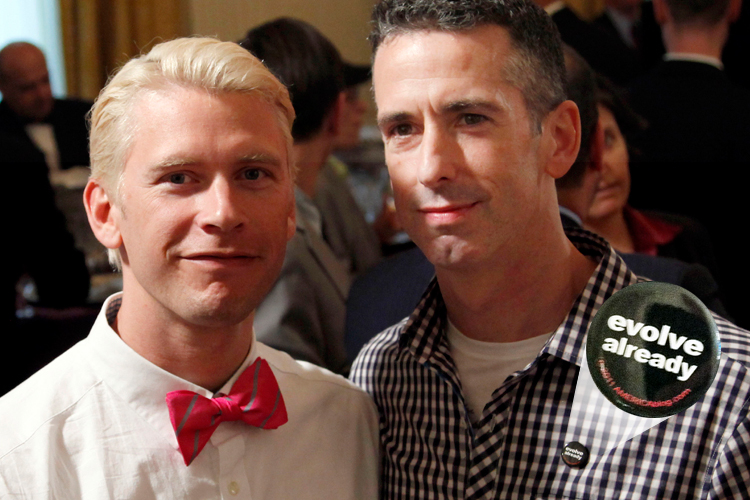
The evolution of Dan SavageDan Savage, right, and his husband, Terry Miller, wait for President Obama to speak at the LGBT Pride Month event at the White House in Washington in June.

The evolution of Dan Savage from sex columnist to political stunt artist has been an inspiring, and often really dirty, tale.

Early readers who discovered his Savage Love advice column (which he launched in 1991 for Seattle’s the Stranger and which went into heavy syndication in the nation’s free weeklies) were first jarred by how readers’ questions began — “Hey, Faggot,” Savage’s attempt to reclaim and defuse the word — then hooked by his remarkably candid style. In that just barely pre-Internet world, when sex was a subject left to breathy advice columnists in the glossies and late-night radio, Savage was like a breath of fresh air. Or maybe a quick whiff of poppers.

His was a blazing, rude voice bursting out in a ’90s culture still weirded out by reports of teens, gays and presidents actually having sex. Along the way, he dropped the “faggot” tag, created a wildly popular podcast, and coined irresistible expressions — from “GGG” (his advice that partners should be “good, giving and game”), to “pegging” and “diamondbacking” (go ahead, look them up) — that are as rudely hilarious as he is. He’s got a show slated for MTV, and he’s emerged as the leading voice not only on sex information but also sexual identity, and may well be the most effective gay rights spokesman around.

And the key is his showmanship. He and his husband, Terry Miller, drove the “It Gets Better” campaign  into the feel-good viral campaign of the YouTube era. But he’s also done well with his hilarious feel-bad campaigns, like his very successful neologism of the word “Santorum,” created in 2003 to shame then Sen. Rick Santorum for comparing homosexuality with bestiality and incest. “There’s no better way to memorialize the Santorum scandal than by attaching his name to a sex act that would make his big, white teeth fall out of his big, empty head,” Savage wrote readers, asking for submissions. A campaign was launched (just try searching the name), and this summer a frustrated Santorum, a GOP presidential candidate, finally was driven to denounce Savage by name on a radio show — a prankster’s purest victory. Savage also recently went after Marcus Bachmann, alleging — relying on nothing more than his trusty gaydar — that the “reparative therapist,” who sports a slight lisp, was probably gay (an idea picked up by “The Daily Show” and  criticized elsewhere).

It should be mentioned that Salon early on was home to a controversial Savage prank: In 2000, we sent him to Iowa to volunteer for the presidential campaign of Gary Bauer. In riveting gonzo style, a flu-addled Savage described being so infuriated by Bauer’s gay-baiting in the press that one night in Bauer HQ he began “licking doorknobs … the front door, office doors, even a bathroom door. When that was done, I started in on the staplers, phones and computer keyboards. Then I stood in the kitchen and licked the rims of all the clean coffee cups drying in the rack.” Conservatives and media mavens condemned both Savage and Salon. Iowa even went after Savage; he ultimately pleaded guilty to a misdemeanor charge of fraudulent voting in a caucus, and was sentenced to some probation and community service and given a small fine.

I spoke to Savage last week about politics, President Obama and the latest prank he may well have in store for Rick Santorum.

There’s still a lot to be concerned about. But do you get giddy with the progress you’re seeing?

[Laughs.] Yeah, I actually am! You know, we’re winning.

Anyone who wants evidence that we haven’t won yet just needs to look at the Republican field. You know, we live in a two-party system, and for one party, the only thing they can seem to agree on is hating gay people. They hate us like they hate evolution. Unfortunately, they just can’t wish us away, any more than they could wish evolution away. It’s not a done deal and it’s not sewn up. But they’re now fighting a rear-guard action, while we’re advancing on all fronts.

The heartening thing, even if we are cursed with a President Santorum, which is not going to happen, or President Perry or Bachmann, is what we’ve seen over the past 20 years, under Democrats, there’s been some progress. There’s been great progress since the Democrats got the wake-up call in November of last year, on gay issues, legislatively. But there’s not a lot of regress under Republicans. They seem to shrug and live with it, with gay progress, once it’s achieved.

And yet, increasingly, there seem to be many Republicans who no longer think of it as an issue, who are even willing to lead on it.

Really? Wait, wait, wait. So many? I thought it was three.

[Laughs] OK. Maybe a few more than that, at least in New York.

I think if there are so few that if you fucked them all at once it wasn’t an orgy, but a four-way, you can’t call that a lot.

But even a Michele Bachmann — who has genuinely shocking views about homosexuality — she has to completely muzzle herself on the campaign trail.

Yeah, I mean we’ve been seeing that for 18 years. I think back to Colin Powell, when “don’t ask, don’t tell” passed, before he gave testimony in the Senate in favor of it, had to clear his throat and say that gay and lesbian Americans were good and loyal and brave and true, just like other Americans. But not fit to serve. He had to pass a compliment before he stuck a knife in us.

You’re seeing this sort of — you can’t engage in the kind of vicious demagoguery when everybody loves Ellen. And, more important, 75 percent of Americans have a relative who’s out. So they’re having to — depending on which audience they’re playing to — really  moderate their anti-gay bigotry. You’re not talking about the gay boogey-monster anymore. You’re  talking about Neil Patrick Harris. And you’re talking about my gay nephew. And you’re talking about my lesbian co-worker — who aren’t these monsters. Which is why they’ve had to craft these photo-negative arguments, compared to their previous arguments, where they acknowledge that gay people are contributing members of society — which even Santorum does now — but that marriage needs to be reserved for [straight people].

And it’s hilarious! But I think their anti-gay hatred is just as toxic. They’re just trying to dress it up. What we’re seeing is the Southern strategy, and dog whistles on race, which we’ve been seeing since Nixon. We’re going to get  dog whistles about sexual orientation for 50 years.

One of the things I like about your podcast so much is you do spend a lot of time talking to people outside urban elite areas — you spent a lot of time last year talking about Constance McMillen, for example – where life for gays hasn’t evolved that quickly.

One of the things that was a wake-up call for me last year before the “It Gets Better” campaign — why we launched it, my husband and I — was when I was sort of unaware how bad it was getting out there. You know, in the Greensburg, Indianas, and the Topachakees, Californias, where Constance McMillen was. What I didn’t realize before those suicides opened my eyes, was that as it was getting better in New York or San Francisco or Seattle, it was getting worse out in the sticks, out in mega-church land. Because those of us who are out and urban and fully integrated into our work lives and families, our existence has made it impossible for queer 14-year-olds to fly under the radar in a Greensburg.

When I was a kid, and I was odd, the default assumption was that I was odd, not that I was gay. Now when a kid is odd in a Greensburg, gay or straight, the default assumption is gay. Because my job requires me to be in constant communication with people all over the country who are writing in to “Savage Love,” calling the podcast, I think I’m a little more conscious of what’s going on out there in the boonies — but even I didn’t see that. And that’s a bitter pill for those of us my age to swallow. Us out there leading our lives and being successful have actually kind of made it worse for 14-year-old gay kids in Greensburg, Ind.

Well, made it worse, but that’s part of progress, right?

Absolutely. I’m not suggesting that we shouldn’t have lived this way, or we shouldn’t have come out. And the people who are most responsible for making it worse are of course anti-gay politicians and anti-gay preachers, and parents, teachers and peers who are persecuting these kids. But we’ve created a kind of hyper-awareness about sexuality and sexual orientation that has let to hyper-scrutiny about those things, in places where people weren’t on the lookout for it before. Everybody’s on the lookout for it now.

It’s going to be hell on that kid from Greensburg before it gets better.

Yeah, absolutely. It’s going to be, unfortunately.

So, Obama. A lot of gay supporters of him obviously feel the same larger disenfranchisement with him that a lot of people on the left feel — maybe even more acutely, because he’s waffled on his language about gay marriage, now claiming that he’s “evolving” on the issue. How do you feel about him?

Well, I think my feelings began to evolve after the midterms in 2010. I think the Democrats saw the writing on the wall, with the percentage of the gay vote going to Republicans [doubling] to 30 percent; donations from gays — gay groups, gay orgs, gay people — to Democrats plummeting; that they realized they could no longer just fob us off with speeches and the occasional appearance with the Human Rights Campaign — that they had to deliver. It wasn’t until after that, that we got “don’t ask, don’t tell” [effectively ended], that they stopped the DOMA appeal. Anyone that argues that this was the plan all along, to pass the DADT repeal at the 11th hour in a lame duck session, a hail-mary pass thrown by Joe fucking Lieberman, is an apologist and an idiot. But we got those things because we began to push back and play hardball.

The gay vote isn’t just gays — my dad … well, my Dad will vote for jackasses … but my siblings won’t vote for anti-gay politicians — the gay vote is our families, our extended families. And the gay vote is bigger than the Jewish vote. It’s bigger than the Miami-Cuban vote. And Jews and Miami Cubans get everything they want. Tremendously powerful blocs. And it was after the November 2010 midterms that we suddenly, in the eyes of the Democrats, overnight morphed into Jewish Miami-Cuban cocksuckers who couldn’t be taken for granted anymore. And they had to give some winners.

So how do I feel about the Obama administration? I’m really very pleased with what’s been delivered. I am not an idiot, and I’m not a Pollyanna sort of kumbaya type. I don’t doubt we wouldn’t have seen these things, that these things would not have been delivered, if we didn’t make it clear there would be a price to pay if they weren’t. Obama “isn’t there yet” on same-sex marriage — if you believe him. And, frankly, I don’t. I don’t think somebody who was for same-sex marriage in ’96 is against it in 2011. And I agree with Tracy Baim, the editor of Windy City Times, who did the interviews with Obama back in the ’90s when he was running for state Senate in Illinois, that we’re not going to listen to what he says anymore, because it’s too aggravating. We’re going to watch what he does. And he’s doing the right stuff.

Not on every front, for LGBT — the gay guy whose partner is being deported. I’ve been screaming about this for two, three years. Janet Napolitano issued a directive saying we’re not going to enforce the Widow’s Penalty anymore, which is where somebody who is not a U.S. citizen — a foreign national marries a foreign citizen — emigrates to America and then their partner dies within a year — they’re supposed to be deported.

It’s a shocking policy.

I guess it’s to disincentivize murdering your new American husband, at least for 12 months. And they don’t enforce it, and it’s the law. She literally said at the time, we’re going to stop enforcement while Congress works on a solution. And we know how Congress smiles on immigrants.

So when’s that solution coming? The same argument, we could suspend enforcement of the deportation of legal spouses of same-sex couples, under the same logic — but we don’t. That’s a failure of the Obama administration. And, the administration says, we have to follow the law. Well, Janet doesn’t, apparently. She has more power and authority than the president, her boss, to address this injustice?

So there are things that are frustrating and galling, still. But DADT, dropping the DOMA appeal, all the little fixes around the edges that they’ve done. All that adds up to something that has to be rewarded. The LGBT movement, I think, doesn’t do itself any favors if we convince our ostensible allies in the Democratic Party that we’re never satisfied. We won’t be fully satisfied until we have full civil equality, but these developments are satisfying and there has to be a payback. It’s a political process.

You were invited to a White House reception, but you wore an “evolve already” button, jabbing Obama for his “evolving” comments. But you support his political pragmatism.

Right. Which means, I went to the president’s reception. I didn’t leap over the rope line to meet him. I’m going to write him a check. I’m going to wear an “evolve already” button, and participate in this kabuki nonsense around his position on gay marriage. What we know about evolution now is there are leaps in evolution. I believe the president will experience an evolutionary leap in January of 2013, win or lose the election. I think we’re going to see a lot of evolution then. And that’s, it’s insulting when somebody says your relationship, your marriage isn’t as important or valid, and your family doesn’t deserve the same protections as everybody else, for political reasons. But we’ve got to play the game. We have to win the argument. And we are — we are playing the game and winning the argument.

You see the polls on marriage equality moving in our favor. Unfortunately, you know, some people say therefore the president should come out in favor of marriage equality. Fifty-one, 52 percent of Americans aren’t for marriage equality in every state. And the overwhelming support for marriage equality in California and New York, and blue states, isn’t going to add up to a victory. I’ve actually written and think that if the president came out for marriage equality now, I don’t think Republicans who are for marriage equality are going to vote for him on that basis, but I do think Democrats who oppose it will vote against him, for that reason. So politically, I don’t think it’s unwise for the president to evolve at the pace he’s evolving right now. But I don’t believe him.

It does feel like there’s this inexorable pull toward gay marriage, ultimately, in every state. That the die is cast.

Remember when abortion was legal in all 50 states? And now, effectively, it’s disappeared from some states.

Everything can be turned back.

Yeah. It’s a little like skirmishes you see with gay marriage are going to play out nationally in really fascinating ways. You have states like Louisiana, that have refused to issue birth certificates for children who were legally adopted by same-sex couples. And they’re violating the law. And you’ve got to sue them at every step.

Were you surprised when Rick Santorum started invoking you? It’s so amazing.

Oh my god. I think, you know, it’s hilarious that all these years later, he’s having to jump down in the gutter with me. Republicans run on victimology. Sarah Palin is a victim, and now Bachmann is a victim, because Newsweek made her look crazy, because she’s never looked crazy in a photo before. And I’m persecuting Rick Santorum, and his own children can’t Google his name. I think it’s hilarious. There’s a reason they used to lock up editorial cartoonists in the 19th century. Because someone who is powerful, or lusts for power, you can really harm him by making him ridiculous. And my readers and I really succeed in making him ridiculous. And Rick Santorum himself ran that ball the last five yards into the touchdown zone when he sent out that [fundraising support] letter to all his supporters. So any of his supporters who had not yet heard about the neologism — and he didn’t spell out exactly what it was — anyone who read his letter who were curious what it might be all ran to their computers and Googled his name.

[Laughs.] And it fills me with delight! What’s funny is, people said: “Oh, ‘It Gets Better’ is anti-bullying, and here you are bullying Rick Santorum.”

Do people really say that?

Oh, abso-fucking-lutely. Oh my god.

That’s amazing.

There’s a difference between taking a piss out of a powerful politician and mocking him, and bullying a 14-year-old kid to death in a rural area. And, Rick Santorum, who wants to reinstate “don’t ask, don’t tell”; have a federal anti-gay marriage amendment; prevent me from going to my partner’s bedside in a medical emergency, which is what that boils down to, when you get down to actual marriage; impoverish my husband and child, should I die, because I’m the sole income in our family; destroy my family. He would prevent me from adopting, if he could, and take our kid out of our home, if he could. He would literally destroy my family. I made a dirty joke at his expense, and I’m the monster.

Now,  you’re issuing “a new definition of Rick,” if he doesn’t lay off gay people during this campaign.

[Laughs.] Well, that was just a joke. It looks like I might have to follow through on it now.

Ricks across the world, watch out.

I get all the credit for “The frothy mix of lube and fecal matter that is sometimes the byproduct of anal sex.” But it was actually a Savage Love reader that suggested that definition [of "Santorum"] and readers voted from a field of 10 and picked that one. And a reader actually sent in a great definition for “Rick,” that turns “Rick Santorum” into a sentence, that I might actually put in the column next week. So I won’t say exactly what the new definition of “Rick” is, but it’s coming.

OK, we’ll look for that. If you suddenly had a change of heart — or actually, if he did — and you wanted to stop the Santorum campaign,  do you think you really could at this point?

I don’t know. I offered, if Rick Santorum made a $10 million donation to Freedom to Marry, to pull down SpreadingSantorum.com, in the interest of civility, and penance for him. But I’m not sure that would do it.

Continue Reading Close
Kerry Lauerman

Kerry Lauerman is Salon's Editor in Chief. Follow him on Twitter: @kerrylauerman.

Mother-daughter sexperts

Susie Bright and her daughter, Aretha, make parental talks about sex look easy -- and fun

  • more
    • All Share Services

Topics: , , ,

Mother-daughter sexperts

Most parents loathe talking to their kids about the birds and the bees, let alone pubic hair grooming, faked orgasms and “water sports” — but most parents are not legendary “sexpert” Susie Bright.

Better than talking about these things, she penned an advice column in 2009 with her daughter, Aretha, then 19, for the ladyblog Jezebel. Their answers to questions about everything from porn to Paxil were unflinching but playful, and at times controversial. Now the pair have collected those columns into a new e-book, “Mother/Daughter Sex Advice.” Together, they read as an irreverent version of “Our Bodies, Ourselves” for the Internet age. The mother-daughter team also reflect on what the experience of writing the column was like, and it turns out it wasn’t as weird as many would think: For the most part, it was just a continuation of conversations they had been having throughout Aretha’s life.

I spoke with them both by phone about sex-positive parenting, where they draw the “TMI” line with each other, and their tips for making “the sex talk” less awkward.

Aretha, this might be an annoying question, because I’m sure you’ve gotten it for most of your life, but: What’s it like having a “sexpert” for a mom?

Aretha: I’ve been getting this question since second grade. Kids brought it up in the line at the cafeteria. I remember being way more defensive about it then, because just saying the word “sex,” it was like a four-letter word.

But now? It’s the same answer I always give, which is that it was pretty cool. I was the envy of all of my friends throughout puberty and high school. It’s interesting because now that I’m college-aged, I can see differences in how kids were brought up and, you know, I can see how my upbringing has affected me.

Did you have friends in high school who desperately wanted to come over and ask your mom for advice?

Aretha: I started community college when I was 13, so I had college friends who were in their 20s and late teens, and they felt really comfortable talking to my mom. Sometimes I got really jealous because they’d want to have alone time with her to talk about their relationship problems. With my high school friends, they felt too shy and inhibited. It was more that they’d come to me with a crisis and then I’d bring it to my mom.

Were you ever uncomfortable talking to your mom about sex when you were younger?

Aretha: No. Never. From age zero to now, I don’t think it’s ever been uncomfortable.

Susie: There’s an important distinction between “Do you feel comfortable talking about your personal sex life with your parents?” and “Do you feel comfortable talking about other people’s sex lives and sex in general, sex in the news and ‘what if’ sex, where you say, ‘I have a friend …’” All of that we’re very comfortable with. I think anybody would be shy when you feel like you need a little distance between you and your parents.

Sometimes I talk to kids and they tell me, “I have the opposite problem. My parents confide to me as if I was their little friend.” For me, that isn’t a healthy, sex-positive parental frame any more than being uptight and refusing to let a single word be said about it. Somehow, it’s the opposite but the same thing. A good parent says, “You can talk to me about anything and it can be in general terms. If you’ve got a physical problem and you’re uncomfortable talking, can I help get you to a clinic or a doctor that you would feel comfortable talking to?” Don’t get all hurt that they don’t want to tell you, just help them find someone that they can talk to instead of getting all sulky about it and saying, “You have to tell me everything or else I won’t help you!”

Aretha: I think we’ve always been sensitive about talking about each other’s sex lives. Except for when it comes to things that happened earlier in her life. I remember being really curious about how my mom lost her virginity. I could hear that story a million times.

Susie: There’s so many different levels of what it’s like to have conversations about sex, and because so many families don’t discuss it at all, they think that once you open the door it’s somehow like there’s no privacy, there’s no boundaries, there’s no self-respecting way to talk about anything. But I knew that wasn’t the case, even from my own growing up. My mom told me about getting her period, which I thought was fascinating, because she told me about the nuns stuffing a rag down her pants and they wouldn’t tell her what was happening. Her moral was, “I’m telling you this because you’ll never have to go through that, because I’m going to tell you the scientific reason for menstruating.”

My dad was the same. He would say, “I was so shy, I never kissed anyone until I kissed your mom, and I was in college,” but there were other things he wouldn’t have expressed to me — and of course not. It just starts to feel creepy, and I guess not everyone’s creep line is in the same place.

It’s just knowing that you can hold your privacy and yet you can share things that are part of a valuable conversation. Part of what I liked so much about writing the Jezebel column, and writing this book, was that I could hear Aretha’s reactions to things and it made me realize how strongly she felt about certain topics. I wasn’t going to just say to her, “So, Aretha, what do you feel about oral sex personally?” No way, I would have been too embarrassed and she would have been like, “Are you out of your mind?” When I heard her sticking up for other girls getting satisfied in bed and not just lying there and crying afterward …

Aretha: Why would I want them to do that? That makes no sense!

Susie: Well, you say that, but I know plenty of women who would say, “What do you expect, you shouldn’t be so romantic or you should try harder.” There are some really negative, shaming answers. The fact that you were such a good advocate, it just made me so happy inside. It wasn’t like I had dragged you over to a desk every day and said, “Now, Aretha, how do you spell ‘orgasm’?”

Susie, what sort of parental anxieties did you have about sex?

Susie: Well, I still have them in the sense — this is more dating and relationships — when she meets someone new, I wonder if I’ll like her boyfriend. If I don’t think they did something right or they hurt her feelings, there’s part of me that wants to run over and slap them — even though I’m supposed to just listen and be cool because they’re probably going to make up in 10 minutes and then I’ll look ridiculous.

Aretha: From my side, I see my mom worrying, like, “I want Aretha to feel like she can ask for what she wants with anyone, because not everyone’s had the same upbringing she’s had, so they might not know that everything’s supposed to be egalitarian.”

Susie: Yeah, but you haven’t had any really terrible sweethearts. You’ve had pretty open-minded people in your life so far.

Aretha: Well, there might be ones that maybe you don’t know about …

Susie: OK, now it all comes out! [Laughs] When you first asked that question, Tracy, I wondered what you meant, if it was, “Were you worried that Aretha would get pregnant too young?”

Well, here’s another question: What do you think most parents are afraid of when it comes to sex and their kids — is it the fear of them getting pregnant, of them having sex too soon?

Susie: I think the fear of having sex too soon is this big, tender topic that covers a lot of things. On the surface, they would say, “An early pregnancy or some sort of STD could be tragic and wipe my kid’s life out.” But if you scratch at that a little bit, lots of times it’s because the parent identifies with the kids and is having memories about regrets, about things they did or didn’t do when they were teenagers. So their child’s coming of age is like their chance of doing it over again.

As much as it’s true that I could just jump in there and completely micromanage every detail for Aretha, it is so important not to do that, to be a good listener and let them know that you hear them, to respond if they want your help but to mostly just be really solid and say, “I’m there for you.” You have to take every lesson you ever learned from a good therapist and bring it to bear and give them the space to figure it out on their own — not to be neglectful but not to be a busybody either. It’s such a hard line to walk, I’m not trying to make it sound easy.

Why is it so hard for most parents and kids to talk about sex with each other? We make such a big deal about the Sex Talk, as though it’s one talk that happens, ever, between parents and their kids. Why is that?

Aretha: Where to even start?

Susie: There’s so many fingers you want to point. For me, it had a lot to do with being raised in a religion that was very condemning of sexuality outside of procreation and women’s subjugation.

That sure covers a lot territory. So how can you make talking about sex with your kids, or with your parents, less awkward?

Susie: I got some of my first lessons of how to handle this when I worked in a vibrator store and someone would say, “How do I raise this with my husband?” or “How do I raise this with my wife?” I got really good at answering this: First of all, if talking is the part that freaks you out, buy a book and leave it in the bathroom or on the coffee table.

Aretha: I think you have to be careful with that, though! So many people complain, “My parents left a book under my bed about our changing bodies and they never said word one, they just expected me to find the book and come to them with questions later.” And guess what, they never came to them with any questions because they figured, “My parents are too shy to talk to me about it so I shouldn’t talk to them.” Not to, like, totally slam your suggestion, mom.

Susie: But they did something! People are always asking me, “Are there any particular books I should have in my house for sex education?” and I say, “You know what? If you have books at all, that’s great.” Books! Newspapers! Talk about what you’re reading on the Web! Sex will inevitably come up if you’re talking about it like you’d talk about anything else — in politics, in science, in arts. It’s not a ghettoized topic.

Here’s another thing: I call it “the cool aunt theory.” You realize that you, the parent, are too upset and uptight about sex to say anything, but your sister or friend or ex or someone you know very well has a sense of humor and has a good head on their shoulders and you go to them and ask, “Could you do this?” Or here’s another thing, when your kid raises an uncomfortable question, to just say, “You know, that is a really good question and I’m not sure I know the answer.” You’ve given yourself some time, but you’ve been friendly about it and then you can decide if you bring in somebody in the family or you get a book or find a documentary on PBS. The point is you don’t just freeze like a deer in the headlights and go, “Ahh!”

You can use that for a million things. People act like this is the only difficult topic — try talking about death in the family or money issues. There are so many things where people feel tense and if you can find some calming, loving ways to handle touchy questions in one area, you can pretty much apply it to everything.

Aretha: And definitely you can never start too early. Kids are talking about sex in one way or another starting in kindergarten.

Generationally, how were your youthful sexual experiences different?

Aretha: My mom was in high school in the ’70s — you know, a lot of free love everywhere. Seriously, when I was in high school and I liked two boys at the same time, my mom would suggest that we have an open relationship, like it was the most normal thing in the world! And she was like, “Why are you so possessive of each other? You’re so young, you don’t know who you are yet, so just experiment! They can’t even say they’re straight yet.” I just remember feeling like, “She does not understand. It is so different now.”

There’s also way, way more virgins and people who are waiting to have any sexual experiences. In some ways, I think kids know more, but they also know less, practically speaking.

Susie: I knew I was being kind of snotty when I was saying, “Why not have an open relationship?” but I just had to make my little feminist point.

Aretha: Well, you said it a lot.

Susie: I have a lot of feminist points to make, I guess. You know, all these people that are trying to live out the romance bible are going to grow up and realize that life is more complicated, and why not be exposed to reality? People either are having open relationships or they’re cheating, and here are these people in ninth grade acting like they’ve got to take their vows and it’s just so silly!

I not only came of age in the ’70s, I was also in a major urban high school and I was in a feminist consciousness-raising group, I was involved in an underground commie anarchist newspaper. So it’s like, yes, I was in an extremely different scene, but the tenderness, the inexperience, the shyness and all the drama that happened every day, that was the same.

Did you notice any themes in the questions that you got for the column?

Aretha: Um, that they have horrible boyfriends and that they should dump them?

Susie: The funniest line was people would always say, “Our sex life is awesome, but …” and then they would tell me this problem that would negate it being “awesome.” This is from my crabby old feminist dyke warrior lady position, but I was constantly saying, “Why would you give a fuck what he thinks?” Or I’d think, “What you need is a nice, big lesbian experience.” I would think that the lesbian cure, if you were in a lesbian milieu, you wouldn’t be so second-guessing yourself and your femaleness all the time, but I realized that’s a generation gap too. I get some questions from young lesbians and some of them are just as fragile as any straight girl. I realized it’s more my feminist point of view rather than gay or straight.

What was your favorite question that you got for the column?

Aretha: This wasn’t my favorite question, it was what happened afterward: Someone sent us a picture of her hand and an engagement ring on it and I was like, “Yes! It worked out!” I liked the throw-up column, the girl who throws up every time her boyfriend comes in her mouth. I liked the boyfriend who asked how he could ask his girlfriend to shave her pubic hair, politely.

Susie: Aretha’s answer to that is, “There is no polite way!”

Aretha: I stand by that.

Susie: My favorite was we answered a question from a girl who was given a Paxil prescription after a five-minute intake and it had a terrible impact on her libido. We wrote her a super-sympathetic, supportive thing that basically said, “Go see someone who will pay attention to you.” We thought it was a great answer, but it got a lot of pushback from people who are using and approve of the SSRI’s in their life. The Paxil cheerleaders were enraged!

But the girl who wrote the question really, really liked our answer and felt encouraged. It felt good, it makes you feel great when you’re a total stranger and you’re able to make a positive difference in someone’s life or their health. That’s what I like about my job in general, and it was even more poignant to do it with Aretha. It was like suddenly having a million daughters instead of just one.

Continue Reading Close
Tracy Clark-Flory

Tracy Clark-Flory is a staff writer at Salon. Follow @tracyclarkflory on Twitter.

Why Obama’s in bed with abstinence-only education

Behind the administration's decision to fund a controversial sex education program

  • more
    • All Share Services

Topics: ,

Why Obama's in bed with abstinence-only education (Credit: woaiss via Shutterstock)

In the week since sex educators and activists called out the Obama administration for getting in bed with Heritage Keepers Abstinence Education, the Department of Health and Human Services has stayed silent on why the program had been added to a list of approved, “evidence based” programs for teen pregnancy and STI prevention – until now. In an interview with Salon, HHS spokesman Mark Weber said Heritage Keepers had met the criteria, “gone through a transparent, rigorous review process” and had “demonstrated outcomes” – in this case, delaying sexual activity, and that alone.

The controversy arose when, sometime in April, Heritage Keepers Abstinence Education was quietly added to an Office of Adolescent Health list of approved groups eligible for government funds — “the holy grail of the Administration’s commitment to a science-based approach to teen pregnancy prevention and a directive for grantees of the President’s Teen Pregnancy Prevention Initiative,” wrote four prominent sexual health experts in RH Reality Check. They accused HHS of “succumb[ing] to the political pressure of social conservatives and allowed the ideology of the right to prevail over the health and well-being of the nation’s youth.”

On April 30, over a dozen major organizations, including the ACLU and Human Rights Campaign, asked Secretary of Health and Human Services Kathleen Sebelius to explain Heritage Keepers’ inclusion. They said the program “ostracizes lesbian, gay, bisexual, and transgender (LGBT) youth; promotes heterosexual marriage as the only acceptable family structure; withholds life-saving information from sexually active youth; and uses fear-based messages to shame youth who have been sexually active and youth living in ‘nontraditional’ households.”

Like most abstinence-only programs, contraception and condoms aren’t on the agenda, nor is detailed information about sexually transmitted diseases or safe sexual behavior. Sample language from the student manual: “girls have a responsibility to wear modest clothing that doesn’t invite lustful thoughts.” Both aspects are awkward at a moment in which the president’s reelection campaign is struggling to have it both ways on gay marriage, as well as to paint itself as a champion of reproductive health.

The RH Reality Check piece also says that there is “limited evidence of effectiveness” of the Heritage Keepers program. But Christopher Trenholm, associate director of research at Mathematica Policy Research, which conducted the independent research evaluation for HHS, and whose previous work is cited as proof that the Heritage Keepers program doesn’t work, told Salon there are actually two different programs in question. The one in the 2007 Mathematica study that was found to have little impact on sexual abstinence, a complementary after-school program called Life Skills Education Component, differs from the health class curriculum that ended up on the HHS list.

This time around, Trenholm’s task was to grade the outside research that purported to back up the organization’s claims. HHS decided that every organization that got a moderate or high rating on doing what it said it did would end up on the approved list. Mathematica took a look at a 2011 study of Heritage Keepers Abstinence Education as taught to 2,215 7th- through 9th-grade students, which found that a year after participating in the program, “sexual experience” increased from 29 to 33 percent of students, compared to 43 percent of students in the control group. The study quality was deemed “moderate,” allowing Heritage Keepers to tout its HHS seal of approval on its website.

In other words, Heritage Keepers simply followed the rules of the “evidence based” system – and prevailed. The problem for supporters of inclusive and comprehensive sex education is that the HHS criteria say that studies “must measure program impact on at least one measure of sexual risk behavior or its health consequences.” That measure can be contraceptive use or fewer sexually transmitted infections, or it can be simply delaying sexual activity, as Heritage Keepers was found to do – but it doesn’t have to do both or all. And as written, it certainly does not mean that the program can’t marginalize LGBT students or shame students about their sexual behavior.

I asked Weber, the HHS spokesman, what would have to change for such groups to be left out of the program. Would the criteria simply have to be revised? “What we’re committed to is an open and transparent scientific process,” he repeated. That process appears to have been followed here – but it shows the limits of a narrowly technocratic approach.

Update. Critics respond to the HHS rationale: “HHS is being frighteningly shortsighted,” said Dr. Elizabeth Schroeder, executive director for Answer, a national sexuality education organization based at Rutgers University. “Heritage Keepers relies on fear, shame, distorted information and biases. Why are we supporting any program that discriminates against groups of students and endangers their health? How can the HHS justify putting its seal of approval on a sexist, homophobic curriculum?”


Continue Reading Close
Irin Carmon

Irin Carmon is a staff writer for Salon. Follow her on Twitter at @irincarmon or email her at icarmon@salon.com.

Right-wing sexual pathos

Attempts to ban talk of birth control and homosexuality from classrooms reveal conservatives' deepest sexual fears

  • more
    • All Share Services

Topics: , ,

Right-wing sexual pathos (Credit: Everett Collection via Shutterstock)

Imagine a high school teacher having to separate a smooching pair outside the classroom door to protect herself from being sued for condoning “gateway sexual activity.” Envision a sex education class where the mention of homosexuality is forbidden by law and discussion of contraception, or even puberty, is deemed unnecessary.

That’s the world that would be created by a recent raft of abstinence education bills in Tennessee, Utah and Wisconsin. These initiatives are frightening — but, viewed the right way, they shine light on extreme conservatives’ deepest, darkest fears about sex. They’re veritable inkblot tests for right-wing sexual pathos.

This week saw the passage of a Tennessee bill that has the usual aim of abstinence initiatives — to “exclusively and emphatically” promote abstinence until marriage. But the bill ultimately goes above and beyond the usual. It allows parents to seek damages in court if a teacher “promotes gateway sexual activity” to their child. It’s unclear what exactly “gateway sexual activity” is because the measure defines it vaguely as “sexual contact encouraging an individual to engage in a non-abstinent behavior.” Critics of the bill have suggested that this could include everything from hand holding to french kissing. The bill also proscribes “implicitly” promoting or “condoning” gateway sexual activity (the latter could mean simply turning a blind eye to it, hence the example above).

The potential legal implications here are what’s most important, but understanding the philosophy behind this view of “gateway” sexual activity is crucial, too. The thinking here is transparent: Premarital or extramarital sex, even physical affection, is like a drug — all-consuming, addictive and life-destroying. Sen. Margaret Dayton, a co-sponsor of the bill, actually said, as the Salt Lake Tribune paraphrased, “Teaching children about contraception is comparable to telling kids not to do drugs, then showing them how to ‘mainline’ heroin.” Here we have that fundamental fear of sex, of the power it holds over us, and of the possibility of losing ourselves (or our kids) to it.

Shortly before the “gateway” bill, Tennessee lawmakers advanced Senate Bill 49, dubbed the “Don’t Say Gay Bill,” which stipulated that “no public elementary or middle school shall provide any instruction or material that discusses sexual orientation other than heterosexuality.” The measure managed to get Senate approval but, after intense public and legislative outcry, it was yanked by one of its sponsors before it faced a final vote in the House. An abstinence bill in Utah, which breezed through the state legislature but was ultimately vetoed last month by the governor, similarly banned any discussion of the gays. Wisconsin’s abstinence bill doesn’t prohibit the mention of homosexuality, but it does overwrite a current law requiring that teachers “use instructional methods and materials that do not promote bias against pupils of any race, gender, religion, sexual orientation, or ethnic or cultural background.”

Here we have that classic conservative view of homosexuality as a corruptive idea rather than an inherent identity; as a social virus — one that can be inoculated against through silence (or, as some of us might prefer to call it, censorship) — rather than an inborn reality. (What always strikes me about this attitude is that it seems implicitly to hold that gay sex is so awesome that just hearing about it will make folks want to try it; otherwise, it wouldn’t pose such a threat, now, would it?) It also gets at that right-wing sore spot: The possibility of sex for love or pleasure, rather than procreation.

Of course, homosexuality is far from the only thing that treads in this forbidden territory. The Utah bill forbids any “human sexuality instruction” from covering contraception, premarital sex or “the intricacies of intercourse, sexual stimulation, or erotic behavior.” (The ultimate effect of the extreme restrictions is a ban on human sexuality classes. Either teach anti-gay, anti-contraception, abstinence-only “human sexuality,” or teach nothing at all.) Contraception helps reduce the negative consequences for engaging in pleasure- or love-based premarital sex — and abstinence-only advocates desperately want to keep the sexual stakes high. (For the same reason we see attempts to restrict access to contraception and HPV vaccines.)

Speaking of negative consequences, the Utah and Wisconsin bills share a focus on STIs and unwanted pregnancy as the inevitable result of premarital sex. The Utah measure requires that human sexuality classes underscore “the importance of abstinence from all sexual activity before marriage and fidelity after marriage as the only sure methods for preventing certain communicable diseases.” The Wisconsin initiative mandates that human sexuality classes “promote abstinence and marriage over contraception” and “emphasize that abstinence is the only reliable way to prevent pregnancy and avoid sexually transmitted infections” (which is patently false).

Even the acknowledgement of hormonal changes and natural urges is dangerous. Earlier this month, Wisconsin Gov. Scott Walker signed into law a bill that removed not only contraceptives but also puberty — puberty! — from the list of required topics in sex-ed classes. The concept of puberty itself makes natural what abstinence-only advocates desperately want to seem unnatural.

More relatable is the concern guiding the push for greater parental power in some of these bills. The Utah measure requires that guardians make up the majority of review committees for human sexuality curricula and that they be allowed to participate in the development of abstinence-only classes. This year, Arizona introduced a bill that requires schools to obtain written permission from parents in order to teach any form of sex ed and secures parents’ rights to opt out on behalf of their kids. Adults are desperate enough to control sex in their own lives — from the content of their, or their spouse’s, fantasies to the threat of infidelity. And, of course, there’s that universal desire to protect our kids from the dangers of the world (and you don’t have to be a right-winger to believe that sex can be dangerous).

Together, these recent bills make clear several fundamental fears — of the power of sex, of losing control of our kids and of the allure of non-procreative sex without consequences. Aside from their magnitude, those worries aren’t a uniquely right-wing phenomena. What is uniquely right-wing is taking such extreme attempts to legislate against those fears.

Continue Reading Close
Tracy Clark-Flory

Tracy Clark-Flory is a staff writer at Salon. Follow @tracyclarkflory on Twitter.

Ab-ed moves ahead

A sexist, anti-gay abstinence-only program quietly gets the Obama administration's stamp of approval. Why?

  • more
    • All Share Services

Topics: ,

Ab-ed moves ahead (Credit: iStockphoto/Spauln)

Just yesterday I wrote of how the war on sex has gotten worse in recent years and, what do you know, now comes news that an abstinence-only program has been added to the government’s list of gold-starred, “evidence-based” programs for pregnancy prevention.

The Department of Health and Human Services didn’t bother to issue a press release about the problematic addition, but a handful of tireless sexual health advocates — Debra Hauser, Monica Rodriguez, Elizabeth Schroeder and Danene Sorace — noticed the change on the department’s website and today took to RH Reality Check to spread the word. Previously, the only approved abstinence programs on the list were after-school programs.

The program, Heritage Keepers Abstinence Education, “contains little or no information about puberty, anatomy, sexually transmitted diseases, or sexual behavior,” they write, nor does it “include information about the health benefits of contraception or condoms.” Worse still, it relies on inaccurate, fear-based classroom exercises, promotes heterosexual marriage as the only happy and healthy life path, harps on the potential harm of premarital relationships, promotes hoary gender roles and stereotypes and entirely ignores the existence of LGBT people.

Oh, also? The evidence of the program’s effectiveness is highly questionable. A report ordered by Congress concluded that Heritage Keepers “had little or no impact on sexual abstinence or activity.”

Several years ago, the Sexuality Information & Education Council of the U.S. (SIECUS), where two of the RH Reality authors are employed, conducted an in-depth review of the Heritage Keepers’ curriculum and found it “relies on messages of fear and shame” and that even topics “frequently discussed in detail in other abstinence-only-until-marriage programs, such as condoms and STDs, receive very little mention.” The review offers up many disturbing examples of the fear-based messaging, most memorable of which is the following exercise:

Each student rolls a six-side die; the number that comes up corresponds to a particular consequence. Students who roll a one have contracted HIV, a two contracted herpes, a three HPV, a four untimely pregnancy, a five infertility, and a six emotional pain.

I believe that’s what you call a loaded die. All of the potential outcomes are crap; there is no chance in this “educational” exercise for emotional intimacy or pleasure. The game is designed to end with a simplistic takeaway: “Having sex outside of marriage is gambling with your future.”

It isn’t the only instance where the program presents marriage as an infallible guard against all potential negative consequences of sex. Consider this excerpt from the program’s student manual: “Sex is like fire. Inside the appropriate boundary of marriage, sex is a great thing! Outside of marriage, sex can be dangerous.” Right, because it’s never dangerous within marriage. A signed piece of paper from the justice of the peace magically eliminates risk of STIs, sexual violence, infidelity — you name it!

Seriously, though, I’m not being hyperbolic — the program actually presents marriage as a rape prevention tool. The program claims, “According to the data, 9 percent of married women are forced by their spouse to perform sexual acts, however 46 percent of women report that someone they were … ‘in love with’ forced them to have sex against their will, and 22 percent of women report being forced to do so by someone they ‘knew well.’”

First, as SIECUS beautifully points out, those figures come from a survey of women who had been forced to perform a sexual act — not of women in general. In other words, the correct factoid is that, at least within a small sample of women who had experienced sexual assault, 9 percent were assaulted by their marriage partner. Second, “even if married women as a whole face fewer incidences of sexual assault, for women in abusive relationships, marriage provides no protection,” says the SIECUS report. (Also, correlation ain’t causation.)

According to the Heritage Foundation, in addition to putting you at risk for being raped, premarital relationships may destroy your ability to bond. (I’m having Eric Keroack flashbacks! What is this, 2006?) “[It] may be that when people bond closely through sexual activity, then break up and bond with someone else, and then someone else, it may become increasingly difficult to maintain a lasting bond.” It may be that it may be? That’s considered evidence-based education?

It’s no surprise that the program calls on students to abstain from sex until marriage – not to think about whether that’s a choice that they want to make, just to do it, teacher’s orders: “Now is the time for you to make the commitment for the very best for yourself, to wait for the commitment of marriage to have sex.” The teacher is instructed to then hand out “commitment cards.”

None of that is to mention the sexual double standard in the curriculum. It invokes the ol’ saw about males being visual creatures and explains, “This is why girls need to be careful with what they wear, because males are looking! The girl might be thinking fashion, while the boy is thinking sex. For this reason, girls have a responsibility to wear modest clothing that doesn’t invite lustful thoughts.” The familiar message is that girls are the sexual gatekeepers (there’s also an undercurrent of “don’t ask for it”).

It follows, of course, that the curriculum would ignore same-sex partnerships: It “operates under the assumption that all students in the class, or all people in the world for that matter, are heterosexual,” says the SIECUS review. “All references to sexual activity, arousal, and relationships are specific to male-female couples.” As the RH Reality piece argues, “The stigmatization of LGBT youth throughout the program reinforces the cultural invisibility and bias these students already face in many schools and communities. The curriculum’s focus on marriage as the only appropriate context for sexual behavior further ostracizes LGBT youth and the children of LGBT parents who still cannot legally marry in most states.”

No wonder HHS didn’t issue a press release. It’s hard to put a positive spin on the Obama administration giving its stamp of approval to a sexist, anti-gay, fear-based education program.

Continue Reading Close
Tracy Clark-Flory

Tracy Clark-Flory is a staff writer at Salon. Follow @tracyclarkflory on Twitter.

Abstinence isn’t working

Teen births are down, thanks to contraception use. Why does the right ignore the facts and insist it's abstinence?

  • more
    • All Share Services

Topics: , , ,

Abstinence isn't working (Credit: iStockphoto/tkachuk)

Earlier this week, when the CDC announced a record low in the teen birth rate, it listed two possible causes: “The impact of strong pregnancy prevention messages” and “increased use of contraception.” The Guttmacher Institute came out with an even stronger message: “The most recent decline in teen births can be linked almost exclusively to improvements in teens’ contraceptive use,” the organization said in a press release, which pointed to another CDC study for evidence.

But that hasn’t stopped conservatives from claiming that the drop is a result of, you guessed it, abstinence education and, paradoxically, an increase in abortions.

Janice Crouse of Concerned Women for America expressed her outrage over the CDC analysis: “They don’t even mention the fact there’s been a tremendous increase in effectiveness and pervasiveness of abstinence education. They don’t mention the fact that teen sexual activity, by their own admission, is down.” As Think Progress noted this week, teen birth rates are actually highest in states with abstinence-only policies. Not only has it been widely documented that such programs are largely ineffective, it’s also been shown that such programs may prevent contraception use.

Now, it’s true that teens — specifically 15- and 16-year-olds — are delaying sexual activity, but the change in contraceptive use over the years has been much more profound, and there has been no significant change in sexual activity among 18- and 19-year-olds. What’s more, there was no change in sexual activity among teens, period, from 2008 on, says Laura Lindberg, senior research associate at Guttmacher, so the recent decline in teens births certainly can’t be attributed to abstinence. Also, it should be noted that abstinence can be the result of any number of social influences, not necessarily abstinence-only education. (Consider research showing that teens who receive sex education are much more likely to delay sex.)

Bill Albert, chief program officer at the National Campaign to Prevent Teen and Unplanned Pregnancy, told me that arguments like Crouse’s have a problem of “simple chronology.” The teen birth rate peaked in 1991, “some years before the federal investment in abstinence education,” he said. “So it’s clearly not responsible for declines that began in 1991.” In fact, he says, “The teen birth rate increased during the height of the federal investment in abstinence education. Those who would credit abstinence [for the decline] should also take the blame for the increases.” Albert added, “Researchers who have looked at it closely over the past several years tend to believe it is contraception that is making the difference. If the abstinence education programs are helping teens to use contraception more consistently, then we should thank them, but I don’t think that’s what they’re doing.”

Crouse isn’t the only conservative twisting the latest CDC news to fit an anti-choice agenda: In a piece titled “Credit Abstinence With Helping Reduce Teen Birth Rates,” on the anti-choice site LifeNews.com, Kristan Hawkins writes, “While the birth rate has fallen, it must be made clear that the CDC is looking at the birth rate and not the pregnancy rate in teens,” and then claims that the teen abortion rate has increased, without citing any evidence. She must have missed this headline from February: “Teen Pregnancy, Abortion Rates at Record Low” — that’s according to research from Guttmacher. In 2008, the most recent year for which data is available, the teen abortion rate was down 59 percent from its peak in 1988.

Hawkins’ next target? Why, contraception, of course. “It cannot be stated enough that 50% of women who are using some form of contraception find themselves unexpectedly pregnant.” Again, she offers no citation, but being a contraception user (i.e., you have used a condom recently) is different from using it correctly every time. According to Guttmacher, 54 percent of women who have had abortions became pregnant during a month when they used contraception — but a minority of those women used the method correctly. She adds that “contraception is not an effective means of preventing pregnancy 100% of the time” — right, just 99.9 percent of the time, in the case of oral contraceptives, when used correctly. (Abstinence, when it’s followed 100 percent of the time, really has that compelling 0.1 percent advantage.)

If anything, such data should recommend a need for better sex education and access to long-term methods of birth control.

My favorite part of her rant, though, is where she equates Plan B with abortion. This anti-science party trick just does not get old! “Most importantly, we cannot the [sic] measure the usage of abortion-causing emergency contraception (Plan B) and the role it is now playing in decreasing teen birth rates.” For the millionth time: Plan B is an emergency contraception. It prevents ovulation and fertilization, just as with all hormonal contraceptives. It does not cause abortion if the egg has already implanted, which is the medical definition of pregnancy, according to both the National Institutes of Health and the American College of Obstetricians and Gynecologists. In short: The increase she cites in Plan B use is actually yet more evidence for the argument that greater contraception use caused the decline in teen births.

This isn’t the first time this has happened, either: It happens every time the CDC releases a new report finding a continuing drop in teen pregnancy. What these reactions make clear is that no evidence — whether it’s on the benefits of making contraception widely accessible or the positive impact of comprehensive sex ed — will stop the war on sex. Where there is a scientific study providing such proof, there will be a right-winger willing to gesture vaguely in the direction of mythical evidence to the contrary. “In a way, I’m so tired of this debate,” says Albert. “Why don’t both sides declare victory and go home? If we say, ‘OK, you win,’ can we stop?”

Continue Reading Close
Tracy Clark-Flory

Tracy Clark-Flory is a staff writer at Salon. Follow @tracyclarkflory on Twitter.

Page 1 of 19 in Sex Education