
Natural Disasters

Jokes abound online after quake

Earthquake causes little damage, lots of Internet humor

  • more
    • All Share Services

Topics:

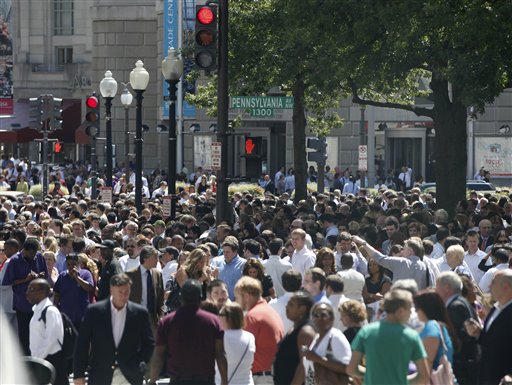
Jokes abound online after quakePeople crowd Pennsylvania Avenue in Washington, Tuesday, Aug. 23, 2011, as they evacuate buildings after an earthquake his the in Washington area. The 5.9 magnitude earthquake centered northwest of Richmond, Va., shook much of Washington, D.C., and was felt as far north as Rhode Island and New York City. (AP Photo/Charles Dharapak)(Credit: AP)

This afternoon’s earthquake had barely stopped before the online jokes started.

Since the geological incident — which occurred in Virginia, but was felt up and down the East Coast — Twitterers (and other merry Internet pranksters) have invoked everyone from God to Ryan Gosling in their efforts to mock sensationalist responses and calm frazzled nerves.

Continue Reading Close

Emma Mustich is a Salon contributor. Follow her on Twitter: @emustich.

House Republicans still fighting disaster relief funding

Updated: The war against FEMA funding could end in a government shutdown

  • more
    • All Share Services

Topics: , , ,

House Republicans still fighting disaster relief fundingHarry Reid and John Boehner

[UPDATED BELOW] There have been a lot of natural disasters lately, all over the country, and FEMA is basically out of money. Congress is going to appropriate more money for FEMA, probably, but Democrats want to give FEMA a few extra billion dollars than Republicans do, and Republicans want to “offset” all FEMA funding by defunding Democratic legislative priorities. (This is more about “spite” than “fiscal responsibility,” in other words.) There is also the possibility that this will end in another government shutdown, because Congress refuses to do anything unless the consequences of not doing something are incredibly and immediately dire, these days.

The Republicans in the House are likely to pass a continuing resolution keeping government running for the time being that includes $3.7 billion in offset funding for disaster aid. The Senate’s measure contained $6.9 billion. The latest news is that Rep. Louise Slaughter failed to get the Democratic proposal into the resolution, making it likely that either the House will fail the pass the resolution (many Republicans don’t support it because it doesn’t cut enough spending), increasing the risk of shutdown, or the Senate will stay in session next week and pass it with more disaster aid, forcing it back to the House, where it could fail again.

This is a great way to fund a government, right?

I imagine that the GOP is betting that obstructionism and a potential shutdown will be blamed on “Congress,” generically, and they have learned that they can absorb that hatred and turn it into voter cynicism that leads to increased support for conservatives who hate the government. Reid and the Democrats, meanwhile, will probably cave at the last second to avoid a shutdown. And everyone will say, “oh dear, what is wrong with Washington,” and the answer to that question will remain “Eric Cantor.”

UPDATE: Well, the other problem is “John Boehner,” who is just very bad at his job. The continuing resolution failed 195-230, with Democrats holding out due to the FEMA funding mess and dozens of Republicans voting no because Boehner has no control over them.

Continue Reading Close
Alex Pareene

Alex Pareene writes about politics for Salon and is the author of "The Rude Guide to Mitt." Email him at apareene@salon.com and follow him on Twitter @pareene

Rick Perry’s Texas cuts firefighting budget while wildfires burn

But don't worry, they'll demand federal money to make up the difference

  • more
    • All Share Services

Topics: , , , ,

Rick Perry's Texas cuts firefighting budget while wildfires burn

Rick Perry hates the federal government so much, he wishes they would just go away, completely, except when he needs them to send him bulldozers. Why does Rick Perry need bulldozers? Because he is the governor of Texas, and much of Texas is currently on fire. Wildfires are right now burning thousands of homes, exacerbated by a devastating drought that has persisted all year, despite prayer.

Perry has spent this entire disastrous year berating the feds for not spending enough time, attention and — most important — money on helping his fire and drought-ridden state, at one point claiming the president had a personal vendetta against the state of Texas. (The U.S. Forest Service and National Interagency Fire Center are currently commanding firefighting efforts near Bastrop.)

Of course Rick Perry doesn’t want to see Texas burn, so it is rational of him to ignore his rhetorical distaste for the federal government and demand that it help. And Texas could use the help, because Perry and the Republicans who control all three branches of Texas government have severely slashed the budget of the Texas Forest Service.

Perry’s fanatical opposition to raising revenue to close Texas’ budget gap meant that his allies in the Legislature had to find creative ways to cut costs, like cutting $34 million over the next two years from the agency that fights wildfires. The Forest Service is mostly volunteer-based, and the cuts will largely affect the state’s assistance grants to buy volunteer departments the tools they need to fight fires.

The Forest Service was appropriated $117.7 million for the 2010-2011 fiscal year. That is not enough to cover the expense of fighting the fires currently burning across the state. For the 2012-2013 fiscal year, which began this month, the agency was appropriated $83 million.

The state has already approved supplemental spending to pay for firefighting that has already taken place, which is also $61 million short of what is needed. So, in other words, the budget intentionally appropriates less money than everyone knows the Forest Service will actually need in order to maintain the illusion of fiscal responsibility. And the Republicans will demand more federal money to make up the gap. While decrying federal spending.

Ken Layne draws a connection between gutting the Forest Service budget and the growing trend of municipal budget slashing done primarily to prove seriousness about the moral necessity of “austerity” in these Tough Times. But Perry’s not allowing everything to go to hell, like the people of Costa Mesa, Calif., so much as he’s requiring fiscal irresponsibility to pay for very basic services, like putting out fires. No new taxes and balanced budgets until it turns out we need money really bad!

Continue Reading Close
Alex Pareene

Alex Pareene writes about politics for Salon and is the author of "The Rude Guide to Mitt." Email him at apareene@salon.com and follow him on Twitter @pareene

FEMA chief: Aid won’t be hindered by money issues

Craig Fugate insists cash-strapped agency will be able to adequately address Irene recovery

  • more
    • All Share Services

Topics: ,

FEMA chief: Aid won't be hindered by money issuesFEMA Administrator Craig Fugate gestures during the daily news briefing at the White House in Washington, Monday, Aug., 29, 2011. (AP Photo/Pablo Martinez Monsivais)(Credit: AP)

The head of the federal disaster assistance agency says recovery efforts in the wake of Hurricane Irene will proceed regardless of a dwindling emergency fund.

Federal Emergency Management Agency administrator Craig Fugate tells CBS’s “The Early Show” a drawdown in assistance funds will have no negative impact on the agency’s efforts to help stricken Eastern Seaboard states.

Fugate says “we’re going to do what we’re supposed to do.” He says FEMA “will work with the White House on funds needed to recover from this and other disasters.” The agency has less than $800 million left in its disaster coffers.

Fugate says FEMA’s current focus is on Hurricane Irene recovery efforts and says it must also gird for any new disasters.

“We don’t know what’s coming down the line,” he says.

Disaster aid account faces shortfall after Irene

FEMA funds run low, as the Obama administration is forced to sideline several older rebuilding projects

  • more
    • All Share Services

Topics: ,

Disaster aid account faces shortfall after IreneTom Chase waves atop of his friend's beach home in the aftermath of Tropical Storm Irene, in East Haven, Conn., Monday, Aug. 29, 2011. (AP Photo/Jessica Hill)(Credit: AP)

The government’s main disaster aid account is running woefully short of money as the Obama administration confronts damages from Hurricane Irene that could run into billions of dollars.

With less than $800 million in its disaster aid coffers, the Federal Emergency Management Agency has been forced to freeze rebuilding projects from disasters dating to Hurricane Katrina to conserve money for emergency needs in the wake of Irene. Lawmakers from states ravaged by tornadoes this spring, like Missouri and Alabama, are especially furious.

The shortfalls in FEMA’s disaster aid account have been obvious to lawmakers on Capitol Hill for months — and privately acknowledged to them by FEMA — but the White House has opted against asking for more money, riling many lawmakers.

“Despite the fact that the need … is well known,” Reps. Robert Aderholt, R-Ala., and David Price, D-N.C., wrote the administration last month, “it unfortunately appears that no action is being taken by the administration.” The lawmakers chair the panel responsible for FEMA’s budget.

FEMA now admits the disaster aid shortfall could approach $5 billion for the upcoming budget year, and that’s before accounting for Irene.

As a result, funds to help states and local governments rebuild from this year’s tornadoes, as well as past disasters like hurricanes Katrina and Rita and the massive Tennessee floods of last spring, have been frozen. Instead, FEMA is only paying for the “immediate needs” of disaster-stricken communities, which include debris removal, food, water and emergency shelter.

“Going into September being the peak part of hurricane season, and with Irene, we didn’t want to get to the point where we would not have the funds to continue to support the previous impacted survivors as well as respond to the next disaster,” FEMA Administrator Craig Fugate told reporters at the White House on Monday.

Republicans controlling the House and the Democratic-controlled Senate may be headed toward a battle over whether to cut spending elsewhere in the budget to pay for tornado and hurricane aid.

A top leader in the tea party-driven House says that chamber will find those offsetting spending cuts. The Senate, however, is likely to take advantage of a little-noticed provision in the recently passed debt limit and budget deal that permits Congress to pass several billion dollars in additional FEMA disaster aid without budget cuts elsewhere.

“We will find the money if there is a need for additional money,” House Majority Leader Eric Cantor, R-Va., told Fox News on Monday. “But those monies are not unlimited, and we have said we have to offset that.”

But Sen. Dick Durbin, D-Ill., who presided over a recent hearing on disaster costs, says the number and cost of disasters have grown dramatically over the past few years.

“If (Cantor) believes that we can nip and tuck at the rest of the federal budget and somehow take care of disasters, he’s totally out of touch with reality,” the No. 2 Senate Democrat said Tuesday.

Earlier this year, the administration requested $1.8 billion for FEMA’s disaster relief fund, despite pent-up demands for much more. Appropriations for last year totaled four times that amount.

FEMA estimates that the request still left the disaster fund short by $2 billion to $4.8 billion for the upcoming fiscal year. Those are figures the agency provided to Congress this spring — before Irene or the tornadoes that destroyed huge swaths of Joplin, Mo., or beat up the South.

With recovery operations from Irene still in the early stages, FEMA spokesman Rachel Racusen said it is too early to know whether that projected shortfall has increased or by how much.

“It’s just too soon to know what any uninsured losses will be,” Racusen said.

“Even though the president himself said that we are going to do everything we can to help these communities rebuild, the rhetoric has not matched reality, and the Disaster Relief Fund is running out of money,” Aderholt said.

The likely vehicle for replenishing the disaster account is the homeland security spending bill for the budget year beginning Oct. 1. The House passed the measure in early June, but the Senate has yet to act.

A House-Senate collision over disaster aid would risk further delays in replenishing dangerously low FEMA disaster accounts.

“It’s too early to tell what the damage assessment will be and what next steps may need to be taken,” said Meg Reilly, a spokeswoman for the White House budget office.

It’s hardly the first time that longer-term rebuilding projects like schools and sewer systems have been frozen out to make sure there’s money to provide disaster victims with immediate help with food, water and shelter. But it’s frustrating to communities like Nashville, Tenn., which is rebuilding from last year’s historic floods.

The Obama White House is just the latest administration to lowball disaster relief requests. Over the past two decades, Congress has approved $130 billion for FEMA’s disaster account. But the bulk of that money, $110 billion, has been provided as emergency funding in addition to the annual budget.

Associated Press writer Alicia Caldwell contributed to this story.

Continue Reading Close

Obama: Emergency readiness evident after Irene

On sixth anniversary of Hurricane Katrina disaster, the president emphasized the need for vigilance

  • more
    • All Share Services

Topics: ,

Obama: Emergency readiness evident after IreneA flooded road is seen in Hatteras Island, N.C., Sunday, Aug. 28, 2011after Hurricane Irene swept through the area Saturday cutting the roadway in five locations. Irene caused more than 4.5 million homes and businesses along the East Coast to reportedly lose power over the weekend, and at least 11 deaths were blamed on the storm.(AP Photo/Jim R. Bounds)(Credit: AP)

President Barack Obama says the sixth anniversary of Hurricane Katrina illustrates the need for the federal government to respond as best it possibly can to natural disasters.

He says his administration’s improved emergency readiness was evident over the weekend in reaction to Hurricane Irene.

Katrina struck six years ago Monday and became a symbol for government failure. Obama, in a statement, says his administration has improved emergency response to be “more resilient after disaster strikes.”

He said Americans should continue efforts to make sure that New Orleans and the Gulf Coast recover.

Obama maintained a high profile in advance of Hurricane Irene, warning residents along the Eastern Seaboard to be vigilant.

He said emergency responders will address the needs of communities hit by Irene “as quickly and effectively” as possible.

Page 1 of 38 in Natural Disasters