
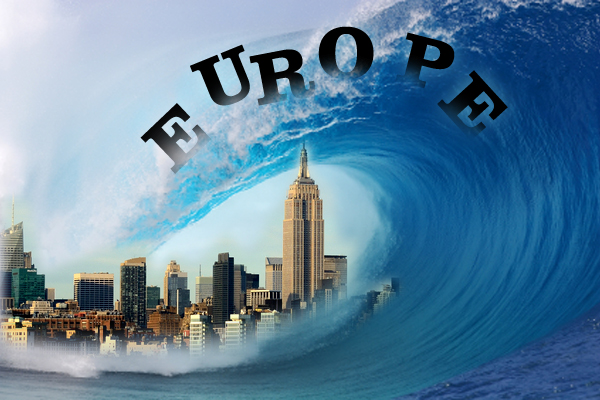

The sense of panic and confusion in Europe seems to grow by the hour. Let’s review the last day or so of events.
- Germany’s economics minister warned that, to save the euro, Greece might have to go through some sort of “insolvency procedure.” Bloomberg News promptly reported that there is now a “98 percent” probability that Greece will default.
- An Italian bond sale went badly, forcing Italy’s borrowing costs sharply higher. Investors were heartened, however, by the news that Italy’s foreign minister was begging China to bail out the country with a significant investment. This was the same foreign minister who had previously warned against China’s “reverse colonialism.”
- The price of insuring against the default of bonds issued by Portugal, Italy and France jumped.
- Bank stocks in France tanked. French banks own about $57 billion in Greek debt — and much, much more in Spanish and Italian debt.
- German Chancellor Angela Merkel smacked down her own economics minister, and declared that she wouldn’t allow Greece to go into “uncontrolled insolvency.”
- “I think we will do Greece the biggest favor by not speculating much, but instead encouraging Greece to implement the commitments it has made,” Ms. Merkel told RBB Inforadio, a public broadcaster in the Berlin region. “What we don’t need is unrest in the financial markets — the uncertainties are already big enough,” she said.
- Merkel’s promise calmed the waters — for the moment. French bank stocks — and the U.S. stock market — suddenly rebounded.
So what does this all mean? First guess: Anyone looking to Congress, the White House or the supercommittee for answers to U.S. economic problems — or for even a hint as to the future direction of the U.S. economy, is almost certainly looking in the wrong place. The biggest downside threat to the U.S. economy, right now, is Europe. Whether or not Merkel can steer a path toward resolution of the Greek crisis will likely exert far more influence on American livelihoods than whether or not the payroll tax cut gets extended, or even whether Republicans succeed in forcing more austerity down U.S. throats.
Just how exposed U.S. banks are to Europe is a hotly debated question — some banking analysts claims direct exposure is relatively minimal, while others note that we just have no idea how much credit default swap insurance U.S. banks have sold to European banks.
Who ends up holding the bag if Europe implodes? Astonishing as this is to contemplate, just three years after credit swaps played a major role in precipitating the financial crisis of 2008, we just don’t know. But even in the midst of our ignorance, formulating a disaster scenario is child’s play.
If Greece slips into default (controlled or uncontrolled) and Italy follows down the insolvency garden path, French banks are certainly in big trouble. If the French banking sector collapses, at the very least, Europe will be headed for recession, and at worst, the interconnectedness of the global banking system will transmit chaos straight across the Atlantic to New York in less time than you can say “systemic event.”
Another recession in Europe would be bad enough — add yet another grim headwind to the troubles limiting U.S. growth. But another global credit crunch? Is it any wonder that every new headline from Europe seems to spark an immediate zig or zag in the U.S. stock market?
