Budget Showdown
Supercommittee under lobbyist assault
Unless Congress forces disclosure, money will prevail over democracy in budget cutting
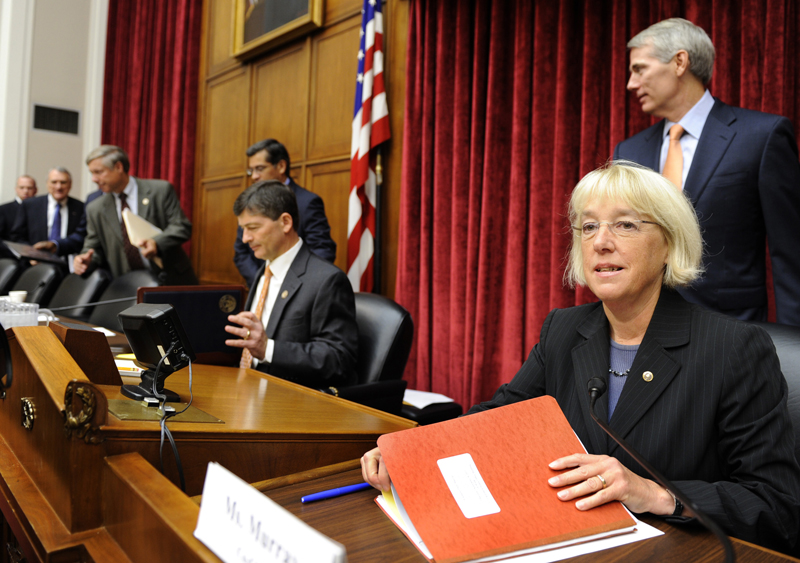
Congressional Super Committee Co-Chair Patty Murray (D-WA), (R) and fellow Co-Chair Rep. Jeb Hensarling (R-TX) (L) are seated as they arrive to open the inaugural meeting to search for at least $1.2 trillion in new deficit reductions, in Washington, DC, September 8, 2011. REUTERS/Mike Theiler (UNITED STATES - Tags: BUSINESS POLITICS)(Credit: © Mike Theiler / Reuters) All summer, NFL owners and players faced off in bare-knuckled negotiations that threatened to scotch this year’s season. In the end, they reached a compromise. Americans have been cheering since last Thursday’s first game.
The NFL opener coincided with the start of negotiations among members of the congressional supercommittee, tasked with crafting a long-term financial plan for our country. Unfortunately, the prospects for a crowd-pleasing, conciliatory ending seem much less likely.
This powerful committee held its first public hearing on Tuesday. Its “fans” — corporate lobbyists of all stripes — went wild, rushing the Capitol and positioning to get the biggest bang for their clients’ bucks. One candidly revealed his best offensive strategy: “writing 12 really large checks.” No doubt prominent campaign contributors of past elections, like the telecom giant AT&T and the abortion-rights advocate Emily’s List, are also expecting front-row seats.
But, in the words of Supreme Court Justice Elena Kagan, “Democracy is not a game.” The committee’s choices will set the nation’s fiscal course for years — if not decades — to come, and will affect virtually all American voters, industries and communities of interest. The stakes couldn’t be higher.
There is only one way to ensure that committee members (the “supers”) stay super-focused on the general good rather than personal gains: through robust transparency. All potentially corrupting outside influences — large campaign contributors, lobbying contacts and fundraising relationships with outside political groups — must be made public.
The reasons for the first two are obvious. Real-time disclosure of large campaign contributions made to supers while they are deliberating is a key way for the American people to ascertain who is trying to curry favor now. Indeed, there is bipartisan support to impose a tight deadline upon such contributions — a rarity in today’s polarized political environment.
In early August, Sen. David Vitter, R-La., introduced the Super Committee Sunshine Act, which would force committee members to disclose contributions over $1,000 within a 48-hour window. In his words, “Given the important work this committee will be doing over the next four months, it’s just plain good government for the public to know what special interests are trying to influence the committee.”
Last week, Reps. Dave Loebsack, D-Iowa, Mike Quigley, D-Ill., and Jim Renacci, R-Ohio, introduced the more comprehensive Deficit Committee Transparency Act. Like its Senate counterpart, this bill would demand prompt disclosure of campaign contributions. It would also require supers and their staffs to publicly disclose meetings with lobbyists and other special interests within 48 hours.
Disclosing lobbying contacts is just plain common sense. As the Washington Post recently reported, almost 100 registered lobbyists who used to work for members of the supercommittee now represent “defense companies, health-care conglomerates, Wall Street banks and others with a vested interest in the outcome of the panel’s work.” And, half of the supers currently employ former lobbyists on their staffs. These close connections already raise the suspicion of backroom dealings. Holding meetings in secret does nothing but confirm our worst suspicions.
Unfortunately, both these bills are currently languishing in committee, and are not likely to see the light of day unless public attention forces congressional leaders to act. Even so, these measures are not enough.
The supers must also be forced to disclose their involvement in soliciting funds for supposedly independent groups that seek to influence politics. These groups — like SuperPACs, 501(c)(4)s, and trade organizations like the Chamber of Commerce — play an outsize role in today’s elections, and can be designed to shield tit-for-tat arrangements with specific candidates. Without transparency, special interests could funnel political dollars for supers through friendly third-party groups with no disclosure obligations, ensuring that their political largess never becomes public.
Supers have certainly benefited from outside spending in recent elections. In her tight reelection last year, Sen. Patty Murray, D-Wash., enjoyed more than $9 million of outside spending, helping her squeak by her Republican opponent, Dino Rossi. Sen. Pat Toomey, R-Pa., spent years as the president of the anti-tax Club for Growth, a group that spent $8.2 million on independent expenditures last election cycle. As supers anticipate future hard elections, there is no question they will want these heavy-hitting political players on their side.
The temptation to promise political favors today for electoral support tomorrow will be hard to resist. The only solution is full transparency. After all, our democracy is on the front line.
House Republicans lose their will to fight
The GOP's readiness to cut a payroll tax deal reveals a political party in retreat
Eric Cantor and John Boehner (Credit: AP/Charles Dharapak) Have House Republicans lost their mojo? That’s the first conclusion that jumps to mind when attempting to read the tea leaves of the current negotiations over extending the payroll tax cut. On Tuesday, the most popular word used to describe the House GOP’s purported decision to abandon requiring spending cuts to offset the cost of another extension of the payroll tax cut was “cave.”
Ouch. A full two weeks before the ultimate deadline, Republicans are already willing to cut a deal that will add another $100 billion to the deficit. It wasn’t so long ago that these same Republicans were playing last-second brinksmanship while threatening to shut down the federal government in fervent protest of Big Government. Since when did the Tea Party become so meek?
Continue Reading Close
Andrew Leonard is a staff writer at Salon. On Twitter, @koxinga21. More Andrew Leonard.
Obama’s unwinnable payroll tax cut fight
The president's political position is strong, but Democrats still have to cut a deal that won't be pretty
President Obama (Credit: AP/Carolyn Kaster) With barely more than two weeks left to go in 2012, it is only fitting that Congressional Republicans and Democrats are once again engaged in doing what they do best: playing politics with the economy. The current fight over extending a payroll tax cut and unemployment benefits is just one more installment in the nation’s least favorite reality TV show: Partisan Gridlock.
Both sides more or less agree that it would be a bad idea to raise taxes and cut benefits during a weak economy — the question is what kind of pound of flesh will be extracted in exchange for a deal. Democrats want to pay for the extensions by taxing millionaires. Republicans want to pay for the measures by scooping money out of Obama’s priorities, such as health care reform, while pursuing their own agenda — gutting EPA regulations, getting the Keystone XL pipeline built, making it harder for poor women in Washington D.C. to get an abortion.
Continue Reading Close
Andrew Leonard is a staff writer at Salon. On Twitter, @koxinga21. More Andrew Leonard.
The economic price of the supercommittee fail
The interests of the wealthy are protected again, at the expense of economic growth
Mervin Sealy from Hickory, North Carolina, takes part in a protest rally outside the Capitol Building in Washington, October 5, 2011. (Credit: Jason Reed / Reuters) On Monday, the Dow Jones industrial average fell 300 points, a plunge immediately blamed on the supercommittee’s failure to agree on a debt reduction deal. If this is true, investors were displaying a remarkable lack of attention to current events. Is there anyone on Wall Street or in Washington, D.C., or anywhere else who expected the supercommittee to succeed? Failure should already have been “priced in” by the markets. As anticlimaxes go, the only surprising thing about the supercommittee’s impotence is that anyone was surprised by it.
Continue Reading Close
Andrew Leonard is a staff writer at Salon. On Twitter, @koxinga21. More Andrew Leonard.
Senate blocks House disaster aid bill
Relief legislation voted down after House Republicans passed offset-heavy version yesterday
Senate Majority Leader Harry Reid of Nev. gestures during a news conference on Capitol Hill in Washington on Thursday, Sept. 22, 2011, to discuss FEMA funding and the Continuing Resolution to fund the government. (AP Photo/Harry Hamburg)(Credit: AP/Harry Hamburg) The Democratic-led Senate blocked a House-passed bill on Friday that would provide disaster aid and keep government agencies open, escalating the parties’ latest showdown over spending and highlighting the raw partisan rift that has festered all year.
In a tit-for-tat battle, the Senate first used a near party-line vote of 59-36 to derail the measure from the Republican-run House. The House bill would fund federal agencies and provide $3.7 billion in disaster assistance, partly paying for that aid with cuts in two loan programs that finance technological development.
Continue Reading CloseHouse passes disaster aid, but Senate Dems object
Bill adds more offsets to secure Republican passage, all but guaranteeing death in Senate
Senate Majority Leader Harry Reid of Nev. gestures during a news conference on Capitol Hill in Washington on Thursday, Sept. 22, 2011, to discuss FEMA funding and the Continuing Resolution to fund the government. (AP Photo/Harry Hamburg)(Credit: AP) With the economy sputtering, the warring factions of Congress have lurched toward gridlock over the usually noncontroversial process of approving disaster aid and keeping the government from shutting down.
The GOP-dominated House early Friday muscled through a $3.7 billion disaster aid measure along with a stopgap spending bill to keep the government running past next Friday. The narrow 219-203 tally reversed an embarrassing loss for House GOP leaders that came Wednesday at the hands of rebellious tea party Republicans.
Continue Reading ClosePage 1 of 58 in Budget Showdown