
Biography

“Can we ever really know Ernest Hemingway?”

For his masterly new biography, Paul Hendrickson tracked down Papa's brother, a living friend -- and his boat

  • more
    • All Share Services

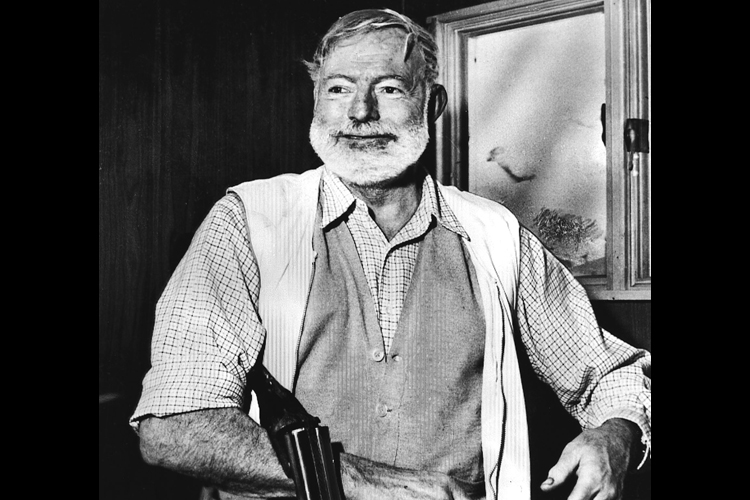
Ernest Hemingway, cradling a shotgun.

As Paul Hendrickson concedes early in his new book, “Hemingway’s Boat: Everything He Loved in Life, and Lost, 1934-1961,” the world isn’t in dire need of another Papa bio. “Ernest Hemingway,” he writes, “has been examined by so many scholars and memoirists and respected biographers and hangers-on and pretenders and doctoral students desperate for a dissertation topic that I feel sometimes we have lost all sense of who the man really was.”

So Hendrickson, a winner of the National Books Critics Circle Award for his 2003 book “Sons of Mississippi,” decided to go at his subject in a roundabout way. The result is a book that is as much about Hemingway himself as it is his relationship with Pilar, the 38-foot seafaring vessel on which he spent endless hours during the final decades of his life. On board Pilar, Hemingway wrote, loved, argued, drank and, for a time during World War II, went looking for enemy submarines. And it’s a boat, Hendrickson believes, that may have had a distinct impact on the evolution of Hemingway’s prose.

In a recent phone interview, Hendrickson talked about traveling to Cuba to see Pilar for himself; his delight in locating a still-living Hemingway contemporary; and how the book took root in a long-ago meeting with a stranger who just happened to be Ernest Hemingway’s brother.

How did you get started on the book?

This book, in a sense, goes back through at least three decades and four intervening projects. It may have been seeded in the winter of 1980, when my wife and I were fleeing the winter snows for Bimini. There, waiting to go over in a little seaplane, a 20-minute hop from Miami to Bimini, there was this man with a big Hemingway beard and tattered clothes and tennis shoes and a grocery sack under his arm. I whispered to my wife, “That’s got to be Ernest Hemingway’s little brother.” I was an amateur Hemingway student by then, and I knew about [Leicester Hemingway] “the Baron,” 16 years younger than Hemingway, whom Hemingway mostly despised. But here was this guy going to Bimini, where Hemingway had haunted and made famous. As luck would have it in this 12-passenger Grumman Goose seaplane, he took a seat right ahead of us, and I leaned forward and said, “Sir, by any chance are you Ernest Hemingway’s brother?” And there was this bared-teeth grin, and he said, “Yeah, and if you’re lucky it’ll get you a cup of coffee.” We got along fabulously. He told me that weekend some inside stories that to me were not only incredible but incredulous. Most of them turned out to be true. Other books went on, and my job at the Washington Post went on, but I never really forgot that encounter.

You write, “We’ve had far too many Hemingway biographies.” Is that why you decided to use the boat as a narrative device?

I do believe we’ve had far too many biographies and critical explanations of the man, each one contradicting the last. I didn’t want to join that group. If I was going to do something, I wanted to do something different, which would lead to point B. I can only do what I can do. When I’ve gotten in trouble with books before it’s because I have not been authentically true to who I am and what I can do. I am not a conventional biographer. I am not a thoroughgoing, date-of-birth to last day of life kind of biographer. My brain doesn’t think that way. There’s a great Emily Dickinson line starting a poem that says, “Tell all the Truth but tell it slant.” And that’s what seems to power my imagination.

Hemingway bought the boat in 1934, as his marriage is dissolving, and as he’s getting his first spate of bad reviews. This was a major period of transition in his life.

Absolutely. You could say that at the moment he gets this boat he is still the reigning monarch of American literature, but he’s already been sniped at by the critics. He’s still the king; he controls the crown. But he understood that he was beginning to have trouble. One theory about Hemingway is that he turned to a lot of journalism in the ’30s because the fictional well was starting to go dry. The first book that comes up after acquiring Pilar is this quasi-documentary, novelist, journalistic report “Green Hills of Africa,” which in its own day suffered bad reviews. Why did he write that book rather than a pure novel about Africa? I think in some sense he began to understand that he was losing some fictional power. And yet he roars back in 1940 with “For Whom the Bell Tolls,” the novel about the Spanish Civil War that, ironically and retrospectively, in the long view of history, I think is a weak novel — even though it was his largest-selling novel.

Many Hemingway detractors like to say that it was all downhill from the ’30s onward. I don’t see it that way at all. I think it’s a sine curve, like most of our lives.

He really did live a life onboard his boat. In addition to landing 500-pound marlins, he got into a dispute with the poet Archibald MacLeish that was the beginning of the end of their friendship; he wrote parts of “Green Hills” onboard; he accidentally shot himself in the legs.

While we’re talking, I just flipped open a journal. Here’s a note I wrote to myself when I was writing the previous book, “Sons of Mississippi.” The Hemingway book was festering, and here’s the note I wrote: “Hemingway’s boat. June 18, ’02. If you study what happened just on that boat you’ll get Hemingway’s whole life.”

About a third of the way through the book you write, “For the last several books and years, Ernest Hemingway’s world-famous prose style has been discernibly if subtly altering.” And you add, “I believe Pilar was a key part of the change, allowing him to go farther out, where you don’t see the shoreline.” What do you mean by that?

It’s both, in my mind, a literal and metaphorical idea. It is clear that by the mid-’30s the famous prose style of these seemingly simple-minded, declarative sentences without any subordinate clauses had begun to go by the wayside. Not entirely, but he was experimenting with other things — the sentence line was growing much, much fuller, and there were often many subordinate clauses. Why is this so? What explains it? I don’t know that anybody can quite explain it. Some people have thought it had to do, as I say in the book, with getting out of those tight, damp enclosures of Europe and, indeed, atavistically what he came from in the winters of Oak Park, Ill., and crawling out where you can be ever the bohemian, in your beard and your sandals and your raggedy beltless shorts in Key West. Does this have something to do with the expansiveness in his own writing? That’s an interesting theory that no one can ever prove. But what you do notice is the evolving change. I like to think that the acquiring of this boat and the ability of Pilar to release him from shore was doing something to him. He was no longer shore bound. It was a seagoing vessel, and you could go far enough out where you would lose sight of land. And I wonder metaphorically whether that, in its sense of adventure, in its sense of release, in its sense of freedom, didn’t help expand the sentence line.

I also found it interesting when you write, “Hemingway, a man in a solitary profession, could barely stand to be alone, no matter how much he’d curse at the world for not leaving him alone.” In that way, Pilar was his own world, wasn’t it? He could control who was onboard, and who wasn’t.

I think what you’re saying is spot-on. You’re in that beautiful environment, but when you’re in this contained little capsule you can control it, largely, because you are the captain of it. You also like being challenged, I think, by the elements, these storms that will come up that you cannot control. I think this was also part of the constant adventure that Hemingway needed to seek, needed to challenge himself against. You can control that capsule, and yet the double-edged sword: He hated being alone. His letters to the women he’s wooing, who will become his wives and then they’ll become failed marriages. Constantly the refrain is: I can’t stand to be alone, I’m so lonely. I need you. He needs people around him, and at the same time he is so angry that people are around him and taking his writing time away. So he’s shooting himself in the legs once again.

Who is Walter Houk? How did you find him and what did he do for the book?

He’s 86. He’s reading the book in its entirety now. He is one of two or three veritable, authentic living Hemingway witnesses. If I’m not a conventional biographer, I have to be true to what I can do. The journalistic nose in me instantly said, “Holy shit. You mean there’s somebody alive who knew Hemingway. My God.” I was trembling. For me to have been able to go and spend all this time with Walter Houk, who turns out to be a great old guy, not a self-aggrandizer. But a very, very astute man, who, yes, is slipping into Alzheimer’s but whose long-term memory is so brilliant and beautiful. His life suggested itself to me, “Whoa, Paul, you could make this guy a character in his own right in the story and tell a part of Hemingway through him.”

What did Hemingway do with the boat in 1942, during the war?

It’s a part that I expect to be criticized by certain critics who wish to say, “Gee, he turns Pilar into a Q-boat, a sub-hunting boat, patrolling off the north coast of Cuba. Why didn’t you do more with this?” The short answer is because my imagination took me elsewhere. And also because it has been written by others to some extent. He armed Pilar as a sub-hunting boat, and no matter how much the exercise got polluted with too much ego and too much booze and too many hangers-on, I believe that at base Hemingway had great motivations — and really did want to encounter a sub and would have been willing to blow up Pilar and himself in the cause of taking down one sub.

The boat today is in Cuba?

The prologue begins in May 2005, when I’m looking at Pilar as if it’s dying of thirst and wanting only to get into water. In the process of doing this book, the boat became restored, and I was going to close the book by going back to Cuba and seeing Pilar in her shiny, well-refurbished state. But I did not go there, because I’ve had to contend with a significant health issue in the last year-and-a-half, during the finishing of the book. The doctors did not want me to go back to Cuba, because you don’t want to land in a Cuban hospital. I wrote a different kind of epilogue and then wrote the coda.

And in the process you dispelled, at least in your own mind, the rumors that the Pilar on view in Cuba is an impostor, not Hemingway’s actual boat.

Yes, this is probably the authentic boat. But you know, I don’t care, ultimately, because that’s somebody else’s project to see if this is the absolute authentic boat. Pilar is my metaphor, my storytelling vehicle, and there’s a secret sly part of me that’s happy if we can’t know. Because that only adds to the notion of: Can we ever really fucking know Ernest Hemingway?

Kevin Canfield has written about arts and culture for the New York Times, Los Angeles Times, Bookforum and many other publications.

“Thomas Hart Benton: A Life”: Great art or populist trash?

A new biography of Thomas Hart Benton explores the American muralist's paradoxical life, work and reputation

  • more
    • All Share Services

This article appears courtesy of The Barnes & Noble Review.

Artists’ reputations rise and fall, but few have gyrated as wildly as that of the painter and muralist Thomas Hart Benton. In the 1930s he was acclaimed as the greatest artist in America, with his face on the cover of Time. Later he was ridiculed as a populist throwback, a stumbling block on the road to abstract expressionism. But recently scholars and curators have given the artist a second look — and have reread him as a critical component of American art history, not just a crowd-pleaser. This first biography of the painter, by Justin Wolff, continues the Benton revival. And among artists, he needs a biography more than most — for “Benton’s art, as rich and dynamic as it may be, is not as paradoxical as the man was.”

Barnes & Noble ReviewBenton may now be an emblem of populism, but he came from decidedly patrician stock. He was born in Missouri in 1889 and named after his uncle, Sen. Thomas Hart Benton — who fought alongside Andrew Jackson in the War of 1812 and served six terms in the upper house, a Western Democrat who opposed slavery from the beginning. The painter’s father served in Congress too. Maecenas Benton, known as “the Colonel,” was elected to the House when Tom was 8, and in Washington the boy saw paintings for the first time: not anything in the national museums, but the immense murals in the Library of Congress.

Benton had a glacial relationship with his father. “They only spoke to squabble,” Wolff writes. “Tom was smug; the Colonel was unforgiving.” It took years for young Benton to convince his family to let him study art, first at the School of the Art Institute of Chicago and later in Paris. In Chicago he took boxing classes, roughed up fellow students, and declared in his letters home that he was a born genius. But in Paris, where he met Gertrude Stein and much of the rest of the avant-garde, doubt set in. “I was merely a roughneck with a talent for fighting, perhaps, but not for painting,” he later told an interviewer.

At 30, Benton’s career seemed stalled. He had moved to New York at the explosive birth of Modernism, and the art world orbited around the twin poles of Marcel Duchamp (who lived in Benton’s building) and Alfred Stieglitz (who, lamented Benton, advocated art with “no real function”). For an artist with more classical aspirations, he seemed not just out of place but reactionary, and this despite his serious commitment to Marxist theory. When he wasn’t fighting with painters, such as his eternal bête noire Stuart Davis, he was fighting with lovers — one woman ended up stabbing him. It wasn’t until the 1920s that Benton finally had his breakthrough: Like his hero Tintoretto, he started making dioramas and painting from three-dimensional models, a practice he’d stick with to the end of his career. “He finally felt connected to a practical tradition,” says Wolff, for Benton “never trusted that aesthetic innovation legitimized itself.”

You can see the efficacy of those dioramas in his breakthrough painting “People of Chilmark,” a torrent of bodies in the surf, which is on view in “Youth and Beauty: Art of the American Twenties,” a spectacular exhibition now at the Dallas Museum of Art. But they come through even clearer in his murals, where his volumized figures obtain massive scale. His first murals, for the New School in New York, were done “in return for the price of the eggs” used in the tempera, but soon they were everywhere: in the state capitol of his home state of Missouri; in Harry Truman’s library, where the former president called him “the best muralist in our country”; even in the Country Music Hall of Fame.

Benton was a bruiser, but in Wolff’s hands he can seem positively tender at times. He was happily, passionately married (a double portrait of him and his wife, Rita, is also on view in “Youth and Beauty”), and his students idolized him — one in particular. Jackson Pollock left Wyoming at 18 to study under Benton in New York, and his relationship with his teacher progressed from love and emulation to codependence and, finally, a kind of Oedipal rejection. He was already drinking heavily in his student years, and Benton, Wolff acknowledges, “was not the best role model for the defiant Pollock.” But he kept Pollock afloat in his early years in New York, helping him find work and inviting him to stay at his home in Martha’s Vineyard. It didn’t take long, though, until Pollock started showing up unannounced, empty bottle of gin in hand. At one point Benton had to bail him out of jail.

In 1940, grieving for a friend who’d just died, a drunken Pollock took a knife to most of his early work, slicing his Bentonesque canvases to scraps and tossing them out the window. The rest is history, if by “history” you mean the oversimplified view that Benton’s regionalism was just a last gasp before a Pollock-led triumph of American abstraction. But Wolff’s biography, like the exhibition “Youth and Beauty,” helps us see that art history is not a linear succession of avant-gardes, but a mess of personalities and ideas that can never be fully untangled. And at our current political and economic crossroads, when a populist impulse has roared back to life, we may finally be in a position to look at Benton with the same attention we’ve lavished on his most famous student.

Continue Reading Close

Jason Farago is a regular contributor to the Guardian and writes criticism for the London Review of Books, n+1, Frieze and other publications. He is also editor of Art in Common, a blog on art and urban life.

“The Queen and the Maid”: Joan of Arc’s secret backer

A historian argues that the medieval saint's success was engineered by stealthy political genius

  • more
    • All Share Services

Joan of Arc

Attention, “Game of Thrones” fans: The most enjoyably sensational aspects of medieval politics — double-crosses, ambushes, bizarre personal obsessions, lunacy and naked self-interest — are in abundant evidence in Nancy Goldstone’s “The Maid and the Queen: The Secret History of Joan of Arc.” Goldstone’s premise, innovative but not outlandishly so, is that Joan’s rise from poor, illiterate farmer’s daughter to mystical champion of French nationalism during the Hundred Years’ War was largely orchestrated by Yolande of Aragon. Yolande, who was the Duchess of Anjou and Countess of Maine as well as the Queen of Aragon (among other titles), was also the mother-in-law of the dauphin, Charles, whose military triumph over the occupying English and coronation in Reims were the two great causes espoused by the saintly, if warlike, Joan. As Goldstone sees it, Yolande’s political genius goes under-recognized.

“The Maid and the Queen” describes two ways exceptional women found to exercise power in the Middle Ages. Yolande — who ran Aragon while her husband (and, later, her son) pursued a fairly hopeless claim to the throne of Sicily — raised money, sponsored advisors, negotiated strategic marriages and otherwise worked, often indirectly, to further the interests of her six children. She backed the Armagnac side in the protracted French civil wars that weakened the country to the point that Henry V and Henry VI of England found it ripe for the picking. The other side, the eel-like Burgundians, formed on-again, off-again alliances with the limey invaders.

Charles, who became dauphin (heir to the French throne) only after his four elder brothers died, had gone to live with Yolande in her castle at Angers at age 11, when he was betrothed to her daughter, Marie. His father was intermittently mad (a situation that led to much of the chaos in France) and his own mother was so self-serving that eventually she repudiated him as the illegitimate product of an adulterous affair in order to appease a more useful ally. (Goldstone finds persuasive proof of his legitimacy.) Charles called Yolande his “Bonne Mère” (good mother) and, as Goldstone writes, “became very attached to her, relying on her judgment and reflexively turning to her in moments of distress. No one had more influence with Charles than Yolande.”

Nevertheless, after Charles’ father died, Yolande’s sway was eclipsed by that of avaricious Georges de la Trémoille, grand chamberlain, whose interest lay in, as Goldstone puts it, “undermining the king’s confidence as a means of controlling him and enriching himself as much as possible.” A major military defeat against Henry V spooked Charles, and he became obsessed with his disputed legitimacy and the possibility that God had thwarted him because he was not, in fact, the rightful king. As he tarried, the English solidified their base in northern France. Yolande raised and funded a substantial army, but she still couldn’t get her lily-livered, self-doubting son-in-law to fight.

Goldstone believed that Yolande’s extensive network of spies and contacts — particularly her youngest son, Renè, who was in line to become the Duke of Lorraine — notified her when a teenage peasant girl from the northern village of Domrèmy (on the border between Lorraine and Champagne) developed a following. In a touch right out of a J.J. Abrams series, there was a well-known prophecy, first circulated by a Provencal seeress, that “France will be lost by a woman [Charles' profligate and unpopular mother] and shall thereafter be restored by a virgin.” No one believed in Charles more than the charismatic and manifestly pious Joan, who treated his coronation and rule as sacramental.

Like medieval churchwomen with more conventional careers, Joan wielded an authority rooted in both her chastity and her claim to a hot line to heaven — in Joan’s case, the voices of the saints who directed her actions and promised success to Charles. (When she was finally captured by French allies of the English and subjected to a kangaroo trial for heresy, the question of whether, by wearing men’s clothes, she had behaved “immodestly” was given great weight.) At her famous meeting with the dauphin in 1429, Joan was said to have delivered an unspecified “sign” to Charles, confirming her holy status. Goldstone believes that she simply addressed his most corrosive, secret anxiety by immediately assuring him that she had been sent by God to verify his legitimacy and help him retake his kingdom.

Historians differ on how much military authority Joan exercised over the next year and how effective that authority was. But there is no doubt that her symbolic power was immense; she transformed a grinding dynastic squabble into a holy war in the eyes of French commoners, who had previously had little reason to side with any of the aristocratic combatants. Her valor in the heat of battle rallied flagging French troops again and again, above all in the raising of the siege of Orleans, a huge morale booster for Charles loyalists. The retrial that overturned her conviction for heresy 25 years after her execution became “a collective catharsis staged at the national level, in which not only Joan but the entire French population achieved redemption,” Goldstone writes.

Because so much of this material is familiar, delivery becomes a crucial factor in any popular history of these events. Goldstone’s is vigorous, witty and no-nonsense in the tradition of the late, great popular historian Barbara Tuchman. She registers moral disgust at the Burgundian lackeys who tormented and killed Joan of Arc, as well as pragmatic admiration for the campaign-trail chops of Yolande and her mother-in-law, Marie of Blois, who knew that the best way to consolidate support in your son’s or husband’s duchy was to travel from one provincial town to another, patiently listening to the local burghers’ gripes and then handing out plenty of cash. And she’s very funny when exploring the roots of the campaign to rehabilitate Joan’s reputation in a theological conflict within the University of Paris: “So much of life is fleeting, ephemeral: Seasons change, civilizations rise and fall; people are born, they live a little, they die. But faculty disagreements endure.”

“The Maid and the Queen” does suffer a bit from the fact that the figure Goldstone presents as driving events, Yolande, is almost never at the scene when the action occurs. Her influence must be inferred by the presence or behavior of men who were allied to her in one way or another. Of course, this is the only way Yolande could have operated, but it makes Goldstone’s central argument difficult to substantiate. “There is no more effective camouflage in history than to have been born a woman,” she writes. Not all of that camouflage can be conclusively cleared away, but thanks to this book, a bit more of this remarkable life has been coaxed out into the open.

Continue Reading Close
Laura Miller

Laura Miller is a senior writer for Salon. She is the author of "The Magician's Book: A Skeptic's Adventures in Narnia" and has a Web site, magiciansbook.com.

“Dreaming in French”: Three remarkable women in Paris

What the young Jackie Kennedy, Susan Sontag and Angela Davis discovered in the city of light

  • more
    • All Share Services

Susan Sontag, Angela Davis and Jackie Kennedy

Jacqueline Kennedy, Susan Sontag and Angela Davis are three very different American women who shared one similar rite of passage: a year spent in France during their early adulthood. Alice Kaplan’s superbly perceptive “Dreaming in French: The Paris Years of Jacqueline Bouvier Kennedy, Susan Sontag and Angela Davis” makes a prism out of those visits; the white light of expectation goes in, and a myriad of astonishing colors comes out.

A year abroad is far from a rare experience for American college students these days, but it’s a surprisingly undercontemplated custom; Kaplan — a professor of French at Yale and the author of a memoir and several prize-winning books on French history — singles out a recently-published academic study by Whitney Walton. However, most attempts to understand the transformative visits of young Americans to other countries have come in the form of coming-of-age memoirs and autobiographical first novels. About Paris, above all, American youth has spun extravagantly romantic fantasies of self-discovery, blossoming cosmopolitanism and creative ferment.

Jacqueline Bouvier arrived in 1949, to a Paris that was, literally, black. Its white stone buildings hadn’t been cleaned of street soot since the war. This, like the ration card issued to Bouvier for sugar and coffee, is the sort of detail that sketches an entire mode of life, scrimping and shadowed. Kaplan is a master at delivering such details and at selecting just the right aspect of everyday experience to illuminate an important point she wants to make.

In the section on Sontag, Kaplan notes, “There’s rarely a published account of Parisian intellectual life in the 1950s — French or American — that doesn’t involve hotel rooms.” Sontag, who, unlike Bouvier and Davis, spoke only “elementary” French during her 1957 sojourn to Paris, inhabited a “social world that was essentially American,” a hotel world. For the ambitious young critic, her months in Paris were primarily a period of introspective and erotic exploration; with a husband and child back in America, she submerged herself in an affair with a woman, Harriet Sohmers, who some thought to be the real-life model for the character Jean Seberg played in “Breathless.”

For Bouvier, to the manor born and raised but essentially broke due to the profligacy of her father, France offered a chance to steep herself in the European art and culture she adored. As part of a program run by Smith College, she stayed with a comtesse in the respectable 16th arrondissement, but only because the comtesse (who’d been in the Resistance and done time in a German labor camp), had to take in boarders to make ends meet. The shortage, in this shabby genteel milieu, of both bath tubs and baths, and especially the very basic nature of French toilets, delivered the “most intense” culture shock that Bouvier and her wholesome cohort experienced. The unheated houses of their host families ran a close second. Their Paris was uncomfortable, but replete with the exotic riches of the past.

Davis, on the other hand, arrived in 1963, a fluent French speaker and precocious academic intellectual expected to achieve great things as a philosopher by her mentor at Brandeis, Herbert Marcuse. She’d been imprinted with what Kaplan calls “the mythical power that France held for black Americans” as a realm where a full portion of freedom and dignity, inaccessible in America, could at last be enjoyed. Raised in segregated Birmingham, Ala. — in a neighborhood so plagued by racist bombers it was dubbed “Dynamite Hill” — Davis and her sister had once entered a white shoe store speaking French and pretending to be from Martinique. Instead of being shown to the back entrance for “colored” customers, they were treated “like dignitaries” in the front of the shop. French, for Davis, was the language of liberty, an escape hatch to another, better life.

As Kaplan recounts in an insightful passage on the role of newspapers in the education of American students overseas, Davis had no sooner arrived in France than she picked up a copy of the Herald Tribune to read of the bombing of the 16th Street Baptist Church in her hometown. This act of domestic terrorism killed four 14-year-old girls, two of whom were Davis’ friends. Kaplan compares the American and French coverage of the event, all of which Davis must have studied avidly, to illustrate how each society was far more likely to acknowledge the prevalence of racism away from home. In Paris, Davis receive more respectful treatment than she got in the U.S., but all around her she saw Algerians targeted for abuse much like that she’d endured back home.

Kaplan devotes a section of each of the book’s three parts to “The Return,” the story of each woman’s later life in America and the role France and French culture played in it. There’s Jackie Kennedy’s expert negotiation of the politics of the visual, redecorating the White House, and herself, in a manner that satisfied her taste for French design without appearing unpatriotic. (Her husband did complain of “too Frenchy” official dinners, with menus that “nobody could read or understand.”) Sontag became the most visible American intellectual to champion the French “New Novel” to stateside readers. And Davis, when tried in 1970 for conspiring in a courtroom kidnapping and shoot-out in California, became a symbol of the battle for social justice to many French people, tens of thousands of whom marched to protest her imprisonment. French schoolchildren and secretaries sent her letters of support.

Some books are well-written on a sentence-by-sentence basis; you leaf back through the pages to find you’ve underscored choice lines. “Dreaming of French” is the sort of book where you (well, I) draw vertical lines next to entire paragraphs. Kaplan produces some exquisite lines, yes, but she is positively incandescent on the level of thoughts and observations. Of Sontag, she notes the obsessive list-making and sees the outsider, the girl from the provinces schooling herself on the societies she longed to infiltrate: “Throughout her life, she would enter a new world by recording its manners, its important people, creating her own grammar in the form of lists.” The big lectures and rote learning methods of the Sorbonne, she describes as “the part of French education that was as ritualistic as Catholic mass.” In Davis’ childhood efforts to teach herself French, she sees that, “for such a person, a counterlife of dreams and imaginary travel was an absolute necessity.”

Although Davis may have needed it most, all three of these women cherished an imaginary French counterlife as girls. Tracing the effect of an unlived fantasy on a person’s actual life is a delicate operation, but then so is accounting for the influence of that first immersion in a foreign country. Kaplan writes of her subjects that “the deep history of their transformation involved smells and tastes and visions — fleeting sensual experiences not easy to capture in a conventional life story.” An eccentric landlady or the first sampling of couscous can make an indelible impression on a sensibility cast wide open by travel, an impression that can in turn color ideas and feelings for decades to come. No, it’s not easy to capture such things, but Kaplan proves that it can be done.

Continue Reading Close
Laura Miller

Laura Miller is a senior writer for Salon. She is the author of "The Magician's Book: A Skeptic's Adventures in Narnia" and has a Web site, magiciansbook.com.

“Island of Vice”: Teddy Roosevelt vs. booze and sex in old New York

A new history of TR's stint as the Big Apple's police commissioner illustrates the folly of moral crusades

  • more
    • All Share Services

“Sing, heavenly muse, the sad dejection of our poor policemen,” read the Homeric opener to a story on the front page of the New York World in 1895. “We have a real Police Commissioner. His name is Theodore Roosevelt. His teeth are big and white; his eyes are small and piercing … his heart is full of reform.” Roosevelt, a few years ahead of his entrance into national politics, had his work cut out for him. New York was, as author Richard Zacks puts it in “Island of Vice: Theodore Roosevelt’s Doomed Quest to Clean Up Sin-Loving New York,” the “vice capital of the United States,” with 8,000 saloons and over 30,000 prostitutes.

“Island of Vice” is Zacks’ account of Roosevelt’s tenure on New York’s police commission during the mid-1890s. As such, it faces a dilemma. The hero of the story is, obviously, TR, that quintessential American, with his boundless energy and can-do spirit, his faith in traditional values and the moral use of violence, his omnivorous mind, his machismo and his naivete. The antagonist is sin-loving New York, Roosevelt’s hometown but above all the decadent and narcissistic big city that salt-of-the-earth Americans love to hate. Yet the book’s main attraction isn’t the glimpse it offers of a larval president or the chance to revel in rural/suburban rectitude. Anyone who settles in with “Island of Vice” will be reading it for the vice.

Few subjects are more amusing than tales of mischief and malfeasance executed by colorful characters with the antique flamboyance of an earlier era. Zacks, who knows this, extravagantly butters his book with figures like the brawling tavern-keeper Mike Callahan, who demonstrated his commitment to 24/7 service by tossing the keys to his establishment’s front door into the East River. (He would not need them again for 25 years.) It’s delightful to learn that the current site of the NYU campus was once a neighborhood known as Frenchtown, notorious for importing European filles de joie willing to engage in oral sex — a service that, by all reports, few of their American colleagues offered. Or that a “tight house” on Bayard Street featured women who wore formfitting bodystockings and danced with soldiers. (A private show without the tights was referred to as a “dance of nature.”)

Roosevelt, a Republican, came into office on a wave of political discontent with the once-supreme Democratic Party machine known as Tammany Hall. Police corruption scandals and a very energetic Presbyterian minister named Charles H. Parkhurst had rubbed the city’s nose in its own cesspit. Parkhurst formed a society of moral crusaders, including a team of detectives who took the reverend on a tour of New York’s fleshpots, everything from opium dens to dirt-floored “stale beer” joints (serving dregs collected from other bars) to a whorehouse where the reverend and an oversensitive congregant watched naked women play a game of leapfrog. Then they moved on to Frenchtown, where they witnessed some girl-on-girl action that Parkhurst declared “the most brutal, most horrible exhibition that I ever saw in my life.”

Although Parkhurst’s nocturnal research raised an eyebrow or two, like all such reformers he needed proof of New Yorkers’ easy access to vice in order to refute police claims that they had such crimes under control. In a way, they did. The police chose to let assorted rascals flourish unchecked not because they took a worldly view toward “victimless” crimes, but because they were extracting payoffs to look the other way. From shoeshine boys who “owned” certain street corners to shopkeepers whose sidewalk displays violated city ordinances, New York presented a (literal) wealth of shakedown opportunities for the boys in blue. Catching thieves and murderers was more of a sideline.

This nasty state of affairs was the result of the pervasive cronyism and political patronage of Tammany Hall. Roosevelt, appointed with three other commissioners by a rich and idiosyncratically independent mayor, had the job of cleaning it up. Initially popular, he went on legendary “midnight rambles” with his friend, the journalist Jacob Riis, looking for patrol officers who slept or drank on the job, hassled innocent civilians or fraternized with streetwalkers. When it came to slapping down bullying or negligent officers, the public stood behind TR.

That’s not to say Roosevelt didn’t meet with considerable resistance. The figure Zacks offers up as his antithesis is William “Big Bill” Devery. Devery was a thoroughly crooked yet strangely endearing precinct captain who, as the New York Times noted in his obituary, “was always on trial for something or other and always being acquitted” — the latter due entirely to his political connections. Devery, a product of Hell’s Kitchen, epitomized the kind of cop Roosevelt wanted to see ejected from the force. The force and its various allies fought back every step of the way.

Roosevelt also feuded bitterly, and self-destructively, with his fellow commissioners and other city officials. He angered the leaders of his own party’s machine by alienating sizable portions of New York’s population. This he achieved by deciding to strictly enforce “excise” laws preventing bars from serving alcohol on Sundays. Previously, the law had seemed to exist solely for the financial benefit of the police, and in truth very few citizens besides Puritans like Parkhurst really wanted to see a Sabbath-day prohibition put into effect. But Roosevelt mulishly insisted that “while the law is on the statute book it must be strictly enforced.” He refused to back down, even when, among others, the entire German community (who viewed Sunday outings at the biergarten as a wholesome family activity) rose up against him and his party and helped vote Tammany Hall back into power.

Some of the most entertaining parts of “Island of Vice” describe the ingenuity of saloonkeepers in circumventing the excise laws. Because a “hotel” that also served food was entitled to sell booze on Sundays, many bars converted their second floors to “rooms” — cubicles where drinks could be ordered — or required that each beer be accompanied by a sandwich. It wasn’t necessary that the sandwich actually be eaten and often the same dessicated specimen would be passed from customer to customer. A joke circulated about a dive where drinking had to be temporarily suspended (with much cursing) because “somebody ate the sandwich.” An unanticipated side effect of these bogus “hotels” was that females of the type Roosevelt described as “semi-respectable” ended up drinking in dangerous proximity to private “rooms” where they might easily lose what remained of their virtue.

The most lustrous resource for anyone writing about Gilded Age New York are the archives of the city’s multiple newspapers. Saucy, scathing and flagrantly partisan, they are irresistibly quotable, and Zacks does not resist. The Pulitzer-owned New York World was the nation’s largest-circulation paper and an implacable Roosevelt critic. Insisting that “RUM RULED THE CITY” despite the police commissioner’s best efforts, it told of a Sunday when “the Tenderloin [neighborhood] glistened with its brilliant evil; the eastside wallowed in beer.” Complaining of the “ponderous” ankles of an actress whose performance in “Ten Minutes in the Latin Quarter; or, a Study in the Nude” had provoked a scandal, another paper demanded that “she ought not to be allowed to reappear upon the stage unless submerged in bloomers and shoulder-of-mutton sleeves.” Bemoaning the “dry” Sundays of the Roosevelt regimen, yet another broadsheet wrote “New York is rapidly becoming a jay and hayseed village such as had the supreme felicity of giving birth to Dr. Parkhurst.”

Roosevelt himself seldom drank and was devoted to his wife and children, but one of his flaws was an impatient inability to see how anyone else might experience life differently. He stubbornly squandered his political capital on a battle that seems entirely pointless and quixotic to contemporary eyes. His skirmishes with other officials over issues like budgetary allotments and promotion protocol are bureaucratic matters that Zacks tries, and often fails, to make interesting. The reader returns with pleasure to the Leigh Sisters and their famous “umbrella dance” and longs to hear more of the pool hall and betting parlor on Bleecker St. that catered exclusively to women.

There’s grist for a few good movies between the covers of “Island of Vice,” but none that would feature a Hollywood ending. Because it’s hard to side with Roosevelt in this fight, the book offers more ambiguous pleasures. Between risque anecdotes and vintage dirty jokes, it provides a vigorous depiction of large-scale municipal politics in all its sticky, sweaty glory, and an ever-useful reminder that there are limits to even the most dynamic leader’s ability to dictate personal morality. Sin-loving New Yorkers wouldn’t have it any other way.

Continue Reading Close
Laura Miller

Laura Miller is a senior writer for Salon. She is the author of "The Magician's Book: A Skeptic's Adventures in Narnia" and has a Web site, magiciansbook.com.

The enigmatic Putin

A new biography delves into the life of Russia's terrifying and mysterious leader

  • more
    • All Share Services

The enigmatic Putin

There are those who believe — and I am one of them — that Vladimir Putin is the only world leader operating today with a coherent long-term strategic vision for his country. Russian policy has been derided as amoral, wicked and misguided. But for the last 10 years, since the departure of the stroke-addled boozer Boris Yeltsin, Russia has never been called unguided, and its mysterious steersman is unquestionably Putin himself.

Barnes & Noble ReviewMasha Gessen’s political history of Putin’s times,“The Man Without a Face,” gives at least a dozen reasons to tremble before her subject. It is a rage-filled indictment of the Russian prime minister, astonishingly brazen in its personal animus and willingness to name Putin as the author of terrible crimes. Among recent profiles of contemporary Russia, there are certainly books that are more sober and more cautious. There are few as furiously accusatory.

Putin comes across as a sort of malevolent and murderous Russian Bismarck, expertly consolidating power after a decade-long anarchic slide. Once in power, Gessen claims, he and his government have spared no effort or life to silence critics and cow the population into acquiescence. Gessen strongly implies that Putin has something akin to a mental defect that compels him not only to triumph over but to rob and destroy his enemies.

As a biography, “The Man Without a Face” struggles to weave the sparse available details of Putin’s life into a coherent narrative. We know certain facts about his childhood: by his admission, Putin grew up a “real thug,” a bloody-knuckles neighborhood brawler constitutionally incapable of backing down from a challenge. His father suffered terrible war wounds but survived, and even as a child, Putin aspired to join the KGB. Normal Russian kids from that era, Gessen says, wanted to be Yuri Gagarin. Putin wanted to be the guy who kept tabs on Yuri Gagarin.

He got his wish and joined the KGB as an operative sniffing out internal dissent. Subsequently, as an officer in Dresden, East Germany, he watched the Soviet Bloc unravel around him. When the newly free East Germans rioted and confronted him personally, Putin appealed to Moscow for guidance and was permanently shaken when his superiors responded that they were powerless and left him and his young family at the mercy of uncertain times.

Gessen contends, contra Putin’s publicly acknowledged CV, that after the break-up of the Soviet Union he never left the intelligence services, and that nearly from the start of the new Russia he has been insidiously tunneling under Russian democracy and preparing it for the utter collapse that we witness today. When he came to power, as Yeltsin’s chosen successor, few knew much about his origins or fitness for the job. He appeared to be “malleable and disciplined,” says Gessen, and therefore a good caretaker for the rich Yeltsin-linked incumbents from the first decade of independent Russia. But, she says, “the people who lifted him to the throne knew little more about him than you do,” and they were spectacularly wrong.

After sketching this thin biography (the ingredients of a detailed version are presumably locked in a KGB vault somewhere) Gessen describes a long series of crimes, most of them well-known, and in almost every case sees Putin as either a silent partner in their execution or as solely responsible. None of the accusations are new — for years journalists and activists have accused the FSB of blowing up apartment buildings, killing hundreds, as false-flag operations designed to boost Putin’s support as an anti-terror figure — but arrayed here in series they make Putin’s government look insanely sinister. These crimes, needless to say, include the murder and beating of the anti-Putin press.  Putin has even menaced foreign journalists. At a public press conference in Brussels, a Frenchman asked an uncomfortable question about Chechnya, and Putin responded by inviting him to come to Russia and have his gonads chopped off.

But the darkest note in Gessen’s book is not political but psychological. Putin’s need for total dominance of others, personally and politically, reaches levels that — if these stories are true — should spook us all. In 2005, when Putin met Robert Kraft, owner of the New England Patriots, he asked to examine the American’s ring, a diamond-encrusted monstrosity given to winners of the Super Bowl. “I could kill someone with this,” Putin said, creepily, and then placed it in his pocket and left. Putin’s fortune is estimated at $40 billion, allegedly the result of skimming a huge share of business deals, so he doesn’t need to take such items for money.  But Gessen says Putin’s nature is to covet, and when he combines pathological covetousness with unrestrained power, the result is the kleptocratic disaster that is contemporary Russia.

Putin’s public presence has, of course, been an occasion for some comedy. Bloggers half-jokingly have professed crushes on him, Stephen Colbert called for a “Putin ’08” write-in campaign for the White House, and we see a photo gallery every time the Kremlin’s releases another album of beefcake publicity photos (showing Putin in varying states of virile undress, performing outdoors activities such as fly-fishing and underwater archaeology).

For those of us safely abroad, where the free press and its gonads are relatively secure, it’s easier to appreciate the humor in all this. Even Russians have been known to laugh: when George W. Bush announced that he had looked into Putin’s eyes and “was able to get a sense of his soul,” Russians thought the quote was a real knee-slapper, since among Russians it is common knowledge that Putin has no soul. But in the context of Gessen’s jeremiad, and the recent elections, the only humor possible about Putin is of the gallows variety.

Continue Reading Close

Graeme Wood is a writer and political analyst based in the Middle East.

Page 1 of 8 in Biography