
GlobalPost

Obama should support Palestinian statehood

If the president wants to foster peace and be on the right side of history, he must back the Palestinian U.N. bid

  • more
    • All Share Services

Topics: , , ,

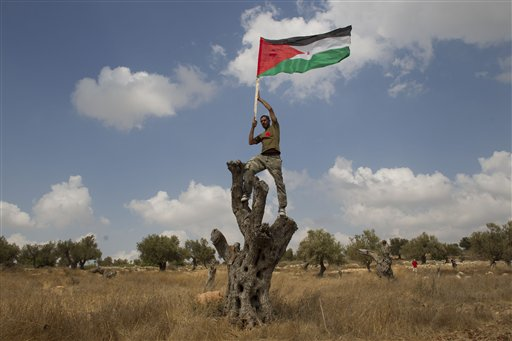
Obama should support Palestinian statehoodA Palestinian waves a flag during a demonstration in the West Bank, Friday, Sept. 9, 2011

BOSTON — President Obama should not veto Palestinian national aspirations in the United Nations Security Council.

The president is not wrong in thinking that this would be better handled in negotiations between the Palestinians and Israel. It would be wonderful if Israel itself were to sponsor a Palestinian state, but this is not going to happen as long as Prime Minister Benjamin Netanyahu is in power.

He has spent his entire career trying to avoid Palestinian statehood with delaying tactics and maneuvers — seemingly willing to negotiate everything anywhere, but in reality putting up every obstacle he can in the path of peace and permanent settlement with the Palestinians.

Not that the Palestinians are guiltless in this stand off. They have had offers and opportunities they have not taken. But the entire Middle East is now in a state of flux and transition, and, as a practical matter, to try to keep the Palestinians frozen in their status as an occupied people without political rights is to ask for serious trouble — both for Israel and the U.S. The next Intifada will be far more destructive than the last two.

As a moral matter it is simply time to let the Palestinians have their state just as Harry Truman recognized that the Jews, after all they had been through in Europe in World War II, should have their state in 1948.

Many Israelis understand this. Former Defense Minister Binyamin Ben-Eliezer told The New York Times that “the world is tired of this conflict and angry at us because we are viewed as conquerors, ruling over another people. If I were Bibi Netanyahu I would recognize a Palestinian State. We would then negotiate borders and security.” But Netanyahu comes from the so-called “Revisionist” wing of Zionism that is reluctant to give up any part of what they consider the biblical land of Israel.

When David Ben Gurion on May 14th, 1948, declared that the state of Israel would come into being at midnight, America responded with de-facto recognition almost immediately. But the Soviet Union came through first with de-jure recognition, something the U.S. did not grant until an elected government had been formed in January of 1949.

Even with the two superpowers onboard, the U.N. Security Council did not grant Israel U.N. membership until May 11, 1949 — a full year after the state was declared — and after a long fight to physically secure its borders.

Palestine might come into being in reverse order — declare sovereignty now, gain admittance to the U.N., and then negotiate the borders with Israel, as Ben-Eliezer suggested.

There are many who say there are dangers involved in a Palestinian state, and they are right, just as those in Truman’s State Department, including George C. Marshall, were right in warning that the creation of a Jewish state would cause a sea of troubles.

And there are those who say that the Palestinian problem is exaggerated, that it doesn’t really matter if they remain an occupied people, because giving them their freedom would not solve all the issues of the Middle East or placate Islamic extremists. And they, too, are right. Giving the Palestinians their state would not solve all the issues of the Middle East, but it would surely help. Again and again, year in and year out, the centrality of the Palestinian problem never goes away. Even General David Petraeus, from his command post in Afghanistan, recognized that Israel’s occupation of the Palestinians was hurting America’s war efforts as far away as Pakistan and Afghanistan.

Richard Perle and David Frum, in their book, “An End to Evil, How to Win the War on Terror,” submit that “in the Arab and Muslim World, the Palestinian issue has never been about compassion, mercy, or even justice. First and always, this issue has been about vengeance…”, i.e., “the destruction of Israel and the re-conquest of the Holy Land.” This might be true of some, but this is akin to saying the Jews in Israel want to take over Jordan just because that was an original “revisionist” goal back in 1947, or because David Ben Gurion once put feelers out to the British and French in 1956 that Jordan should be divided up between Israel and Iraq. Yes, some Arabs still might want to destroy Israel, just as some Israelis want to expel all the Palestinians, but that does not represent the vast majority nor government policy in either Israel or the Arab world.

The Obama administration tried its best to talk the Palestinians out of going to the United Nations to legitimize their state but failed. Given the administration’s record, this failure was entirely predictable. Obama came into office seeming to promise a renewed energy toward trying to solve the Palestinian problem, following President Bush’s near-total support for whatever Israel wanted.

Obama went eyeball to eyeball with Netanyahu over settlements, and the Palestinians saw that Obama blinked first. It was obvious then that Obama might talk a good game, but that the Israeli tail was always going to wag the American dog. The sight of Netanyahu who, having defied and insulted the American president, addressing a joint session of Congress with congressmen and senators of both parties jumping to their feet like jack-in-the-boxes to show their support, was all anyone needed to understand Israel’s power in the American Congress.

The Democratic Party has to be mindful of pro-Zionist political support. But it is in America’s strategic interest, and ultimately in Israel’s interest too, to lance the boil of the Israel-Palestinian conflict.

If it was the right thing to do to recognize the state of Israel when it was first born, it is time now to grant the same rights and privileges to the Palestinian people. The Obama administration is always talking about being on the right side of history in the Middle East. The United States could abstain, if it must, but vetoing Palestinian nationalist aspirations would put us on the wrong side of history.

Continue Reading Close

Syria at a “tipping point”

As diplomats debate a Yemen vs. Libya path for Syria’s revolt, civilians fear a new scourge: sectarian violence

  • more
    • All Share Services

Topics: ,

Syria at a This frame grab made from an amateur video provided by Syrian activists on Monday, May 28, 2012, purports to show the massacre in Houla on May 25 that killed more than 100 people, many of them children. (Credit: AP Photo/Amateur Video via AP video)
This article originally appeared on GlobalPost.

DAMASCUS, Syria and BEIRUT, Lebanon — With bodies literally piling up at the feet of his ceasefire observers, Kofi Annan, the UN-Arab League envoy, left Damascus Wednesday after his latest meeting with President Bashar al-Assad.

Global PostAs he left, he warned that Syria faces a “tipping point.”

Policymakers and political analysts are debating two potential paths for the uprising in Syria, based on the outcomes of two very different Arab revolutions: The NATO-led intervention that toppled Libya’s former dictator, or the orderly, by comparison, transfer of power that ousted Yemen’s president but left much of his family in power.

“The big question today is to implement the Libyan or Yemeni scenario in Syria,” the head of a Damascus-based think tank told GlobalPost, requesting anonymity to speak without fear of reprisal.

“The United Sates will discuss the Yemeni scenario with Russia to implement it in Syria, but if Russia refused then the Libyan scenario is coming for sure.”

US President Barack Obama is already actively seeking Russian cooperation on removing Assad from power while retaining the structure of the state, according to a report last week in the New York Times.

Yemen’s Vice President Abdu Rabbu Mansour al-Hadi ascended to the top job backed by both the opposition and by powerful remnants of former President Ali Abdullah Saleh’s regime — including his own family members still running the security forces.

But analysts say Syria’s vice president, Farouk al-Sharaa, who has been all but absent from the public sphere since the start of the uprising in March last year, has neither the trust of the opposition nor the support of the regime, making any such transition of power highly problematic.

“Sharaa is very weak and has no power and popularity among either pro- or anti-regime Syrians. The army and senior security officers don’t respect Sharaa, who spends his days between his house and his office doing nothing,” the analyst said.

“He doesn’t even hold meetings with visitors to Syria or key local figures. So the Yemeni scenario is going to fail, even if Russia supports it.”

Amid the international outcry that followed the killing by Assad’s security forces of at least 108 people in the villages of Houla, in northwest Syria, on March 25, Russia repeated its refusal on Wednesday to sanction any international action that could lead to military force used against Assad’s regime.

The continued diplomatic deadlock came as details emerged that the massacre, one of the worst in the 14-month uprising, was sectarian in nature, leading to fears that the conflict was shifting from an uprising to a civil war.

Moreover, the conflict appears to have sharper consequences than previously believed: According to a report co-authored by the Syrian Network for Human Rights and the Damascus Centre for Human Rights Studies, more than 14,000 people have died, well above the widely quoted but outdated UN estimate of 9,000.

UN monitors in Syria, whose accounts were corroborated with other sources, found that most of the 108 Syrians killed in Houla appeared to have been shot at close range in “summary executions of civilians, women and children.”

Fewer than 20 people were killed by government artillery fire, UN High Commissioner for Human Rights spokesman Rupert Colville told a news conference in Geneva on Wednesday.

Speaking to GlobalPost from Houla, a resident said that the attacks began after security forces had opened fire on a large anti-regime protest on Friday afternoon.

In response, local rebel fighters from the Free Syrian Army, which he said had been largely in control of Houla for the past three months, stormed military checkpoints set up around the villages and launched a coordinated attack against a nearby army base, using rocket-propelled grenades and machine guns.

That triggered the army to launch a barrage of rocket fire on the four villages, using similar weapons as the assault that devastated Homs’ Baba Amr district. Previously, the resident said, Houla had suffered bombardment, but from tank fire, not the heavier rockets and mortars used in the May 25 attack.

Houla is a collection of four Sunni-majority villages some 20 kilometers northwest of Homs. It is surrounded by villages that are home to Allawites, a sect of Shiite Islam, to which the Assad family and a majority of the regime’s ruling elites belong.

An opposition activist in Houla told GlobalPost that as shelling intensified around 6:30 p.m., he saw what he believed were Allawite militiamen, known as shabiha, arriving on five buses protected by soldiers.

“The bombing began as usual and there were numerous injuries. But this Friday the bombing was more severe. During the shelling, buses with shabiha arrived at the village of Houla from the surrounding villages of Fulla, Al Qabu and Al Shinnea.”

The activist did not witness the killings himself, but said that when members of the Free Syrian Army returned to Houla after battling the military late on Friday night, he and other activists entered the homes that had been raided.

“We entered the houses after the departure of the shabiha and found families had been slaughtered with knives. Almost all the women and children had been stabbed and the men had been shot,” he said.

“Frankly, what I felt when we were dragging the bodies of women and children out of their homes is only that I want to take revenge against the other sect which has committed this massacre. Unfortunately this is how the regime has made us think.”

Thirty-four women and 49 children, by the UN’s count, were stabbed or shot dead at point-blank range.

Most of those killed belonged to the large Abdel Razzak family. Local activists provided Human Rights Watch with a list of 62 dead members from the family. According to survivors, the Abdel Razzaks own the land and farms next to the national water company and the water dam of Taldou, one of the villages of Houla, and lived in eight or nine houses next to each other, two families to a house.

“[The killers] were wearing military clothes. I couldn’t see their faces. I thought they wanted to search the house,” an elderly woman from the Abdel Razzak family told Human Rights Watch.

“After three minutes, I heard all my family members screaming and yelling. The children, all aged between 10 and 14, were crying. I heard several gunshots. I was so terrified I couldn’t stand on my legs. I heard the soldiers leaving. I looked outside the room and saw all of my family members shot. They were shot in their bodies and their head.”

Syria’s state news agency SANA said Assad told Annan today that “terrorist groups” had stepped up their actions recently, and it was up to the states that arm, finance and harbor them to abide by Annan’s plan to end the violence engulfing Syria.

Civilians are cynical about the negotiations.

“Syrians don’t want words on paper and meetings in offices or five-star hotels. Syrians want practical solutions to stop the killing and massacres,” Osama, a 30-year-old civil engineer who said he supports neither the opposition nor regime, told GlobalPost in Damascus.

“The Annan plan and 300 UN monitors couldn’t prevent massacres in Houla, Hama and Homs in the last three days. Syrians began to believe there is no hope from the UN and the international community. If the people of Houla had weapons, then Assad’s Allawite Shabiha could not have slaughtered those women and children in cold blood.”

A correspondent in Damascus, Syria, contributed to this report. Hugh Macleod contributed from Beirut, Lebanon.

Continue Reading Close

Ireland’s euro vote: Why it matters

Tomorrow's referendum on austerity measures could be a milestone for the country -- and the continent's crisis

  • more
    • All Share Services

Topics: ,

Ireland's euro vote: Why it matters Dubliners bask in the sunshine on the River Liffey on Friday, May 25, 2012, as an anti-EU poster advises voters to reject the European Union's fiscal treaty in Dublin, Ireland. (Credit: AP Photo/Shawn Pogatchnik)

BERLIN — While the euro zone bickers over how to stimulate growth, the process of implementing the austerity element of Berlin’s vision for Europe grinds on.

Global PostSo far, five countries have ratified the Fiscal Treaty — the agreement pushed by Chancellor Angela Merkel, and given a preliminary nod in December — requiring countries to limit their deficits and debt, or else face heavy penalties.

This week the Irish get to have their say. While the other countries simply need parliamentary approval, in Ireland the decision is being made via a referendum. In February the Attorney General advised the government that a public vote was needed, as any significant changes to the constititution in Ireland require a referendum.

Unlike the votes on the Lisbon and Nice Treaties, both of which the Irish rejected on the first go, there is no veto this time. The Fiscal Treaty comes into force when 12 of the 17 euro zone members ratify it.

The latest polls indicate that the Irish are going to vote in favor of austerity, bucking the recent voting trend in Greece, France and even Germany. But that doesn’t mean that the Irish are enthusiastic adherents of Merkel’s belt-tightening fixation.

As much as anything, the Irish referendum could be described as a battle between fear and anger.

“It depends which motivates us more,” says Ben Tonra, professor of international relations at University College Dublin.

Only countries that ratify the Fiscal Treaty will have access to the euro zone’s new permanent bailout fund, the European Stability Mechanism (ESM), which comes into force on July 1. Many Irish voters realize that, even if they hate austerity, they may well need access to the ESM.

In November 2010, Ireland obtained 85 billion euros from the troika of creditors — the European Union, the European Central Bank and the International Monetary Fund.

While the government has professed that it will again seek funding directly from the bond markets at some stage in 2013, that is looking increasingly unlikely. With the current level of uncertainty in the euro zone, Dublin could well be forced to look for a second bailout.

As for the referendum, the “yes” campaign argues that without access to the ESM, future austerity could be even harsher. And they say that many of the requirements of the Fiscal Treaty are already being met as part of Ireland’s bailout program.

They also warn that a “no” vote could undermine the country’s credibility, since Ireland is hugely reliant on foreign direct investment. Those advocating in favor of what they call the “Stability Treaty” argue that Ireland’s recovery would be threatened if foreign investors were spooked by a rejection of the treaty and any implications that it could have for Ireland’s position in the euro zone.

On Sunday night in a televised speech, Prime Minister Enda Kenny warned that rejecting the treaty would bring “uncertainty at a time Ireland definitely doesn’t need it.”

That sense of uncertainty could persuade many to vote yes, even if they disagree with the wisdom of the treaty itself.

“I think this is a lousy treaty,” says Tonra. “It’s bad economics, it’s bad politics and it’s badly written. But what it does do is it gives us access to cash.”

On the flipside of these fears about the future is a profound anger in Ireland over the country’s current predicament.

Many Irish people are furious at their political elite for getting them into this mess, and at the European Union for forcing them to effectively take on the gambling debts of speculators, bankers and property developers.

The bailout became necessary as a result of the previous government’s ill-fated decision to guarantee all of the country’s banking debts in 2008. Those debts turned out to be astronomical, as a result of reckless lending to property developers, and Ireland bailed out the banks at enormous cost.

As the state took on these liabilities, the markets pushed up its borrowing costs, leaving Dublin with little choice but to turn to the troika.

Making matters worse, the state has been overly reliant on real estate transaction taxes. Once the property market crashed, that left a massive hole in public finances. At the same time, there is more demand on the public purse due to soaring unemployment. For 2012, the funding gap is an estimated 13 billion euros.

That deficit comes despite a succession of harsh budgets that have been imposed at the behest of the troika, including billions of euros worth of expenditure cuts and new taxes.

At the same time, the bondholders — who had loaned to the reckless Irish banks — have been paid back billions of euros from the state coffers.

The Irish government’s attempts to persuade the ECB of the need to write down this albatross of bank debt have been to no avail so far. As a result, the public anger is directed not just at their own politicians but at Brussels and Frankfurt, too.

“The ECB has been utterly dogmatic in terms of protecting not only senior bondholders but junior bondholders,” explains Tonra. “And has basically said all these speculators have to be paid back and they have to be paid back on the shoulders of Irish taxpayers.”

Commentators often point to Ireland as Europe’s austerity success story. Unlike in Spain and Greece, on the surface, Ireland’s economy appears to have returned to growth, albeit modestly, with the EU predicting a rate of just 0.5 percent for 2012. Moreover, official figures show a trade surplus, although this may not be a reliable indicator since it is distorted by the many multinationals based in Ireland who repatriate their profits.

Yet most Irish people don’t feel that things are getting better. The number of those struggling to pay back often-massive mortgages is growing. On Friday the Central Bank announced that one in 10 mortgages are in arrears of more than 90 days. Unemployment remains around 14 percent, up from 4.5 percent just five years ago, and it would be even higher if not for high levels of emigration and the return home of many immigrants who contributed to Ireland’s boom.

The party seen to have caused the mess, Fianna Fáil, was booted from office last year. However, members of the current government, particularly the center-left Labour Party, have seen their support decline, with backers angry at them for continuing the same austerity agenda.

Left-wing nationalist party Sinn Féin, the biggest critic of the Fiscal Treaty — which it dubs the “Austerity Treaty” — has seen its support soar, particularly among working-class voters.

Other opponents include businessman Declan Ganley, who helped defeat the Lisbon Treaty first time around, and smaller left-wing groups, including the Socialist Party.

They warn that the treaty institutionalizes an austerity policy that is not working and will not fix Ireland or Europe’s problems, despite promises to tack on some kind of growth element. “Austerity contradicts growth, austerity kills growth,” says Paul Murphy, a member of the European Parliament for the Socialist Party. He argues that by voting yes, the Irish people would be signing up for even harsher austerity.

The no campaign is calling on voters to not let themselves be persuaded by the warnings of the government about the ESM, arguing that the EU would never allow a member state to be in a position where it had no access to funding.

“The yes side has been overwhelmingly dominated by fear, by really scaremongering people,” says Murphy. “They are painting a bleak Armageddon picture of what will happen if people vote no.”

He and the other opponents claim that Ireland has a veto over the ESM, which has yet to be anchored into EU law, something that requires unanimity among all 27 member states. They argue that the government could say that unless the link between the ESM and the Fiscal Treaty is removed, they will block the bailout fund. However, the government says it has already agreed to the ESM.

Murphy says that if the Irish were to vote no, it would undermine the treaty across the bloc. “If you had a no vote in the only country that has a popular vote on it, it would have ramifications across Europe” and send “a clear message to Merkel and her friends across Europe.”

Yet critics say the no campaign has failed to be convincing on the crucial issue of future funding.

“When it comes to this vital question of: Where is the money going to come from? How do we fund our services? How do we bridge the gap between what goes in and what goes out? I think even fair-minded, objective people would say that they fail rather dismally,” says John O’Brennan, director of the Centre for the Study of Wider Europe at the National University of Ireland, Maynooth, outside of Dublin.

O’Brennan himself is uneasy about the Fiscal Treaty, particularly as it is another sign of a move away from the community model that was a mark of the way the EU operated for so long, whereby institutions such as the European Parliament, Commission and Court of Justice acted as a counterbalance to national interests.

Within the euro zone, the trend has increasingly been for intergovernmental decisions. This allows the bigger countries such as France and Germany to steamroll the smaller peripheral ones. And this, he argues, is leading to an increasing democratic deficit in the EU.

Yet for all that unease and rage, it looks like the great anxiety about how Ireland will pay its way could have the upper hand on Thursday. A number of polls released over the weekend showed that the yes vote was in the lead. However, the large number of people who are still undecided means that there could be a late swing to the no side.

And turnout could be crucial. While polls ahead of the first Lisbon and Nice referendums showed that those treaties would be approved, the anti-Treaty voters turned out in greater numbers.

O’Brennan predicts that on Thursday fear is still likely to trump anger. “Undoubtedly there is an element there that wants to punish the government,” he says. “But that is tempered by the risks.”

“We are very angry, but we are not angry enough that we can vote no.”

Continue Reading Close

Syria’s walking wounded

Syrian forces target medical workers and hospitals, leaving the country's injured with no place to go

  • more
    • All Share Services

Topics: ,

Syria's walking woundedThis image, made from amateur video released by the Shaam News Network and accessed Monday, May 14, 2012, purports to show a Syrian rebel helping an injured man in Rastan, Homs, Syria. (Credit: AP Photo/Shaam News Network via AP video)
This article originally appeared on GlobalPost.

JABAL AL ZAWIYA, Syria — The pickup truck swerved around the corner as three frantic men stood on the back screaming,“Go! Go!” Bouncing painfully between their legs was a man drenched in blood.

Global PostHe was one of seven injured in a series of tank blasts last week in the village of Deersonpol, in Syria’s northern Idlib province. Four others were killed instantly in the attack by government security forces. Of the seven to undergo the harrowing route to the nearest “safe” hospital in Deir Alsharky, 12 miles of bad road away, three survived, three died and the whereabouts of the fourth remains unknown.

There were many hospitals much closer to the scene, but these are government run, and the risk of execution or arrest, particularly for those arriving with battle wounds, is so high that citizens throughout the area endure these dangerous journeys every day.

“Most of the death cases we see are because of the distance,” said Dr. Mohammed, a neurosurgeon who treated the Deersonpol cases at his clinic in Deir Alsharky. “Most bleed to death along the way. Today we lost three from injuries that could be treated if we’d got to them in time.”

Many doctors and patients asked to be referred to only by their first names for fear of authorities. Dr. Mohammed was no exception. After his home and his practice in Damascus were raided by authorities, he became wanted on the charge of treating injured demonstrators and members of the Free Syrian Army. He was forced to flee the city with nothing.

“The soldiers would come into the hospitals and kill and arrest patients, especially after the Friday demonstrations,” he said of his work in Damascus before he fled the city in January. “Even in the intensive care units, the soldiers would come in and kill the patients in their beds or drag them into the streets. I have seen this many times.”

Due to the risks, secret hospitals have sprung up across the country. Some are manned only by untrained nurses. Volunteer doctors and surgeons working in primitive conditions run others, like Dr. Mohammed’s clinic. Immediately after surgery, the patients are sent to safe houses protected by the Free Syrian Army, where their condition is monitored.

Doctors Without Borders, an international nongovernmental organization, confirmed the government practice of targeting medical workers and patients in a report released earlier this month.

“We saw militarized health care facilities, meaning that access to medical care depends on which side you belong,” said Brice de le Vingne, the organization’s director of operations in Brussels. “Health facilities are being targeted, thus endangering patients and preventing health care workers from doing their jobs. Health facilities and pharmacies are looted and destroyed.”

Dr. Mohammed said most of his equipment is donated and smuggled in from Turkey. He shows a respirator, two new surgical sets and a radio that just arrived. Medical supplies and medications are always in short supply.

For some patients, the treatment they need is simply not available in these makeshift secret clinics.

In Maarat Al-Numaan, a government checkpoint stands by the city hospital. A few blocks away in a narrow alley is the door to the secret clinic. The doctor here, Ahmed Rawin, said they are afraid to keep patient records in case of a raid. They list only those who need follow-up treatment in the safe houses in a small notebook. Dr. Ahmed told the story of one recent patient in desperate need of life support.

“We moved him to the international hospital under a fake name,” he said. “Within days the soldiers came and killed him. They threw his body into the street.”

Many seek treatment in Turkey, but the journey is difficult. Rowad, 22, said he just returned from surgery across the border. As a member of the Free Syrian Army, he was injured by shrapnel during a clash with government forces. Nerve damage caused him to lose feeling in his right leg. After surgery performed by Dr. Mohammed, members of the Free Syrian Army snuck him across the Turkish border for follow-up surgery.

“Most of the way we managed to go by car, but they had to carry me for about three kilometers,” said Rowad, who still has no feeling in his leg, but can now walk with the help of crutches.

Dr. Mohammed said in the past week he has sent three urgent cases across to Turkey. Two died en route.

Activist Abdul Aziz Agini, who works with the Free Syrian Army near the Turkish border, said he receives requests to arrange transport for patients almost daily.

“We suffer a lot to get them there. We must carry them on our backs,” he said.

There isn’t enough manpower for everyone, however, and many in desperate need of medical treatment must wait to find a safe passage.

In Ariha, another town in Idlib province, the smell was nauseating as a 60-year-old man removed a bandage from his infected feet — most of the skin and flesh was gone. The man, who works as a butcher, was arrested at a checkpoint. His court papers say he is accused of “participating in demonstrations.” He was held and tortured for 45 days.

“They hit my foot with a wire cable telling me to confess,” he said, adding that he was released 10 days earlier. “When they took me to court, they had to carry me. When the judge saw me, he didn’t even question me. He ordered my release.”

So far, the route through Turkey has been too dangerous for someone in his condition. Until now he has been unable to get any treatment.

“We are in a large concentration camp called Syria,” he said. “My fate is in God’s hands.”

Volunteer doctors say they receive many cases of torture by authorities. Treating these patients often leads to their own arrest. Dr. Najib Aledel has been imprisoned twice for his work in a secret hospital in Ariha. Ten days after his last release, Dr. Aledel said he was back on the wanted list.

“There was no injury for me,” he said in reference to his two months of total prison time. “But I saw very bad deeds happen to others, and there is no [medical] treatment inside the prisons.”

Dr. Aledel said the cease-fire agreement between the government of Bashar al-Assad and the Free Syrian Army is in name only. The patient number has dropped, but not significantly, he said. And medical supplies, he said, are so low he and his staff often give their own blood to patients in need of transfusions. He said there are no humanitarian groups or overseas aid, and the only supplies come through private donations, both local and international. In all clinics, doctors said they desperately need more support from abroad.

Mohammed, an activist and pharmacist that secretly supplies these underground clinics in Ariha, believes these attacks on the medical system are yet another way to instill fear into the people.

“The government is aiming for social chaos so people will get desperate and ask for the government to come back,” he said. “But now we have started. There is no going back.”

Continue Reading Close

Egypt erupts again

Anger over Egypt's surprising election results has spilled into the streets. It's now anyone's guess who will win

  • more
    • All Share Services

Topics: ,

Egypt erupts again The revolutionary youth of Egypt return to Tahrir to protest the outcome of the Egyptian presidential election, Cairo, Egypt, Monday May 28, 2012. (Credit: AP Photo/Fredrik Persson)
This article originally appeared on GlobalPost.

CAIRO, Egypt — Egyptian protesters set fire last night to the campaign headquarters of Ahmed Shafiq, the controversial presidential contender, following the official announcement of Egypt’s first round of presidential elections in Cairo.

Global PostHundreds of demonstrators took to Cairo’s iconic Tahrir Square to rally against Shafiq, a member and unabashed supporter of the regime of former President Hosni Mubarak, toppled last year following a wave of popular protests. At least eight people were arrested, but no injuries or deaths were reported.

Campaigning on law and order and a heavy-handed crackdown on anti-regime protesters, Shafiq secured second place in last week’s vote. In what many Egyptians say is the most polarizing outcome of the elections, Shafiq will face the Muslim Brotherhood’s candidate, Mohamed Morsi, in a run-off that pits Islamists against a Mubarak holdover on June 16.

Both Shafiq and Morsi scored surprise, upset victories against the other candidates, after trailing considerably in pre-election polls behind secular-liberal candidate, Amr Moussa, and independent Islamist, Abdel Meneim Aboul Fotouh.

Analysts and observers of Egyptian politics are reeling from the results, cautioning that right now the Egyptian electorate is so dynamic — with alliances and voter sentiment shifting so rapidly and unpredictably — that attempting to accurately forecast a winner of next month’s run-off is ultimately futile.

“Everything I thought I knew about this country has collapsed,” said Hisham Kassem, independent publisher and longtime opposition activist, of the divisive election results. “All analyses of the polls are so far unconvincing. The game has changed considerably.”

Indeed, for weeks preceding the elections — the first free, multi-candidate polls in Egypt’s history — both local and international think-tank surveys put Moussa, a former minister of foreign affairs and centrist figure, in the lead, with as much as 40 percent of the vote.

In the final tally, Moussa scored just under 11 percent.

In another bombshell, Hamdeen Sabbahi, a leftist-socialist candidate who, along with Morsi, never broke 10 percent in pre-election surveys, won both of Egypt’s most populated governorates — Cairo and the Islamist stronghold of Alexandria — to land in third place nationally.

Morsi, with the strong electoral machine of the Brotherhood behind him, was catapulted to first place with the most votes, after being written off as a weak candidate with only 8 percent of the vote prior to the vote.

The Brotherhood flourished for years as Egypt’s largest and most organized opposition force.

Some observers blamed the gross miscalculations on the difficulties of conducting research in Egypt, particularly in gauging voter sentiment in rural areas.

The government-affiliated Al Ahram Center for Strategic Studies, for example, conducted face-to-face interviews with 1,200 respondents for their surveys, but did not publish the socio-economic breakdown of the survey’s subjects.

“But sometimes in face-to-face interviews, villagers are influenced by having a village elder nearby,” said Rasha Hassan, a social researcher with Harassmap, an Egyptian, online social initiative that tracks sexual harassment trends through text messaging. “You have to take [things like this] into account.”

Telephone polls are also misleading, because most rural village households do not have landlines — only mobile phones.

Still, the polls, including one from the DC-based Brookings Institution that was in fact quite rigorous, could not capture the tumult and fluidity of voter sentiment in Egypt’s transition period, said Michael Hanna, a fellow at The Century Foundation in New York.

Similar to other countries that have made the transition from authoritarian to democratic rule, the Egyptian political landscape is likely to change drastically from one election to the next in the immediate post-revolution period, experts say.

There are many factors that could have swayed the vote, even at the last minute.

Least surprising was Morsi’s jump to first place, buoyed by the mammoth grassroots network of the Muslim Brotherhood that energized voters to go to the polls, analysts say. Many of their core ideological voters, particularly in Egypt’s impoverished southern region, may not have been represented accurately in the surveys.

Kassem said he had predicted there would be two strong voting currents — Islamist and pro-stability — but that the so-called “stability” vote would be represented by Moussa, who echoed many ordinary Egyptians’ sentiments by chiding demonstrators for spreading chaos.

Shafiq, as a member of the old regime who emphasized his military credentials during the campaign, did not have a true constituency among Egyptian voters, he said.

Shafiq was indeed ranking low in the polls, until a last-minute surge at the end of May, when several surveys from the Cabinet Information Decision and Support Center, a government-linked research group, put Shafiq in the lead.

Hanna credits his rise to violent clashes between protesters and military police at the ministry of defense in the Abbaseya neighborhood of Cairo earlier this month, and state media still controlled by Mubarak holdovers.

“Obviously the control of state media, the law and order narrative put forward by SCAF” — the Supreme Council of Armed Forces, made up of Egypt’s ruling generals — “is potent in combination with Abbaseya,” Hanna said. “It had a big impact on the election, drawing the stability vote from Moussa to Shafiq, whom some state-run polls were putting in the lead in the last days of the campaign period.”

But to draw a linear plot from secular and Islamist voter choices in the first round to the run-off would be a mistake, Hanna and Kassem say.

Saleh Ali Ahmed, a 39-year-old voter and self-described devout Muslim from the Brotherhood stronghold of Ismailia province, exemplifies the complexity of the Egyptian electorate.

“If the run-off is between Morsi and Shafiq, I will vote for Shafiq,” he said on the first day of the polls, before the official results were announced. “Morsi is very weak within the Brotherhood, and he will have no real power.”

Kassem said one can assume that those who voted for Moussa, a non-Islamist, will switch to Shafiq, who has promised to curb rising Islamist power.

“But it is just a guess,” he said. “And anyone’s guess is as good as mine.”

Continue Reading Close

Disneyland: Japan’s gay pioneers

A recent ceremony at Tokyo Disneyland highlights how far the country still needs to go for gay rights

  • more
    • All Share Services

Topics: , ,

Disneyland: Japan's gay pioneers (Credit: Cindy Hughes via Shutterstock)

TOKYO, Japan — In one respect, the decision by Tokyo Disneyland to allow a gay couple to hold their “wedding” at the theme park is a sign of progress in a country that has, until recently, largely ignored the issue of same-sex unions.

Global PostBut some campaigners have argued that leaving it to Mickey Mouse to give his blessing to Koyuki Higashi and her partner, Hiroko Masuhara — in a strictly symbolic ceremony — is also a mark of how far Japan has to go before it affords the same rights to the lesbian, gay, bisexual and transgender (LGBT) community as it does to heterosexual couples.

Tokyo Disneyland condoned this and all future same-sex ceremonies after receiving an inquiry from Higashi. Cue a confused response from a subsidiary, Oriental Land Company, which licenses the name and characters from Disney in the United States.

Higashi, 27, and her partner could “marry” at the park, they were told, but only if they dressed “like a man and a woman.” Park officials were worried that other visitors might be offended by the sight of two women in wedding dresses or morning suits.

The park relented on the dress code after a storm of protest on Twitter and other social media networks — it had all been a misunderstanding by an individual employee, it said — but the couple will not be allowed to exchange vows in the park’s chapel due to “Christian teachings.”

Those restrictions go to the heart of the flimsy protection offered to the rights of LGBT people in Japan, say campaigners. Homosexuality is not illegal, but same-sex marriages are not legally recognized.

“There needs to be more pressure for legal unions between gay people in Japan,” said Taiga Ishikawa, one of only a handful of openly gay politicians in the country. “This is only a guess, but I’d say there are more people now who are in long-term relationships and want that to be recognized in the form of a civil partnership.”

The 37-year-old, who won a seat on the Toshima Ward assembly in Tokyo last year, is campaigning to introduce an ordinance in the area to offer some form of marital recognition and to increase the number of administrative rights and services afforded to same-sex couples. But he admits that it’s “some way off.”

If Disneyland was being held up as an agent of progress, one of Japan’s most popular celebrities popped up to demonstrate that, in some quarters, ignorance reigns.

Commenting on TV on President Barack Obama’s recent declaration of support for gay marriages in the US, the film director and comedian Takeshi Kitano told a fellow guest: “Obama supports gay marriage. You would support marriage between humanoid and animals eventually, then,” before questioning the ability of gay couples to raise children.

Kitano has since tried to explain his outburst: “I was only talking about people who love their pets so much that they may think of marrying them,” AFP reported him as saying. “There is no way I look at gay people in the same way as I do animals, let alone implying sexual relations with animals.”

His were not the first comments with homophobic overtones to be made by a high-profile public figure in Japan. In late 2010, Shintaro Ishihara, the outspoken governor of Tokyo, suggested gay people were “deficient” after watching same-sex couples take part in a parade in San Francisco. “We have even got homosexuals casually appearing on television,” he said. “Japan has become far too untamed.”

Yuji Kitamaru, a journalist who writes about LGBT issues, said he was “very disappointed” by Kitano’s remarks, particularly as he has spoken up for minorities, including transgender people, in the past. “I felt it was a big betrayal not only to us and the audience, but also to himself. Public figures like Kitano can easily indulge in that kind of bigotry because Japanese people in general haven’t considered the difference between public discourse and private gossip.”

Yet Kitamaru, who has written on LGBT issues in Japan for two decades, believes social media has quickly become the forum for a more open discussion about sexuality, citing Twitter’s role in the Disneyland decision and a meeting held in Ni-chome, a gay neighborhood of Tokyo, to thank Obama for his support.

Higashi and her partner, meanwhile, have visited Disneyland to break their good news to Mickey Mouse. They have yet to set a date for the wedding, and there are reports that their inquiries were intended only to test the theme park’s commitment to equality.

Ishikawa welcomed Disneyland’s decision, which apparently came after officials in Tokyo contacted the company’s US headquarters. “I wrote 10 years ago that I looked forward to the day when gay and lesbian couples could hold hands and go to Tokyo Disneyland, so I’m very happy,” he said. “But we’re still not at the point where a man or woman can tell people, especially co-workers, that they have a same-sex partner.”

Continue Reading Close

Page 1 of 36 in GlobalPost