
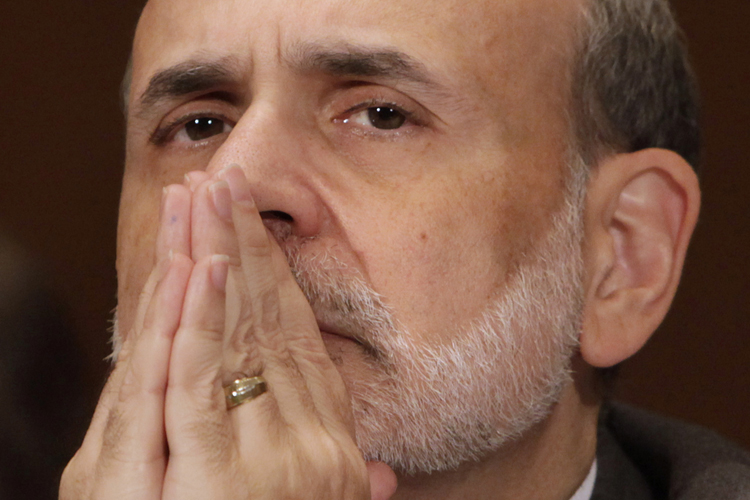

If the stock market reaction is any indicator, the early reviews of Ben Bernanke’s latest scheme to juice the economy, “Operation Twist,” are negative. At 1 p.m. ET, the Dow Jones industrial average was down nearly 360 points.
Deciphering investor psychology is never straightforward, and particularly so recently, when there are so many potential reasons for fear and panic: our amazingly dysfunctional U.S. Congress, the ongoing European drama, and the steady drumbeat of negative economic indicators. But today’s tremors can be tied to the Fed’s announcements on Wednesday fairly easily.
The statement released by the Federal Open Market Committee was the most downbeat of the entire year to date. After months of telling us that the slowdown was caused by temporary factors that would ameliorate before the end of the year, the Fed was forced to acknowledge that there are “significant downside risks to the economic outlook.”
So the Fed took action, and while the steps it unveiled were more aggressive than most people expected, and certainly constituted a rebuke to GOP congressional leaders who were telling it not to do anything, the strategy isn’t going to be enough to make a significant difference. That’s a downer: When you acknowledge seriously deteriorating conditions but take insufficient action to address them, you inject more fear into the markets.
So what exactly did the Fed do? What is Operation Twist?
There are two key elements.
First, the Fed announced that, over the next nine months, it would sell $400 billion worth of short-term government securities and buy $400 billion worth of long-term government securities. This doesn’t change the overall Fed balance sheet, so it can’t be caricatured as “printing money.” But what it does do is change the average length of duration of the securities that the Fed is holding.
And that, in turn, means that there will be fewer long-term securities available on the open market for other investors to buy. Scarcity will increase demand, and in consequence, the yields on those bonds — the interest rates that the U.S. government has to offer to attract buyers — will fall. This will effectively lower borrowing costs throughout the entire country. And theoretically, that should stimulate economic activity.
Second, the Fed announced that it would reinvest the cash from expiring mortgage-backed securities into new mortgage-backed securities. This represents a reversal of the Fed’s previous strategy, which was to allow its huge portfolio of mortgage-backed securities to gradually shrink. The result of this reversal should be downward pressure on mortgage interest rates, which would, again theoretically, result in an upsurge in refinancing and a boost to the housing market.
Economists generally agree that these moves will have some impact. The problem is that they just don’t expect it to be very large. Borrowing costs are already very low, but gunshy banks just aren’t willing to make loans, no matter how cheap the cost of capital. The main problem afflicting the U.S. economy is a massive shortfall of demand, and tinkering at the margins with interest rates isn’t going to change much. As Paul Krugman pithily put it, the Fed’s action is like “using a water pistol to stop a charging rhino.”
However, the fact that the Fed felt compelled to make these moves, even after receiving a letter from the Republican congressional leadership demanding that it take no “extraordinary interventions” in the economy, and in the context of Republican presidential candidates declaring that such intervention is “treason,” is all the proof we need that the U.S. economy is in trouble.
What the Fed announced yesterday is hardly “treason,” by any sane interpretation. One could even argue that it doesn’t measure up to the level of “extraordinary.”
But it’s also not enough to cure what ails us, and that’s why markets are plummeting.
