Energy
Solyndra's China syndrome
While Republicans seize upon a solar power fiasco to attack green energy, the Chinese get even more ambitious
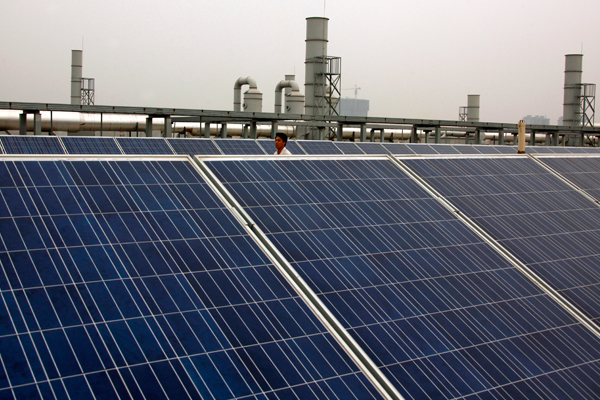
A worker walks behind solar panels on the factory roof of the Yingli Green Energy Holding Company in Baoding, Hebei Province.(Credit: Reuters/David Gray) When faced with a panel of out-for-blood House Republicans, keeping mum is probably a prudent idea. But the sight of Solyndra’s corporate executives pleading the fifth amendment at Friday morning’s Congressional hearing certainly didn’t inspire confidence. Whatever one thinks of the merits of industrial policy targeted at green energy, Solyndra’s failure is a grade A debacle. While the New York Times reports today that there is no evidence yet of direct political favoritism, it probably wasn’t a good idea for Solyndra executives to be telling Congress that the company was doing fine just five weeks before declaring bankruptcy.
The Times makes a convincing argument that the White House misjudged the state of the world solar power market in its eager push to get Solyndra’s loan guarantee guaranteed. Thas a shame — in a perfect world, we would all wish for a government that never made a bad investment, and never backed a loser. But the hypocrisy of Republicans on this issue is absurd. The economics of nuclear power are so dicey that private insurers refused to offer policies on nuclear power plants until Congress passed a law limiting nuclear power utility liability and putting the taxpayer on the hook for the costs of a meltdown. But Republicans love loan guarantees for nuclear power plants.
The broader context around the Solyndra decision is that the nation was on the brink of a depression and the Obama administration was attempting to move as quickly as possible to pump money into the economy that would not only stimulate economic growth, but also serve the larger agendas of creating green jobs and combat the challenge of climate change. If mistakes get made in the pursuit of that agenda, can’t reasonable people accept them as the cost of doing business?
But there’s an even larger context. China will shortly roll out its 12th five-year-plan for renewable energy deployment. The details of China’s plan, as reported by Melanie Hart at Think Progress, are nothing short of staggering.
According to the latest leaks in the Chinese media, the new renewable energy plan will raise solar targets to unprecedented levels: 10 GW of installed solar capacity by 2015, including 9 GW from photovoltaic installations and 1 GW from solar thermal electric power generation, and 50 GW total installed capacity by 2020.
The United States is currently ahead of China, with 2.6 GW installed solar capacity at year-end 2010. The United States is also leading in solar equipment, with $1.9 billion in overall net exports in 2010, and a $247 million trade surplus with China.
For China, these new targets are truly big. As of year-end 2010, China had around 700 megawatts of installed solar capacity, so meeting the new 2015 target will require adding another 9.3 GW to the grid — a capacity expansion of over 1,000 percent during the 2011-2015 five-year plan period.
Will China’s government occasionally subsidize the wrong solar power technology in pursuit of these goals? Assuredly so! Will corruption steer government dollars into private hands? Without question! Will China end up dominating a crucial technology of the 21st century that possibly points a way out from global fossil fuel dependence. Well, I can’t say yes for certain, but I can guess that the probability of China getting there is lot more likely than it is for the United States. Earlier this week, I reported that in March, former Michigan governor Jennifer Granholm met a Chinese official who was positively gleeful at U.S. failure to pursue an aggressive national energy policy. No wonder!
I would never want to be a citizen of a one-party dominated repressive state like China, but the U.S. is now so far at the other end of the spectrum of government efficacy that is downright embarrassing. As I write these words, Republicans and Democrats are at loggerheads — with another government shutdown possibly looming — because Republicans want to offset the cost of disaster relief by cutting funding for green energy initiatives. It is a position that manages to simultaneously be transparently political and incredibly dumb. And it’s business as usual for the U.S. Congress.
Andrew Leonard is a staff writer at Salon. On Twitter, @koxinga21. More Andrew Leonard.
Worse than Keystone
Environmentalists are focused oil and gas, but a bigger carbon disaster may be brewing in the Pacific Northwest
A coal mine owned by Arch Coal Co. (Credit: AP/Matthew Brown) Coal is without question our dirtiest fuel source: When burned, it dumps toxins like mercury and nitrogen oxides into the air and packs an outsize punch when it comes to carbon emissions. Since America has a lot of it, though, we’ve tended to use a lot: Historically, around half our electricity has been generated by coal combustion plants. But as a result of sustained anti-coal activism, low prices for natural gas, and new EPA regulations on power plant emissions, Americans are using a lot less coal than we used to, and the future of the sooty stuff in this country is looking dim. So the U.S. coal industry is pinning its hopes on China. While historically most of our exported coal has gone to Europe, U.S. exports to China increased 176 percent between 2009 and 2010, and that number is likely to keep rising as the Asian market for coal continues to expand. The prospect of shipping coal across the Pacific is even more appealing considering that Western states like Wyoming and Montana have vast coal reserves in the Powder River Basin, one of the largest coal deposits in the world.
Continue Reading CloseAlyssa Battistoni writes about the environment and politics from Seattle. More Alyssa Battistoni.
We don’t need new roads
America's love affair with cars is finally waning. Investing in more highways is bad policy
(Credit: ARENA Creative via Shutterstock) Interstate 70 in Colorado, one of the nation’s best-known arteries, is the latest thoroughfare to incite an archetypal fight. Running at capacity as it cuts through Denver, this gateway to the Rocky Mountains is about to be expanded over the objections of residents whose low-income neighborhoods will be sliced apart.
No doubt, the road will probably win — as roads almost always do in these battles. Indeed, the story of I-70 summarizes the 60-year tale of urban development in modern America: Instead of beefing up public transit, cities build neighborhood-destroying highways, cars fill up those highways, cities then build more highways to alleviate traffic, and then yet more cars flood the roads, creating even more traffic. Known as the “fundamental law of highway congestion,” this cycle perfectly embodies the “if you build it, cars will come” axiom confirmed in 2011 by researchers at the University of Toronto.
Continue Reading Close
David Sirota is a best-selling author of the new book "Back to Our Future: How the 1980s Explain the World We Live In Now." He hosts the morning show on AM760 in Colorado. E-mail him at ds@davidsirota.com, follow him on Twitter @davidsirota or visit his website at www.davidsirota.com. More David Sirota.
The rules that should govern energy subsidies
Taxpayer dollars shouldn't be propping wealthy fossil-fuel companies whose products we want less of
In this March 19, 2012, photo, a motorist pumps gas at a Mount Lebanon, Pa., mini-mart (Credit: AP Photo/Gene J. Puskar) Along with “fivedollaragallongas,” the energy watchword for the next few months is: “subsidies.” Last week, for instance, New Jersey Senator Robert Menendez proposed ending some of the billions of dollars in handouts enjoyed by the fossil-fuel industry with a “Repeal Big Oil Tax Subsidies Act.” It was, in truth, nothing to write home about — a curiously skimpy bill that only targeted oil companies, and just the five richest of them at that. Left out were coal and natural gas, and you won’t be surprised to learn that even then it didn’t pass.
Continue Reading CloseBill McKibben is the Schumann Distinguished Scholar at Middlebury College, and founder of the global climate campaign 350.org. His latest book is "Eaarth: Making a Life on a Tough New Planet.". More Bill McKibben.
The new oil reality
Get used to $4 a gallon. The cost of extracting and refining petroleum is higher than ever -- and that won't change
(Credit: AP Photo/Gene J. Puskar) Oil prices are now higher than they have ever been — except for a few frenzied moments before the global economic meltdown of 2008. Many immediate factors are contributing to this surge, including Iran’s threats to block oil shipping in the Persian Gulf, fears of a new Middle Eastern war and turmoil in energy-rich Nigeria. Some of these pressures could ease in the months ahead, providing temporary relief at the gas pump. But the principal cause of higher prices — a fundamental shift in the structure of the oil industry — cannot be reversed, and so oil prices are destined to remain high for a long time to come.
Continue Reading CloseMichael T. Klare is a professor of peace and world security studies at Hampshire College and the author of "Resource Wars," "Blood and Oil," and "Rising Powers, Shrinking Planet: The New Geopolitics of Energy." More Michael Klare.
Obama’s most dangerous foe: High gas prices
The president's energy speech calls for a review of his record. He gets a B+ overall, but an F on climate change
(Credit: AP/Ben Margot) Looking for the biggest threat to Obama’s reelection? Hint: It’s probably not Mitt Romney, Rick Santorum, Newt Gingrich or Ron Paul. The president’s most lethal opponent lurks wherever you choose to fill up your gas tank: high gas prices.
This week, the average price of a gallon of gas in the United States hit $3.57. That’s the highest prices have ever been in February, a fact that is all the more sobering when one considers that prices usually rise in the summer, so more pain is likely on the way. And while it has been reasonably well-established that high gas prices, in and of themselves, don’t necessarily sound the death knell for an incumbent, there is definitely a link between the cost of energy and the health of the economy. And since the health of the economy this summer will probably be the single most important factor determining who wins the White House, the equation becomes pretty simple. If high gas prices derail the current economic recovery, Obama becomes more vulnerable.
Continue Reading Close
Andrew Leonard is a staff writer at Salon. On Twitter, @koxinga21. More Andrew Leonard.
Page 1 of 55 in Energy