
Wall Street

What no-drama Obama could learn from no-hysterics Eric

With mild manners, New York Attorney General Eric Schneiderman takes a hard line

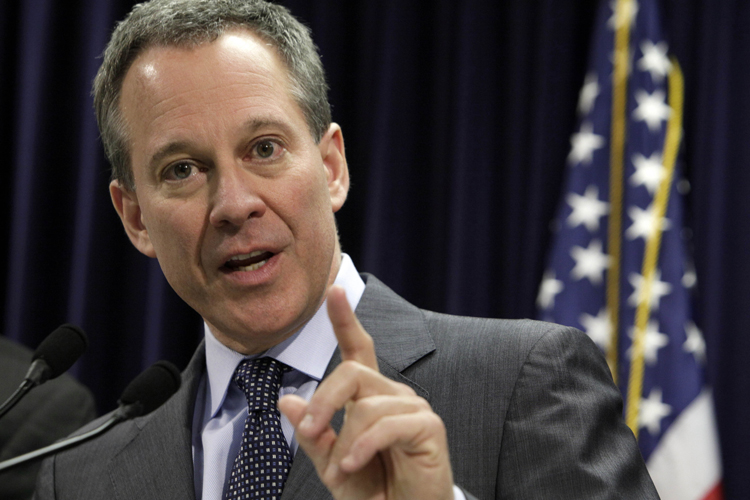
New York Attorney General Eric Schneiderman answers a a question during a news conference in his New York City office, Friday, March 18, 2011. The New York attorney general says the earthquake resistance of the Indian Point nuclear power plants should be considered in the plants' application for new 20-year licenses. Attorney General Schneiderman says federal regulators have ignored the plants' quake safety in the relicensing process. He said Friday that the Nuclear Regulatory Commission should amend its regulations to require a seismic analysis. (AP Photo)(Credit: AP)

The man New Yorkers elected as their latest Sheriff of Wall Street seems so much smaller than one expects a man in such an outsize job to be, sitting behind his huge desk flanked by a potted rubber plant on one side and the state flag on the other. Behind him, the behemoth black iron shell of the Freedom Tower — Manhattan real estate’s rough, unfinished rebuke to terrorists — hogs the sky and blocks out the sunset.

Low-key and boyish-looking at 55, New York Attorney General Eric Schneiderman is the American progressive movement’s best and probably last hope for some kind of public retribution against the banksters, some righting of wrongs — rolling of heads — as far as the Great Recession. Yet, he is the anti-Spitzer, in style, if not substance. He has none of Eliot’s dominating physicality, none of the hawk-eyed vigor of the man striding around town with everyone’s high hopes riding on his shoulders, until he fell, quite literally, on his own figurative sword. This reasonable character could not, one hopes, turn out to be Client 10.

Schneiderman, like Obama, comes from the low-drama school of political presentation. He doesn’t get red-in-the-face mad. He doesn’t seduce. He’s earnest and self-effacing and pedagogical. But unlike the president, he has a steady refusal to back down and a ready willingness to fight. He is the antihero that boiling mad progressives hope can manacle and perp-walk those responsible for the financial crisis.

Schneiderman may not disappoint. In an interview with Salon in his office, Schneiderman refused to get specific about criminal or civil, jail time or fines. But he made clear that he has committed time and staff to an investigation with goals that go well beyond extracting $20 billion in exchange for release from prosecution, the deal that his fellow state attorneys general have tossed onto the table down in Washington, and which the Obama administration would like to see him sign.

“The people who caused this crash have to be held accountable and I don’t detect any diminution in the desire of the people of New York for that basic kind of justice to be done,” he said. “Part of this [investigation] is to air this out and expose it so we can make sure it never happens again.”

What everyone wants to know, of course, is can he play to win in the contact sport of Wall Street litigation? If, as he says, his time in the New York Assembly taught him that politics was “a contact sport,” it was football. The Wall Street game is more extreme, Thai boxing, maybe. I asked him if he thought he had what it might take — the starch, the fight and the clean trou with which to wade into battle. I asked, or rather told him, his fight was “dangerous.”

“Well, we’ll find out, won’t we?” he shrugged.

As if responding on cue to that taunt, the New York Post reported two days later that one of Schneiderman’s staff attorneys had been moonlighting as a dominatrix for hire under the name Alisha Sparks. In her day job, she had negotiated deals with errant bankers, by night she was allegedly taking money to whip submissive men into states of bliss. Schneiderman promptly put her on unpaid leave on the basis of the charge that she had broken the rule against outside employment. His press secretary assured me that Sparks hadn’t come anywhere near the current ongoing investigation. But financial bloggers immediately smelled a rat and suggested the outing was just the beginning of a coordinated dirty war on Schneiderman’s office as he turns up the heat with bank subpoenas.

“I think the banks are very scared,” said Tom Adams, a former securities insurer who now writes about the banking industry for nakedcapitalist.com. Adams says he believes Schneiderman has no shortage of hurt and angry former Wall Street players willing to talk to him about what went down.

“To impose accountability seems to be an overarching theme for him, by pursuing this in a way the SEC hasn’t,” Adams went on. “A crisis happened and there were people responsible. I think he has fertile territory in MBS [mortgage backed securities] and CDOs [collateralized debt obligations] and if he actually names individuals and gets meaningful time, that would be significant, more than taking away the jets or the Hamptons homes.”

For all his mildness, Schneiderman disdains the current discourse of Washington.

“One of the things that concerns me right now is this effort to rewrite history, to move us away from the fact that it was bad deregulatory moves and greedy, risky conduct that caused this to happen and that it wasn’t the fault of the teachers and cops and firefighters who now seem to be the targets of this effort to cut spending. The markets didn’t crash because we were paying too much to teachers.”

Nice words to hear from someone with subpoena power on Wall Street. But in June, Iowa Attorney General Tom Miller booted Schneiderman off the 50-state AG’s committee that’s been trying to make its own deal with the banks over mortgage servicing. Miller’s spokesman in Des Moines said Schneiderman’s desire to go after the big fish — the investors and banks — would hurt consumers.

“We are trying to focus on homeowners, not investors,” said Geoff Greenwood of the Iowa AG’s office. “We are focused on foreclosure, servicing. We are not trying to address everything under the sun in connection with our financial crisis and we think that by including securitization we are definitely stalling the case, broadening beyond homeowners and potentially pitting homeowners against investors.”

Schneiderman responds that he’d rather not “get into a tit for tat” over what happened with the Iowa AG, but insisted that their tack is too narrow. So, he’s pursuing a New York-based investigation, which may or may not lead to a separate and better deal, leveraged with depositions and subpoenaed documents revealing facts about the mortgage servicing issues that affect consumers, and also the so-called securitization issues — the mortgage-backed securities and CDOs, investor products that actually led to the economic crash still playing out on the shabby streets and foreclosed homes of Main Street America.

“The sense of public confidence has been eroded so badly,” he says. “People still haven’t gotten over the crash and the bailout … and people are not going to be satisfied until they have a sense that those responsible have been held accountable. This was a man-made catastrophe.”

Schneiderman said his office is “digging into” earlier phases of the mortgage-backed securities era. “Origination, the pooling of loans by the banks, the securitization, sale,” he said, and activities after 2004, when the housing bubble started filling with air, and the numbers of mortgages dropped. “That’s when things started to shift and you can see this whole process of — making money of these securitizations was so profitable, that it didn’t stop when it should have stopped.”

Around the same time, he noted, investors began scrutinizing MBS more carefully, and diverting money into the more complex but also troubled collateralized debt obligations. As everyone knows in hindsight, the quality of mortgages deteriorated, the quality of securities deteriorated, and it all collapsed. “We are looking at what caused that to happen and what people were doing and what people knew,” he said.

The same well-heeled Manhattan stream that spawned Spitzer also produced Schneiderman. He’s a privileged, Jewish native of the Upper West Side, where he still dwells. His dad was a lawyer, he attended the city’s elite Trinity prep school and then Harvard Law. Schneiderman’s trajectory into politics was a little less perfectly aimed, or perhaps a little more perfectly progressive. He seems to have collected all the progressive merit badges. Besides a stint helping out his aunt running an abortion clinic in Washington before Roe v. Wade, when he was 17, he spent a college year in China talking with people there about Vietnam, and worked in a jail in the Berkshires, in western Massachusetts, starting up a drug and alcohol program.

He spent 15 years with a corporate firm and occasionally defended bankers and financiers. But he gravitated toward pro bono work, and eventually decided to run for the New York state Senate. There, he managed to so irritate the Republicans in control that they attempted to gerrymander him out of a job by redrawing his West Side district to include all of Hispanic Washington Heights and Inwood, and almost none of white, Jewish, Upper West Side New York. He won anyway and learned some “political Spanish” along the way. “I know how to say the state budget is not balanced in Spanish,” he said.

New York Public Interest Group lawyer Gene Russianoff worked with Schneiderman when the public action group sued the transit authority over a fare hike, on civil rights grounds, and won. “He was like a gift from the gods,” Russianoff said. “Politically savvy, a great lawyer and really good on his feet. He made things happen, but he’s not your table-banging extemporaneous politician. He’s thoughtful.” Russianoff recalled sharing space at a news conference with him when he was a state senator. Schneiderman leaned over and drily advised, “Answer all the questions: The sponsor has not read the bill.”

Schneiderman deflects comparisons with Spitzer, with whom he is friendly. “Look, I did not expect to get engaged in this more national level. The difference is, Eliot brought cases because he had jurisdiction” — cases that no one in the Bush administration Securities and Exchange Commission or Justice Department would have bothered with at the time. “This is a very different time. This is more politically significant than nationally significant. I think the Indian Point case [a groundbreaking action against nuclear power] was a case of national significance.”

Given that he’s now running a case of national political significance, the question is, can he withstand the heat, as Spitzer and, yes, Anthony Weiner — New Yorkers with similar political, if not other, passions — could not?

“I didn’t get involved in public life because I need a job or some lust for power,” he said. “I liked public policy law and I can always go back to that and if I can’t pursue my long-term vision of what I think is right and what I think is the quintessentially American mission of constantly working toward greater equality and greater justice, then I can go do something else! People think everyone in politics is like Bill Clinton, who was 8 and wanted to be president. That’s certainly not my profile.”

In pursuing his own investigation, Schneiderman has irritated the administration and the bankers, but he hasn’t buckled. He says that to believe there is any other possible way to resolve things is misguided.

“Look, this [the AG's deal] is fraying at the edges. I don’t know at what point this thing actually ends.” He admits pressure from the Obama administration to get on board: “There were sort of calls made to friends,” he said without naming names. “But my take is people who are concerned about this, borrowers, unions whose members’ pension funds got some of the bad paper, they are all very supportive.”

Since Schneiderman left Tom Miller’s pack, he has garnered the support of other AGs. Delaware’s Beau Biden (in whose state, like New York, most of the trusts were registered), Massachusetts’ Martha Coakley, Minnesota’s Lisa Swanson and Kentucky’s Jack Conway have indicated they support his tack of investigate first, negotiate later.

“He’s taking on the administration, which wants to put everything behind us without doing any work,” said Tom Adams. “The administration wants to impose best practices going forward and put everything else behind. What do you expect? The Obama chief of staff is from Chase Bank.”

Schneiderman doesn’t share progressive discontent with Obama, though. “I think that he is doing the best he can with a party on the other side that will do things that are really bad for the country just to beat him. We haven’t seen this kind of politics in my lifetime. It’s the kind of thing you expect in less developed countries.”

Nina Burleigh (www.ninaburleigh.com) is author of “The Fatal Gift of Beauty: The Trials of Amanda Knox.”

Let’s put Jamie Dimon on trial

JPMorgan CEO Jamie Dimon should explain why a megabank that accidentally loses billions is good for the economy

Jamie Dimon (Credit: Reuters/Keith Bedford)

Let’s put JPMorgan Chase chairman, president and CEO James “Jamie” Dimon on trial. Mr. Dimon has a reputation for being the sagest guy on Wall Street and an expert at managing risk. JPMorgan emerged from the financial crisis not just unscathed but secure enough to step in and rescue Bear Stearns when the government asked it to. (He gets very mad when you say that his bank got bailed out by the government, and he insists that the government made him take all that free money.) Then his bank somehow accidentally lost billions of dollars last week, whoops! And he is really embarrassed, but not embarrassed enough to fire himself. So, let’s put him on trial and force him to explain what good he and his bank are.

The SEC is investigating the massive loss, but that will take a lot of time and the eventual report will probably be very difficult for novices to understand and probably they won’t put anyone in jail. Dimon might have to be hauled before Congress to answer questions, but no one watches congressional hearings, and no one likes members of Congress. I think a big televised prime-time tribunal would be best. And then maybe some JPMorgan shareholders, unemployed people, journalists and angry bloggers can just ask him some really simple questions about why he thinks JPMorgan shouldn’t be regulated at all.

While I am definitely endorsing a humiliating show trial, we don’t have to send Jamie Dimon to jail afterward, even if a jury of people who had their houses foreclosed on them find him guilty. The point of this is to mainly have him on the record, compelled to answer questions plainly and clearly, to an unfriendly audience of non-Davos people.

This very good explainer helps us to understand how exactly JPMorgan came to misplace billions of dollars, but it raises more questions than it answers. Questions like, “Wouldn’t it have been better if that $2 billion had been used for almost anything in the world besides shady mega-bank gambling that no one understands?” And, “Doesn’t it seem you guys could save a bit of money on salaries and so forth while still achieving basically the same results if you replaced your chief investment officer with some old people who play video slots all day?”

I am just not really clear on the role JPMorgan has in a healthy and functioning economy, whether it is making billions in high-stakes gambling or losing billions in high-stakes gambling. It seems like America was actually doing pretty well with there not being any such thing as credit-default swaps, which JPMorgan invented, in the 1990s, right before investment banks were allowed to merge with retail banks and do whatever they wanted with everyone’s money.

I’d also like Mr. Dimon to have to explain whether he knew he was about to have to admit to losing billions of dollars when, on May 3, he complained about the “discrimination” faced by bankers. Dimon also argued a few days later that the economy would’ve added twice as many jobs in the last 24 months if it weren’t for a “constant attack on business” from various unnamed hippies and government bureaucrats. I would like to know how many jobs were created when JPMorgan accidentally lost some unknown amount of money that is likely to end up being more than $2 billion? Also did Dimon lie during his first-quarter earnings call last month, or did he have no idea what sort of things his chief investment office was up to (even after their actions were reported in the press)? If he didn’t have any idea, shouldn’t he maybe step down to run a smaller bank, where he can keep a closer eye on everything? Dimon said initially that the stuff that lost all the money wouldn’t have violated the Volcker Rule, even though it plainly violates the spirit of the Volcker Rule but also he’s not sure if the bank broke any laws? Jamie, I think maybe you should consider retirement; this bank is too complicated for you.

Dimon gets so defensive when people trash banks and bankers because he thinks his bank makes the world a better place. He thinks that JPMorgan making as much money for itself as possible is good for everyone, because capitalism. Much as today’s super-rich, the .01 percent who are largely CEOs and financial industry professionals, are a bunch of rentiers who’ve convinced themselves that they are job-creating titans of industry, Dimon has convinced himself that his firm is making our economy function better instead of just playing incredibly complex computer games with unimaginable sums of other people’s money.

So let’s haul him before a judge (I would be fine with Judge Judy) and ask him to explain, without jargon, what positive role JPMorgan plays for the American and world economies that a few much smaller, less leveraged firms couldn’t also play while not being at risk of losing billions of dollars by accident in a “hedge” and sending world markets reeling.

I mean, I’m sure he’d never admit to any sort of culpability for our current morass (it’s the gubmint’s fault!) because he clearly believes his own bullshit and he’s never faced any sort of serious challenge to his viewpoint, but it still might be very good television.

Continue Reading Close
Alex Pareene

Alex Pareene writes about politics for Salon and is the author of "The Rude Guide to Mitt." Email him at apareene@salon.com and follow him on Twitter @pareene

Romney’s Jamie Dimon problem

JPMorgan's $2 billion blunder makes Mitt's pledge to repeal Obama's bank reform look dumb

Jamie Dimon (Credit: Reuters/Shannon Stapleton)

Here is the most important sentence in Jamie Dimon’s Thursday afternoon conference call discussing JPMorgan’s colossal trading screw-up: “Just because we’re stupid doesn’t mean everybody else was.”

If you’re looking for the most easy-to-understand breakdown of how JPMorgan managed to lose $2 billion, read Marketplace reporter Heidi Moore’s fabulous explainer. Readers who fancy themselves financially sophisticated can ponder DealBreaker’s Matt Levine’s analysis. If all you want is a guide to the critics “flaying” Dimon’s hide, check out the New York Times’ DealBook.

But for our purposes right now, all you need to concern yourselves with is Dimon’s monumentally disingenuous self-castigation. Because Dimon is not stupid. Under his tenure, JPMorgan has been the best-run of the big banks. So Dimon’s self-criticism gets it all backward. The fact that JPMorgan was so very stupid is so very scary because we can rest assured that just about everybody else is doing things even more idiotic.

The whole point of the infamous “Volcker Rule” included in the Dodd-Frank bank reform act is to restrict the banking sector’s ability to clobber the economy by doing dumb things. As the Huffington Post’s Mark Gongloff noted, if  a strict version of the Volcker rule had been in place, JPMorgan, quite possibly, would have been prevented from making a bet that would lose the bank $2 billion — or more.

However, the Volcker Rule is not yet in effect. The final details are still being hammered out, and the brutal truth is that financial sector lobbyists have almost undoubtedly ensured that the kind of “hedging” bet JPMorgan just made would be technically legal under the new rules. There’s a remote possibility that the blowback from Morgan’s disaster might strengthen the final version of the rule, but don’t hold your breath. The worst financial crisis in 80 years resulted in bank reform that at best can be categorized as tepid and perhaps fatally compromised. One bad stumble by JPMorgan that, lucky for us, doesn’t seem likely to ignite a system-wide crash isn’t going to make a dent in Washington regulatory policy.

On the other hand, there could well be real political repercussions. Because if anyone is going to come out of this mess looking even stupider than Jamie Dimon, it’s got to be Mitt Romney — the presidential candidate actively campaigning on a pledge to repeal Dodd-Frank.

Barack Obama has been rightly dinged from the left for his soft approach to Wall Street, but there’s a reason why Big Capital is shunning him and pouring money into Romney’s campaign. Romney’s answer to the financial meltdown is to do absolutely nothing; to abandon even any pretense of reining in Wall Street bad behavior, to return us to the pre-crash regulatory status quo.

That’s suicidal. The U.S. economy may well skip over JPMorgan’s folly without any serious long-term damage. But that’s not the point. What we learned from the financial crisis is that the real danger inherent in Wall Street’s endless orgy of speculative trading is the prospect that multiple bets could go bad simultaneously when there is a big external shock to the system — like the housing bust. That’s when a downturn becomes a crash.

I can’t say with certainty that Dodd-Frank will do a good job of protecting us from a replay of the great financial crash of 2008. But the prospect of electing someone as president who is promising Wall Street that he will let them blithely self-regulate? That seems even stupider than JPMorgan’s $2 billion bad bet.

Continue Reading Close
Andrew Leonard

Andrew Leonard is a staff writer at Salon. On Twitter, @koxinga21.

Wall Street’s infrastructure racket

Mayor Rahm Emanual's new strategy for financing renovations isn't actually new -- and it rewards the greedy

Rahm Emanuel (Credit: AP/Jacquelyn Martin)
This article originally appeared on AlterNet.

When Mayor Rahm Emanuel introduced a “new and innovative” financing tool last month to help Chicago renovate failing infrastructure without precipitating another budget crisis, many in the city were understandably critical.

Chicagoans have already endured the notorious 75-year lease of their parking meters to a consortium headed by Morgan Stanley. That sale promulgated a system wherein the public is held hostage by private finance, due largely to the inclusion of arcane legal stipulations like “non-compete clauses” and “compensation events” in the language of the contract.

AlterNetEllen Danin, writing in the Northwestern Journal of Law and Social Policy relates that: “Chicagoans learned about compensation events when CBS reported that the city’s parking meter contract required reimbursement for events like repairing streets. Public records showed that in the first quarter of 2009, the city was liable to the parking meter contractor for more than $106,000 in lost income during the slow months for street repair and street closings for festivals, parades, and holidays, as well as repairs and maintenance. At that rate, it is not unreasonable to predict that Chicago will owe roughly $500,000 a year to the private contractor.”

The city essentially acts as an insurer for the meter merchants, with the return being a one-time injection of roughly a billion dollars that the previous mayor, Daley the Second, haphazardly exhausted on closing budget deficits in the waning years of his two-decade tour at the helm.

With the current infrastructure deal, Emanuel has repeatedly claimed that this is not privatization: This is not like the parking meter deal. Can the public believe him?

Here is how the “infrastructure trust” works: the city pays for upgrades to its roads, rail or schools with dollars pooled by Emanuel’s friends from the banking and investment world. Meanwhile, the city retains “ownership” of the infrastructure, though this comes at the cost of having to ensure a revenue stream for the fund. Emanuel’s favorite example is his $225 million pet project to green-retrofit some of the city’s older buildings. The savings on energy usage stemming from the renovations are then extracted and used to pay off investors. Of course, the city could also sell municipal bonds to raise necessary funds, and then use the savings in energy costs to pay the loan back at a much lower cost to taxpayers. But then Emanuel’s friends (and campaign donors) would not be the richer for it.

While the mayor bills his plan as “bold” and “innovative,” the reality could not be further from the truth. Public-private partnerships (PPPs) have been around for decades in various forms and their track record is replete with delays, cost overruns and prolonged legal battles. What’s more, the beneficiaries of these investment mechanisms are the same rapacious Morgan Stanleys and Goldman Sachs that gave us the mortgage-backed securities scandal and the ensuing recession. Using the economic malaise they created as cause, they have ratcheted up their advocacy of PPPs as a means of helping cash-starved public entities finance capital-intensive projects.

The upshot is that they are holding us hostage all over again. They are using infrastructure built over decades with public monies as collateral to extract profit off of the back of taxpayers. A cursory look at some past projects of this nature demonstrates that PPPs are often inefficient, overly costly and inherently unjust.

The London Tube Nightmare

The granddaddy of all PPP debacles is the London Underground. Metronet PPP is the brainchild of former Prime Minister Gordon Brown. The contract design kept London Underground in public hands while privatizing the renovation and renewal elements to the system. As with the Chicago parking meter deal, the contract was replete with virtually unintelligible legalese designed to give the private partners an advantage in court, while also rendering public scrutiny of the contract exceedingly difficult. Bureaucratic costs related to drawing up contracts with external bidders ultimately surpassed 500 million pounds.

In the Guardian, Christian Wolmar notes that “the idea that the PPP would keep costs down has also proved fanciful. It is a recipe for disputes, which often end up in the hands of expensive lawyers. During the first contract, there is a mega dispute brewing over Tube Lines’ failure to complete the resignalling of the Jubilee Line which should have been finished this month and is now set to take until the autumn, with numerous extra weekend closures. In addition, the arbiter’s report says that claims involving a staggering £727m have been laid by Tube Lines, £500m of which are still outstanding.”

As bloated contractual costs and project overruns spun out of control, Metronet ultimately collapsed in 2008. A year later, the entire PPP went down with it after an arbiter refused to allow funds for the other private partner, Tube Lines, to do further renovations. The final cost to taxpayers is estimated at somewhere between 170 million and 410 million pounds, which does not account for the inconvenience of relentless service stoppages and construction delays. Former London Mayor Ken Livingstone complained at the time: “We are being asked to write a blank cheque in order to prop up failing Tube Lines. In other countries this would be called looting, here it is called the PPP.”

Orange County’s Privatized HOV Lane

Almost equal in disrepute to the London Tube fiasco was the privatization of one high-occupancy vehicle (HOV) lane on California’s SR-91. In the early ’90s, the Orange County Transportation Authority (OCTA) proved incapable of procuring necessary funding for implementation of the new HOV using traditional revenue streams, so instead developed a private partnership to construct and manage the project, which opened December 27, 1995.

This contract included “non-compete” clauses that prevented the public from providing necessary maintenance to the adjacent free lanes. The California Department of Transportation hoped to add new lanes between SR-91 and another recently completed public toll road. These improvements would have violated the non-compete terms of the contract, though CalTrans argued there were overriding safety concerns that permitted them to proceed with the construction.

The ensuing public row served to turn opinion against the private toll lane. Ultimately, the outcry led to passage of Assembly Bill 1010, which authorized OCTA to acquire the lane for $207.5 million in 2003. California’s earliest experiment with private financing of a publicly controlled entity, like the London Tube, came crashing to a premature halt on the heels of widespread public outrage.

What is most telling is that popular frustration centered on a principal term of the contract, which was publicly available for viewing prior to approval. Once again, a common ploy of instigators of these contracts is rendering the terms so confusing as to limit public scrutiny. Meanwhile, the mainstream press tends to focus on the bottom line and avoid the esoteric legal mumbo jumbo, much to the detriment of an enlightened public.

The SDX

California, ever the epicenter of political innovation, was also the site of another one of the most significant PPP boondoggles. In this case, Australian investment group Macquerie led an assortment of banks that invested in a new expressway from San Diego to the Mexican border, beginning with the project’s commencement in 2000 and lasting until the contract expiry in 2042.

However, faced with the challenges of the housing crisis and wider economic slump, the project faced persistent toll revenue shortfalls and ultimately filed for bankruptcy last year. Meanwhile, the cost of the project jumped from $360 million to $843 million, while being delayed for over a year. In the bankruptcy proceeding, the South Bay Expressway LLC was created to administer the road and ultimately purchased by the San Diego Association of Governments (SANDAG) for $344.5 million.

This project received an initial $140 million boost from funds provided by the Transportation Infrastructure Finance and Innovation Act (TIFIA). TIFIA is designed as a tool to provide federal investment in PPPs. Interestingly, Rahm Emanuel cited the program as an example of a financing tool that his Infrastructure Trust is based on. However, this is a bit misleading, as TIFIA is composed entirely of federal funds used to augment existing finances for capitol projects. Meanwhile, Emanuel’s trust is composed of $1.7 billion in funds raised from private banks leveraged against a $200 million investment by the city.

Nonetheless, the two shortcomings of this project are particularly instructive. Its primary problem was the failure to meet the initial high-shooting projections initially set out. Traffic patterns are extremely difficult to accurately anticipate: a situation not helped by the backdrop of the worldwide recession and the location of this road in a region that was particularly burdened by the foreclosure crisis. The intrinsic uncertainty of usage of public infrastructure renders it a poor focal point for private, profit-driven investment. The reality is that parks, roadways and bridges require periodic capital investment irrespective of profitability. Public entities are far more well-equipped to finance these unreliable projects for the very reason that government is not motivated by profit.

The second problem this project faced by this PPP, like so many others, was its predilection to legal wrangles. SBX was involved in legal proceedings with InTrans, the toll system provider, and a number of construction related contractors. One source speaking with TollRoadNews called the governing contract a “sue-me contract” that was “made for litigation.” Given the immense costs seen by the London Tube PPP, this should come as no surprise. These projects seem to invite costly litigation just from their sheer complexity.

Toward Sustainable Investment in Infrastructure

PPPs are purported to make additional resources available for public expenditure on capital-intensive infrastructure projects. However, the opposite tends to be the case. A report published by the Public Services International Research Unit notes: “The great majority of PPP’s rely on a stream of income from payments by government – i.e. public spending…In a context where there are political demands to cut public spending, the existence of PPP’s creates greater threats to other spending on public services. This is because PPP’s create long-term contractual rights to streams of income, and so governments are legally constrained from reducing payments to PPPs.”

Even the International Monetary Fund warns that public investment in PPPs should be subject to strict scrutiny in a July 2009 publication: “Intervention measures should be consistent with the wider fiscal policy stance, be contingent on specific circumstances, and be adequately costed and budgeted.” The IMF also argues that PPPs related to weathering the economic crisis should include a “turn off” mechanism. A green paper published by the Commission of the European Communities in April 2004 even went further, recommending against PPPs as a tool to close any budget deficits. They argue that the mechanism should be employed primarily when the private entity is providing a specific field of expertise.

After all, why should anyone trust the same racketeers who precipitated the global economic crisis to make acute investment decisions on behalf of the people? All levels of government face serious fiscal constraints stemming from a range of causes, including the ongoing recession and regressive tax policy across the board. When financiers so generously offer to open up the purse strings to invest in pet infrastructure projects, the public response ought be: “No, thank you. Instead, we are going to raise the top marginal tax rate.” That would be a far more efficient and prudent way of beginning to tackle the fiscal crises in government.

Continue Reading Close

No one went to jail, so why is Wall Street so mad?

Not prosecuting any of the parties responsible for the recession has just served to embolden them

(Credit: Reuters/Joshua Roberts)

In Newsweek, Peter Boyer and Peter Schweizer explore the question of President Obama’s Justice Department’s failure to press any major criminal charges against Wall Street. We learn, distressingly, that “finance-fraud prosecutions by the Department of Justice are at 20-year lows.” Ex-Countrywide whistle-blower Eileen Foster, to name one prominent critic of the Justice Department’s inaction, is still urging the Justice Department to do something about her former colleagues, but to no avail. What’s holding them back?

Well, a lot of things. For one, criminal cases for finance-related wrongdoing are hard and complicated to prosecute. The Justice Department is stocked with a lot of people with experience defending financial institutions — including Attorney General Eric Holder, a former partner at Covington & Burling, which represents many of the worst of the mega-banks. Plus, curiously, a lot of Goldman executives and other Wall Street types keep donating lots of money to Obama! (Though less money than they gave him in 2008.) The simple answer is that Holder, and Obama, seem to think that while Wall Street did a lot of stupid, venal things that ruined everyone’s lives, those things were largely … legal. Obama said as much to Rolling Stone: “In some cases, really irresponsible practices that hurt a lot of people might not have been technically against the law.” He might be not entirely wrong! Lots of horrible finance industry practices were and are perfectly legal. But we’ll never quite know whether the line was crossed until we … actually investigate.

So it’s all the odder that Wall Street is so damn mad at Obama, right?

In the only slightly oversimplified narrative of the financial crisis and subsequent recession as you and I and most non-billionaires understand it, Wall Street blew up the world economy, then got bailed out to the tune of billions of dollars, and then resumed being hugely profitable and irresponsible as everyone else suffered through foreclosures, massive debt and mass unemployment. In this narrative, the government, led at various points by members of both parties, did everything in its power to maintain the status quo on Wall Street, while offering primarily temporary relief and various ineffectual half-measures to everyone else. Eventually the Democrats passed some form of “financial regulation” that largely has not yet gone into effect and that will not do much to stem or reverse the financialization of our economy. (The SEC is way, way behind on implenting Dodd-Frank and seems in no great hurry to finish.) The president eventually began noting the existence of mass outrage toward the financial sector, but he did little to actually address that outrage beyond proposing a new tax bracket for millionaires.

So, based on all that, it is very hard to see what Wall Street is so mad about! But as I explained earlier today, most of these rich financial industry titans are also dumb, spoiled children. If anything, the president’s failure to treat the chicanery and fraud that led to the crisis as crimes worth prosecuting had the same effect that his failure to prosecute the architects of Bush’s torture regime had: It emboldened the wrongdoers, who are now convinced that they never did wrong. In this environment, the public’s real and justified outrage at Wall Street is wholly inexplicable to finance types, who blame it on the media and Obama’s occasional rhetorical populism. (He is making people hate bankers by pointing out that people hate bankers!)

Now, in lieu of subpoenas and indictments, we have mild criticism — Obama’s occasional off-message mentions of “fat cat bankers” or whatever — and those mild criticisms set off hysterical waves of paranoia and self-righteous fury. Because no one was hauled off in chains, the people who wreaked so much havoc think it’s actually been established that they did not do wrong.

So Obama has now not succeeded in cowing or placating Wall Street.

Continue Reading Close
Alex Pareene

Alex Pareene writes about politics for Salon and is the author of "The Rude Guide to Mitt." Email him at apareene@salon.com and follow him on Twitter @pareene

A big day for the 1%

America's wealthiest made a killing on Wall Street today -- at the expense of the nation's under-employed workforce

Traders work on the floor of the New York Stock Exchange Tuesday, Feb. 28, 2012. World stock markets fell Thursday March 29, 2012 as signs of weakness in the world's two biggest economies kept investors at bay. (AP Photo/Richard Drew) (Credit: AP Photo/Richard Drew)
This originally appeared on Robert Reich's blog.

The Dow Jones Industrial Average hit 13,338 Tuesday, it’s highest since December, 2007. The S&P 500 added 16 points. Wall Street will remember May 1 as a great day.

But most of these gains are going to the richest 10 percent of Americans who own 90 percent of the shares traded on Wall Street. And the lion’s share of the gains are going to the wealthiest 1 percent.

Shares are up because corporate profits are up, and profits are up largely because companies have figured out how to do more with less.

Payrolls used to account for almost 70 percent of the typical company’s costs. But one of the most striking legacies of the Great Recession has been the decline of full-time employment – as companies have substituted software or outsourced jobs abroad (courtesy of the Internet, making outsourcing more efficient than ever), or shifted them to contract workers also linked via Internet and software.

That’s why most of the gains from the productivity revolution are going to the owners of capital, while typical workers are either unemployed or underemployed, or else getting wages and benefits whose real value continues to drop. The portion of total income going to capital rather than labor is the highest since the 1920s.

Increasingly, the world belongs to those collecting capital gains.

They’re the ones who demanded and got massive tax cuts in 2001 and 2003, on the false promise that the gains would “trickle down” to everyone else in the form of more jobs and better wages.

They’re now advocating austerity economics, on the false basis that cuts in public spending – including education, infrastructure and safety nets – will generate more “confidence” and “certainty” among lenders and investors, and also lead to more jobs and better wages.

None of this is sustainable, economically or socially.

It’s not sustainable economically because it has resulted in chronically inadequate demand for goods and services. That’s meant anemic growth punctuated by recessions. Without a larger share of the economic gains, the vast middle class doesn’t have the purchasing power to buy the goods and services an ever-more productive economy can generate.

It’s not sustainable socially because it has resulted in rising frustration over the inability of most people to get ahead.

Austerity economics in Europe is fanning the flames, as public budgets are slashed on the false crucible of fiscal responsibility. In the United States, an anemic recovery and plunging home prices are taking a toll: a large portion of the public believes the game is rigged, and no longer trusts that the major institutions of society – big business, Wall Street or government – are on their side. In Europe and America, 30 to 50 percent of recent college graduates are unemployed or underemployed.

Inequality is also widening in China, where the scandal surrounding Bo Xilai and his family is serving as a public morality tale about great wealth and official corruption. Students in Chile are in revolt over soaring tuition and other perceived social injustices.

It’s a combustible concoction wherever it occurs: Increasing productivity, widening inequality, and rising unemployment create tinder-box societies.

Public anger and frustration can ignite in two very different ways. One is toward reforms that more broadly share the productivity gains.

The other is toward demagogues that turn people against one another.

Demagogues use fear and frustration to advance themselves and their own narrow political agendas – scapegoating immigrants, foreigners, ethnic minorities, labor unions, government workers, the poor, the rich and “enemies within” such as communists, terrorists or other conspirators.

Be warned. The demagogues already are on the loose.

Continue Reading Close

Robert Reich, one of the nation’s leading experts on work and the economy, is Chancellor’s Professor of Public Policy at the Goldman School of Public Policy at the University of California at Berkeley. He has served in three national administrations, most recently as secretary of labor under President Bill Clinton. Time Magazine has named him one of the ten most effective cabinet secretaries of the last century. He has written 13 books, including his latest best-seller, “Aftershock: The Next Economy and America’s Future;” “The Work of Nations,” which has been translated into 22 languages; and his newest, an e-book, “Beyond Outrage.” His syndicated columns, television appearances, and public radio commentaries reach millions of people each week. He is also a founding editor of the American Prospect magazine, and Chairman of the citizen’s group Common Cause. His widely-read blog can be found at www.robertreich.org.

Page 1 of 85 in Wall Street

www.salon.com/topic/wall_street/