
Barack Obama

Are white liberals abandoning the president?

A Nation writer worries that an "insidious form of racism" explains their criticism of Obama. I don't see evidence

  • more
    • All Share Services

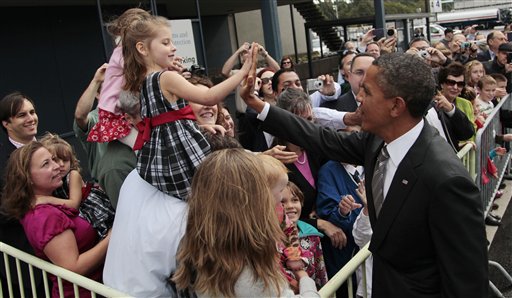
Are white liberals abandoning the president?President Barack Obama, right, greets guests on the tarmac during his arrival at King County International Airport/Boeing Field, Sunday, Sept., 25, 2011, in Seattle, Wash. (AP Photo/Pablo Martinez Monsivais)(Credit: AP Photo/Pablo Martinez Monsivais)

The Nation’s most-read article this week is by my friend Melissa Harris-Perry, “Black President, Double Standard: Why White Liberals Are Abandoning Obama.” Perry doesn’t mention any white liberals by name, nor cite polls showing a decline in support for President Obama among white liberals (as opposed to white voters generally, where his approval rating has dropped sharply). But her piece touched a nerve because of the widespread perception that white liberals are, in fact, abandoning the president.

I’m not sure how to argue with a perception, which is by definition subjective, but I’m going to try, because this is becoming a prevalent and divisive belief. When I say Melissa Harris-Perry is my friend, I don’t say that rhetorically, or ironically; we are professional friends, we have socialized together; she has included me on political round tables; I like and respect her enormously. That’s why I think it’s important to engage her argument, and I’ve invited her to reply.

I couldn’t find any polls measuring “white liberal” support for President Obama, but it’s safe to say many white liberals are disappointed in the president. I think Harris-Perry is wrong when she generalizes about two things: that white liberal disappointment is due to “the tendency of white liberals to hold African-American leaders to a higher standard than their white counterparts” (which she calls “a more insidious form of racism”), and that it’s likely to lead to white liberals “abandoning” Obama in 2012.

In the absence of poll data on white liberal attitudes toward the president, Harris-Perry compares Obama’s current approval-rating woes to the resounding reelection of President Bill Clinton in 1996. Despite Clinton’s failure to pass healthcare reform, a signature Obama achievement, as well as his not so liberal record on NAFTA, “don’t ask, don’t tell” and welfare reform, she says, white liberals stuck with Clinton, yet they are threatening to ditch Obama. She concludes: “If old-fashioned electoral racism is the absolute unwillingness to vote for a black candidate, then liberal electoral racism is the willingness to abandon a black candidate when he is just as competent as his white predecessors.”

But her Clinton-Obama comparison, while provocative and sometimes interesting, has a lot of practical problems.

It’s sad, for many reasons, that we don’t have a more recent Democratic president whose support we can examine. But using Clinton means we’re reaching back 15 years to his reelection, and 20 years to his first campaign. White liberal leadership, and individual white liberals, have changed dramatically in that span of time. Speaking for the only white liberal whose views I can report unimpeachably, I think about American politics, and Democratic politics, differently than I did two decades ago. (Although I should point out here that I both supported and sharply criticized Clinton throughout his presidency. You can check my Salon archive.)

So it’s hard to usefully compare the attitudes of a hard-to-define demographic group — “white liberals” — across a span of 20 years, factor in the specific ups and downs of two presidencies, and come to any fair political conclusions. It’s especially hard given the enormous difference in the economy during their two presidencies. Clinton presided over one of the strongest economies in American history; Obama inherited the worst mess since the Great Depression. Clinton probably gets more credit than he deserves for the economy, while Obama gets too much blame. But it’s nearly impossible to compare voters’ opinions of the two presidents given that stark contrast. With a booming economy, Obama would be riding higher with all voters, of every race.

In the absence of reliable poll data about white liberal opinion on Obama and Clinton, we at least need some specific anecdotal evidence. I understand why Harris-Perry didn’t want to single out any particular individuals, but it’s hard to know this is happening, let alone debate why, unless we can identify representative white liberal constituencies and individuals, and compare their support of Clinton and Obama. At different times and on different issues, liberals and progressives, whites included, howled over Clinton’s decisions, from DADT to welfare reform to the reckless behavior that led to his (absolutely outrageous and politically motivated) impeachment.

If we take Congress, two white liberal lions of the Senate, Ted Kennedy and Daniel Patrick Moynihan, crusaded against and voted against what was, for liberals, Clinton’s most disappointing policy, welfare reform. Most white liberals in Congress voted against it. (His white Health and Human Services deputy, Peter Edelman, left the administration over it, calling it “the worst thing” Clinton had ever done.) White liberal Sen. Byron Dorgan was one of the few Democrats with the integrity and foresight to stand up to Clinton and his economic team when they supported the repeal of the Depression-era Glass-Steagall banking restrictions, which opened the door to Wall Street corruption that torched the economy in 2008.

In terms of media, today’s progressive media infrastructure didn’t exist during the Clinton presidency — there was no Rachel Maddow, unfortunately, and no Daily Kos; no “netroots” or blogosphere at all. Salon came to national prominence to defend the president from the GOP witch hunt, but our writers and editors divided over Clinton’s various achievements and disappointments. On MSNBC, liberals Keith Olbermann and Chris Matthews helmed a lineup that was hugely critical of Clinton (today Matthews is one of Obama’s leading defenders, while Olbermann, once a passionate supporter, has left both MSNBC and the Obama camp). The New York Times editorial pages, helmed by white liberal Clinton critic Howell Raines and featuring (once-liberal) Maureen Dowd and Frank Rich, savaged Clinton and Al Gore. White progressives at the Nation attacked Clinton harshly on NAFTA, welfare reform and his Wall Street-friendly economic policies, while defending him from impeachment, much like Salon.

Outside of Congress, many of the white progressives giving Obama the most trouble weren’t uncritical Clinton supporters, either. While we remember Moveon.org getting its start to back Clinton during impeachment, it’s worth recalling that it wanted Congress to censure Clinton for his misdeeds; its slogan was “censure, and move on.” Also, the progressive online group was tiny back then, with nothing like the reach it has now. Obama critic Michael Moore was also a Clinton critic, who famously supported Ralph Nader over Gore in 2000. Nader and Michael Lerner, two organizers of the recent letter calling for a primary challenge to Obama, both regularly attacked Clinton. Though Lerner is remembered for his supposed bonding with Hillary Clinton over his “politics of meaning,” after the 1994 midterm debacle, he blamed Clinton for his cautious centrism and insisted in Tikkun:

What a president can do, and what Clinton might still be able to do to save his presidency and the liberal and progressive forces in the next two years, is to articulate a vision, a worldview, an ethical perspective, and legitimate a new form of discourse. And he can convince the American public that his specific proposals follow from and embody that worldview, so that to the extent that they accept his worldview they will also become supporters of his program. For this he doesn’t need the approval of Congress. All he needs is courage.

I quote Lerner at length not because I think he’s that influential, but because, if you substitute Obama for Clinton in that passage,  you’ve got the essence of most white progressives’ complaints today.

It’s also problematic to compare Clinton’s reelection numbers with Obama’s midterm approval ratings. What people tell pollsters in times of disappointment, and how they then vote, can be two very different things. Gallup tracking polls don’t break down “white liberal” approval ratings, so the closest proxy I could find for the two presidents was approval by Democrats. Gallup data shows that at the exact same point in their presidencies, 74 percent of Democrats approved of Clinton’s performance; 75 percent of Democrats approve of Obama’s. Given that black Democrats have been loyal supporters of both presidents, that might indicate their approval ratings among white Democrats aren’t far apart, but in the absence of hard data, I don’t want to go too far with interpretation.

Barring more major trouble with the economy or a big misstep by the president, I expect Obama’s support by all demographic groups to be higher at the ballot box than it is in opinion polls today. Elections concentrate the mind.

- – - – - – - – - -

The difference between Clinton’s booming economy and today’s broken one creates political problems for Obama in another way: He was largely elected due to Americans’ fears that we were headed into an abyss, and their faith that he would bring the economic change he promised. Like a pilot taking over with a plane in a nose dive, Obama kept the economy from crashing, but he hasn’t lifted it into smooth skies. Maybe it makes me an unrealistic and entitled white progressive — that’s pretty much what black author Ishmael Reed called Obama’s white critics — but I think it’s clear that even with a recalcitrant Congress, the president could have done more than he did to dismantle the rigged system that let Wall Street destroy the economy, as well as more to help its casualties.

You don’t have to believe every conversation reported in Ron Suskind’s “Confidence Men” — and I don’t — to see that at almost every juncture, the president and his economic team sided with Wall Street and the banks that caused the crash, rather than with the crash’s victims. Many politicians share the blame: Democrats and Republicans let the financial sector rig the rules to enrich itself and impoverish the rest of us for the last 30 years. They’ve gotten increasingly rich by lending us the cash we didn’t get in raises since wages stagnated in the 1970s, after the Democrats began running away from economic populism (but that’s another, longer story you can read about in my book next year). But given the political opening to challenge that system in 2009, Obama essentially left it intact.

As I wrote last week, Obama appointed the Clinton economic-team veterans most friendly to Wall Street — most notably, Tim Geithner and Larry Summers — while excluding and/or marginalizing the Clinton vets most critical, like Robert Reich, Laura Tyson and Gary Gensler. And whether it was the Volcker rule getting commercial banks out of speculative, proprietary trading, or efforts to sell shady derivatives on “exchanges” for the sake of transparency, or a contingency plan to force the toxic behemoth Citibank into bankruptcy, Obama let important reforms either die on the vine or be diluted into ineffectiveness. He had a rare window to change the system radically, and it’s now closed.

Meanwhile, over the last decade, progressives — of every race — have become far more sophisticated, and outraged, about the naked control Wall Street and corporate America exert over politicians, including Democratic politicians. Obama brought more progressives into the process in 2008 — Michael Moore and Barbara Ehrenreich moved from Nader in 2000 to Obama — and they brought with them their higher standards for progressive political change and their critique of corporate America’s control. I acknowledge that Moore’s recent comment, “I voted for the black guy and what I got was the white guy,” betrays some racial ickiness, but so did Cornel West’s insistence that Obama fears “free black men” because he’s half-white.

There is one point on which I agree with Harris-Perry, at least partly. She argues that much of white liberals’ disappointment with the president “can be attributed to their disappointment that choosing a black man for president did not prove to be salvific for them or the nation.” I think there’s some truth there; I’ve written it about myself, right after the election. I wrote that one reason I was skeptical of candidate Obama in 2008 (apart from the fact that, correctly, I considered him an economic centrist) is that I looked to him to be a transformative, Martin Luther King Jr. figure, rather than a politician, and that I was

“… scrutinizing his every move not only for political efficacy but for moral, political and racial justice. It was too big a burden to place on our first black presidential nominee, and now, on our first black president. I also came late to the realization that Obama represents an advance beyond King in terms of our foreordained roles for African-Americans. We want them perfect, we need them to be the country’s conscience, to make us better than we are. It’s been very hard to simply view a black politician as an American leader.”

I also thought that the white left, in particular, projected hugely when it anointed Obama the definitive progressive in the race. In Harris-Perry’s journalistic home base, the Nation, Tom Hayden’s infamous “All American progressives must support Barack Obama” manifesto claimed deliriously: “We believe that Barack Obama’s very biography reflects the positive potential of the globalization process … By its very existence, the Obama campaign will stimulate a vision of globalization from below.” I should note, however, that Hayden’s piece was co-written by two black Obama supporters, Danny Glover and Bill Fletcher, along with Barbara Ehrenreich, proof’s that the left’s capacity for self-delusion came in all colors.

And yet, the president bears some responsibility for expectations that he’d be “salvific.” His dreamy “We are the ones we are waiting for” campaign encouraged projection. On the night he clinched the nomination, he gave the famous speech where he promised that “if we are willing to work for it”…”we will be able to look back and tell our children this was the moment when we began to provide care for the sick and good jobs to the jobless; this was the moment when the rise of the oceans began to slow and our planet began to heal; this was the moment when we ended a war and secured our nation and restored our image as the last, best hope on earth.” As Ari Berman reported in “Herding Donkeys,” Obama assembled a lefty campaign team by promising he was building not just an election machine, but a movement. “Even if we don’t win,” Obama told one Howard Dean campaign veteran, “how we do it, by getting people involved and building a grassroots movement, will leave the political process and the party better for having done it that way.” Obama raised progressives’ expectations to get elected, and he’s living with the results.

…….

As long as we’re looking at the president’s racial support, let’s look broadly. While white liberal support for Obama has almost certainly dropped, so has his support within every group. Why are Latinos abandoning Obama? Two thirds of Latinos voted for the president in 2008; the Gallup tracking poll showed Latino support dropping to 44% at the end of August, though it jumped up above 50 percent this week. Overall, the president is polling in the 40s among Latinos since the end of June. And while black support remains strong, it’s declined, too. Obama won 95 percent of black voters in 2008, and his approval rating hovered in the 90s for most of his first two years. This week, it’s at 82 percent, and it’s been steadily in the 80s since February. That’s still high, but it’s not the enthusiastic, near-unanimous support that elected him.

The president himself acknowledged the rising volume of African American discontent in his speech to the (increasingly critical) Congressional Black Caucus Saturday night. The economy in particular, he said, “gets folks discouraged. I know. I listen to some of y’all.” Then he delivered a scolding: “Take off your bedroom slippers. Put on your marching shoes. Shake it off. Stop complainin’. Stop grumblin’. Stop cryin’. We are going to press on. We have work to do.”

We could probably find racial crosscurrents beneath every group’s disappointment with the president, even the CBC’s. The legacy of racism, and the historic developmental path of African-American leadership, factor into black politicians’ complex responses to the first black president. How could it not? But it’s easier, and in my opinion more productive, to identify the practical reasons for discontent among the president’s multiracial base – most of which, it must be said again, still supports Obama. The most frequently stated reason for liberal disappointment is his failure to push more aggressively for solutions to our economic disaster, and particularly for jobs. I would argue that had Obama delivered his September jobs speech, and his jobs legislation, two years ago, and fought for it passionately, his standing with all subgroups within his base would be higher.

Finally: Looking for racial motives to explain white liberal disappointment with Obama, in the face of so many economic reasons, seems unnecessarily divisive. It’s hard not to notice that despite our admirable 40-year crusade to purge racism, overt and unconscious, from Democratic politics, most Americans, of every race, have grown worse off – and meanwhile, the same proportion of African Americans live in poverty as when Dr. King tried to launch a Poor People’s Campaign. As progressives have focused on the real and corrosive legacy of racism against minorities, one American minority has done very well, and that’s the richest one percent, who now earn a quarter of the nation’s income, up from 8 percent under Jimmy Carter.

I’m not saying our crucial effort to fight racism led to that outcome; I’m just noticing that it didn’t prevent it. I’m certainly not saying progressives should give up attacking racism. But I believe we need to pay much more specific attention to the grinding disadvantages of class as well as race if we want to undo the economic disaster of the last 30 years. Those of us who believe in economic justice must work harder to define a new vision, and a new language, of inclusion and prosperity for everyone. Blaming racism for a diverse assortment of white liberals’ diverse complaints about the president won’t get us there.


Joan Walsh

Joan Walsh is Salon's editor at large.

Presidential race is most costly ever

The election is poised to dwarf the cost of 2008, when Super PACs didn't pump millions of dollars into the race

  • more
    • All Share Services

Presidential race is most costly everPresident Barack Obama, left, tours TPI Composites, a manufacturer of wind turbines blades, with plant manager Mark Parriott, Thursday, May 24, 2012 in Newton, Iowa. In Obama’s second visit as president to Newton, a city of about 15,000 east of Des Moines, he argued for Congress to renew wind energy tax credits.(AP Photo/Pablo Martinez Monsivais)(Credit: AP)

The battle between President Barack Obama and Republican Mitt Romney will be the most expensive presidential contest ever — by a long shot.

There are two main reasons. It’s the first time both major-party candidates are declining post-Watergate federal campaign financing — and the spending limits attached. And the proliferation of super PACS is pumping untold millions into the fray on both sides, mostly for advertising.

So fashion your seat belts and prepare for a howling tempest of broadcast ads, especially if you live in a battleground state.

Obama and Romney were both coming off a week of intensive national fundraising.

Without Democratic primary opposition, Obama had a huge early advantage.

But Romney, likely to surpass the 1,144 delegates needed for the GOP nomination next Tuesday with a primary win in Texas, is starting to catch up as major conservative donors begin opening their wallets.

Through April, Obama and Democratic groups supporting him have raised nearly $450 million and have more than $150 million in the bank. Romney and Republicans backing him have collected more than $400 million during the same stretch and have about $80 million at their disposal.

Both candidates are shooting for raising around $800 million, which would put their combined campaign spending at roughly $1.6 billion. Add another few hundred million from super PACs and convention spending.

Obama opted out of public financing in 2008 and raised $750 million. His spending swamped GOP rival Sen. John McCain, limited to spend the $84 million he received from taxpayers. Super PACs didn’t exist then.

We know what happened in that race. Romney didn’t want to see it happen to him.

Neither candidate had public appearances Friday. Romney was taking a long weekend California hiatus from campaigning, while Obama planned several ceremonial events on Memorial Day.


Continue Reading Close

When leaders actually lead

Some Obama backers insisted the president could do nothing on his own to advance gay marriage. Boy, were they wrong

  • more
    • All Share Services

When leaders actually leadU.S. President Barack Obama speaks at a campaign fund raising event in Denver, Colorado May 23, 2012. (Credit: Reuters/Kevin Lamarque)

I count myself as a supporter of President Obama who reserves the right to criticize him when I disagree. And I disagreed with his reluctance to come out in support of gay marriage for a long time. I’m also on record wishing he’d taken a stronger public stance behind several big progressive priorities — a larger stimulus, tougher Wall Street reform, a public option for health insurance, a big jobs bill – whether or not he had the congressional support to make it happen.

Throughout the president’s first term, his most ardent supporters have reacted to those of us pushing him to do – and say – more on such issues with frustration and anger, some of it nasty and personal, some of it thoughtful and well-argued. They rightly blame Congress for blocking action on key progressive priorities, but strangely downplay the power of presidential leadership. Late last year, New York magazine’s Jonathan Chait twice attacked liberal Obama critics for being “unreasonable” about what the president alone could accomplish, because “liberals, on the whole, are incapable of feeling satisfied with a Democratic president.”

Chait took particular aim at lefty image guru Drew Westen, a one-time Obama admirer who criticized the president in the New York Times not merely for what he hadn’t accomplished, but for failing to tell a compelling story. Chait accused Westen and other progressives of embracing:

…a model of American politics in which the president in not only the most important figure, but his most powerful weapon is rhetoric. The argument appears calculated to infuriate anybody with a passing familiarity with the basics of political science. In Westen’s telling, every known impediment to legislative progress — special interest lobbying, the filibuster, macroeconomic conditions, not to mention certain settled beliefs of public opinion — are but tiny stick huts trembling in the face of the atomic bomb of the presidential speech. The impediment to an era of total an uncompromising liberal success is Obama’s failure to properly deploy this awesome weapon.

Chait caricatured Westen’s argument (and the beliefs of those who agreed with it), but he got lots of love for both pieces in the pro-Obama blogosphere, where folks finally felt they had a real diagnosis for the illness of those they dismissed as “emoprogs.” But now that we see the changes wrought by Obama’s politically risky embrace of gay marriage, maybe it will be easier for folks to understand that it’s the job of political advocates not merely to praise, but to push their leaders forward.

Steve Kornacki runs down the astonishing political changes we’ve seen in the mere two weeks since the president carefully announced his supposed change of heart on gay marriage. The nation’s largest African-American organization, the NAACP, has come out behind it – and maybe most important, recognized it as an important civil rights issue. Maybe most dramatic, in Maryland, African-American voters have now flipped to support the state’s gay marriage ballot measure 55 to 36 percent –almost the exact percentage by which they opposed it in previous polling on the state issue. And in the latest ABC News/Washington Post poll, African-Americans’ support for gay marriage jumped to 59 percent from 41 percent in the wake of the president’s historic announcement.

Now, I’m not going to argue that Obama’s turnaround alone caused this sea change. The arc of the moral universe has been bending toward justice on gay rights for a long time, and as I wrote last week, the president gave it an additional tug. There have been advocates within the NAACP working to make this happen for a long time, and they deserve a lot of credit. African-American voter opinion had already been trending in this direction, even if black voters had been less receptive to gay marriage than other demographic groups. There is also an emotional and personal component to the president’s stance that makes his moral suasion hard to replicate on behalf of, say, the jobs bill or the public option. (And let’s also remember it’s white voters who are most hostile on some of those economic issues, thanks to the divide and conquer politics of the GOP over the last 40 years.)

Still, it’s hard not to conclude that Obama’s words made a significant difference in the political course of this debate. Ironically, it was once critics of Obama who mocked the power of words, and specifically the candidate’s own oratorical gifts. Obama shot back at them many times.

“Don’t tell me words don’t matter,” he told Wisconsin Democrats in February 2008. “‘I have a dream’ — just words. ‘We hold these truths to be self-evident, that all men are created equal’ — just words. ‘We have nothing to fear but fear itself’ – just words. Just speeches.” At many times over the last three years, I’ve been amazed at how Obama’s critics and supporters seemed to change sides on the question of the power of his words.

I give the folks who call themselves “prag progs” – pragmatic progressives, as opposed to “unreasonable” emoprogs – a lot of credit for fixing attention on what the president has accomplished, and reminding others not merely to fixate on what he hasn’t. But I think it’s time that all of us acknowledge that there’s a role for constructive pressure, too. Progressive change has always required impatient agitators – and it will continue to.

Continue Reading Close
Joan Walsh

Joan Walsh is Salon's editor at large.

Obama courts LGBT vote

The president has launched a new website and video touting his "evolution" on gay marriage

  • more
    • All Share Services

After a long “evolution” on marriage equality, the Obama campaign is moving to take full ownership over LGBT rights as a political issue today, rolling out a new website and video narrated by Glee’s Jane Lynch.

Lynch, who married her partner in 2010 after New York legalized same-sex marriage, praises Obama in the video, calling him “a leader who not only acknowledged the LGBT community, but who embraced us.” Lynch ticks off a series of Obama’s accomplishments, saying the president has made “more significant advances on LGBT issues than other president that came before him.”

But on a conference call this morning, campaign officials said the website, called “Obama Pride,” is as much about touting the president’s advances on LGBT rights as it is a means to organize and engage with the LGBT community. “We will run robust LGBT Vote programming to turn out LGBT voters this November,” said National LGBT vote director Jamie Citron.

The five-minute video also features new interview-style footage of Obama, who explains how his view on marriage has changed over time and notes that “we’ve seen a profound cultural shift just over the past decade,”

Indeed, the roll out — timed to coincide with Harvey Milk Day — comes as a new Washington Post/ABC News poll finds opposition to gay marriage at all time low in the wake of Obama’s announcement.

That puts Obama on the right side of history, the campaign said. “[Mitt] Romney’s position on same-sex marriage is also historic but not in the way it should be,” said Obama co-chair Joe Solmonese, the outgoing president of the LGBT advocacy group Human Rights Coalition, who noted that Romney has pledged to push for an anti-marriage equality amendment.

While the marriage reversal carries major political risks, the aggressive PR effort from the deliberate Obama campaign suggests they feel confident that Obama’s stance on gay rights will be a net gain, politically. Already, fundraising is reportedly up as both disillusioned gay Democrats and even some gay Republicans are coming back into the fold. Indeed, the founder of the Log Cabin Republicans, Rich Tafel, told NPR last weekend that he’s considering defecting to Obama in light of the announcement. If the campaign and Jane Lynch have their way, he won’t be the last.

Continue Reading Close

Alex Seitz-Wald is Salon's political reporter. Email him at aseitz-wald@salon.com, and follow him on Twitter @aseitzwald.

Barack Obama: Shoestring president

Spending has grown more slowly under Obama than either Reagan or Bush. Will the media stop parroting the GOP?

  • more
    • All Share Services

Barack Obama: Shoestring president (Credit: AP)

Updated with video below.

With so many Republican lies about President Obama, it’s pretty hard to pick out the worst one. The most vicious stuff, of course, comes from the crazy birthers, who won’t go away. (Way to spend Arizona’s tax dollars, Sheriff Joe Arpaio!) Then there are the more mainstream slurs – Newt Gingrich calling him “the food stamp president,” or Obama’s “friend” Sen. Tom Coburn saying he favors government programs because “as an African American male,” he received “tremendous advantage from a lot of these programs.”

But if you measure the power of a lie by its utter truthlessness combined with the breadth of its reach, the notion that Obama has presided over a wild federal spending spree is probably the biggest whopper spread by the GOP, with the help of the right-wing noise machine and lazy mainstream media. Mitt Romney regularly rails against the “debt and spending inferno” the president supposedly ignited. Last month on Fox, Charles Krauthammer called Obama’s spending “radical, unprecedented,” and CBS Radio’s Mark Knoller reported that the “National debt has increased more under Obama than under Bush.”

On Tuesday, the Wall Street Journal’s Marketwatch debunked all of those claims: “Although there was a big stimulus bill under Obama, federal spending is rising at the slowest pace since Dwight Eisenhower brought the Korean War to an end in the 1950s,” writes Rex Nutting. “Even hapless Herbert Hoover managed to increase spending more than Obama has.” In his first term, Obama will have increased spending by 1.4 percent; in his last three years, George W. Bush increased annual spending by an average of 8.1 percent – and in Bush’s last fiscal year, 2009, spending jumped 17.9 percent. Republican deity Ronald Reagan increased spending an average of 8.7 percent in his first term. Nutting continues:

After adjusting for inflation, spending under Obama is falling at a 1.4 percent annual pace — the first decline in real spending since the early 1970s, when Richard Nixon was retreating from the quagmire in Vietnam.

In per capita terms, real spending will drop by nearly 5 percent from $11,450 per person in 2009 to $10,900 in 2013 (measured in 2009 dollars).

Strangely, Marketwatch frames Nutting’s article as “commentary,” I guess because he’s an opinion columnist, but his facts and figures come straight from the non-partisan Office of Management and Budget and Congressional Budget Office. The charts he uses are vivid and leave no room for doubt: When the president says he’s dropped spending to its lowest levels since the Eisenhower presidency – back before the Civil Rights Act, the Occupational Safety and Health Act, the Clean Water Act, the Economic Opportunity Act, or the establishment of the Environmental Protection Agency or Department of Education — he’s telling the truth.

Mild-mannered White House press secretary Jay Carney was nearly moved to swearing on Wednesday, pointing to the facts outlined by Nutting and telling reporters “don’t buy into GOP B.S.” (That became a leading Politico headline later in the day.) But will the media heed Carney’s warning?

We’ll see. Somehow I doubt it. I discussed where the “big spender” lie fits into the pantheon of GOP falsehoods on MSNBC’s “Hardball” with David Corn:

Visit msnbc.com for breaking news, world news, and news about the economy

Continue Reading Close
Joan Walsh

Joan Walsh is Salon's editor at large.

My friend calls Obama a monkey

What am I supposed to say to this dude? What's his problem?

  • more
    • All Share Services

My friend calls Obama a monkey (Credit: Zach Trenholm/Salon)

Dear Cary,

I have a friend that cannot speak about the president of the United States without using the word “monkey” or “chimpanzee.”

There have been presidents I was not thrilled about, but certainly I would not stoop to this.

This individual is well-off, has a degree and is considerate about most other topics.

What the HELL is his problem?

Thanks Cary,

Bewildered

Dear Bewildered,

Your friend’s problem is that he is a racist.

It’s not nice to label people. A racist may be an excellent builder of miniature racing-car models. He may be a good whistler.

But he’s still a racist. Being a racist is stupid and repugnant. What’s worse, it can spread. It’s each person’s job to not be a racist.

He can stop being a racist. You can help. You can tell him that while he may have certain racist thoughts, he can stop being a racist by not voicing any of these thoughts ever under any circumstances.

Maybe that would lead to some positive personal change. Or maybe he would give you a hurt, bewildered look of confusion and self-pity that makes you want to punch him.

Don’t punch him. That won’t help.

Well, it might help a little. It might temporarily curb his outward expressions of racism. But I’m against hitting people even as a gift of enlightenment.

Just tell him that being a racist is not cool anywhere in the United States of America or in Europe or Asia or Africa or North America or South America or Australia or Antarctica. which pretty much means the whole world, all the continents, plus the open oceans and in outer space also. Racism is not cool even in outer space or on other planets. It’s not cool, period. It’s not cool anywhere, not in public or in private. It’s one of those things that you just want to get rid of completely and be done with.

Tell your friend that the next time he says some kind of racist remark like that, that you’re terminating all contact with him.

Now, everyone has a shadow self that embodies the repressed. We all have our share of unvoiced hatred and fear, irrational beliefs, strange, criminal impulses. Thoughts come into our heads that we must censor because to voice them would disturb others.

We may have sexual fantasies about our friends’ wives or husbands, or their sisters or brothers or their children; we might have taboo curiosities. We may find ourselves imagining elaborate ways to connect physically that involve hydraulics, servo motors, pulleys and latex.

Some of us have so many of these thoughts that we move to San Francisco.

But let’s not complicate the issue.

Also, there are rumored to exist tiny protected intellectual zones where people have advanced degrees in things you never heard of and special vocabularies come into use in a specialized context, where you can say things that have several layers and degrees of irony and are understood in sophisticated ways that you couldn’t explain to your friend even if you understood them yourself, which you’re not going to.

That’s different.

There is also weird humor which unless you’re Sarah Silverman, don’t try that either. It’s too advanced for you.

And don’t get on your high horse and pretend there are degrees, that racism exists on a continuum. There are no degrees. There is no continuum.

Racism is bad. It’s evil. Nobody should be voicing racist thoughts.

If your friend keeps it up, just totally, radically de-friend him. Become his special not-friend.

Be done with it. It’s that simple.

Continue Reading Close
Cary Tennis

Cary Tennis writes Salon's advice column, leads writing workshops and creative getaways, publishes books, writes an occasional newsletter and tweets as @carytennis.

Join Cary's Online Writing Workshops

Page 1 of 585 in Barack Obama