Chris Christie

Now Chris Christie is seriously messing with Republicans

Apparently, flirting isn't frowned upon inside the Reagan Library

Chris Christie

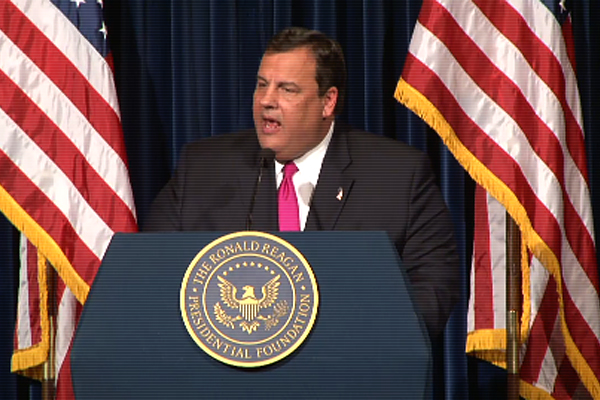
Chris Christie didn’t say he’s running for president on Tuesday night, he didn’t say he’s thinking about running for president, and he didn’t even say he might think about running for president. And yet the prospect of a Christie candidacy still threatens to haunt the current GOP field for the foreseeable future. If you want to understand why, just compare these two very different responses to the same question:

No. 1: “Short of suicide, I don’t really know what I’d have to do to convince you people that I’m not running. I’m not running.”

No. 2: “And so my answer to you is that I thank you for what you’re saying and I take it in and I’m listening to every word that you’re saying it, and I feel it too.”

No. 1 was uttered in the New Jersey State House last November, one of Christie’s adamantly colorful denials that he might seek the presidency in 2012. No. 2 is from Tuesday night, after he delivered an address on national policy at the Reagan Library (!) and a woman in the crowd literally begged him to run for president. In other words, Christie used to be far, far more eager to swat down presidential chatter than he now seems to be.

The question is whether it really means anything — or if Christie just wants us to think it might mean something. To answer this, it may be helpful first to backtrack and remember exactly how it happened that a second-year governor ended up delivering one of the year’s most widely-anticipated political speeches.

The story starts not long after Christie took over as New Jersey governor in 2010, when he began winning acclaim from national conservatives, who found themselves riveted by the blunt charisma he exhibited in YouTube videos and television clips. The post-Bush GOP was without an obvious leader, and the impressive communication skills Christie flashed marked him as someone to watch. There was even some faint talk that he might be a very, very darkhorse for the 2012 presidential race — but this was generally dismissed out of hand. He was just months into his term; surely Republicans would have a roster of far more credible candidates to choose from.

Months passed, the midterm election came and went, and Republicans began focusing more intensely on 2012. A number of would-be candidates declined to run, leaving a field littered with no-shot fringe aspirants and Mitt Romney, whose presence hardly stirred much interest among the party base. Christie’s name was again touted, this time more widely — especially after New Jersey’s Democratic legislature passed his public pension overhaul plan. He met with some donors but also issued comically blunt disavowals of interest. A health scare over the summer (asthma, it turned out) was taken as further proof Christie wouldn’t run. Then Rick Perry became interested in the race, and suddenly it seemed like the GOP might have its answer: A candidate pure enough for the base but solid enough to pass muster with the establishment. Then Perry opened his mouth, and trouble came out. Some Republicans begged Paul Ryan to get in; he said no. Others again urged Christie; same answer. But Perry’s problems got worse, much worse, and Republicans despaired: Obama’s vulnerable and we’re stuck choosing between Perry and Romney?!

That all brought us to Tuesday morning, which began with the political world absorbing the news that former New Jersey Governor Tom Kean, a man who’s close to Christie, had told the National Review that Christie was now giving the presidential race “a lot of thought” — this as Christie prepared to deliver his long-scheduled speech on national policy at the Reagan library. Speculation built, until Christie’s brother Todd told the Star-Ledger later in the morning that Kean was off his rocker and that “I’m sure that he’s not going to run.” But then, by the afternoon, Christie’s camp was spreading the word (anonymously, of course) to the media that Todd had actually gone too far — that he’d “been too cold in saying absolutely not,” as the New York Times reported it. Christie’s speech was now just hours away and the speculation exploded again. C-Span decided to take his 9 p.m. address live and Fox News cut-in to “Hannity” to show some of it.

OK, that brings us to the actual speech, which was … serviceable. At a fairly quick clip, Christie ran through an address that was heavy on platitudes and broad strokes (he condemned leaders who shield voters from “difficult truths” without explaining what any of those truths might be).

But he hasn’t built his national reputation on his ability to read a speech; it’s in off-the-cuff settings — debates, town halls, interviews — where his charisma is apparent. This was certainly true on Tuesday night. When he put the text down and opened the floor to questions, Christie came to life, and so did the room. You can read all of the details here, but the Cliff’s Notes version is that Christie showcased the same natural ease and Jersey tough guy humor that have been at the heart of his YouTube hits. It was a far more commanding, authentic-feeling performance that Romney, Perry or any other Republican candidate — or national Republican figure — has managed to pull off. And it culminated with the aforementioned woman standing up and begging Christie to run for president for the sake of her children:

The immediate effect of Christie’s response, and of his handling of his entire California trip, will be to intensify the White House chatter. He can’t drag this on too long — the filing deadline for Florida’s primary is at the end of October, and from a practical standpoint he’d probably have to move a lot sooner than that. But until he either jumps in or reverts to making I’d-sooner-kill-myself-than-run declarations, Christie will hover over the GOP race. Simply put, he lived up to his billing on Tuesday night. The guy who held court at the Reagan library is an infinitely stronger, more compelling communicator than either Romney or Perry, and with the clock running out, Republicans now know that Christie really is their last, best hope to save them from having to nominate one of those other two. Christie has become to the 2012 GOP race what Mario Cuomo was to the 1992 Democratic contest.

Which brings us to the question of whether he’s actually considering joining the race. Here are the realistic possibilities of what Tuesday night means, as I seem them:

  • It’s all a scam: Christie’s level of interest in a ’12 bid is the same as it’s always been — nonexistent. But he recognizes the unique potential of this moment and is cashing in, for his state party (note how many fundraisers for the New Jersey GOP he managed to cram into his trip West this week) and for himself (playing coy built suspense and resulted in a huge audience for Tuesday’s speech — and surely this will only help down the road, like maybe in 2016).
  • It’s an ego trip: He’s still not going to run, partly because his wife is against it and partly because he fears the consequences of losing — like the fact that he’d face cries of home state abandonment and likely lose the governorship in 2013. But his poll numbers in New Jersey are a little stronger now, giving him a little more wiggle room than he had a few months ago. Plus, he’s a political animal — so why not pretend to be a candidate for a week or two, bask in the attention and adoration that he’s always dreamed of, then call it off before Romney and Perry (and others) tear him to shreds over his secret liberal past?
  • It’s an opportunity he never thought would exist: When the presidential chatter started, Christie was as sure as everyone else that his party would have many better options. So, given own shaky political standing in blue state New Jersey, it made all the sense in the world to adamantly deny interest in the race. And he really meant it too! But in the past few weeks, especially since Perry’s dreadful debate performance, it’s suddenly begun to dawn on him that he’d have a real shot at winning the nomination — and, given the state of the economy, the presidency too. Not a great shot, mind you, but a far better one than he thought he’d have six months ago — and maybe even a better one than he’d have in 2016. He still has plenty of doubts, and the all-or-nothing risk of a presidential campaign means that his governorship would essentially end the minute he entered the race — no small consideration given that Christie loves being governor and spent a decade pursuing the office. So he probably won’t do it. But you saw that woman begging him to run, right?
  • It’s just part of the master plan: All of the pieces are falling into place, just like he knew they would. Those over-the-top denials? The perfect way to show humility, and hardly a risk — Republicans were always going to come back to him. There was just no way that Romney or Perry (or Thune or Barbour or Daniels) would ever to get it done for them, and the more Christie dug in his own heels, the more attractive he’d seem. This would build desire, which would eventually turn to panic, at which point Christie would finally relent just enough to attract unprecedented national interest for a speech in California, at which an average Republican voter would issue a dramatic, emotional plea for him to ride to the rescue of the party and the nation.

Personally, I find No. 3 the most logical, but some combination of No. 1 and No. 2 also makes some sense. Of course, there’s be no guessing to do if he’d just used that suicide line instead.

* * *

I was on MSNBC’s “The Last Word” with Lawrence O’Donnell just before Christie’s speech on Tuesday night. Here’s the segment:

Visit msnbc.com for breaking news, world news, and news about the economy

Steve Kornacki

Steve Kornacki writes about politics for Salon. Reach him by email at SKornacki@salon.com and follow him on Twitter @SteveKornacki

Chris Christie’s gas tax foolishness

By not budging on decades-old taxes, Republican governors keep gas artificially cheap -- and create big problems

Lincoln Tunnel traffic (Credit: Joe Shlabotnick / CC BY 3.0)

Here’s a wild statistic: At any given moment, a third of the cars in Manhattan are just passing through on their way to somewhere else. Why? Because it’s cheaper than driving around it.

Thanks to a quirk of history, the East River bridges to Manhattan aren’t tolled, nor are the outbound Hudson tunnels — you can drive from Long Island to New Jersey for free if you go through Manhattan. Go around Manhattan, however, and you’ll hit tolls of up to $13. The system gives drivers a financial incentive to drive straight through the most crowded, most congested patch of land in the country.

With gas taxes, we make the same mistake: We artificially depress the price of fuel so that the least efficient way to get somewhere — in this case, a private car — is also sometimes the cheapest.

New Jersey Gov. Chris Christie has given us an opportunity to discuss this absurdity. On Tuesday, the New York Times revealed the true reason he killed plans for a new rail tunnel from New York to New Jersey. Yes, he was genuflecting before Tea Party deficit hawks, but, said the paper, the decision was actually “more about avoiding the need to raise the state’s gasoline tax.”

Washington gets some flak (not nearly enough) for not raising the federal gas tax. The last time it budged, a T-Rex was chasing Jeff Goldblum, and Meat Loaf was in the Top 40. But individual states are just as guilty of keeping their gas taxes frozen, which, because of inflation, effectively adds up to more deeply discounted gas every year. Fourteen states haven’t raised their gas taxes in at least two decades, including New Jersey, which now has the nation’s third-lowest rate — it hasn’t gone up since 1988. This has caused the state’s real-dollar gas-tax revenue to fall by 40 percent. By not keeping the tax apace with transportation costs, New Jersey loses half a billion dollars a year.

When we talk about the federal gas tax being too low, we talk about the fact that keeping the price of gas down encourages sprawl and discourages sales of fuel-efficient cars — both worthy concerns. But by ignoring the problem of states refusing to raise their rates as well, we miss out on the fact that, for instance, New Jersey’s Transportation Trust Fund is now $12.5 billion in debt. Wyoming last year voted down an attempt to raise its gas tax, the country’s second-lowest, which would have allowed it to repair underground storage tanks that are leaking petroleum into the earth. And South Carolina, which borrowed $52 million from Washington last year to close a budget gap created by its super-low gas tax, recently moved to cut that tax by 10 percent more.

And why not? Gas is expensive now, right? The truth is, the price of gas is unnaturally low, held down by governors who would sooner take a handout from Washington than increase the price by a penny per gallon. This thinking is creating a fiscal disaster for state governments. And it’s put New Jersey on track to earn a dubious distinction: By mid-century, it will become the first state in America to literally run out of land. By making “drive till you qualify” so cheap, all the Garden State’s unprotected open space will be completely gone in a few short decades.

Maybe it’s best if we just drive around it.

Continue Reading Close
Will Doig

Will Doig writes the Dream City column for Salon

Chris Christie just made stuff up about tunnel he canceled

Hard-charging New Jersey governor's reasons for canceling a major transit project called into question by report

Chris Christie and Mitt Romney (Credit: Reuters/Brine Snyder)

Whoops, turns out Chris Christie was just lying about everything when he canceled that train tunnel project in 2010.

Canceling the long-planned Access to the Region’s Core rail tunnel project was likely the most high-profile decision Christie made in his first months as governor of New Jersey. The press generally treated it as a tough-but-necessary decision from a no-nonsense politician who was getting serious about the budget. It was actually just an incredibly short-sighted way of getting around a promise not to raise New Jersey’s (very low) gas tax. And Christie lied about the reason he canceled the project, according to a study from the Government Accountability Office.

The New York Times has the details of the report today, and in classic Times fashion it is repeatedly calling Christie a liar without using the word. Instead, Christie “exaggerated” and “misstated” his rationales for canceling the project.

The report by the Government Accountability Office, to be released this week, found that while Mr. Christie said that state transportation officials had revised cost estimates for the tunnel to at least $11 billion and potentially more than $14 billion, the range of estimates had in fact remained unchanged in the two years before he announced in 2010 that he was shutting down the project. And state transportation officials, the report says, had said the cost would be no more than $10 billion.

Mr. Christie also misstated New Jersey’s share of the costs: he said the state would pay 70 percent of the project; the report found that New Jersey was paying 14.4 percent. And while the governor said that an agreement with the federal government would require the state to pay all cost overruns, the report found that there was no final agreement, and that the federal government had made several offers to share those costs.

The governor then took billions of dollars earmarked for the tunnel — which would have relieved congestion on the two 100-year-old single-track cross-Hudson tunnels currently shared by Amtrak and New Jersey Transit — and used it for Jersey’s gasoline tax-funded infrastructure fund. Because keeping mass transit inefficient and gas taxes low is a really good example of “fiscal discipline” and tough decision-making.

The two extant tunnels currently operate at capacity, with minor delays growing into major disruptions of service on both systems’ lines. So next time your train to Manhattan is hours late, New Jersey resident, make sure to thank your superstar governor for holding the line on gas taxes for people who decided to drive into the city.

Christie’s office still defends the decision and I expect the governor to soon deflect criticism stemming from the GAO report by finding someone new to yell at for a YouTube video. Christie’s willingness to brazenly lie about irresponsible budgetary decisions while somehow maintaining his “responsible fiscal conservative” cred is why so many Republican elites hoped he’d jump into the 2012 presidential race. There’s always 2016!

Continue Reading Close
Alex Pareene

Alex Pareene writes about politics for Salon and is the author of "The Rude Guide to Mitt." Email him at apareene@salon.com and follow him on Twitter @pareene

The real problem with honoring Whitney

The uproar over Christie's order to fly the flags at half-staff was about race and gender, not drug addiction

(Credit: AP)

If any single political figure in America is a flesh-and-blood personification of a Rorschach test, it is Republican New Jersey Gov. Chris Christie. In almost every way, he raises vexing questions which ultimately say more about us than they do about him.

Is he, for instance, refreshingly authentic or just downright offensive? Is he regular-guy fat or too obese to be president? Is he a rare moderate Republican who is at least willing to discuss legalizing gay marriage or is he a standard GOP bigot who is deftly maneuvering to prevent such legalization?

How you answer all of these questions is a matter of political identity — your answers all but determine where you fall on the larger political map, and in the process, highlight your assumptions about a whole host of issues.

Now, in the wake of Whitney Houston’s tragic death, Christie’s done it again. By ordering his state government’s flags to half-staff to mourn the singer’s tragic death, he has ignited a heated national debate about who should — and who should not — be posthumously honored by the public. In the process, his move has provided a lesson in how dog-whistle politics works — and how the ugliest forms of bigotry still dictate so many Americans’ unconscious reflexes.

To summarize the details of this latest manufactured controversy, read the arch-conservative Washington Times’ writeup (emphasis added):

Twitter was abuzz Wednesday with reaction to the decision by Christie… In online postings, there were two main arguments against the honor for the Grammy Award winner who died over the weekend in California at age 48: One was that it should be reserved for members of the military, first responders and elected officials. The other was that it’s wrong to honor a drug addict.

Heather Clause, a Richmond, Va.-based blogger who writes about teen moms and was tweeting critical comments, said in a telephone interview that she was appalled by the planned flag-lowering.

“It’s just such a bad example for people,” said 23-year-old Clause. She said the decision was like saying if someone sings well, drug use doesn’t matter and “you can still be an idol.”

In upstate New York, Rebecca Eppelmann, a newspaper copy editor, also tweeted her disgust at the Houston honor, then discussed her views.

“It should be for major events,” she said. “It’s horrible that she passed away. It’s not something that should warrant this.”

Thankfully, Christie did the right thing and proudly stood by his decision, saying “I am disturbed by people who believe that… because of her history of substance abuse that somehow she’s forfeited the good things that she did in her life — I just reject that on a human level.” But that hasn’t stopped the backlash. In response to Christie’s alleged crime of honoring the dead, conservatives’ Fake Outrage MachineTM has rip-corded to life, generating the usual howls of heartland outrage — including a man who burnt a New Jersey flag in protest of Christie’s order.

Of course, when singer Frank Sinatra died and New Jersey’s flags were flown at half-staff, this kind of outrage was nowhere to be found — despite the fact that Sinatra himself was a drug abuser (the drug in question being alcohol). Likewise, the outrage was nowhere to be found when Elvis Presley died of a drug overdose in 1977 and flags all over America were flown at half-staff. Indeed, as the Rockford Register Star’s Chuck Sweeney notes, that event prompted an order for “all city flags in Memphis (to be) lowered to half staff”; compelled former President Richard Nixon to “ask Americans to fly their flags at half staff in honor of Elvis”; and got then-President Jimmy Carter to issue a statement saying, “With Elvis, a part of our country has died.”

What, then, explains the difference? Why would there be a hostile reaction to the way New Jersey memorialized the drug-abusing Houston, when there was no such hostile reaction to the way the drug-abusing Sinatra and Presley were memorialized?

The answer, of course, is rooted, in part, in racist and sexist double standards.

When famous white men engage in illicit activities, American culture allows them to nonetheless retain their street cred, their wholesome image and their public honor. In some instances, in fact, the illicit behavior contributes to their mystique and their legacy — it is seen as a cool part of who they are. This is exactly why one of the iconic images of Sinatra is him in a tux with a highball in his hand — because a white, male-dominated culture accepts — and even at times celebrates — the blemishes of fellow white men.

By contrast, when famous women — and particularly famous women of color — engage in the same behavior, the same swath of America that celebrates the Presleys and Sinatras often reacts with indignant disgust. Hence, the backlash to Christie daring to minimally honor Houston — a reaction that shows a white, male-dominated culture which accepts the imperfections of white males simultaneously refuses to accept the imperfections of “the other.”

Importantly, such a double-standard isn’t just amplified by men. In this case, some of those criticizing Christie’s decision are women. But that merely shows how pervasive the double standard really is — it’s so widespread and so accepted that it’s operating at a subconscious level across demographic divides.

To be sure, it’s fair to raise questions about whether any entertainer deserves the same form of state-sponsored memorial as soldiers, elected officials, first responders and other public servants. Such principled and necessary queries make us contemplate a culture that overly deifies famous people, regardless of why they are famous — and challenging that celebrity-worshiping theology is important.

However, if we are going to accept entertainers being recognized and memorialized by our civic institutions, then we ought to apply one standard. Either icons should be recognized regardless of their lifestyle choices, or they should not be recognized because of their lifestyle choices. Applying two standards to two sets of icons — and applying those standards selectively against women and minorities — converts solemn memorials of the dead into more ugly expressions of racism, sexism and other pathologies that still plague America.

Continue Reading Close
David Sirota

David Sirota is a best-selling author of the new book "Back to Our Future: How the 1980s Explain the World We Live In Now." He hosts the morning show on AM760 in Colorado. E-mail him at ds@davidsirota.com, follow him on Twitter @davidsirota or visit his website at www.davidsirota.com.

Did Chris Christie make a crude, sexist joke?

With Mitt Romney beside him, the New Jersey governor responds to women hecklers with an apparent oral sex reference VIDEO

While stumping for Mitt Romney on Sunday night, Chris Christie made what some have interpreted as a blow-job joke. A couple of female hecklers in the crowd shouted something about jobs “going down” and Christie responded, “You know, something may be going down tonight, but it ain’t going to be jobs, sweetheart” (the video is below).

His body language, tone and diminishing use of “sweetheart” — not to mention the “oooh” of the crowd — made me hear it as a blow-job joke, but I didn’t exactly trust my interpretation, seeing I hear sexual double-entendres everywhere. Some cleaner-minded commentators have picked up on it too, though: XX Factor’s Torie Bosch called it an “oral sex joke” that was “flagrantly demeaning, even misogynistic.” Slate’s David Weigel, who was present at the event, writes, “I can honestly say that the fellatial joke didn’t occur to me at all … it sounded like the ‘something’ was just the Occupy movement, as in ‘you’re gonna go down.’” In this case, it seems hindsight was … X-rated: Weigel ends his blog post with, “But now that I think about it … .”

Bosch actually mentions my recent piece on “the prudes of the GOP” by way of saying that, “clearly, Christie isn’t in that camp” — but I’m not so sure that prudery is at odds with a demeaning sex joke. In fact, I see it as an essential element of prudery, which casts sex as a dirty and shameful act (except under a very rigorously policed – and, quite frankly, rare — set of circumstances. I don’t know what Christie actually intended by his remark, but if it was to say, “Suck it, sweetheart,” I wouldn’t be in the least bit surprised. It would be yet another prime example of right-wing conservatives viewing sex itself as a “gotcha.”

Continue Reading Close
Tracy Clark-Flory

Tracy Clark-Flory is a staff writer at Salon. Follow @tracyclarkflory on Twitter.

The carnage Chris Christie leaves behind

You'd never know how vulnerable Obama really is from the farce that the GOP race has become

Chris Christie announcing that he will not be seeking the 2012 Republican nomination for president. (Credit: Reuters/Lucas Jackson)

There were plenty of obvious, logical reasons for Chris Christie to announce this afternoon — hardly for the first time, but probably for the last time — that he won’t run for president in 2012.

Filing deadlines for key early primaries are a few weeks away and the first contests are just a couple months away, meaning that Christie would have had almost no time to build a national fundraising network and a state-by-state campaign infrastructure from scratch. And there would have been all of that uncomfortable scrutiny from conservative opinion leaders — not to mention his opponents — over his secret liberal past, particularly on immigration. Plus, he would have been risking everything he has in New Jersey, with a losing national campaign (one that he would have embarked on after a year’s worth of adamant, over-the-top denials) making his path to reelection as governor in 2013 even more iffy than it already is.

So he made the safe call, using a press conference in Trenton to say that he’d felt obligated to consider pleas from Republicans to enter the race but that “the deciding factor was that it did not feel right to me, in my gut, to leave now when the job here is not finished.” But when you look at what, exactly, he’s saying no to, it raises the question of whether Christie made a smart call. Just consider what the Republican presidential race now looks like.

There’s Mitt Romney, who’s the nominal front-runner and the safest-seeming general election option for the GOP. But Romney has been running for president with all his might for six years now, and he can’t seem to break 25 percent in national polls. Romney’s profound vulnerability was confirmed when Rick Perry entered the race in mid-August and immediately overtook Romney, building a comfortable double-digit lead. It’s only because Perry has performed so poorly as a candidate that Romney has managed to retake the lead, but even that comes with an asterisk: Almost all of the support that Perry has lost in the last few weeks has gone to second-tier fringe candidates (Herman Cain and Newt Gingrich, mainly) instead of Romney. The newest poll, from ABC News and the Washington Post, has Romney at 25 percent, followed by Cain and Perry at 17. This is a sad commentary on Romney’s standing within his own party.

And let’s look closer at Perry, because his freefall may be even worse than that poll suggests. There’s also a new survey in Florida, released yesterday afternoon, that has him plummeting to fourth place — with just nine percent, behind even Gingrich. The promise of Perry’s campaign was that he’d instantly and permanently unify conservatives, who had been desperately seeking a credible alternative to Romney. Instead, he’s unnerved them with overheated campaign trail antics and a series of mediocre to brutally bad debate performances. And he’s failed so far to provide them with a satisfactory cover story for his own ideological baggage, which has actually allowed Romney — yes, Romney — to tout himself as the candidate of consistency.

Nor is there any reason to regard Cain as a threat to win the nomination, despite his recent return to prominence. He has no discernible strategy (and doesn’t even plan on being in Iowa for more than a month!) and just lost his press secretary … to a campaign for lieutenant governor. And when the spotlight was on him earlier this year, he demonstrated an alarming lack of basic foreign policy knowledge. The more attention Cain gets now, the more likely he is to wilt — again. The same is doubly true for Gingrich, who is essentially waging a one-man campaign with no money or organization. His recent polling success is the product of a few strong-seeming debate performances, but if you think he’s on the verge of becoming a contender, just remember: He’s unusually prone to self-destruction. 

This is the field that Christie would have been running against. Already, without even lifting a finger, he was running at 17 percent nationally, according to a just-completed Quinnipiac poll, tied with Romney for first and ahead of Cain (12 percent) and Perry (10). And while it wasn’t quite as rosy for Christie, the ABC/Washington Post survey has had him at 10 percent.

Some believe it would have been all downhill from there, and maybe they’re right. But think back to that question-and-answer session Christie did at the Reagan Library last week, the one that ended with the woman begging him to run, and the crowd responding with a standing ovation. The performance was vintage Christie. In off-the-cuff-settings — town halls, debates, interviews — he is one of the strongest, most compelling communicators in American politics today. Like him or not, he’s a lot more than the caricature of rage that many mistakenly assume he is. He generates positive personal feelings from audiences, particularly Republican audiences; they like him and they want to be with him — and if that means rationalizing away a less-than-conservative past position or two, they’ll do it. Romney and Perry and most other politicians on the national stage today just don’t have the same effect on people.

What’s most amazing is that the value of the Republican nomination is only increasing, even as the party’s nominating process looks more and more like a farce. Given the state of the economy, just about any candidate the GOP nominates will have a real chance of defeating Barack Obama and becoming president. And yet the party is stuck choosing between Romney and Perry. Oh, and maybe a pizza guy, too. 

Continue Reading Close
Steve Kornacki

Steve Kornacki writes about politics for Salon. Reach him by email at SKornacki@salon.com and follow him on Twitter @SteveKornacki

Page 1 of 9 in Chris Christie

www.salon.com/topic/chris_christie/