
American History

The truth about Garfield's assassination

A new book explores how politics, science and medicine contributed to the president's death

  • more
    • All Share Services

The truth about Garfield's assassination

In November 1881, Charles Guiteau, a charlatan suffering from mental illness, stood trial for the assassination of President James Garfield. As part of his erratic defense, Guiteau argued that he should not be charged with murder, because the bullets he fired from his ivory-handled revolver didn’t kill the president. Instead, Garfield died as a result of the care he received from his doctors. “I deny the killing, if your honor please,” he said. “We admit the shooting.”

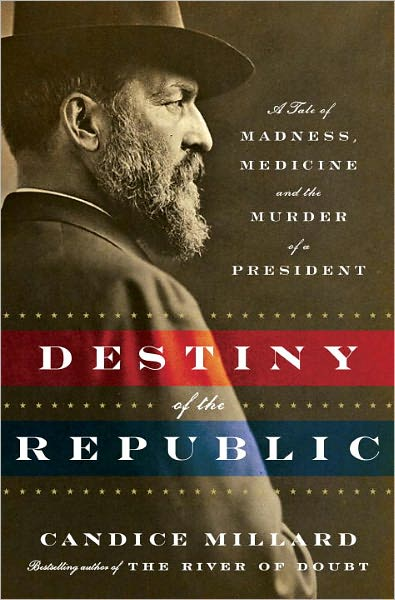
Barnes & Noble ReviewWhether they were prompted by insanity or simple desperation in the face of his looming, almost inevitable execution, there was element of truth in Guiteau’s ravings. In “Destiny of the Republic: A Tale of Madness, Medicine, and the Murder of a President,” Candice Millard reconstructs the events leading up to and following Garfield’s assassination. The murder serves as a lens through which to examine Garfield’s life, Guiteau’s peripatetic existence, the fortunes of the Republican Party, the political spoils system, the role of scientific invention, and the state of the American medical profession. By keeping a tight hold on her narrative strands, Millard crafts a popular history rich with detail and emotion.

One of the pleasures of the book is the chance to learn more about Garfield, who appears as a fully realized historical figure instead of a trivia answer. A child of a poor family, he worked as a canal driver before attending college at Ohio’s Western Reserve Eclectic Institute. During the Civil War, Garfield’s leadership of Ohio’s 42nd Regiment yielded a bloody victory over Confederate forces at the Battle of Middle Creek, securing Kentucky’s allegiance to the Union. Elected to Congress as a Republican, Garfield served nine terms in the House, developing a reputation for oratory and a willingness to dig into financial issues. Drafted to stand for president against his wishes, Garfield entered the White House in 1881 with more than a bit of reluctance.

Unlike Garfield, Guiteau never found his calling. An odd little man, he was by turns a lawyer, a swindler, and a traveling evangelist whose constant movement from city to city made it possible for him to escape the consequences of unpaid bills and delusional behavior. As his fortunes declined, so did his mental state. Having delivered a short speech at a “small gathering” in New York endorsing Garfield’s candidacy, Guiteau came to believe that he had orchestrated Garfield’s victory. Guiteau spent weeks loitering in the waiting rooms of the White House and State Department, intent on securing an ambassadorship to Vienna or Paris. When the appointment didn’t materialize, Guiteau was subject to a divine revelation that came “like a flash” while he lay in bed: God commanded him to kill the ungrateful president.

His mind quickly taken over by this obsession, Guiteau borrowed some money, bought a pistol at a sporting goods store, and commenced stalking the president, an activity that Millard shows to have been shockingly easy, even in a city that had witnessed Lincoln’s shooting less than two decades prior. After some false starts, the assassin waited for Garfield in a Washington, D.C., train station on July 2, 1881, and shot him twice in the back. Seized by the crowd, Guiteau gave himself up to the police and asked them to deliver a letter to Gen. Sherman. He expected in short order to be proclaimed a hero.

Millard devotes most of the second half of the book to a revealing chronicle of Garfield’s treatment after the attack, and its consequences. American medicine in the 1880s had not yet embraced Joseph Lister’s ideas about germs and their role in promoting infection — indeed, many were mounting a furious counterattack against what they considered a nonsensical foreign innovation. Within minutes of Garfield being shot, dirty fingers were inserted into the wounds to feel for the bullets. Millard shows how contemporary ideas about patient care — diet, pain management, the cause of infections, wound care and sterilization — led to Garfield’s death two and a half months later. An invention by Alexander Graham Bell, which could detect the presence of metal, might have been able to locate where one of the bullets had lodged, but the doctor overseeing Garfield’s care restricted its use out of concern for his own ego. The once-robust Garfield would lose 80 pounds as his body became a collection of pus-filled abscesses brought on by septic poisoning.

Millard’s sympathetic portrayal of Garfield leaves the reader wondering what might have been had he lived. What kind of president would the bookish man from Ohio have turned out to be? The answers to these counterfactuals are outside the purview of Millard’s book, but their seeming inevitability attests to her ability to bring to life the man at the center of her story, and his brief entry into the annals of presidential history.

The new face of “Democrats are the real racists!”

The National Review's lame attempt at revisionist political history

  • more
    • All Share Services

The new face of (Credit: Library of Congress)

Apparently it is a great big lie — an “utter fabrication with malice and forethought” — to say that the Democrats lost their longtime hold over the old Confederacy because their support for civil rights legislation drove white Southerners away. That’s according to the National Review’s Kevin Williamson, who wrote a big National Review piece about how mad this lie makes him, when the secret truth is that Republicans have always been, and will always be, the single most pro-civil rights party ever.

The piece is largely an attempt to add a patina of respectability to the ancient, brainless comment thread talking point about how Robert Byrd was in the Klan, but lots of Republicans voted for the Civil Rights Act, so therefore Democrats are the real racists. (In this respect, the piece is an homage to Jonah Goldberg’s “Liberal Fascism,” which attempted to expand “Nazi stands for National Socialist” to book length, without pictures.) The only problem is that the “lie” he’s arguing against is 100 percent true, except when he states it in such a way that it no longer resembles what anyone has ever actually claimed.

So: It’s true, and no one denies this, that Republicans used to be very good on civil rights and Democrats used to be super racist. It’s true that Woodrow Wilson was a bigot and (Northern, liberal) Republican senators were better than (Southern, conservative) Democratic senators on civil rights in the 1940s, 1950s and 1960s. Williamson’s argument seems to be that Republicans couldn’t have taken advantage of a Democratic split over civil rights by appealing to racist white Southern voters because Republicans were too uniformly pro-civil rights, themselves. (This great big lie he’s debunking is one that Nixon and Lee Atwater and Ronald Reagan happily signed on to — they were thrilled when the Democrats fractured the New Deal coalition by eventually embracing civil rights!)

Williamson would, I guess, call it revisionist history, but he has revised all of the history out of it.

Even if the Republicans’ rise in the South had happened suddenly in the 1960s (it didn’t) and even if there were no competing explanation (there is), racism — or, more precisely, white southern resentment over the political successes of the civil-rights movement — would be an implausible explanation for the dissolution of the Democratic bloc in the old Confederacy and the emergence of a Republican stronghold there. That is because those southerners who defected from the Democratic party in the 1960s and thereafter did so to join a Republican party that was far more enlightened on racial issues than were the Democrats of the era, and had been for a century.

Oh, did they? It’s dubious to argue that the party that nominated Barry Goldwater for president was “far more enlightened” than the one that nominated Kennedy, but Johnson was a big ol’ Texas racist, so sure, fine, pretend Nelson Rockefeller cancels out Barry. But the segregationists didn’t all wake up and decide to vote for Republicans starting in 1965 — they revolted. George Wallace started a third party. They continued fighting for racism within the party, and they eventually lost. But it wasn’t until the conservative movement had finished fully taking over the Republican Party that the great shift finished.

After devoting a lot of words to LBJ’s very real history of being a loud-mouthed racist, Williamson explains that Johnson’s dumb, loud-mouthed racism was just a reflection of the whole of Democratic Party philosophy and belief since time immemorial.

Johnson did not spring up from the Democratic soil ex nihilo. Not one Democrat in Congress voted for the Fourteenth Amendment. Not one Democrat in Congress voted for the Fifteenth Amendment. Not one voted for the Civil Rights Act of 1875. Eisenhower, as a general, began the process of desegregating the military, and Truman, as president, formalized it, but the main reason either had to act was that President Wilson, the personification of Democratic progressivism, had resegregated previously integrated federal facilities. (“If the colored people made a mistake in voting for me, they ought to correct it,” he declared.) Klansmen from Senator Robert Byrd to Justice Hugo Black held prominent positions in the Democratic Party — and President Wilson chose the Klan epic Birth of a Nation to be the first film ever shown at the White House.

Johnson himself denounced an earlier attempt at civil-rights reform as the “nigger bill.” So what happened in 1964 to change Democrats’ minds? In fact, nothing.

What is the funniest part of this: How it basically makes one brief stop in between 1875 and the mid-20th century in its exhaustive history of Democratic racism? Or how Williamson is clearly annoyed at having to even slightly, obliquely credit Harry Truman (Democrat!) for desegregating the armed forces, a thing (Democrat) Harry Truman did? Like, maybe what happened in 1964 was the eventual result of an intraparty battle that was happening in 1948 when Democrat Harry Truman desegregated the armed forces (and Strom Thurmond, future Republican, threw a big fit about it)?

The 1964 Civil Rights Act, and Lyndon Johnson’s role in ensuring its passage, was one major victory in a years-long effort by the party’s liberals to make the Democratic Party the civil rights party, and it worked so well that the racists were effectively no longer welcome. They responded by changing their positions or changing sides. It wasn’t an overnight change, because politics is slow, but it happened: Robert Byrd and even George Wallace changed their positions on black civil rights and apologized. Those who couldn’t adapt, or those for whom bigotry was more genuine belief than political opportunism, left the party. Strom Thurmond became a Republican. Lester Maddox launched a third-party presidential bid against Jimmy Carter and eventually endorsed Republican Pat Buchanan in 1992. Maddox was also a charter member of the Council of Conservative Citizens, the white supremacist paleoconservative group that once counted Trent Lott, Thurmond and Jesse Helms as members. These guys are the heirs to the conservative white Southern Democrat tradition. I’m not really sure they themselves would consider it a pernicious lie to say as much.

What would have been much, much more entertaining would have been if, instead of writing this piece about “Democrats” and “Republicans,” Williamson had written it about liberals and conservatives. Barry Goldwater and George Wallace both used conservative rhetoric to justify their segregationist beliefs — and so did William F. Buckley. Both parties at the time had liberal and conservative wings, and in each of those parties it was the liberal wing that was right on civil rights.

There was really only one American political party with a solid record on civil rights in the first half of the 20th century, and it was the American Communist Party. But “in praise of the liberal Northeastern Republicans who stood with the communists on civil rights and who were eventually driven from the party by conservatives like the ones who founded this magazine” would not go over well in the National Review, I imagine.

Williamson goes on to argue that the white South didn’t go Republican because of civil rights, it went Republican because of … the New Deal. So while the change happened too slowly and gradually to be ascribed to racism, it can happily be pinned on a series of popular economic programs that had been enacted 30 years prior to 1964. (Programs so popular that Southern racists and blacks joined together in a political coalition that lasted until liberals began … winning civil rights victories.)

But let’s not also forget to blame hippies and welfare:

The Republican ascendancy in Dixie is associated with the rise of the southern middle class, the increasingly trenchant conservative critique of Communism and the welfare state, the Vietnam controversy and the rise of the counterculture, law-and-order concerns rooted in the urban chaos that ran rampant from the late 1960s to the late 1980s, and the incorporation of the radical Left into the Democratic Party. Individual events, especially the freak show that was the 1968 Democratic convention, helped solidify conservatives’ affiliation with the Republican Party.

In other words, it was literally everything that was going on in the 1960s besides civil rights issues that made white Southerners eventually fully embrace the Republican Party. (And blacks continue to support the Democrats because Democrats lied about what happened in the 1960s and because Johnson promised them free government money forever, apparently.)

I mean it’s obviously true that the shift didn’t happen purely because of the Civil Rights Act of 1964, but it’s just as obviously true that it’s a hilarious and deeply stupid misreading of history to pretend that the Republican Party has always and will always be the champion of civil rights.

[Thanks to, and please also read: Adam Serwer, Jonathan Chait, Mark Schmitt, Clay Risen, and Jonathan Bernstein.]

Continue Reading Close
Alex Pareene

Alex Pareene writes about politics for Salon and is the author of "The Rude Guide to Mitt." Email him at apareene@salon.com and follow him on Twitter @pareene

Faux history for the GOP

Republicans love David Barton and his new book, "The Jefferson Lies" -- even though it gets history wrong

  • more
    • All Share Services

Faux history for the GOP

Earlier this month, the evangelical writer David Barton’s new book, “The Jefferson Lies,” hit the New York Times bestseller list for hardcover nonfiction. Barton isn’t popular, however, only with the ordinary American reader. On May 8, John Boehner authorized the use of Statuary Hall in the U.S. Capitol for a religious service to commemorate the first inauguration of George Washington. Among the speakers was Barton, who is revered by social conservatives because he argues that the nation was founded primarily by evangelical Christians on explicitly Christian teachings.

Barton — “one of the most important men alive,” according to Glenn Beck — is frequently criticized as a pseudo-historian by progressives and academic historians for his claims about the Founders. He is now facing scrutiny, however, from evangelicals. After Barton’s speech in the Capitol, John Fea, chairman of the history department at evangelical Messiah College, accused Barton of “peddling falsehoods” about Washington, and asked, “Is it time to gather Christian historians together to sign some kind of formal statement condemning Barton’s brand of propaganda and hagiography?”

There is no question that Barton’s history lessons are important to the conservative wing of the GOP. Barton, who was named one of Time magazine’s top 25 most influential evangelicals in 2005, was also tapped by Tea Party Caucus chairwoman Michele Bachmann to teach classes on the Constitution to congressional members in 2010.

During the GOP presidential primary season, Barton was a central figure in the religious right’s effort to crown a religious conservative as the GOP front-runner. In 2011, at the Rediscovering God Conference in Iowa,  Mike Huckabee gushed:

I almost wish that there would be a simultaneous telecast and all Americans would be forced, forced at gunpoint no less, to listen to every David Barton message and I think our country would be better for it. I wish it’d happen.

In 2010, before Newt Gingrich decided to run for president, he appeared on David Barton’s Wallbuilder’s radio show, telling Barton:

And I can assure you that if we do decide to run next year, we’re promptly going to call you and say “we need your help, and we need your advice, and we need your counsel…If we decide to run, David, we’re going to need you.”

Most recently, speaking in Statuary Hall, Barton related a legend about George Washington’s prayer in the snow at Valley Forge. In the story, a British loyalist overheard Washington praying, went home to his wife and proclaimed that the revolutionaries will win the war because of Washington’s fervent prayers. According to historian Fea, Washington probably did pray for success, but the story of Isaac Potts stumbling upon Washington praying in the snow is a legend. In his book “Was America Founded as a Christian Nation: A Historical Introduction,” Fea demonstrates that the facts don’t add up. For instance, Potts was probably not near Valley Forge at the time and he was not married at that time, meaning he could not have had a conversation with his wife about Washington’s prayer. Fea says this kind of revisionism is common, saying that “Barton continually tells stories of the past that are not true.”

Over the past year, I read some of Barton’s claims about history, checked them out, and found most of them to be problematic. Some of these claims have been restated in “The Jefferson Lies.” For example, Barton claims that Jefferson did not free his many slaves because of restrictions in Virginia law. Barton says Jefferson could not free them because by 1826, when Jefferson died, the law forbade such emancipations. This claim is quite misleading. In 1782, Virginia passed a law on manumission, which allowed the emancipation of slaves at any time, not just at death. In fact, many slaves were freed by other slave owners after this law passed. However, after this law passed, Jefferson sold some slaves for cash, instead of freeing them. Although legal provisions relating to emancipation were tightened a bit in 1785 and further in 1806, there was a 24-year window wherein Jefferson could have freed his slaves while he was alive.

In 1806, Virginia law was changed to require emancipated slaves to leave the state or face being resold into slavery. In fact, Jefferson favored deportation. He wrote in his autobiography, “Nothing is more certainly written in the book of fate than that these people are to be free. Nor is it less certain that the two races, equally free, cannot live in the same government. Nature, habit, opinion has drawn indelible lines of distinction between them. It is still in our power to direct the process of emancipation and deportation peaceably …” In “The Jefferson Lies,” Barton refers to the 1806 law but minimizes Jefferson’s views on deportation, and does not indicate that emancipation could have occurred before a master’s death.

One chapter in “The Jefferson Lies” deals with the so-called Jefferson Bible. The Jefferson Bible refers to Jefferson’s extraction of passages from the New Testament Gospels that he believed were really the words and deeds of Jesus of Nazareth, leaving aside what he believed was added by others. Jefferson said the work was like extracting diamonds from a dunghill. Jefferson made two such efforts, one in 1804 and the other sometime after 1820. In “The Jefferson Lies,” Barton tells readers that Jefferson included miracles of healing from Matthew chapters 9 and 11. However, a review of the table of texts used by Jefferson to construct his works reveals that he did not include the passages Barton claims.

While there are many false claims in “The Jefferson Lies,” another obvious historical molehill Barton makes into a mountain is Jefferson’s signature on shipping passports that are dated with the words, “in the year of our Lord Christ.” Common diplomatic language at the time, those actual words were required by treaties with European nations and included on preprinted forms. Barton says Jefferson chose to include that religious language into his presidential business. Not so. Jefferson, like Adams before him and several presidents after him had no choice because, as Jefferson once told Secretary of the Treasury Albert Gallatin, “Sea-letters are the creatures of treaties.”

My co-author Michael Coulter and I have addressed these and other claims in our book, “Getting Jefferson Right: Fact Checking Claims About Our Third President.” For an article that later became a part of that book, I wrote Barton and called Wallbuilders without response. In April, 2011, Barton declined to appear with me on a Christian radio program. According to Fea, this is not surprising. “When he is called out on these falsehoods by a respectable historian, even evangelical historians who for the most part share his faith, he refuses to admit to his errors.”

After years of being attacked by progressives, will Barton reexamine his claims due to friendly fire? With “The Jefferson Lies” hitting the New York Times list of bestsellers, it seems clear that being fast and loose with the facts sells well. All the more reason for people in the evangelical community to subject claims about the Founders to a renewed scrutiny.

Continue Reading Close

Warren Throckmorton, PhD is an Associate Professor of Psychology at Grove City College (Pa.). He blogs regularly about religious and mental health issues at www.wthrockmorton.com.

America’s great divergence

The new innovation economy is making some cities richer, many cities poorer -- and it's transforming our country

  • more
    • All Share Services

America's great divergence (Credit: karamysh via Shutterstock)
This article is an excerpt from the upcoming book "The New Geography of Jobs," available May 22 from Houghton Mifflin Harcourt.

Menlo Park is a lively community in the heart of Silicon Valley, just minutes from Stanford University’s manicured campus and many of the Valley’s most dynamic high-tech companies. Surrounded by some of the wealthiest zip codes in California, its streets are lined with an eclectic mix of midcentury ranch houses side by side with newly built mini-mansions and low-rise apartment buildings. In 1969, David Breedlove was a young engineer with a beautiful wife and a house in Menlo Park. They were expecting their first child. Breedlove liked his job and had even turned down an offer from Hewlett-Packard, the iconic high-tech giant in the Valley. Nevertheless, he was considering leaving Menlo Park to move to a medium-sized town called Visalia. About a three-hour drive from Menlo Park, Visalia sits on a flat, dry plain in the heart of the agricultural San Joaquin Valley. Its residential neighborhoods have the typical feel of many Southern California communities, with wide streets lined with one-story houses, lawns with shrubs and palm trees, and the occasional backyard pool. It’s hot in the summer, with a typical maximum temperature in July of ninety-four degrees, and cold in the winter.

Breedlove liked the idea of moving to a more rural community with less pollution, a shorter commute, and safer schools. Menlo Park, like many urban areas at the time, did not seem to be heading in the right direction. In the end, Breedlove quit his job, sold the Silicon Valley house, packed, and moved the family to Visalia. He was not the only one. Many well-educated professionals at the time were leaving cities and moving to smaller communities because they thought those communities were better places to raise families. But things did not turn out exactly as they expected.

In 1969, both Menlo Park and Visalia had a mix of residents with a wide range of income levels. Visalia was predominantly a farming community with a large population of laborers but also a sizable number of professional, middle-class families. Menlo Park had a largely middle-class population but also a significant number of working-class and low-income households. The two cities were not identical—the typical resident of Menlo Park was somewhat better educated than the typical resident of Visalia and earned a slightly higher salary—but the differences were relatively small. In the late 1960s, the two cities had schools of comparable quality and similar crime rates, although Menlo Park had a slightly higher incidence of violent crime, especially aggravated assault. The natural surroundings in both places were attractive. While Menlo Park was close to the Pacific Ocean beaches, Visalia was near the Sierra Nevada range and Sequoia and Kings Canyon National Parks.

Today the two places could not be more different, but not in the way David Breedlove envisioned. The Silicon Valley region has grown into the most important innovation hub in the world. Jobs abound, and the average salary of its residents is the second highest in America. Its crime rate is low, its school districts are among the best in the state, and the air quality is excellent. Fully half of its residents have a college degree, and many have a PhD, making it the fifth best educated urban area in the nation. Menlo Park keeps attracting small and large high-tech employers, including most recently the new Facebook headquarters.

By contrast, Visalia has the second lowest percentage of college-educated workers in the country, almost no residents with a postgraduate degree, and one of the lowest average salaries in America. It is the only major city in the Central Valley that does not have a four-year college. Its crime rate is high, and its schools, structurally unable to cope with the vast number of non-English-speaking students, are among the worst in California. Visalia also consistently ranks among American cities with the worst pollution, especially in the summer, when the heat, traffic, and fumes from farm machines create the third highest level of ozone in the nation.

Not only are the two communities different, but they are growing more and more different every year. For the past thirty years, Silicon Valley has been a magnet for good jobs and skilled workers from all over the world. The percentage of college graduates has increased by two-thirds, the second largest gain among American metropolitan areas. By contrast, few high-paying jobs have been created in Visalia, and the percentage of local workers with a college degree has barely changed in thirty years—one of the worst performances in the country.

For someone like David Breedlove, a highly educated professional with solid career options, choosing Visalia over Menlo Park was a perfectly reasonable decision in 1969. Today it would be almost unthinkable. Although only 200 miles separate these two cities, they might as well be on two different planets.

The divergence of Menlo Park and Visalia is not an isolated case. It reflects a broader national trend. America’s new economic map shows growing differences, not just between people but between communities. A handful of cities with the “right” industries and a solid base of human capital keep attracting good employers and offering high wages, while those at the other extreme, cities with the “wrong” industries and a limited human capital base, are stuck with dead-end jobs and low average wages. This divide—I will call it the Great Divergence—has its origins in the 1980s, when American cities started to be increasingly defined by their residents’ levels of education. Cities with many college-educated workers started attracting even more, and cities with a less educated workforce started losing ground. While in 1969 Visalia did have a small professional middle class, today its residents, especially those who moved there recently, are overwhelmingly unskilled. Menlo Park had many low-income families in 1969, but today most of its new residents have a college degree or a master’s degree and a middle- to upper-class income. Geographically, American workers are increasingly sorting along educational lines. At the same time that American communities are desegregating racially, they are becoming more segregated in terms of schooling and earnings.

Certainly any country has communities with more or less educated residents. But today the difference among communities in the United States is bigger than it has been in a century. The divergence in educational levels is causing an equally large divergence in labor productivity and therefore salaries. Workers in cities at the top of the list make about two to three times more than identical workers in cities at the bottom, and the gap keeps growing.

Cities with a high percentage of skilled workers offer high wages not just because they have many college-educated residents and these residents earn high wages. This would be interesting but hardly surprising. But something deeper is going on. A worker’s education has an effect not just on his own salary but on the entire community around him. The presence of many college-educated residents changes the local economy in profound ways, affecting both the kinds of jobs available and the productivity of every worker who lives there, including the less skilled. This results in high wages not just for skilled workers but for most workers.

I consider the Great Divergence to be one of the most important developments in the United States over the past thirty years. The growing economic divide between American communities is not an accident but the inevitable result of deep-seated economic forces. More than traditional industries, the knowledge economy has an inherent tendency toward geographical agglomeration. In this context, initial advantages matter, and the future depends heavily on the past. The success of a city fosters more success, as communities that can attract skilled workers and good jobs tend to attract even more. Communities that fail to attract skilled workers lose further ground.

The growing divergence of American communities is important not just in itself but because of what it means for American society. While the divide is first and foremost economic, it is now beginning to affect cultural identity, health, family stability, and even politics. The sorting of highly educated Americans into some communities and less educated American into others tends to magnify and exacerbate all other socioeconomic differences. For example, there are vast differences in life expectancy among inhabitants of American cities, and these differences have been expanding for the past three decades. The divorce rates, crime rates, and political clout of different communities have also been diverging. These trends are reshaping the very fabric of our society.

The United States is not in particularly high spirits these days. Fear of economic decline is widespread, and insecurity about America’s standing in the world and its economic future is growing. Talk of the “death of the American dream” is everywhere, from well-articulated op-ed pieces to crude talk radio shows, from casual barbershop conversations to highbrow academic symposia. In a nation sharply divided along political lines, concern about the economy is shared almost equally by those on the left and on the right.

On the surface it seems we have good reason to be worried. Middle-class salaries are declining. Good jobs are scarce. Take the typical forty-year-old male worker with a high school education: today his hourly wage is 8 percent lower than his father’s was in 1980, adjusted for inflation. This means that for the first time in recent American history, the average worker has not experienced an improvement in standard of living compared to the previous generation. In fact he is worse off by almost every measure. On top of this, income inequality is widening. Uncertainty about the future is now endemic.

But the economic picture is more complex, more interesting, and more surprising than the current debate suggests. America’s labor market is undergoing a momentous shift. While some sectors and occupations are dying, others are growing stronger, and still others, just born, promise to alter the landscape dramatically. Most of all, the geography of jobs is changing in profound and irreversible ways. While these trends are national, even global, in scope, their effects are profoundly different in different cities and regions of the country. For example, the effects of globalization, technological progress, and immigration on American workers are not uniform across the United States. They favor the residents of some cities and hurt the residents of others. As old manufacturing capitals disappear, new innovation hubs are rising and are poised to become the new engines of prosperity. An unprecedented redistribution of jobs, population, and wealth is under way in America, and it’s likely to accelerate in the decades to come.

Some of the changes in the economic map reflect long-run forces that are outside our control. Others can be shaped and managed. But none of them are random, chaotic, or unpredictable. In the end, they all reflect clear and rather basic economic principles. Unfortunately, they tend to be obscured by the flood of data on the fluctuations of the stock market or the latest employment numbers. The focus on short-term events often results in information that is incomplete, irrelevant, or both. What happened today, this week, or even this month is not very illuminating, because the fundamentals of an economy evolve at a much slower pace.

But if we take a step back and look at the big picture, the forces that have been driving these changes reveal themselves very clearly. They are far more fascinating and much more important than the daily movements of the Dow Jones. This book examines the long-term trends that really matter to our lives—the vast changes that have taken place in the American labor market over the past three decades and the economic forces underlying these changes. But it also looks forward, seeking to provide insight into the trends that will shape our economy over the next three decades.

Economists like to distinguish cyclical change, the ups and downs of the economy driven by the endless cycle of recessions and expansions, from secular change, the long-run developments that are driven by deep-seated but slower-moving economic dynamics. Most of the current public debate on the economy—in the media, in Congress, in the White House—focuses on the former. The time horizon in this debate is six months or a year at most: How do we end the recession? What should be in this year’s budget? How will unemployment affect the next election? In this book, the focus is almost entirely on the forces that drive long-run trends. Understanding why these changes are taking place, where they are occurring, and how they are affecting individual Americans is crucial. Our jobs, our communities, and our economic destiny are at stake.

The changes taking place in the United States can be seen around the globe. New economic powerhouses are displacing old ones. What used to be tiny, barely visible dots on the map have turned into thriving megalopolises with thousands of new companies and millions of new jobs. Nowhere are these changes more obvious than in the Chinese city of Shenzhen. If you have not heard of it, you will. It is one of the fastest-growing cities in the world. In just three decades it has gone from being a small fishing village to being a huge metropolis with more than 10 million residents. In the United States, a fast-growing city like Las Vegas or Phoenix may triple or quadruple in size over a thirty-year period. Shenzhen’s population has grown by more than 300 times in the same period. In the process, Shenzhen has become one of the manufacturing capitals of the world.

Shenzhen’s rise is truly remarkable because it parallels almost perfectly the decline of U.S. manufacturing centers. Thirty years ago Shenzhen was an unremarkable small town that no one outside of southern Guangdong Province had even heard of. Its fate—as well as the fate of millions of American manufacturing workers —was sealed in 1979, when the Chinese leadership singled it out to be the first of China’s “Special Economic Zones.” These zones quickly became a magnet for foreign investment. In turn, that flow of investment led to thousands of new factories. These factories are where many American manufacturing jobs have gone.

As Detroit and Cleveland have declined, Shenzhen has grown. Massive production facilities of all kinds carpet the region. Every year the skyline adds new high-rise offices and apartments, and its workforce swells as more and more farmers leave rural areas to look for better-paying jobs in its cavernous factories. The Chinese call it the city with “one high-rise a day and one boulevard every three days.” As you walk along its wide streets, you feel the city’s energy and optimism. Shenzhen has been China’s top exporter for the past two decades and has built one of the world’s busiest ports, a sprawling facility dotted with huge cranes, enormous trucks, and containers of all colors. Twenty-four hours a day, seven days a week, 365 days a year, these containers are loaded onto enormous cargo ships bound for the West Coast of the United States. Twenty-five million of these containers leave the port each year, almost one per second. In less than two weeks that merchandise will be on a truck headed for a Walmart distribution center, an IKEA warehouse, or an Apple store.

Shenzhen is where the iPhone is assembled. If there is a poster child of globalization, it is the iPhone. Apple has given as much attention to designing and optimizing its supply chain as to the design of the phone itself. The process by which the iPhone is produced illustrates how the new global economy is reshaping the location of jobs and presenting new challenges for American workers.

Apple engineers in Cupertino, California, conceived and designed the iPhone. This is the only phase of the production process that takes place entirely in the United States. It involves product design, software development, product management, marketing, and other high-value functions. At this stage, labor costs are not the main consideration. Rather, the important elements are creativity and ingenuity. The iPhone’s electronic parts—sophisticated, but not as innovative as its design—are made mostly in Singapore and Taiwan. Only a few components are made in the United States. The last phase of production is the most labor-intensive: workers assemble the hardware and prepare it for shipping. This part, where the key factor is labor costs, takes place on the outskirts of Shenzhen. The facility is one of the largest in the world, and its sheer size is extraordinary: with 400,000 workers, dormitories, stores, and even cinemas, it is more like a city within a city than a factory. If you buy an iPhone online, it is shipped directly to you from Shenzhen. Incredibly, when it reaches the American consumer, only one American worker has physically touched the final product: the UPS delivery guy.

At a superficial level, the story of the iPhone is troubling. Here you have an iconic American product that has captivated consumers everywhere, but American workers are involved only in the initial innovation phase. The rest of the process, including the making of the sophisticated electronic components, has been moved overseas. It is therefore natural to wonder what might be left to American workers in the decades to come. Is America entering a phase of irreversible decline?

Over the past half century, the United States has shifted from an economy centered on producing physical goods to one centered on innovation and knowledge. Jobs in the innovation sector have been growing disproportionately fast. The key ingredient in these jobs is human capital, which consists of people’s skills and ingenuity. In other words, humans are the essential input—they are coming up with the new ideas. The same two forces that have decimated traditional manufacturing, globalization and technological progress, are now driving the rise of jobs in the innovation sector. The Great Recession has temporarily halted this growth, but the long-term trend points upward.

Globalization and technological progress have turned many physical goods into cheap commodities but have raised the economic return on human capital and innovation. For the first time in history, the factor that is scarce is not physical capital but creativity. Not surprisingly, innovators capture the largest share of the value of new products. The iPhone is made of 634 components. The value created in Shenzhen is very low, because assembly can be done anywhere in the world. Even sophisticated electronic parts, like flash memories and retina displays, create limited value, because of strong global competition. The majority of the iPhone’s value comes from the original idea, its unique engineering, and its beautiful industrial design. Essentially this is why Apple receives $321 for each iPhone—much more than any part supplier involved in physical production. This matters tremendously, not just for Apple’s profit margin and for our sense of national pride, but because it means good jobs.

The innovation sector includes advanced manufacturing (such as designing iPhones or iPads), information technology, life sciences, medical devices, robotics, new materials, and nanotechnology. But innovation is not limited to high technology. Any job that generates new ideas and new products qualifies. There are entertainment innovators, environmental innovators, even financial innovators. What they all have in common is that they create things the world has never seen before. We tend to think of innovations as physical goods, but they can also be services—for example, new ways of reaching consumers or new ways of spending our free time. Today this is where the real money is. A part of the $321 that Apple receives ends up in the pockets of Apple’s stockholders, but some of it goes to Apple’s employees in Cupertino. And because of the company’s great profitability, it has the incentive to keep innovating and to keep hiring workers. Studies show that the more innovative a company is, the better paid its employees are.

You might think that the rise of innovation is pretty exciting if you work for, say, Google or a biotech company but that it doesn’t matter all that much if you’re a teacher or a doctor or a police officer. After all, the majority of Americans will never work for a high-tech startup. Why should they care about the rise of innovation? As it turns out, however, innovation matters not only for the well-educated workers who are directly employed by high-tech firms—the scientists, engineers, and creators of new ideas—but for most American workers.

If you take a walk in one of America’s cities, most of the people you see on the street will be store clerks and hairstylists, lawyers and waiters, not innovators. About a third of Americans work either for the government or in the education and health services sectors, which include teachers, doctors, and nurses. Another quarter are in retail, leisure, and hospitality, which includes people working in stores, restaurants, movie theaters, and hotels. An additional 14 percent are employed in professional and business services, which include employees of law, architecture, and management firms. In total, two-thirds of American jobs are in the local service sector, and that number has been quietly growing for the past fifty years. Most industrialized nations have a similar percentage of local service jobs. The goods and services in this sector are locally produced and locally consumed and therefore do not face global competition. Although jobs in local services constitute the vast majority of jobs, they are the effect, not the cause, of economic growth. One reason is that productivity in local services tends not to change much over time. It takes the same amount of labor to cut your hair, wait on a table, drive a bus, or teach math as it did fifty years ago. By contrast, productivity in the innovation sector increases steadily every year, thanks to technological progress. In the long run, a society cannot experience salary growth without significant productivity growth. Fifty years ago, manufacturing was the driver of this growth, the one sector responsible for raising the wages of American workers, including local service workers. Today the innovation sector is the driver. Thus, what happens to the innovation sector determines the salary of many Americans, whether they work in innovation or not.

A second reason that the rise of innovation matters to all of us has to do with the almost magical economics of job creation. Innovative industries bring “good jobs” and high salaries to the communities where they cluster, and their impact on the local economy is much deeper than their direct effect. Attracting a scientist or a software engineer to a city triggers a multiplier effect, increasing employment and salaries for those who provide local services. In essence, from the point of view of a city, a high-tech job is more than a job. Indeed, my research shows that for each new high-tech job in a city, five additional jobs are ultimately created outside of the high-tech sector in that city, both in skilled occupations (lawyers, teachers, nurses) and in unskilled ones (waiters, hairdressers, carpenters). For each new software designer hired at Twitter in San Francisco, there are five new job openings for baristas, personal trainers, doctors, and taxi drivers in the community. While innovation will never be responsible for the majority of jobs in the United States, it has a disproportionate effect on the economy of American communities. Most sectors have a multiplier effect, but the innovation sector has the largest multiplier of all: about three times larger than that of manufacturing.

Excerpted from The New Geography of Jobs, by Enrico Moretti. Copyright © 2012 by Enrico Moretti. Reprinted by permission of Houghton Mifflin Harcourt Publishing Co. All rights reserved.

Continue Reading Close

Enrico Moretti is a professor of economics at the University of California, Berkeley, whose research has been supported by the National Science Foundation, the National Institutes of Health and has been featured in the New York Times, the Wall Street Journal and Slate, among other publications.

America’s appalling holidays

From Loyalty Day to Confederate Memorial Day, a trip through our country's more disconcerting celebrations

  • more
    • All Share Services

America's appalling holidays (Credit: PhotosbyAndy via Shutterstock)

Perhaps you were shocked this month when you read that years ago, thanks to its association with international workers and the anarchist movement, May Day was officially named Loyalty Day by the federal government to avoid the appearance of condoning dissent. It’s creepy and Orwellian, but it’s not that unusual.

AlterNetIn fact, naming in general in the post-9/11 era, as in the Patriot Act, the Department of Homeland Security and more has reached particular heights of absurdity. And now, in post-corporate personhood America, we also have the grand pleasure of watching everything, from stadiums to streets, get new names after the same companies that try to woo our dollars and influence policy.

But this isn’t a new American tradition. A simple search of other official national and state holidays shows that region by region, we have some pretty appalling holidays on the books. Here are just a few.

Loyalty Day: May 1, the anniversary of the Haymarket Massacre, was originally commemorated as Labor Day or International Workers day. Later the American government tried to counterbalance this with an Americanization day that later, under President Dwight D. Eisenhower, morphed into “Loyalty Day,” — “a special day for the reaffirmation of loyalty to the United States and for the recognition of the heritage of American freedom.” On Loyalty Day, flags are supposed to be flown and celebrations of America held. But not this year, when May Day celebrations came back and took the streets.

Patriot Day: Not to be confused with Patriot’s day, the New England holiday that commemorates the battles of Lexington and Concord (and the Boston Marathon and Fenway home games), Patriot Day is the official designation for the anniversary of September 11th, 2001. As a born and bred New Yorker, I certainly will never let that anniversary go by without remembering–and I don’t object to its being a recognized observance — but it’s another Orwellian name, one that prioritizes duty to country over memory of a loss. To me, 9/11 is not really about honoring national borders, but the opposite.

Robert E. Lee’s birthday and other Confederate commemoration fetes: Several states, including ArkansasAlabamaFloridaGeorgia and Mississippi, don’t let Martin Luther King Jr.’s birthday be celebrated without tacking on this commemoration of the Confederate general who led armies into the field to defend the genocidal institution of slavery. This is the first of a few official holidays in the former states of the confederacy that are a little bit sketchy.

So along with Robert E. Lee’s birthday we have Confederate Memorial day, officially celebrated in nine states at various times, mostly in the spring. In fact, Texas has two holidays:Confederate Memorial Day and Confederate Heroes day. And then there’s Jefferson Davis’ birthday, also officially celebrated in a handful of states.

Not all the residents of these states are even aware of this passel of holidays, as this blogger at “Left in Alabama” wrote:

I have obviously lived under a rock until lately. I had NO idea that Confederate Memorial Day and Jefferson Davis’ birthday were state holidays. I did know that for some reason my kids’ school lists Martin Luther King, Jr. Day as the King/Lee holiday. That doesn’t sit well with me.

This underscores the point. Weird holidays aren’t about culture (I could only find a handful of actual “Loyalty Day” celebrations on the Internet but about law: Southerners of all persuasions should be able to celebrate their region without having to commemorate one of America’s darkest hours.

Speaking of America’s other darkest hours, Berkeley, California, led the way in officially changing Columbus Day to Indigenous People’s Day, now celebrated by various tribal governments. Others, sensing the problem with having a long weekend dedicated to the father of a genocide, have renamed the day “Italian Heritage Day” or stopped celebrating it at all. I say: keep the long weekend, mandate that it be used to honor those whose stolen land we stand on.

Continue Reading Close

Our real first gay president

Don't believe what Newsweek's cover tells you: The first gay president was James Buchanan more than a century ago

  • more
    • All Share Services

Our real first gay president (Credit: Wikipedia/Salon)
This piece originally appeared on History News Network.

The new issue of Newsweek features a cover photo of President Obama topped by a rainbow-colored halo and captioned “The First Gay President.” The halo and caption strike me as cheap sensationalism. I realize airport travelers look at a magazine for 2.2 seconds before moving on to the next one. I grant that this cover will probably get Newsweek a 4.4 second glance. I also understand that Newsweek is desperate for sales. Nevertheless, I doubt that the Newsweek of old, before it was sold for a dollar, would have pandered as shallowly.

The caption is a superficial way to characterize an important development of thought that the president — along with the country — has been making over recent years. It is also entirely wrong. Like the mini-furor a couple of months back about the claim that Richard Nixon was our first gay president, the story simply ignores that the U.S. already had a gay president more than a century ago.

There can be no doubt that James Buchanan was gay, before, during and after his four years in the White House. Moreover, the nation knew it, too — he was not far into the closet.

Today, I know no historian who has studied the matter and thinks Buchanan was heterosexual. Fifteen years ago, historian John Howard, author of “Men Like That,” a pioneering study of queer culture in Mississippi, shared with me the key documents, including Buchanan’s May 13, 1844, letter to a Mrs. Roosevelt. Describing his deteriorating social life after his great love, William Rufus King, senator from Alabama, had moved to Paris to become our ambassador to France, Buchanan wrote:

I am now “solitary and alone,” having no companion in the house with me. I have gone a wooing to several gentlemen, but have not succeeded with any one of them. I feel that it is not good for man to be alone; and should not be astonished to find myself married to some old maid who can nurse me when I am sick, provide good dinners for me when I am well, and not expect from me any very ardent or romantic affection.

Despite such evidence, one reason why Americans find it hard to believe Buchanan could have been gay is that we have a touching belief in progress. Our high school history textbooks’ overall story line is, “We started out great and have been getting better ever since,” more or less automatically. Thus we must be more tolerant now than we were way back in the middle of the 19th century! Buchanan could not have been gay then, else we would not seem more tolerant now.

This ideology of progress amounts to a chronological form of ethnocentrism. Thus chronological ethnocentrism is the belief that we now live in a better society, compared to past societies. Of course, ethnocentrism is the anthropological term for the attitude that our society is better than any other society now existing, and theirs are OK to the degree that they are like ours.

Chronological ethnocentrism plays a helpful role for history textbook authors: it lets them sequester bad things, from racism to the robber barons, in the distant past. Unfortunately for students, it also makes history impossibly dull, because we all “know” everything turned out for the best. It also makes history irrelevant, because it separates what we might learn about, say, racism or the robber barons in the past from issues of the here and now. Unfortunately for us all, just as ethnocentrism makes us less able to learn from other societies, chronological ethnocentrism makes us less able to learn from our past. It makes us stupider.

To think even for a moment about aspects of personal presentation other than sexual orientation forces us to realize that we today are not necessarily more tolerant. Consider facial hair. In 1864, with a beard, Abraham Lincoln won reelection. Could that happen nowadays? Is it mere chance that no candidate with facial hair has won the presidency since William Howard Taft — and he wore only a mustache? Indeed, since Thomas Dewey in 1948 no major party candidate with facial hair has even run for president, and Dewey wore only the smallest of mustaches.

Perhaps the presidency is too small a sample. Let’s add in the Supreme Court. Since 1930, 34 different men have served on the Supreme Court. All save Thurgood Marshall have been clean-shaven. (Lest readers think that Marshall’s tiny mustache might topple this argument, let me point out that during most of the last 82 years, 70 percent of adult black males have had some facial hair, yet the only three African-Americans to have served on the Supreme Court or as president have had almost none.) The chance that a random sample of 33 white males would have had no facial hair is something like (.9)33 or about .03, not very likely.

“Even” today, many institutions, from investment banking firms to Brigham Young University, flatly prohibit beards on white males. Brigham Young falsifies its past to make this rule seem “natural.” Its chief founder, John Maeser, usually wore a full beard and mustache. In front of the building bearing his name stands his bronze statue complete with full beard and mustache. In about 1960, however, perhaps earlier, BYU banned beards. Then in 1986, the university commissioned artist Ron Bell to paint a portrait of Maeser. Working from an old photograph, Bell did; of course, Maeser wound up bearded. So the administration asked him to remove the beard. “They didn’t want today’s students to believe they could follow suit,” in the artist’s words. He complied.

If this example seems too religious, consider the huge secular company Walt Disney Enterprises. The last time I visited Disney World, it still banned facial hair, although it quietly made exceptions for African-Americans with well-trimmed beards or mustaches.

In themselves, beards may not be signs of progress, although mine has subtly improved my thinking. Nevertheless, we reached an arresting state of intolerance when the Disney organization, founded by a man with a mustache, would not allow one even on a janitor. Moreover, before we trivialize these examples by thinking they apply only to facial hair, consider that Lincoln was also our last president who was not a member of a Christian denomination when taking office. Could a non-Christian like Jefferson or Lincoln be president today? It’s not clear.

All that said, President Obama’s change of heart about gay marriage remains significant. It does show increasing tolerance compared to our recent past. During the nadir of race relations, that terrible period between 1890 and about 1940 when white America went more racist in its thinking than at any other time, the U.S. also clamped down on beards, liquor (briefly) and, yes, homosexuals. As Jackie Robinson was not the first black player in Major League Baseball, but rather the first after the nadir, so President Obama is not our “first gay” president (Forgive me: I cannot seem to retype Newsweek’s silly headline without putting quotation marks around the words), but only our “first” since the nadir.

Remembering that James Buchanan was homosexual complexifies our national narrative, to be sure, but it is a complexity that we need. It prompts us to remember that terrible era, the nadir, when we all moved backward, not just the South. Not just organized baseball but also the Kentucky Derby, the NFL and even previously “black” jobs like railroad foremen got redefined “white only.” Communities across the North became sundown towns, barring African-Americans formally or informally. Even North Dakota outlawed interracial marriage.

Forgetting Buchanan’s sexual orientation helps us forget all the other national secrets we have packed into that closet with him. Ultimately, it prompts us to succumb to chronological ethnocentrism. If, however, we can rid ourselves of the fantasy that we are always getting better, then maybe we can create a nation that actually becomes more tolerant. Then we might — again — elect a real gay president. After all, just three months ago, Disney started letting white male employees grow beards.

Continue Reading Close

Page 1 of 17 in American History