
Music

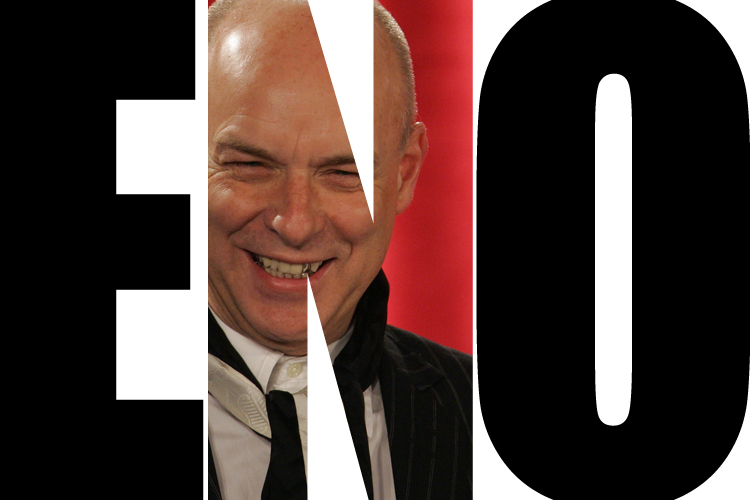
Brian Eno: Success ruins artists

In conversation with the novelist David Mitchell, the U2 and Coldplay producer explains the essence of creativity

  • more
    • All Share Services

Brian Eno: Success ruins artistsBrian Eno (Credit: Reuters)

Brian Eno is widely considered one of the great contemporary composers and music producers, famously for his work with U2 and Coldplay, but perhaps most influentially with David Bowie and the Talking Heads. He began his career in 1971, in his early 20s, as a member of the band Roxy Music, then left to make music on his own, including such albums as “Another Green World,” “Music for Airports” and with David Byrne, “My Life in the Bush of Ghosts,” a landmark in the history of sampling.

His fascination with musical technologies and artistic systems led him to popularize the Koan algorithmic music generator, and, with Peter Schmidt, to develop the “Oblique Strategies” deck of cards, an intervention into the artistic process. His music is heard, unknowingly, by millions of people every day: he created the start-up sound of the Microsoft Windows 95 operating software. He is a founder of the Long Now Foundation, whose mandate is to educate the public into thinking about the distant future. “Drums Between the Bells” is his latest release.

David Mitchell, born in 1969, is the acclaimed, award-winning author of the novels “Ghostwritten” (1999), “Number9Dream” (2001), “Cloud Atlas” (2004) — the latter two shortlisted for the Man Booker Prize — “Black Swan Green” (2006), and “The Thousand Autumns of Jacob de Zoet” (2010). Granta selected him as one of the best young British novelists, and he was named one of the 100 most influential people in the world by Time magazine, which credited him with having “created the 21st century novel.” Mitchell was raised in England, spent many years teaching and writing in Japan, and presently lives in Ireland with his wife and their two children.

Mitchell and Eno were fans and admirers of each other before the idea for this conversation came about, and spoke for the first time over email. David Mitchell asked questions, and Brian Eno provided answers.

I. NO SONG, NO BEAT,

NO MELODY, NO MOVEMENT

Do you agree that no new genre is ever invented, but rather hybridized from something that was there before? That infallible source Wikipedia credits you with coining the phrase ambient music. If that’s so, from what was ambient music cross-pollinated?

Yes, nothing starts from nowhere. My version of ambient was the coalescence of lots of different streams. Some of them were musical, others not. The musical threads I picked up would include Satie, of course, but also the early experiments of Steve Reich, Terry Riley and the other minimalist composers of the late ’60s — all of whom were looking at music as a “steady state” rather than a narrative experience. Also, I would have to add that it was the slow movements of classical works that appealed to me most — the parts where less was happening.

But really, the idea arose out of the new possibilities of the medium of recording. I listened with interest to the work of producers like Phil Spector and Joe Meek and George Martin because I realized that they were doing things with music that could be described as sound painting. For me, trained as a painter, this was exciting: Music was being made like paintings were made, adding and subtracting, manipulating colors, built up over a period of time rather than performed in one sitting. Separated from performance, recorded sound had become a malleable material, like paint or clay. And the results of this process were pointing toward a type of music that was less linear and more immersive: music you lived inside.

The technologies of this manipulation were what I came to specialize in, and they multiply every week, so quite a lot of my time is spent playing with new technology to see what it can do that could never be done before.

What does Doctor Pangloss have to say about how 21st-century human ingenuity is being channeled into inventing juicy gizmos like the iPad, instead of preparing for a world without oil, which, if even conservative estimates are correct, will be upon us by the time my daughter is in her late 20s?

The hope is that some of these gizmos become the tools by which we make those preparations. It’s a worry: Are we entertaining ourselves to death, or are we actually learning new ways of coping? Only time will tell.

One of my favorite definitions of time is that time is what stops everything happening at once. I wonder if music is what stops noise happening all at once?

I think much of your music — like on the albums “Music for Airports,” “Apollo,” “Discreet Music,” “The Pearl” — is ideal writing music. It can kick-start a good writing session, and then, if your mind wanders back to the here and now, your music sends it back to work, but these four albums never obtrude or nag or distract. I wonder if there’s a “Man From Porlock” spectrum on which all music can be placed with, say, Ian Dury at the Porlock end — which is impossible to work to, where listening is compulsory — and much of your work toward the non-Porlock end?

I remember an early review of one of my ambient records saying something like, “No song, no beat, no melody, no movement” — and they weren’t being complimentary. But I think they were accurate, because this is a music of texture and sonic sensuality more than it is any of those things they were alluding to. I’m sure when the first abstract paintings appeared, people said, “No figure, no structure,” etc … The point about melody and beat and lyric is that they exist to engage you in a very particular way. They want to occupy your attention.

I wanted to hear a music that could create an atmosphere that would support your attention but still let you decide where it was directed.

I think I got to this place by noticing what I wanted from music in my own life. Of course I wanted the high-focus, exclusive, pure-Porlock stuff like the Velvet Underground and Shostakovich — but I also wanted a music that simply “tinted” the air around me. Problem was, there wasn’t much of that kind, and what there was all had something wrong with it from my point of view — classical was too stiff and carried the baggage of people sawing away at violins; jazz had too much personality; Muzak was unbearably oversweet.

By the early ’70s, a few friends and I were exchanging cassettes we’d compiled from our record collections — long sequences of “mono-mood” music that were intended to create and maintain a feeling for a long time. Remember that records at this time were compiled on the assumption that nobody could possibly want to spend more than four minutes in the same feeling, so you’d get a fast track and then a ballad and then a dance number, and most classical music was similar: allegro, andante, largo. All of this was based on the idea that music was an ephemeral form — which it used to be, before recording — and that you’d therefore be after an adventure, a narrative.

With recording, everything changed. The prospect of music being detachable from time and place meant that one could start to think of music as a part of one’s furniture. It’s an idea that many composers have felt reluctant about because it seemed to them to diminish the importance of music. But my feeling is that it just widens the possibilities: It doesn’t prevent anyone from writing difficult and engaging, high-Porlock music if that’s what they want to do, and I’ve always tried to make it clear where I felt any particular piece of my own work rested on that widened spectrum. I came up with the word “ambient” to suggest that here was a kind of music that rewarded a different sort of listening behavior, but the term certainly isn’t meant to cover everything I do.

I notice that a lot of pop music now is much further toward the non-Porlock end than it used to be. Bands like Portishead and the Cocteau Twins started it (well, I suppose I did, too, but they made it successful). Now there are countless bands that have a sort of ambient-pop sound, where the vocals are partly buried, the instruments are swathed in echo, and the rhythm instruments are softer and more distant.

Perhaps when music has been shouting for so long, a quieter voice seems attractive.

II. SKY BLUE AND LIGHT

CHOCOLATE BROWN

I read that Paul McCartney got the tune for “Yesterday” from a dream. Once I dreamed that I opened a wooden box at the end of my bed, and on it was written “The Language of Mountains Is Rain.” I used the phrase in an early book. Have your dreams ever chucked you a freebie like that?

I’ve had quite a lot of luck with dreams. I’ve often awoken in the night with a phrase or even a whole song in my head. The fact that these works come from dreams is no guarantee that they’re going to be any good — a direct line to the subconscious is only rewarding if there’s something interesting going on there — but nonetheless it is a thrill to be “given” a chunk of material like that. The song “On Some Faraway Beach” came almost intact in a dream, and, to a lesser extent, other songs have drawn lines or titles from dreams. “Two Voices,” from my album with Peter Schwalm, is an intact dream-poem. I awoke one night with an image of a piece of paper and all the words of the poem written on it, so I just blundered down to the kitchen table and “copied it out.”

I’ve occasionally dreamed ideas for types of music. One was called “reality score,” and it involved the use of samples. Every sound was sampled from a momentous historical recording — the snare drum was a recording of the shot that killed President Kennedy, and so on. I still think this could be great, but I don’t have the necessary persistence and nerdery to actually get it done.

Are you synesthetic? Do you think music can convey emotion because music is a form of universal synesthesia? In my limited case, days of the week and common male names have colors.

I don’t think I’d call myself synesthetic, although I do think of sounds in terms of temperature and brightness and hard-edgedness and angularity. Is that being synesthetic? I don’t seem to have an invariable and involuntary set of responses of the kind you and Nabokov have — a “the letter d is dusty olive green” kind. I do, however, have extremely strong responses to certain “aesthetic” things. I am made furious, for example, by a minor chord lazily used in songwriting, or a throwaway middle eight written just for “variety.”

I despise variety for its own sake. My friends and colleagues find the extremity of my reactions very amusing. Conversely, I am always deeply moved by certain combinations of sound or color — sky blue and light chocolate brown, for example. But there are thousands of others! I have spent a lot of time wondering where those strong preferences come from.

What is interesting to me about music among all the arts is that it is, and always has been, as far as I know, a completely nonfigurative medium. Although cover notes for classical music albums tend to say that the trill of flutes suggests mountain streams and so on, I don’t think anybody listens to music with the expectation that they’re going to be presented with a sort of landscape painting. Even opera, with its strong narrative element, doesn’t depend on the narrative for its effect. So although lots of people still find abstract painting difficult to deal with, they are very happy to listen to music — a much more resolutely abstract form of art.

I know what you mean when you describe music as being resolutely more abstract than art, but doesn’t music’s emotional directness explain its accessibility? Even vocal-less music can stimulate adrenaline, calm you down, or bring on homesickness with a wallop that only literature can rival, among the arts.

When you think about it, why does music have any emotional appeal at all? Why should something so unlike anything else in our experience — unlike, that is, any sound generated by the normal workings of the world — have an emotional impact? Perfume seems to have a similar directness, in that we are affected by it without really being able to articulate why; as opposed to stories, for example, where we have a clearer sense of what’s going on and why it might matter to us.

A science website asked several scientists to tell them what they thought was the most interesting question you could ask of science at this moment. Most of the replies were of the nature “Is the alpha constant stable over the universe?,” “Will the Riemann hypothesis hold?,” “Does junk DNA have a function in the genome?” — science questions. My friend Danny Hillis asked, “Why do we like music?” — a question that has formed the basis of our conversations over the years. And that is truly a mysterious question, which many learned books have utterly failed to answer. Why do I like one composer’s string quartet rather than another’s, when to a Martian visitor they’d seem indistinguishable? What are the differences we’re hearing? What intrinsic wiring exists for having feelings about music? — and by intrinsic wiring I mean the kind of wiring that leads us to prefer symmetrical faces to asymmetrical ones, or to be frightened of spiders.

I used to think that, given enough goodwill, anybody would be able to “get” any music, no matter how distant the culture from which it came. And then I heard Chinese opera.

III. THERE ISN’T A HORSECOW,

THERE ISN’T A VIOLINET

Do you think that music involves propinquity? I’ve noticed with writing, just by placing sentence A — about a ladybird, say — next to sentence B — about a man’s last three seconds of life — a C gets generated as if by alchemy. It’s not there, but it is. You don’t even have to write C — in fact, you shouldn’t. I was wondering if this happens in music, and, if it does, whether this is why, even where your music eschews melody, it still feels as if there is a tune, so long as you don’t try too hard to identify it?

The problem with analyzing music is that there are so many relevant variables. The most complicated is context. When you hear a great moment in a piece of music, how far can you separate it from its context? And how much of its context is relevant: the preceding two bars? The surrounding four bars? The whole piece? What is the context, anyway? Is it your knowledge of how the piece was played? Your understanding of the artist’s other works? Your understanding of the whole genre? I always think that whenever you listen to a piece of music, what you are actually doing is hearing the latest sentence in a very long story you’ve been listening to — all the pieces of music you’ve ever heard. So what you are listening to are tiny differences, tiny innovations. Something new is added, something you’ve grown used to is omitted, something you thought you were familiar with sounds different.

Why are some chords sinister and dimly lit, and others seem wistful, while others are brash and extroverted? How come?

One could maintain that there are no fundamental musical responses — that they’re all the result of acculturation, so somebody growing up in an entirely different culture could quite possibly receive entirely different emotional signals. But this extreme position is not supported by evidence. There do seem to be some “pre-cultural” fundamentals. I think we universally hear “louder” as “more exciting, alarming” and “brighter” as more “lively,” for example. I think few people would argue about that. But there’s a lot of argument about subtler points. Does everybody feel that minor chords (that is, chords with a flattened third) are darker, sadder, more nuanced? If so, why?

The psycho-acoustician’s answer is that the more dissonant a chord is, the more work our perceptual machinery has to do to read it. A minor chord — say C, E-flat, G — apparently requires more neural processing than its major — C, E, G. That may be true: The notes in the former are more complexly related, mathematically. But I don’t understand why it follows that we would translate that neural overtime into “sinister” or “melancholy.”

Of course, a simpler argument is to say that we respond more fondly and comfortably to chords that are most like the ones we heard as children, and are more alarmed and disturbed by those which we connect to our more complicated adulthood. But this argument’s a bit circular: Do we play music made up of major chords to children because that’s what they like and understand, or do we like those chords because that’s what we hear first as children? What responses would a child brought up in a dogmatically 12-tone household have?

Anyway, there’s a whole other axis to consider here. In classical times, or pre-electronic times, the question of timbre was of limited importance. A violin sounded like a violin, and, in the hands of a great player, it could be extended a little this way or that. But it always sounded like a violin, rather than, say, a kettledrum or a harp. So with all other instruments: each is an isolated sonic island in the same way that animal species are isolated genetic islands. Just as there isn’t such a thing as a horsecow, there isn’t a violinet. But there can be now. The field of timbre is effectively unlimited and continuous, and a lot of what contemporary composers  — particularly in pop music — are doing is exploring that huge new palette.

One of the interesting results of that exploration is that the distinctions between, say, major and minor are now augmented, or even displaced, by these new timbral effects. I can confidently invest the brightest major chord with the deepest sadness by manipulating its timbre. Funnily enough, this is something the kitsch painter Tretchikoff discovered. His “Blue Lady” pictures are perfectly normal women made to look deeply interesting by being deep blue. That sort of trick is a commonplace in modern music.

It’s a good day when I learn about a job or discipline I didn’t know existed — psycho-acoustician, thank you for that!

IV. HOW BLIND PEOPLE

MIGHT SEE RADIATORS

With which dead composers do you feel a sense of kinship?

A very important figure in my life was Cornelius Cardew, who died young, in 1981. His approach to making music was fiercely experimental, and although a lot of the experiments now seem a bit dated, when they first worked, they were eye-opening. Cardew started the Scratch Orchestra, of which I was a member. This was a large group of mostly art students who, under Cardew’s influence, regarded the making of music as a kind of philosophical enterprise. That idea of music as philosophy embodied stayed with me.

Painterly isn’t an adjective I would have applied to your music before this dialogue, but, now that I think about it, it strikes me as rather a good one. I’d read somewhere you’d trained as an artist.

I feel a lot more connection with painters than composers. Mondrian, for example, is a big star in my firmament. I am still amazed by the magical simplicity of his paintings. Since Mondrian was the first modern painter with whom I really connected, I’m sure that this feeling of “magic from limited means” has remained a strong meme for me, and why I’d call myself a minimalist.

Novels are palimpsests written over earlier versions, red herrings, wrongly barked-up trees, and still somehow contain the ghosts of the novels that didn’t get written in order for this one, the finished one, to emerge. In a not-dissimilar way, one senses the thought behind an Eno composition — all the paths not taken to find the uncluttered path that is taken.

When I do listen close and hard to your work — as opposed to writing to it — I feel watched. I don’t know where this is going — a confession of paranoia, perhaps! — but your music has a particular hold on its listeners, and we hanker to know why. Sentient snakes may feel a similar curiosity about snake charmers.

Mondrian and “magic from limited means” shed light on your work. For me, you’ve always been a sonic Rothko. A friend describes Rothko as “how blind people might see radiators.”

A brilliant analogy!

You and less than 10 other British musicians have been making artistically muscular and widely listened-to music for, what, five decades? What’s the secret of artistic longevity in the music business? This question was inspired by a recent biography of Syd Barrett — it contained a strong metaphor about creativity being like a tube of paint of finite size, and if you squeeze it out all in one go, there’s none left for a long-term career, but if you spend it in more judicious dabs, you can go on and on. Tube size differs, as it were, but I like the basic image.

Thanks for the compliment, but I think I can only claim four decades at the moment. Perhaps the answer is not to be too successful at any particular thing: Success can become an albatross for an artist, as it does for those actors who do so well in a particular role that they can never successfully take on any other.

What one human work gets to be saved from the fires of destruction at the end of the world?

Christ! That’s a tough one. I could mount a good argument for writing, but a better one for recording, since theoretically that could subsume writing into itself. The very idea of recording — of saving experiences in some way so that they become available to others — is, after all, the basis of human culture: namely, the way in which humans can pass information to each other and thus escape their purely genetic destiny.

I like your observation about how recording fixes the ephemeral, like insects in amber. It makes me think of how the printed word is frozen speech, or perhaps pickled thought. Kilgore Trout might imagine a world where novelists read their work from memory, just the once, then get plastered on home brew to lose their latest work forever, though the collapse of civilization will achieve the same end.

If you could email your 20-year-old self about what was ahead, what would you tell him? Or would you tell him nothing and just let him get on with it?

I think I’d say, “Put out as much as you can. It doesn’t do anything sitting on a shelf.” My feeling is that a work has little value until you “release” it, until you liberate it from yourself and your excuses for it — “It’s not quite finished yet,” ”The mix will make all the difference,” etc. Until you see it out there in the world along with everything else, you don’t really know what it is or what to think of it, so it’s of no use to you.

This article first appeared in the Believer. To read more from the Believer, or to subscribe, visit www.believermag.com.

Trust me on this: The Beatles’ “Let It Be”

The acclaimed author hopes his daughter finds her own musical path but still felt proud when she loved the Beatles

  • more
    • All Share Services

Trust me on this: The Beatles' (Credit: Johnathan M. Thomas via Shutterstock/Salon/Benjamin Wheelock)

How many more of these stories about dads playing music for their children? Every Father’s Day this story comes around! The kid agreeably listens to the beginning of the Goldberg Variations, and then repairs to his bedroom to play with blocks. The kid, no matter how we spin it, ex post facto, is not the center of the story. The dad is. Did I ever pay attention when I was the kid myself? My dad foisted Beethoven on me when I was in grade school, 9th Symphony. He also had a liking for show tunes. Neither rubbed off on me, not Beethoven, not show tunes.

What I remember is when my parents bought that brand-new album “Abbey Roadand played this LP on their brand-new faux-antique console hi-fi, right about when they were separating. That had some impact. I can remember feeling like “Golden Slumbers,” McCartney’s brief, melancholy lullaby from that Beatles album, was a lullaby for me in a time when I could have used one.

Well, now I am a dad myself, and I don’t want to make my daughter have to listen to stuff she doesn’t want to listen to (though, in fact, I have tried to sneak Sun Ra onto the stereo in her presence). I don’t want her to feel that music is an intergenerational chore. I would do almost anything to make sure that music, for her, is something to love.

And yet: Nothing makes me happier than when my daughter does take to a particular piece of music on her own. Recently, e.g., she became obsessed with a very excellent tune by the Pogues. It was “If I Should Fall From Grace With God,” which my daughter refers to as the loud-and-fast song. As in: Papa, play the loud-and-fast song. No delight is more delightful than dancing to the loud-and-fast song with a 3-year-old specialist in the pogo.

And yet, sometimes, it must be observed, the sadder songs are the more genuine songs, or: there are times when the sadder songs come into focus, or: perhaps affirmation in a song is a thing of which one should always be suspect. And so there was a day recently that I was spending the day with my daughter, just me and her, and after all the usual pastimes had been exhausted I said, at last, falling into the trap of so many dads, We still have a few hours here, how about we listen to some music?

I put on “Let It Be.” By the Beatles. In fact, I put on the song “Let It Be.” And I’m talking about the version from “Let It Be,” the Phil Spector production, not the George Martin-produced single that you can find easily, not the “Let It BeNaked” version, which I actually love, too, because I like hearing how guitarist George Harrison thought about what he did on the various recordings. I played my daughter the “Let It Be” I knew best, and which had bludgeoned me much as “Golden Slumbers” had, back in the day, when things at home were coming unglued.

I played the song for her while I was making her a sandwich. It’s really unusual for a 3-year-old to stop moving, unless she’s asleep, and my daughter was not asleep. But she was pretty still. She was transported by the song. Look, you have heard this song 10,000 times, I have heard this song 10,000 times, we are somewhat impervious to the charms of this song, even though it’s a very beautiful song, but when you play it for someone else, in this case someone else who has never heard the song at all, you get back something lost, the original emotional freight of the thing. And with “Let It Be,” which is apparently about a dream Paul had about his dead mother, and, self-evidently, also about the Beatles breaking up, it is hard not to feel that the title, the refrain, is sung with real insight, a real understanding about what it feels like to need the sentiment expressed therein. There really is a lot of misunderstanding and disagreement and dispute in the world, all of it essentially pointless, our time here is so brief, and it would be better if we could all just …

Now, when you’re 3, a sentiment of this kind has maximum impact when repeated, but it’s repeated a lot here, in the song, over and over, and my daughter picked it up quick, the theme, but not so quick that she didn’t want to hear the song again, and so I played the song again, and finished making the sandwich, and then she wanted to hear it again, and I played it again, and then again, and on the third or fourth repetition, that plaintive, moving quality had begun to empty out again, and I was just hearing the song I had heard 10,000 times, and then my daughter asked for it a few more times. We played it six times. That first day. And we have played it more times since. Papa, play that “Let It Be” song.

What’s it like to have resounding success in the dad-playing-music-for-the-kid sweepstakes? I am not sure I want my daughter feeling like she has to like something just because I played it for her. I would like to provide an opportunity, make the music available, then step out of the process, so that she’s absolutely liberated, so that she has self-determination in the matter of her musical interests. That way she can die for Uncle Rock or Dan Zanes if that is what she wants. But I can’t deny, and especially not here, the sense of pride that I feel when she likes something that I too liked, once upon a time in the suburbs. I hope she can do the same when she’s a parent. Maybe one day she’ll share with me things she likes with the same enthusiasm. And maybe one day I can sell her on Sun Ra.

Continue Reading Close

Rick Moody is the author of five books, including "Demonology."

Concord Music Presents: Joe Walsh – “Wrecking Ball”

Joe Walsh performs "Wrecking Ball" live at the Troubadour in West Hollywood, CA

  • more
    • All Share Services


"Wrecking Ball" is off Joe Walsh's new album, Analog Man, available June 5th. Pre-order now on CD and vinyl, plus exclusive T-Shirt bundles.

Born in the U.S.A.: When the president met the Boss

Bruce Springsteen's politics were unformed in the '80s. When Ronald Reagan invoked his name, that changed fast

  • more
    • All Share Services

Born in the U.S.A.: When the president met the BossBruce Springsteen (Credit: AP)
Excerpted from "Bruce Springsteen and the Promise of Rock ‘n’ Roll" by Marc Dolan. Copyright © 2012 by Marc Dolan. With the permission of the publisher, W.W. Norton & Company, Inc.

In the same week that “The River” hit No. 1, in a seemingly unrelated event, Gov. Ronald Reagan of California was elected the 40th president of the United States, garnering a whopping 489 Electoral College votes, while incumbent Jimmy Carter received a mere 49. During the last days of the campaign, Bruce Springsteen and the E Street Band were on tour, of course, still promoting the month-old “River,” but they had election night off. The next night, on November 5, they played a concert at Arizona State University in Tempe that was virtually identical to the one they had played in Los Angeles the previous Thursday — except that it was longer. “All you guys in the aisle find your seats, OK?” Bruce announced three songs in. “There’s gonna be a real long show.”

That night Springsteen rambled, more than usual. Before the postindustrial triptych of “Independence Day,” “Factory” and “Jackson Cage” midway through the first set, he began a long monologue, although not about his father, whom he frequently talked about before “Factory.” Instead, Springsteen used this opportunity to talk about his love of pop music, about what it had meant to him growing up. Spontaneously, falteringly, he offered the most coherent argument he would ever make for the essential unity of the two distinct compositional strains that had flowed into “The River,” its idealistic and pessimistic “hearts”:

I never did good in school, never did good, and they always figured that if you’re not smart in school, it’s because you’re dumb. But I always felt that I never really learned anything, or learned anything that was important to me, till I started listening to the radio back in the early ’60s. And it seemed that the stuff that I was hearing off the radio in all those great songs was stuff that if they knew how, they’d be trying to teach you in school … but they just didn’t know how to. They always talked to your head, they could never figure out how to talk to your heart, you know. And it seems that, like all those singers and all those groups, there’s one thing that they just knew: what it was about. And when I started listening, I found out that the first time … that, instead of the fantasies that you have when you’re a little kid, I had dreams now and that they were different, it was different, and that if that was possible, that I didn’t have to live my life the way that I was, that things could be better. If you just go out, take a chance, find out what’s going on …

It was only toward the end of the first set in Tempe that Springsteen finally addressed the election. “I don’t know what you guys think about what happened last night,” he said as a transition between “The River” and “Badlands,” “but I think it’s pretty frightening. You guys are young, there’s gonna be a lot of people depending on you coming up, so this is for you.” When you listen to recordings of this concert, during this speech you hear scattered cheers from the crowd, but nowhere near as strong as when Springsteen actually started the next song.

Springsteen’s comments before “Badlands” in Tempe that night were virtually the first recorded statement he ever made about politics. At the MUSE concerts a year earlier, he was practically the most apolitical performer on the stage. He had played a small acoustic benefit for George McGovern’s campaign at the Red Bank Drive-In in 1972, but there is no other record of his ever endorsing a political candidate up to this point, or even expressing displeasure with one as he did in the wake of Reagan’s election. In subsequent interviews, he would admit that he had maybe voted once, but no more than that. Like the draft or Kent State, politics was something that happened outside of his life, to his life, while he was trying to make his dreams come true. And he was obviously not the only American who viewed politics that way, especially not in the fall of 1980. Ronald Reagan’s victory, much closer in the popular vote than in the Electoral College, reflected the will of about a quarter of the electorate; only a little more than half of those eligible to vote had done so that year. Like Bruce Springsteen, many other Americans at that point in our history were essentially apolitical.

But there’s a subtle difference between politics and ideology, between elected officials and the policies they enact on the one hand and the underlying principles that cause people to trust or distrust politicians on the other. You can live your life without ever having an opinion on any elected official or legislative body, but you cannot live your life as an adult without having some notion of what a better world would look like. In the late 1970s, as the two dominant political parties in the United States reacted to contemporary economic crises by dissolving into ever greater procedural disarray, such utopian visions of what might work better suddenly became far more important. In 1979, however, only the college professors called this “ideology.” The word that both First Lady Rosalynn Carter and the Reverend Jerry Falwell of the Thomas Road Baptist Church started using that year was “values.”

In 1979 and 1980, as Bruce Springsteen crafted “The River” and began touring to support it, his politics were virtually nonexistent, but his ideology — his “values,” if you must — was all over his songs. Springsteen believed in “freedom,” in as vague a sense as any American would define it, in the freedom to head out where you wanted when you wanted with whomever you wanted with no bossman or exaggerated patriarch telling you what to do. On Springsteen’s first four albums, his ideal world was the road, the way to the next great place but not necessarily the place itself, because all fixed places had the potential to trap you. In Springsteen’s songs, success was seldom material success (no matter how much the singer might want it in real life). In most cases, the success his characters dreamed of or attained was mere survival, making their stand in an environment that was constantly trying to grind them down.

Half of “The River” reinforced this view, not only such “Darkness” survivors as “Sherry Darling” and “Independence Day” but such newer songs as “Ramrod,” “Jackson Cage,” “Out in the Street” and “Cadillac Ranch” as well. There were also all the new songs about connection (“I Wanna Marry You,” “Fade Away,” “Stolen Car,” “The Price You Pay,” “Drive All Night,” and “Wreck on the Highway”), but they were about personal commitments rather than communal ones. Both these aspects of “The River” were undeniably ideological, but they were not political; they sought no help for their characters through governmental or collective action. Even in the album’s title track, the characters’ situation seems more mythic than political. In that song, Springsteen sings, “Lately there ain’t been much work on account of the economy,” but there is no sense here that these characters’ problems could be fixed by a government stimulus package or a cut in the mortgage rates. Their problems are synchronic rather than historical and must simply be endured.

But during this same period, as the nation around him felt adrift in an uncertain and uncommitted age, Springsteen was crafting his first specifically topical songs in almost a decade, since the trendy, epic antiwar songs he had written during the Nixon era. The most obvious of these was “Roulette,” written in a white heat during the first week after the event at Three Mile Island but by all accounts never seriously considered for the album. Almost a year later, toward the end of the “River” sessions, Springsteen had also written the little gem “Held Up Without a Gun,” which managed to turn the most pressing political issue of the late 1970s — the exorbitantly rising price of gasoline — into a rocking good joke.

Indeed, with the gas crisis of the Carter years, history practically forced Springsteen to consider the political implications of his apolitical, personal ideology. In his pre-1979 songs, as in rock songs since at least Chuck Berry, cars and motorcycles were the vehicles of the individualized freedom that he craved. In the late 1970s, however, ration-starved cars and motorcycles became much more specific cultural symbols, emblems of how Americans saw their personal freedom limited by current events. Gas prices had been rising since the beginning of the decade, and in one day, June 28, 1979, OPEC raised the price of a barrel of crude oil by 24 percent. That summer, as Springsteen labored at the Record Plant, blocks-long lines at gas stations became a common, even violent occurrence.

Suddenly, Springsteen’s favorite form of mindless fun had taken on economic, political, and even international significance. The two roadhouse numbers he and the band cut that fall, “Ramrod” and “Cadillac Ranch,” spoke about the sheer fun of driving, in purely sensual terms that were a world away from the desperate tales of escape he had trafficked in on his last two albums. Simultaneously, though, in songs like “Stolen Car” and “The River,” it was also becoming clear that cars could take you nowhere as well, that they could signify escape in the sense of avoidance rather than freedom. In many ways, the great lost album that Springsteen could have released but didn’t in 1980 was a single disc of songs about cars, taking in the freedoms and restrictions that they made possible for his fellow citizens. It would have been a perfect project to release during a year in which driving was an implicitly ideological act.

- – - – - – - – - – - -

Like many other Americans of his era, Springsteen was caught up in the “crisis of the American spirit” about which President Carter had spoken during that same brutal summer of 1979. This was another part of Springsteen’s dissatisfaction during the late 1970s, a more abiding need than could be solved by a simple Top 10 single. He knew that something was missing in his life, that just driving off into the night wouldn’t fill the absence he increasingly felt in his soul, but he was still nowhere near embracing Carter’s solution to this crisis: increased civic involvement. “In a nation that was proud of hard work, strong families, close-knit communities, and our faith in God,” Carter had declared, “too many of us now tend to worship self-indulgence and consumption.” Springsteen obviously believed in hard work, but the only community he had ever been a part of was the Upstage. Ever the proud individualist, he was innately suspicious of virtually all systems, structures, clubs, and experts, even if they claimed they were trying to help him.

In other words, Springsteen’s criticism of Ronald Reagan from the stage in Tempe was in no way a too-late endorsement of Jimmy Carter. It was simply a voiced suspicion of Reagan, who had been clearly labeled a public enemy of rock ’n’ roll since Jeffrey Shurtleff’s mockery of him at Woodstock at the absolute latest. Given his later admissions of political apathy during the 1970s, it is doubtful that Springsteen was acquainted with too many of the specifics of Reagan’s political platform. He just seemed like the kind of person who wouldn’t be too comfortable with “freaks.”

Nevertheless, there was more truth than Springsteen realized to his knee-jerk statement that he didn’t know what his fans thought about what had happened the previous night. What Springsteen probably didn’t know at that time, but would become clear once the 1980 election results were more closely analyzed, was that the youth vote broke slightly for Reagan, with many of the youngest baby boomers casting their first presidential votes that year for the former California governor. Moreover, Reagan received 49 percent of the Catholic vote, 40 percent of the union vote, and 24 percent of the votes cast by registered Democrats, all groups to which Springsteen had strong personal ties.

We will never know for sure, but statistically there is an excellent chance that many of the young women and men in Springsteen’s audience in Tempe who had voted the previous day had voted for Ronald Reagan. This may have seemed inconceivable to Springsteen, but if you weren’t listening carefully, it was surprisingly easy to be a fan of both men that fall. Like Springsteen (not to mention the pop singers of the 1960s whom he so admired), Reagan spoke to the heart, not the head; he “made sense of the world narratively”; and he thought that structures and institutions tended to get in the way of individual effort — all attitudes surprisingly consonant with the ethos of a song like “Out in the Street,” for example. The night before the election, Governor Reagan had even declared that he would be honored to lead what he called “the freest society the world has ever known.” Until Bruce Springsteen started telling audiences what he thought about the Soviet Union or the size of the federal budget — until he told them specifically what he found frightening about the president-elect, which he did not do that night in Tempe — it was perfectly understandable for his more casual fans to think that he might be a “Reagan Democrat” too.

- – - – - – - – - – - – - -

In 1980, Ronald Reagan ran for president mostly on what he considered the most important issues: lowering taxes, shrinking the federal government, rebuilding U.S. defense in the face of what he deemed a détente-emboldened Soviet Union. That year, his campaign aired cheap-looking TV spots in which the candidate spoke directly to the camera about soaring energy costs in front of a fake-looking shelf of books, as if he were a personal-injury lawyer looking for new clients. Four years later, however, after closely reading the poll data, in-house pragmatists like James Baker counseled the president that his long-standing supporters would vote for him no matter what. For the reelection campaign, Reagan’s team focused on images rather than issues, particularly in its advertising, which featured suburban homes, rural churches, forests, and gardens, all of them signifying a bucolic America that the ad copy suggested the president had restored. In 1980, the campaign had sold Reagan. Four years later, it was selling a putatively reborn America, in order to pull in voters who didn’t agree with the president already on specific political policies.

So, just as Bruce Springsteen and his advisers were plotting in the spring of 1984 to snag the broadest possible segment of the record-buying public, Ronald Reagan and his advisers were planning that same season in strategically similar ways to pull in the largest possible portion of the electorate. Reagan might be proceeding from the House Un-American Activities Committee-based right and Springsteen from the Monterey Pop-based left, but in 1984 each man was seeking to go beyond the loyal base that he had painstakingly built during the 1970s in order to capture the hearts and minds of the much wider American center. Viewed side by side, their relaunches look strikingly similar at points, particularly in terms of the visuals they presented. Like Springsteen’s “Dancing in the Dark” video, “Morning in America,” Reagan’s most famous 1984 reelection ad, was filled with pastels and variations on the American tricolor: pretty red roses, a true-blue sky over the District of Columbia, and dazzlingly bright white picket fences and wedding gowns. A casual observer might think that Springsteen was trying to cynically cash in on the contemporary rise in patriotism, but the reverse was actually true: Reagan and his team were, like Springsteen, trying to put on a good show. Walter Mondale might have sought to be the rock ’n’ roll candidate of 1984 by using a Crosby, Stills and Nash song in one of his advertisements, but the sad truth of that year’s presidential campaign is that Reagan knew how to throw a better arena-style concert than Mondale did. Skydivers, hot-air balloons, and forty thousand people chanting “U.S.A.!” may not have been how Franklin Delano Roosevelt would have kicked off a reelection campaign, but it did sound like one hell of a finale for a Van Halen concert.

Politically, Springsteen’s sympathies may have been more with the Democratic camp, but when Democratic politicians spoke about America, none of them seemed to describe the country found in Springsteen songs. At the Democratic National Convention in San Francisco in mid-July — a month after Bruce’s stand at Alpine Valley — Governor Mario Cuomo challenged Reagan’s invocation of John Winthrop’s “shining city on a hill” by speaking about “the other part of the city [where] there are more poor than ever, more families in trouble, more and more people who need help but can’t find it.” Two nights later the Reverend Jesse Jackson famously spoke to the convention of “our Nation [as] a rainbow.” What both Reagan and Springsteen understood in 1984, however, was that, after the last 15 or 20 years of battering national history, most Americans didn’t want their nation to be two or many. They wanted it to be one. As one Reagan aide remarked in a memo written on March 8 (while Arthur Baker was adding aerobic-friendly rhythms to the already synth-heavy “Dancing in the Dark”), “If we allow any Democrat to claim optimism or idealism as his issue, we will lose the election.”

Ronald Reagan’s most deeply held ideological tenet, far more important than any specific policy that might have grown out of it, was his belief that the United States was a nation of individuals. In his acceptance speech at the Republican National Convention, Reagan contended that the core change that his administration had made during the last few years was to shift the government from a philosophy of “statism” that only viewed “people in groups” to one that advanced “the ultimate in individual freedom consistent with an orderly society.” For the casual listener, how different was that from Springsteen’s current variation on the Elvis Presley freedom speech from four years before, now used to introduce “Born to Run” (in this case, in Largo, Maryland, two nights after Reagan accepted the Republican nomination)?

When I was a kid growing up, and I first heard the music of Elvis Presley, the main thing it did for me was it set my mind free a little bit. I could dream a little bit bigger than I had been. His music and the best of rock ’n’ roll always said to me “Just let freedom ring,” and that’s what we’re here for tonight. But remember you gotta fight for it every day.

For the most part, this was as political as Springsteen got in the summer of 1984. Despite the presence of two or three “Nebraska” songs every night, Springsteen’s most notable response to contemporary politics on this tour so far was his decision to cover the Rolling Stones’ “Street Fightin’ Man” during his encores many nights, as significant an addition on this tour as “Who’ll Stop the Rain” had been four years earlier.

That night at the Capital Centre in Largo, “Street Fightin’ Man” directly followed “Born to Run” during the encores, its first appearance after a two-week absence. In the audience that night was syndicated columnist George Will, who had been invited to the show by Max Weinberg’s wife, Rebecca, who was a fan of his tag-team punditry with Sam Donaldson on Sunday morning TV. For his first and only Springsteen concert, Will wore a bow tie, double-breasted blazer, and dress slacks rather than the increasingly de rigueur denim. At Rebecca’s suggestion, the columnist also stuffed cotton in his ears. In general, Will found Springsteen androgynous, noisy and surrounded by pot smokers, yet in the end he concluded that the singer was “a wholesome cultural portent.” As a political commentator, Will may not have cared about rock ’n’ roll’s future, but he did see Springsteen’s abundant success as an emblem of a robust American present.

Although his columns that year never made this clear, George Will was in fact an off-the-books adviser to the president’s reelection campaign. He seems to have come up with the idea of linking Springsteen with Reagan, but his genuine reaction to Springsteen’s concert was very much in keeping with the Reagan camp’s wider reelection strategy — don’t divide, co-opt. In attempting to seize many formerly liberal strains (even ones associated with the 1960s) and claim them for their own, Reagan’s advisers were piggybacking on a larger, hegemonic shift that had been building in U.S. society for the last year or two. In retrospect, historian Gil Troy has dubbed this shift “the Great Reconciliation,” which evidenced itself, in his words, “in the rise of the corporate activist, the consumer with a conscience, a society filled with people yearning to earn like Rockefellers, but occasionally live and sometimes even vote like Beatniks.”

Very much in this spirit, Will essentially announced in his column that rock was not rebellion. It was hard work. “Backstage,” he noted, “there hovers the odor of Ben-Gay: Springsteen is an athlete draining himself for every audience.” Moreover, he classified Springsteen’s brand of rock as a well-made American product, one that produced large profits and need not be shipped overseas (except on well-managed tours). “If all Americans,” Will continued, “—in labor and management, who make steel or cars or shoes or textiles — made their products with as much energy and confidence as Springsteen and his merry band make music, there would be no need for Congress to be thinking about protectionism.”

Whether it was just a lucky accident due to Will’s vacation schedule or a more purposeful delay to help out the president’s cause, Will’s column on Springsteen finally appeared in print on September 13: Over a month after the concert he had attended; a week or so into the official presidential campaign; as “Dancing in the Dark” sank down to no. 50 on the Hot 100, “Cover Me” rose to no. 15, and John Cafferty and the Beaver Brown Band’s ersatz E Street track “On the Dark Side” sat between the two genuine articles at no. 37. Less than a week later, Ronald Reagan made a scheduled stump appearance in Hammonton, N.J., a fairly rural community about an hour’s drive southwest of Freehold and half an hour northwest of Atlantic City. At this appearance, Reagan’s standard stump speech was altered as usual to include a local reference or two. In this case, the president noted, “America’s future rests in a thousand dreams inside your hearts. It rests in the message of hope in [the] songs of a man so many young Americans admire  —New Jersey’s own, Bruce Springsteen. And helping you make those dreams come true is what this job of mine is all about.”

Over the weekend, between shows, Springsteen tried to make light of Reagan’s comments, but the impression persisted that Reaganism and Springsteenism were one and the same. When you heard Springsteen extol unrestricted individualism as he did in the Let freedom ring rap before “Born to Run,” or speak about the Revolutionary War monument in Freehold as he frequently did before “My Hometown,” you could easily understand why. Generationally specific as Springsteen’s remarks before “My Hometown” might be, they were still stylistically in tune with the similarly honorific remarks that the president had made in France in early June on the fortieth anniversary of D-Day, not to mention the tribute to the Statue of Liberty with which he had concluded his speech in Dallas.

By the night of Springsteen’s next performance, at the Civic Arena in Pittsburgh on September 21, it was clear that the singer’s Reagan problem was not going away. That night, almost the first thing Springsteen mentioned to the audience was Reagan’s appropriation of his music. “Well, the President was mentioning my name in his speech the other day, and I kind of got to wondering what his favorite album of mine must’ve been, you know? I don’t think it was the ‘Nebraska’ album,” Bruce concluded, “I don’t think he’s been listening to this one,” and he led the band into their customary rave-up on “Johnny 99.”

Throughout the concert that night, Springsteen made his displeasure at the current administration known, as he had done briefly after Reagan’s election and during the VVA benefit. It’s important to note, though, that in the ensuing three or four years the specific fight that Springsteen had hinted at back then had never really come. In 1980 and 1981, Springsteen implicitly feared another culture war, like the one the nation had experienced during the early Nixon years. But in its rhetoric, the Reagan administration stressed unity rather than division, especially during this election year. Rock ’n’ roll was not a designated enemy for Ronald Reagan (as it might have been for a previous Republican like Spiro Agnew); pessimism was. Springsteen seems to have prepared himself for a fight that wasn’t even an open disagreement.

That night in Pittsburgh, in trying to definitively distinguish himself from Reagan, Springsteen went somewhere he had rarely gone before: Into the politics of class — not the division of the world into conformists and free spirits, but rather its division into haves and have-nots. Pushed to articulate his political convictions, Springsteen finally moved beyond his 1960s rock ’n’ roll individualism, back to the New Deal communalism he had instinctively absorbed from his parents. Now, as he once again reformulated the monuments story before “My Hometown,” he made his most directly anti-Reagan comment yet:

It’s a long walk from the government that’s supposed to represent all the people to where we [are now. It] seems like something’s happening out there where there’s a lot of stuff being taken away from a lot of people that shouldn’t have it taken away from them. Sometimes it’s hard to remember that this place belongs to us, that this is our hometown.

This was a start. If actively articulating his political concern for those less fortunate, those who might benefit from a larger federal government, was all it took for Springsteen to distinguish himself from the president, then a statement like this should have solved his problems of misperception.

But despite Springsteen’s increasingly explicit political statements as the tour rolled on, the ideological similarities between the two men remained. Springsteen could tell you better than anyone else that music speaks louder than words, and arrangements and setlists often speak louder than both. Every night, Springsteen took his audience on the same phased journey from the bad times of late 1981 to the good times of 1983-84, precisely the same historical journey on which President Reagan took his audiences during his stump speeches; from the “Nebraska”-esque days of “drift” and “torpor” to the promise of “you young people.” “[M]y generation,” Reagan declared near the end of his standard stump speech that fall (almost setting his audience up for a rendition of “Born to Run,” his allegedly favorite Springsteen song), “and a few generations between mine and yours . . . grew up in an America where we took it for granted that you could fly as high and as far as your own strength and ability would take you.” In the end, when you compared Springsteen’s fall 1984 tour with Reagan’s, no matter how different their political visions were supposed to be, their rhetoric seemed a lot alike.

Bruce put in more appearances that fall than the president, whose campaign had restricted his stumping to two or three well-chosen photo ops a week. Springsteen was still introducing “Born to Run” by saying “Let freedom ring” but now added “but it’s no good if it’s just for one. It’s gotta be for everyone.” More effectively, he started making room at his concerts for representatives of local food banks and political organizations, giving a shout-out from the stage of the Tacoma Dome to Washington Fair Share, a local coalition dealing with the results of toxic-waste dumping in the Northwest. By that point in the tour, the rock critical establishment (in the person of Jersey Shore-born soon-to-be MTV employee Kurt Loder) had stepped in to try and reburnish Bruce’s liberal reputation. As the tour made its way down the coast to Los Angeles, Loder conducted Springsteen’s first extended interview with Rolling Stone, giving him a widely distributed, rock-friendly forum in which to make his differences from the president clear.

None of it, though, made any difference, at least not in terms of the presidential race. On Sunday, November 4, two days before the election, Bruce and the band finished up a seven-night stand in Los Angeles, pulling out a rarely performed “Shut Out the Light” as a dedication for audience member Ron Kovic. Four days later, they were right back where they had been almost exactly four years earlier: onstage at Arizona State University in Tempe, looking ahead to four years of Ronald Reagan in the White House, this time elected by a wider margin than any nominee since Franklin Delano Roosevelt nearly half a century before. This time, Bruce didn’t say anything from the stage about the election.

Reprinted from “Bruce Springsteen and the Promise of Rock ‘n’ Roll” by Marc Dolan. Copyright © 2012 by Marc Dolan. With the permission of the publisher, W.W. Norton & Company, Inc.

Continue Reading Close

Marc Dolan is an associate professor of English and Film Studies at John Jay Colllege, CUNY, and the author of "Bruce Springsteen and the Promise of Rock ‘n’ Roll"

Trust me on this: David Bowie’s “Hunky Dory”

The Old 97's singer credits Bowie's brilliant "Hunky Dory" for rescuing his adolescence and inspiring his career

  • more
    • All Share Services

Trust me on this: David Bowie's (Credit: Benjamin Wheelock)
This is the second story in the Trust Me On This series, which runs through Father's Day. You can read the other entries here.

Dear Kiddos,

Hey, you turkeys. Listen up. I need you to listen for five minutes. I’m going to impart a little wisdom. You can take it or leave it. For what it’s worth, I’d rather you took it.

The advice is this: David Bowie’s “Hunky Dory” is a perfect album, and, since perfect albums are a rare commodity, it is worthy of deep and repeated listenings.

I’m listening to “Hunky Dory” as I write this. How many times have I listened to this, my favorite record? Like a million? And it never gets old.

I discovered “Hunky Dory” by accident. I was a sad, lonely little kid. Eleven years old and obsessed with Joan Jett, another artist I imagine you kids would enjoy. Back then, the radio was still a real thing that people listened to, believed in and learned from. I stayed up past my bedtime one Saturday night during the Christmas holiday to listen to a weekly show called “The King Biscuit Flower Hour” featuring a concert by my secret girlfriend, Joan Jett. At the end of the set, she played a cover of a song that would forever change the course of my budding musical tastes, “Rebel Rebel.” As it turned out, “Rebel Rebel” would never be one of my favorite Bowie tunes, but I could detect, within its lyric, a narrative voice to which I could relate. Like really relate.

I was a latchkey kid, a thing that no longer exists. Both of my parents worked, so every weekday after school, I had a few hours wherein I could do whatever the heck I wanted. What I usually wanted to do was go to Half Price Books & Records. The next Monday, released from the grim confines of Armstrong Elementary, I walked to Half Price where I found exactly one David Bowie album. I brought home “Hunky Dory,” marveling at its weird, androgynous cover. In those pre-Internet days, one was always left with questions. Is that David Bowie on the album cover? Is that person a guy or a lady? Is it a painting or some sort of artsy photo? Is this even rock ‘n’ roll, or is it some other kind of music, the name of which has been kept a secret from me?

It was just that, some other, new kind of music. New to me, anyway. This album, recorded when I had been less than a year old, opened doors for me. And I thought I caught a glimpse of my own future. My family’s house on Gillon Avenue was empty when the needle dropped on Side A. “Changes,” turned up to top volume, was my anthem from the first line of the first verse. “Still don’t know what I was waiting for,” indeed. This was what I had been waiting for. Putting up with all the cruel dullards in my grade school, all the teachers and coaches, all the stupid kids and mean adults, had been almost unbearable. Suddenly, I wasn’t alone.

“Hunky Dory” is not a kids’ record, but there is certainly a preponderance of imagery relating to childhood. “Changes” speaks of “these children that you spit on.” “Oh You Pretty Things” has the song’s object driving his “mama and papa insane.” In “Kooks,” the singer begs his own kid to stay, reassuring the lucky little guy that “we believe in you.” At the time, I needed to hear that sentiment.  I went back to it over and over again throughout the difficult years of adolescence. David Bowie was not my dad, but he was there in a pinch.

As the album goes on, it gets weirder. And deeper. And darker. “Quicksand” offers up an epic take on the human experience, turning on a phrase that would echo dangerously throughout those most perilous years of my youth, “knowledge comes with death’s release.” I didn’t understand, but I did understand, if you catch my drift. These were meditations on the difficulty of everyday life, and the insane nature of our very existence. Heavy, beautiful stuff.

Antidotes appear in the record’s latter portion. “Happiness is happening/dragons have been bled … fear’s just in your head,” Bowie proclaims in the goofy-but-right-on “Fill Your Heart.” Then he proceeds to introduce the listener to Andy Warhol and Bob Dylan. And then comes “Queen Bitch,” wherein we meet Bowie’s longtime foil, the most underrated guitarist in rock history, Mick Ronson. The riff in “Queen Bitch” hints at what is to come on Bowie’s next LP, “The Rise and Fall of Ziggy Stardust and the Spiders From Mars,” Bowie’s breakthrough album, but “Hunky Dory” is still pre-fame Bowie at his folkie best.

Finally, he leaves us with the epic poem that is “Bewlay Brothers.” As an 11-year-old, I played it repeatedly in an attempt to decipher this song’s meaning. I wrote out the lyrics in my journal, hoping to make sense of them. To no avail. I did know that something had gone horribly wrong, there was madness and sadness, and then the record was over. Just like that.

Again and again, I listened. Memorized. Marveled. Sang along. When I could take it no longer, I found a guitar teacher and learned how to do these things myself. Well, not exactly these things, but my own version thereof. My early songs were such a pale imitation of early-’70s Bowie, that I could have been sued — had anyone ever heard my early songs. It’s quite possible that I spent the whole of my teenage years singing with an English accent. As they say, mistakes were made.

I never got over Bowie. Especially “Hunky Dory.” Many of his other records have remained favorites: “Low,” “Ziggy Stardust,” “Station to Station.” But “Hunky Dory” was my first love. I caught a lot of grief for my borderline-obsessive Bowie fandom. Kids at school used it as ammunition in their attacks on my masculinity. Did I care? Sure. Did I care enough to throw Bowie under the bus and pretend to withdraw my admiration for this artist who set me on the path I knew I was destined to follow? Hell no. David Bowie was and is my hero.

Listen, kids: I want you to hear “Hunky Dory” because I think you will love it. Like I said, it’s a perfect record, and how often do those come along? But the real reason I want you to listen to “Hunky Dory” is because, in its 11 tracks, you will find the clues that will lead you to an understanding of me, your dad. You’ll see signposts pointing the way to the path I chose in life.

Making music for a living isn’t easy. Many things about it are tough as hell: The touring and its requisite absences; the self-absorption; the occasional financial insecurity; the mood swings one attributes to the “artistic personality.” This life, however, is what I was made for. This calling is the only one I’ve ever known. I’m not curing cancer or solving the global hunger crisis. I’m making music. But there is a certain hazy nobility in that vocation. Somewhere, an 11-year-old kid may be putting on an album of mine and discovering that the universe isn’t a meaningless jumble of coincidences, that there is purpose to be found in these three-minute constructions of music and lyrics. Some small but elegant meaning.

Heck, before you guys came along, that was all I had. The great thing is that now I have everything.

Continue Reading Close

Rhett Miller is the lead singer of the Old 97s. His latest solo album, "The Dreamer," will be released on June 5.

Illustrating the ’60s music revolution

How one book captured the spirit and art of the cultural transformation -- as it was happening

  • more
    • All Share Services

Illustrating the '60s music revolution
This article originally appeared on Imprint.

Imprint“When did music become so important?” That’s Don Draper from last week’s “Mad Men,” set in 1966. Later in the episode he turns off “Tomorrow Never Knows,” from the Beatles album “Revolver,” and walks out of the room.

art: Rick Griffin

There’s something happening here, but you don’t know what it is — do you, Mr. Draper? One year later, Rolling Stone magazine will make its debut, followed soon by “Rock and Other Four Letter Words.”

“Rock,” a 250-plus-page Bantam paperback, was published in January 1968 and subtitled “Music of the Electric Generation.” It was one of the first books of its kind, chronicling a cultural revolution that was still in the midst of its own creation. Crammed with black-and-white portraits of bands and musicians, it’s part oral history, part visual LSD trip. One of its fold-out spreads has an intricate, circuitlike diagram that connects over a hundred names, from the Butterfield Blues Band, the Beach Boys, and the Byrds to Busby Berkeley, Brubeck and Bach.

The editor-designer was a writer named J Marks. The photographer for most of the images was Linda Eastman, who went on to work for Rolling Stone and — oh, yes — marry Paul McCartney.

By the sheer force of its graphic presentation, ”Rock and Other Four Letter Words” conveys the mid-1960s music scene’s spirit, vitality and relevance.


Continue Reading Close

Page 1 of 284 in Music