
Andrew Breitbart

Breitbart shock: Obama was in same place at same time as New Black Panthers

Right-wingers once again try to connect the president to a fringe group of laughable conservative boogeymen

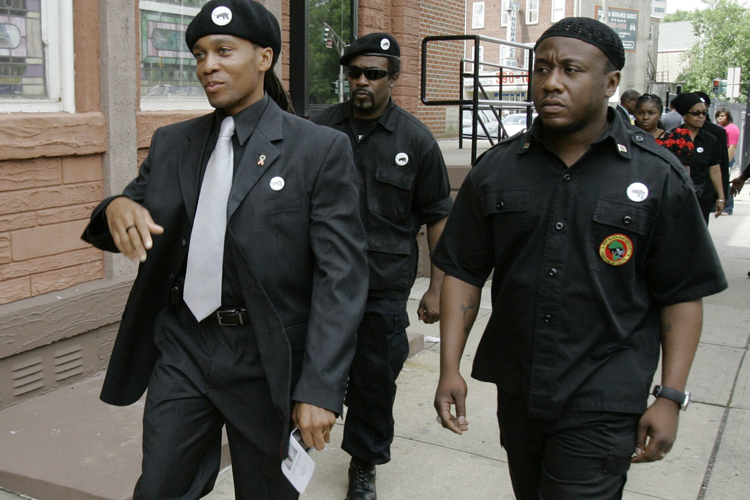
Members of the New Black Panther Party, including, Divine Allah, left, arrive for funeral services for 13-year-old shooting victim, Tamrah Leonard, at the Friendship Baptist Church in Trenton, N.J., Saturday, June 13, 2009. (Credit: AP/Mike Derer)

Andrew Breitbart’s loud, dumb BigGovernment site has a loud, dumb story about how Barack Obama “appeared and marched with the New Black Panther Party in 2007.” The occasion was the 42nd anniversary of the march from Selma, Alabama, and in addition to Barack Obama, Hillary Clinton and Al Sharpton were also there, along with dozens of civil rights era luminaries and thousands of other people because it was a massive annual celebration and not actually an Obama campaign event.

The New Black Panther Party is a cartoonish fringe group of a couple guys who play “’60s radical” dress-up and say mean things about whitey for Fox cameras in order to scare old white people. They have been explicitly rejected by the old Black Panther Party. For some reason, various conservatives have dedicated themselves to proving that this weird, marginal group of Nation of Islam cast-offs is somehow supported by or deeply connected to the Democratic Party and the Obama administration in particular, because, you know, Eric Holder and Barack Obama, those are two guys who very obviously share the values of extremist anti-white proponents of racial separation.

So Breitbart “proves” something or other about the essential anti-white racistness of the Obama campaign by noting that members of the inane New Black Panther Party were spotted by cameras near Obama, at various times, and also NBPP head Malik Zulu Shabazz spoke at the event.

(Brietbart goes on to publish two pictures of the event despite the photographer withholding permission, because “The First Amendment allows photographs of such enormous public importance to see the light of day.” Good luck with that argument in court?)

Andrew C. McCarthy gleefully endorses Breitbart’s story in a breathless post at the National Review’s The Corner:

This is a shocking story, and a breathtaking indictment of the mainstream media which went out of its way to avoid vetting Obama as a candidate — and to make sure anyone who tried to do due diligence got no sunshine. A candidate who chose to appeared in the company of, say, the KKK, would have provoked relentlessly hostile media coverage and, in short order, have been marginalized as disqualified to hold responsible elective office.

If only the media had reported that some fringe weirdos also participated in this event that both Democratic candidates and thousands of other people participated in, and then the fringe weirdos sort of followed Obama around for a while. That would’ve opened America’s eyes! (I mean the media besides NPR, which did report that the NBPP was there.)

Here’s the bit of this sad, desperate reach that is the saddest and most desperate: “Andrew further reminds us that, in March 2008, the Obama campaign website posted an endorsement of Obama by the New Black Panther Party.” Whoa, did they really? Shocking if true! It is, of course, not true. It was a user-generated blog post on the Obama campaign site that the campaign removed as soon as they became aware of its existence. Because websites do not “post” things to themselves, generally, McCarthy’s statement can’t even be charitably described as technically accurate. It’s just a lie.

A random stupid incorrect Breitbart smear is worth paying attention to only to the extent that the smear threatens to bubble up to the more reputable conservative press, or Fox, or Republican elected officials. The McCarthy endorsement means keep an eye on this one!

Alex Pareene

Alex Pareene writes about politics for Salon and is the author of "The Rude Guide to Mitt." Email him at apareene@salon.com and follow him on Twitter @pareene

When Breitbart met Bill Ayers

Two cartoon characters from the left and right had a nice dinner. What does that tell us about American politics?

Andrew Breitbart and William Ayers (Credit: AP)

I saw at least one of Andrew Breitbart’s own tweets about this before he died, but now the Boston Review is up with Bill Ayers’s account of hosting a dinner for Breitbart, Tucker Carlson and their righty companions, just a few days before Breitbart mysteriously collapsed near his Los Angeles home. Reading the piece made me strangely sad. Not about Breitbart, though my heart still goes out to his family, but about American politics.

The story of the encounter between Ayers and his wife Bernadine Dohrn – former Weatherpeople who planned and carried out cruel and politically destructive bombings in the late 60s and early 70s – and Breitbart, Carlson and friends made newly vivid our increasingly cartoonish political culture. Wow: Ayers is a 68-year-old radical who did some bad things in his youth, then settled fairly quietly into the left-wing of the Chicago education world, teaching and raising a family. He became a leading character in the right’s attacks on Barack Obama in 2008 because they had served on a board together and were politically acquainted. At the time, I thought it quite telling that the right had to go all the way back to the era of Richard Nixon to practice its Nixonian fear and smear politics. But hey, it let Sarah Palin say the president liked “pallin’ around with domestic terrorists.”

At their dinner, Ayers and Dohrn and Carlson and Breitbart even made common cause over the fact that “we were all convenient caricatures in the ‘lame-stream’ media,” Ayers shares (thus confirming every anti-elitist’s belief about what the well-off and famous do when they get together: they commiserate about the burdens of fame, across party lines.) But the reasons for Ayers’ fame are roughly 40 years in the past. Carlson and (until last month) Breitbart have been actively engaged in contemporary American politics, in a spirit that, interestingly, borrowed from the 60s counterculture. Both decided the way to get attention was to be outrageous and sometimes juvenile, to mock and expose the powerful. Still, between the two sets of “activists,” there was really no comparison in terms of who was relevant today.

Ayers’ account of their get-together spends too much time detailing the tedious debate over whether the meeting should even take place. Ayers and Dohrn had auctioned off a dinner they’d host and prepare and serve, to benefit a local non-profit, The Public Square – and for a while Chicago folks debated whether the former Weathercouple should have been included in the benefit auction. Much more bitter was the split on the left, as colleagues argued that Ayers and Dohrn shouldn’t host the likes of Breitbart and Carlson. Reading Ayers’ account reminded me of something else that’s awful about American politics: The amount of time the left spends debating ridiculous non-issues. Whether we like it or not, Breitbart and Carlson didn’t need Ayers to legitimize them, they’re admired figures on the right. Who cares if Ayers hosted them for dinner? “No wonder the cadre of right-wing keyboard flamethrowers feels so disproportionately powerful,” Ayers writes. “Liberals seem forever willing to police themselves into an orderly line right next to the slaughterhouse.”

At the dinner, many toasts were made, but no serious ideas seemed to be genuinely engaged. Ayers and Dohrn preached peace and disarmament; by their account, Breitbart and Carlson advocated wars with North Korea and China. They all seemed to surprise one another about how darn affable they were, and how easy it was for all of them to get along.

So why did they bother?

Breitbart and Carlson paid $2,500 for dinner with the ex-Weatherpeople because they’re in search of the lefty Weatherfolk of today. Even when they don’t find them, they try to invent them: attempting to make lawless radical demons out of ACORN and Shirley Sherrod; Sen. Mary Landrieu and the participants in the Journolist. Sometimes they have an impact: Breitbart wielded Rep. Anthony Weiner’s dick shots so well politically that Weiner was forced to resign. (Yet before he died, Breitbart was committed to “proving” that Occupy Wall Street forces were the reincarnation of Weatherkooks and  the Symbionese Liberation Army. His last bit of performance art was to scream at OWS folks “Stop raping people!” That just made him look crazy). Right now, Carlson is at the center of the right-wing machine smearing Trayvon Martin, and its scurrilous “revelations” are spilling into mainstream commentary about the case (Breitbart would be competing with him scoop for scoop, if he were alive.) Even before reading Ayers’ piece, I’ve been trying to understand what they want to accomplish in this case. Ayers’ article helped me along — a little.

I’ve already written about why new details about Martin, even if true, don’t change the central facts of the case: that the cops botched the investigation into his killing at minimum because they didn’t expect to be challenged on the claim that a white man shot a young black man in self-defense. (The truth may be more disturbing.) But why is the right so invested in the image of Trayvon as an animal: a thuggish, gold-toothed Lil’ Wayne quoting predatory gangster? Is their point that the theoretical existence of young black men who might do bad things means we must always trust the police and never ask questions about murky deaths? Why are they so invested in that story?

We know Breitbart and now Carlson are convinced that the left houses the “real racists,” and that we’re ginning up this non-controversy to make clear that this is still an irredeemably racist nation – and our first black president is in charge of our whole conspiracy. Is that the same black president (with a white mom) who uses his own story as evidence of America’s progress and perfectability; who says proudly that it’s a story that could only happen here? Plus, I’ve never understood why they think we’re trying to foment race war – even if you add liberal white race traitors like me, our side would be outnumbered.

The problem is, Breitbart and Carlson haven’t really done a good job at locating these new race-war revolutionaries. Fox News is fixated on the fringy “New Black Panthers,” and Breitbart apparently thought he’d found a black Bill Ayers he could tie to Obama with his “shocking” Derrick Bell tapes. The fact that the president supported the late civil rights crusader’s effort to diversify Harvard’s faculty, even the detail that they’d embraced, is in pretty much every book I’ve read about Obama, including his own. The Bell tapes failed to shock, but Carlson and Breitbart’s minions will no doubt continue to look for more.

Thwarted in their efforts to locate a living lefty bad guy in contemporary politics, they had to settle for meeting a lefty bad guy whose bad deeds are decades behind him. After the dinner, Breitbart tweeted:

Shorthand: Ayers, a gourmand, charmer. Dohrn, hot at 70, best behavior. Potemkin dinner. Pampered by their coterie. Kicked out by half-time.

The fact that he’s not even that bad a guy, in person, probably makes him worse – it’s the banality of evil that makes it dangerous, right?

But back at the hotel bar, Breitbart did a radio interview in which he elaborated:

We were exposed to the two most sophisticated dinner party-throwers in the world . . . This was their battlefield and they couldn’t have been more charming. . . I think I’m going to try and reach out to Bill Ayers and try and figure out if I can maybe do a road trip across the country with him—him and me—and he can show me his America, and I can show him my America, and maybe we can film it and let people decide. Because I’ve got to be honest with you, I liked being in the room with him, talking with him.

I never knew when to take Breitbart’s shtick seriously, but a Road Show with Bill Ayers? Really? It’s one of those ideas that makes me think he was just an old carney at heart, or a traveling vaudeville guy. To him, politics was spectacle – but he had a talent for dragging a lot of people along for the ride, myself included, regrettably.

I guess I’m glad that the dinner was pleasant, that it didn’t feature Breitbart screaming “Stop bombing people!” at Ayers and Dohrn. They signed one another’s books; the vanity of authors knows no ideological lines. They spent a night basking in their own odd collective celebrity, people known for being in “politics” but whose actions, and fame, are only indirectly political – and which hadn’t made life better for people, but worse. We’re certainly not a better country for Ayers’ and Dohrn’s violence ( they’re not (in)famous for their constructive Chicago community work of recent years). And while I’m not equating Breitbart and Carlson’s crusades against their enemies to genuine violence, by any means, there is a coldness and a cruelty as they target their enemies, almost impersonally, and make them into something they’re not –a racist, in Shirley Sherrod’s case — or something they’re not merely – a married Twitter wannabe cheater, in the case of Weiner – or someone we’re not supposed to care about – a menacing gangbanger, Trayvon Martin.

It’s spectacle, sound and fury, leaving us no better able to understand or address America’s problems in the wake of their crusades. We still don’t know what killed Breitbart, but the constant search for an enemy to destroy can’t be good for anyone’s heart. I’m glad he had a nice meal.

Continue Reading Close
Joan Walsh

Joan Walsh is Salon's editor at large.

How Breitbart and Arizona seized on “critical race theory”

Even before Andrew Breitbart seized on it, conservatives were attacking "critical race theory" in Arizona schools

Andrew Breitbart (Credit: Reuters/Brendan McDermid)

In conservative quarters, the hug made famous this month by disciples of the late Andrew Breitbart was more than a hug — it was an embrace by a young Barack Obama of Harvard professor Derrick Bell’s supposedly radical and nefarious worldview: critical race theory. The theory, which analyzes how a colorblind legal system can be used by the privileged class to entrench its power, is “radical” only in a postmodern academic sense, not in its tactics — its soldiers wear tweed and wield the Chicago Manual of Style, not black bandannas and molotov cocktails.

Liberals were quick to mockingly dismiss “hug-gate,” and the scandal largely fizzled in the mainstream press. But this likely won’t be the last we hear of critical race theory before November from the right. Already, conservatives’ menacing interpretation of the theory has shaped policy in some places, suggesting that critical race theory may be on its way to joining the pantheon of right-wing bugaboos.

In January, a new law went into effect in Arizona that prohibits schools from offering courses that “advocate ethnic solidarity instead of the treatment of pupils as individuals.” While the legislation doesn’t specifically mention critical race theory, it quickly landed on the state’s blacklist when officials cracked down on Tucson’s Mexican-American studies program, which former state superintendent Tom Horne had been trying to undermine since 2006 after its students dealt him a personal insult. The Republican finally succeeded with HB 2281, the ethnic studies bill that he authored, when it passed just 20 days after the state’s now-infamous anti-immigration law.

Horne subsequently ruled that Tucson’s program violates his law, citing its teaching of critical race theory. This “racist propaganda,” as Horne described it in his decision, is “fed to young and impressionable students, who swallow [it] whole.” Horne concluded that it was his “duty … to put a stop to this.” Among the books culled from Tucson’s schools when the program got axed were Shakespeare’s ”The Tempest” and “Mexican WhiteBoy,” a young adult novel by Matt de la Peña that deals with familiar themes like growing up, not fitting in and baseball. “The novel’s story is pretty much the American dream,” the New York Times noted Sunday. Nonetheless, it was embargoed for allegedly propagating critical race theory. De la Peña spoke at Tucson High last week, and used his speaking fee to purchase copies of his contraband book for students. Earlier this month, activists organized a scheme to distribute blackballed books, calling themselves “Librotraficante” — book traffickers.

But critical race theory was virtually unknown outside of universities until Arizona and Breitbart made it famous, as Google Trends show. Breitbart’s crew took a page from Horne’s book, using similar mischaracterizations of CRT to portray it as a “a deeply disturbing theory.” Breitbart.com went all in. A search of the site for “critical race theory” returns an astonishing 871 results, over 680 from the past month alone.  Other conservative blogs and pundits, including Fox News’ biggest guns, took up the baton and soon CRT was everywhere.

Over 20 articles on Breitbart’s site are just about CNN anchor Soledad O’Brien, who criticized  editor Joel Pollak’s “complete misreading of critical race theory” on live TV. Conservative pundits pounced on O’Brien for defending the theory, even calling her “anti-Semitic.” (Incidentally, Horne was forced to resign from the board of the local Anti-Defamation League over his support for the ethnic studies ban.)

“If I were to look for a connection … it would be a perplexity over minority success,” Richard Delgado, one of CRT’s most prominent proponents, told Salon. Delgado, who has two books that ended up on Arizona’s blacklist, said, “You have Obama in the presidency, and it’s starting to look for the first time like he’s going to win [again] … The Republican Party is in disarray, the economy is improving, and they’re thinking, ‘Dammit, this is not the way things are supposed to go.’”

As for Arizona, Delgado said Tucson found a kind of “magic” with its Mexican-American studies program that made Latino kids interested in education like never before. Indeed, Tucson schools chief John Pedicone said students who took courses in the program earned higher scores on state standardized tests, were more than twice as likely to graduate from high school and were three times as likely to go to college.

Asked about the program’s high achievement, Arizona Department of Education spokesman Ryan Ducharme dismissed the figures as “propaganda.” “It’s obviously coming from a biased source,” Ducharme told Salon, noting the studies were conducted by the program itself.

An independent study conducted by an auditor hired by Ducharme’s boss, current superintendent John Huppenthal — who took over after Horne became attorney general last year — found similar results. But the state dismissed this finding as well because it relied on numbers supplied by Tucson’s program, Ducharme explained. In fact, the audit Huppenthal ordered and paid $110,000 to conduct “found no evidence that the program is in violation of state law and even recommended that the courses be maintained as part of the district’s core curriculum.”

“This history is frightening to people in power there,” Jean Stefancic, another prominent critical race theorist and close collaborator of Delgado’s, told Salon. Noting that the Hispanic population in Arizona is growing rapidly, she said, “There’s a lot of fear [that] when they decide to vote and they run candidates, what kind of legislators or decision makers will they be? Will they be fair to the people that find themselves in a minority situation? Will they be fair to the rest of us?”

But beyond the electioneering, the use of critical race theory as a political cudgel may have a chilling effect when it comes to talking about race at all. Several of the critical race theorists I spoke with — who are generally known for their outspokenness — were wary to talk on the record in the wake of the Breitbart video. Two preferred not to speak on the record at all.

Just as talking about income inequality can get you branded as a socialist by the right today, talking about racial inequality on a systemic level can lead to charges of reverse racism against whites. And the ultimate irony of having a black president is that it may make it harder for him to discuss race. The killing of Trayvon Martin has sparked national outrage and a heated debate over race, but the White House responded timidly. “Obviously, we’re not going to wade into a local law enforcement matter,” White House spokesperson Jay Carney said Monday. But that policy didn’t apply to Henry Louis Gates’ run-in with Cambridge police just three years ago. Obama publicly condemned the police in the case, and was pilloried by the right for it.

Stefancic said Martin’s case is a perfect example of the importance of critical race theory. Without a racial lens on the incident, it would be a narrow legal question about Florida’s “stand your ground” self-defense laws. But critical race theory allows us to see the whole picture that a strictly colorblind analysis might miss, she said. “When the law tries to redress an action that comes from a certain stereotype, it’s difficult,” she explained.

Continue Reading Close

Alex Seitz-Wald is the Assistant Editor of ThinkProgress at the Center for American Progress Action Fund. He previously worked for the National Journal's Hotline and the PBS NewsHour. Follow him on Twitter @aseitzwald.

The Breitbart media

How the late provocateur helped create the modern press

Andrew Breitbart crashes Anthony Weiner's press conference on June 6, 2011 (Credit: YouTube/CBSNews)

Andrew Breitbart’s fingerprints are all over the majority of the partisan political Internet. The Blaze, the Daily Caller, Huffington Post, even Politico: They’d all look quite different without his influence. There was already Rush Limbaugh and Roger Ailes and Matt Drudge himself, but Breitbart was a phenomenon of the Internet age, and would not have thrived before the Web helped to destabilize the traditional press.

He intuitively understood how the media work even if he needed to invent a grand conspiracy to explain the motivations of its primary actors. He knew that if the press felt it had missed a major story from an unexpected source, it would quickly rush to be the first to publicize further material from that source in the future. He learned this from Matt Drudge, who really did become the de facto “assignment editor” of the political press following his publication of Michael Isikoff’s axed Lewinsky story. The parallel right-wing press has been in existence for years, and the early conservative blogosphere organized itself around blogs from people like Michelle Malkin and Glenn Reynolds, but Breitbart was an expert in forcing their obsessions into the “mainstream.”

Before Breitbart mainstreamed conservative obsessions, he got a graduate-level course in how the MSM worked. Mickey Kaus, in his idealized obituary of Breitbart, tells the story that illuminates the power Breitbart had as the co-editor of the Drudge Report: Breitbart, working on a tip from Kaus, told the Smoking Gun to track down an old interview in which then-gubernatorial candidate Arnold Schwarzenegger bragged about participating in orgies. He publicized the result at Drudge, and it instantly became national news. Work at the Drudge Report was rarely quite so entrepreneurial — usually news outlets would do the work on their own and beg for a link.

The end result of a media environment so fixated on the predilections of this one oddball and his hyperactive aide-de-camp was the rise of Drudge-baiting — the pursuit and promotion of stories designed solely to attract the interest of the Drudge Report. This often involved freak weather and news about Madonna, but it mostly meant things that made Democrats look bad. (The Schwarzanegger story, chosen in part to illustrate Breitbart’s essential fairness, qualified because it had just enough celebrity and sex to make up for the fact that it was damaging to a Republican.)

The sensibility was Drudge’s, but Breitbart was the guy people in the press desperately befriended at parties. The new gold standard of long-form campaign reporting is Mark Halperin and John Heilemann’s “Game Change,” a book that tackles a presidential campaign as a series of hopefully Drudge-worthy nuggets of inane gossip. (Halperin’s previous book was essentially an ode to Drudge’s influence and import.)

The apotheosis of Drudge-bait is Politico, a site that aimed to take the national politics section of a newspaper and strip it of everything but Drudge-bait. Some days half its content seems to be relatively fact-free stories proposing or reinforcing Drudge-friendly narratives (Obama is angry and uses teleprompters, some say).

And there is the one-time “liberal Drudge,” the Huffington Post, which now has consumed the content portion of AOL itself. Breitbart was a co-founder of the site, and though he wasn’t there long, he made his mark. He loved the “celebrities blogging” gimmick that much of the early HuffPo was based around. This remains HuffPo’s most mockable and often detestable feature. (One other idea he might’ve brought to the table: hosting slightly rewritten newspaper and wire copy on the site itself, instead of linking out, as Drudge did, to Breitbart’s consternation.)

“Aggregators” like Drudge and HuffPo have mostly given way to partisan sites that specialize in the actual creation of content. Much of this content is designed as (unpaid) work-for-hire for larger news outlets — be it Fox & Friends or MSNBC — and Breitbart’s “Big” sites helpfully designed and packaged ready-made pseudo-scandals for Fox and others to fixate on.

A fixation of the online conservative movement is “scalp-hunting”: the elevation and demonization of some usually obscure liberal figure done in the hopes of getting them nationally shamed and fired. (Righties sort of do this as “retribution” for what happened to various conservatives who got in trouble and whose trouble was reported in the press, like Oliver North or Scooter Libby.) This is what the Shirley Sherrod video was supposed to be — a routine Van Jones’ing — and what it briefly was until it blew up in Breitbart’s face. It can be done with dead people, like Saul Alinsky, and organizations, like the New Black Panther Party, though the firing of still-living individuals is the primary means by which the conservative press “keeps score,” so it’s best to narrow your focus.

The Sherrod video was also an example of the limits of another of Breitbart’s gifts to modern media: the false “proof.” It is a sad fact of online publishing that some ridiculous portion of readers only read the headlines and look at the pictures before moving on. (The percentage of online commenters who do this is approximately 90 percent, according to studies I have skimmed and had strong opinions about.) Breitbart’s sites exploit this: “OBAMA MARCHES WITH NEW BLACK PANTHERS,” or something like that, goes the headline. The story can’t support the claim. It doesn’t matter. The headline means it’s true for the majority of the readership.

Shirley Sherrod’s anti-white racism became a “fact” that led to her firing because of that convention of online muckraking. The headline said she was racist and there was a YouTube video attached that probably proved it, if anyone bothered to hit play and listen.

This is how right-wing myths are created and sustained — did you hear that Oprah banned Sarah Palin from her show and Michelle Obama spent $30,000 on lingerie? Those are both lies, but they were also both Drudge headlines! — and in a media environment where, thanks to the work of activist/publishers like Breitbart, most previously agreed-upon facts are regularly up for debate anew, introducing new myths can be full-time work.

And in his war on the “mainstream press,” Breitbart played on a long-standing paranoia that Drudge’s rise also depended on: a fear that all the “liberal bias” claims were in fact true, and that what seemed to be nutty, conspiratorial nonsense emanating from the right-wing fringe media was actually the next hot story.

(Breitbart used the standards of traditional “objective” journalism as a weapon, and it often helped his cause that he was simply too exhausting to argue with, unless you were particularly pigheaded.)

The most modern thing about Breitbart was that he was so ridiculous, and so extreme, and yet taken more or less completely seriously by the mainstream press he claimed to despise. (This is in part because he was fun at parties.) Screaming — literally, screaming — vulgar, stream-of-consciousness insults on national television used to be your ticket out of respectability with the news crowd, but now it is basically indulged.

Honestly, if he helped make false civility less of a requirement for being “taken seriously” in the media world, that is almost certainly a good thing. The rest of his influence is too tied up in the influence of the Internet itself on the world of information for him to be directly blamed, but he was the raging, filter-less, irresponsible, vitriol-spewing, tireless avatar of the new way of doing things.

Continue Reading Close
Alex Pareene

Alex Pareene writes about politics for Salon and is the author of "The Rude Guide to Mitt." Email him at apareene@salon.com and follow him on Twitter @pareene

Andrew Breitbart, 1969-2012

Andrew Breitbart transformed himself into a right-wing firebrand -- and remade the political Internet

Andrew Breitbart (Credit: Brendan Mcdermid / Reuters)

Andrew Breitbart, Web entrepreneur and conservative propagandist, died last night, apparently of natural causes, in Los Angeles. His death was unexpected, and the response to its announcement this morning was an odd and probably appropriate mixture of shock and suspicion. He was hugely influential in the creation and evolution of the political Internet, though he was only a national celebrity in his own right for a couple years.

Breitbart was a nice upper-middle-class kid from Brentwood, raised by a Jewish diner-owner and banker, who attended good private schools. According to Chris Beam’s profile, in Breitbart’s very first piece of published writing, for the high school paper, he invented a quote. (A quote making fun of the way a new student from South Korea talked, to boot.)

He went on to Tulane for college, where he seems to have enjoyed himself quite a bit, as most young people in New Orleans do, though in the autobiographical narrative he later invented for himself, his time at Tulane was really spent narrowly avoiding indoctrination into the nihilistic Marxism of the academy.

But Breitbart wasn’t particularly political as a young man. He lived for comedy and show business, and when he went back to L.A. he worked for a while at making it in the studio system. It didn’t pan out.

But his obsession with celebrity clearly drove him, and his young efforts at breaking into entertainment informed his showbiz-centric political philosophy. His book “Righteous Indignation” devoted more space to recounting two appearances on “Real Time With Bill Maher” than it did to anything resembling conservative policy — this was a cultural crusade for Breitbart — and he had a former studio gofer’s obsession with making celebrity connections. Dwight Schultz from “The A-Team” wrote him a nice note. The acknowledgments to his book thanked Victoria Jackson, Dennis Miller and Jon Voight. He was star-struck upon meeting his future father-in-law, actor Orson Bean: “This guy had appeared on the Tonight Show couch seventhmost of any guest. His opinion mattered to me.” (Bean, a longtime conservative, also introduced Breitbart to that Hollywood brand of pseudo-underground conservative that enjoys pretending it’s a sort of secret society in an industry ostensibly run by a cabal-like liberals.) “Hollywood is more important than Washington,” he wrote, explaining his spectacle-driven method of doing political journalism.

Breitbart claimed to have been radicalized by the Clarence Thomas affair, but it was really his favorite radio station KROQ’s transition from late-1980s-style post-punk (Breitbart adored The The and Echo and the Bunnymen) to early-1990s grunge that drove Breitbart to Rush Limbaugh, and conservatism. Then he discovered Matt Drudge’s gossipy online newsletter, and he became Drudge’s first and most influential employee. As Drudge’s newsletter grew into the famous Drudge Report site, Breitbart was Drudge’s ghost, taking “the afternoon shift” for the reclusive right-wing weirdo. Control of Drudge’s front page was and is a tremendous amount of power on the Internet, and Breitbart became friendly with nearly every blogger in L.A.’s small, communal early blog scene. And everyone liked him, because he was funny, and manic, and gregarious.

Through Drudge Breitbart met Arianna Huffington, for whom he began doing “research” work. (Breitbart’s account of working for Huffington is the most intentionally amusing portion of “Righteous Indignation.”) Then he and Huffington and Ken Lerer launched the Huffington Post. Breitbart’s involvement with the site was brief, but it’s an interesting resume item for a hard-charging crusader against Hollywood liberalism.

His most brilliant business move was to found Breitbart.com, a repository for wire stories set up essentially to receive links to breaking news from the Drudge Report, and the income from Breitbart.com and Breitbart.tv made him fairly wealthy. That income stream helped him found the sites that would define the last and most contentious portion of his online career.

“My wife married an almost inappropriately always-lighthearted guy fourteen years ago,” Breitbart wrote in “Righteous Indignation.” “Now she wakes up next to a firebrand who is one of the most polarizing figures in the country.” He has a number of friends from those early blog days who were dismayed at the turn his career and life took, but it was sort of inevitable — the conservative movement grooms its superstars into full-time foot soldiers, and the fight is as much a lifestyle as a job. His finishing school was the right-wing Claremont Institute, where he learned about the intellectual forefathers of the movement he semi-accidentally fell into and found an excuse to get into fun arguments at parties full of the coastal liberals he nearly always hung out with.

So then came Big Government and Big Journalism and the other “bigs”: ridiculous, ugly websites full of misinformation and disingenuous argument and atrocious writing. He began scalp-hunting — he was trained in this line of work back in the 1990s, doing work for the then-right-wing Huffington — taking under his wing a dangerous little liar named James O’Keefe, who performed entertaining stunts with hidden cameras and edited the results into dramatic exposes that invariably fell apart upon closer inspection. (Thankfully, Fox and the New York Post rarely performed that closer inspection.) In the age of Obama, the fights got grossly racially tinged, with Breitbart desperately searching for evidence of widespread anti-white black racism, or evidence of blacks in general gaming the political system for their benefit at the expense of hardworking, rule-abiding whites.

He became the slightly unlikely (as a hard-partying Hollywood media gadfly) self-appointed spokesman of the Tea Parties, defending the movement from all charges of racial resentment-based motivation, making always entertaining if frequently delirious and baffling television appearances, saying outrageous and often indefensibly inflammatory things for attention, and tweeting constantly. The shtick got old, and so many of his predictions of earth-shattering liberal conspiracy-exposing scoops fell flat. He ruined a number of people’s lives for no real reason, and he was generally a toxic influence on the national debate.

It wasn’t actually about “politics” for Breitbart, really. He didn’t care what the top marginal tax rate was. He didn’t see any sort of contradiction in supporting gay rights and drug legalization while working for the election of Republicans. It was about fighting and bomb-throwing and arguing and winning a war against an enemy he built up in his Hollywood-inspired imagination to be massive and powerful. Because that enemy was in his imagination duplicitous and evil, he could justify all sorts of awful behavior on his own part.

He was by all accounts a loving father and husband, and he leaves behind four children.

Continue Reading Close
Alex Pareene

Alex Pareene writes about politics for Salon and is the author of "The Rude Guide to Mitt." Email him at apareene@salon.com and follow him on Twitter @pareene

Why Andrew Breitbart can’t grasp Occupy Wall Street

The conservative provocateur tries to take down a movement he doesn't understand by quoting a few harmless emails

Andrew Breitbart (Credit: Reuters/Brendan McDermid)

Andrew Breitbart has tracked down secret internal Occupy Wall Street emails that prove the entire movement is a leftist conspiracy to destabilize capitalism. There are anarchists involved! And ACORN!

Breitbart obtained a couple thousand listserv emails from some Occupy Wall Street participants and organizers arguing strategy and planning events, and he has “crowdsourced” his analysis of these emails because he doesn’t really understand any of it.

Despite his inability to grasp who these people are and what they want, he has determined “the true purpose” of the movement, based on a couple of random things some anarchist organizers wrote to one another:

The true purpose of the Occupy movement appears to be further economic and governmental destabilization, at a time when the world is already facing major financial and political challenges. By embracing the Occupy movement, President Barack Obama, the Democrat Party, and their union allies may be supporting an effort to harm both the domestic and global economies; to create social unrest throughout the democratic world; and to embrace other radical causes, including the anti-Israel movement. Ironically, the emails suggest that the President and the Democrat Party may soon find their friends in the Occupy movement to be a political burden. The email below calls for the Occupy movement to begin “executing higher-risk actions, civil disobedience and arrests,” and suggests: “We must draw a line, disavow the Democrats explicitly, make our messaging a little uncomfortable.”

The emails themselves show the participants chafing at the prospect of the Democratic Party co-opting the movement, which makes it a bit harder to paint the whole thing as a White House plot of some kind. You can practically hear the gears in Breitbart’s head grinding against one another as he struggles to make sense of that idea.

You’d think Tea Party champion Breitbart would welcome an independent popular movement that seeks to distance itself from the Democratic Party that he hates so much, but he can’t process the idea that these scary leftists aren’t in league with Obama. Poor Andrew Breitbart doesn’t understand Occupy Wall Street because he has a simple-minded, binary understanding of the world: There are good, Tea Party things, and there are bad things supported by the White House/ACORN/SEIU alliance. This is his obsession with “the institutional left,” which he is forced to imagine as a monolithic entity encompassing everyone in a position of power in Hollywood, the media, academia and the government. The idea of members of “the left” have wildly different priorities and goals does not compute.

It may be news to some that the leaderless Occupy movement didn’t spring up fully formed, but evolved with the help and aid of “anarchists” and radical anti-capitalists. It may be news to those people because they haven’t actually been paying attention: Of course there are veterans of the anti-globalization movement involved, Adbusters came up with the idea. Part of what’s causing all this paranoia is that the right wing’s old “hippies and anarchists are behind it all” line isn’t deterring people from identifying with and joining the movement.

Lest you continue worrying about the “true purpose” of this movement, I’d like to point out that the occupation’s direct democracy approach to decision-making means you get a better idea of what the movement’s “purpose” is by actually listening to them than by reading their semi-private emails. There isn’t a secret agenda. The agenda is right there, on the signs and at the General Assembly meetings, screened live online.

In their ongoing effort to report what is happening in the public square as a secretive conspiracy, Big Journalism now reports that liberal journalists and media figures sympathetic to the goals of the movement also emailed one another. (The MSM arm of “the institutional left” heard from, then.) If you wanted smoking gun proof that Dylan Ratigan supported Occupy Wall Street, you could’ve turned on his cable television show.

David Graeber, a writer affiliated with Adbusters, says the email list is “just an expressive forum.” Matt Taibbi describes it as “a bunch of emails from friends of mine, talking about what advice we would give protesters, if any of them asked, which in my case anyway they definitely did not.”

The emails were leaked by some clown calling himself “a cyber-security expert,” who has been on something of a crusade against the online activist collective Anonymous. His aim seemed to be to prove that Anonymous is “secretly” behind the entire movement (their participation has not been a secret, as anyone who’s seen the Guy Fawkes masks could tell you) and to somehow claim that they intend violence. (They’re certainly waiting a while before making their move on that front, what with it being a month into the occupation.) What no one’s been able to prove is that any group — anarchists or Anonymous or the White House — is “controlling” the movement, because there’s no top-down control going on.

(The leaker also passed on emails to the NYPD and FBI. Anyone who’s been involved with any sort of left-wing/anarchist/antiwar protest movement over the last century or so understands that the FBI and the cops will plant people with the movement. Modern demonstrators must obviously also be on the lookout for freelance agents of the right-wing media.)

Continue Reading Close
Alex Pareene

Alex Pareene writes about politics for Salon and is the author of "The Rude Guide to Mitt." Email him at apareene@salon.com and follow him on Twitter @pareene

Page 1 of 12 in Andrew Breitbart

www.salon.com/topic/andrew_breitbart/