
“Ocean’s Kingdom,” a ballet composed by Paul McCartney, with costumes by his daughter, fashion designer Stella McCartney, had its starry premiere in New York in late September, marking the first formal collaboration between a father and daughter who are famously close — and the happy antidote to what has otherwise been the year of Embittered Daughters of Famous Men.
In recent months, we have seen high-profile memoirs by the daughters of writers Joseph Heller and William Styron. Dubbed the “daughterati” by the New York Times, Alexandra Styron and Erica Heller both chronicled difficult, distant relationships with fathers so absorbed in their own careers and personal miseries they barely seem to notice their offspring. Jane Fonda’s latest self-help book, “Prime Time,” again revisits her famously prickly relationship with her aloof father — a relationship already explored at length in her 2005 memoir (and in Patricia Bosworth’s new Fonda biography as well).
But while all of these women have built successful lives in spite of their fathers’ varying degrees of emotional neglect, they can’t entirely seem to let them go, or even to stop engaging with them. These daughters seem less interested in revenge so much as comprehension: Why did I matter so little to him? They circle their subjects compulsively and the critical rigor of their analysis of their fathers’ weaknesses and failures feels even more intimate than a love song. They want to get close. Devoting a year, two years, even more to their fathers means extending a relationship that never satisfied.
What is it about these high-achieving daughters that seems to make them want to keep revisiting (through books, interviews, articles) their relationship with the man they feel has wounded or neglected them? There are many easy answers, such as financial rewards or attention, though none of these women — Fonda least of all — seem to be seeking either. The most oft-cited rationale (especially on book-jacket copy) is one we know so well from the pop psychology shelves: “closure.” But, as James Ellroy has said countless times about his own relationship with his mother, about whom he has written two books and several essays, “closure is bullshit.” By writing about them, talking about them, these daughters are able to continue the “dance with dad” another year, two years, even more, the book leading to book promotion, interviews, articles — more opportunities to extend the relationship indefinitely. When Fonda titles the chapter about working on the film “On Golden Pond” with her father “Closure,” you don’t believe her anymore than the speaker of Sylvia Plath’s “Daddy,” when she insists, in the closing line, “Daddy, daddy, you bastard, I’m through.”
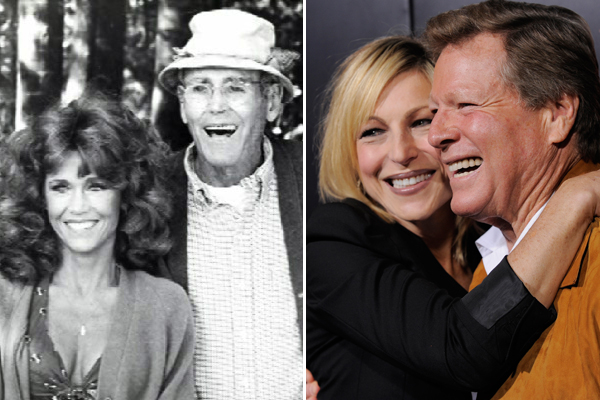
As is often the case, however, the most fascinating and extreme manifestation of this trend is its tabloid variation: the tormented relationship between Tatum and Ryan O’Neal. This summer marked the publication of Tatum O’Neal’s memoir, “Found: A Daughter’s Journey Home,” and the airing of an accompanying TV show on the OWN Network.
“Ryan & Tatum: The O’Neals” documents (or, more accurately, dramatizes) her attempts at reconciliation with her father, with whom she has been estranged for most of her life. From age six to 16, Tatum lived with her dashing movie-star father when her mother lost custody due to problems with speed, alcohol and boyfriends who liked to beat her children with fig-tree switches. After a decade of being her father’s partner in crime, however, Tatum watched her father “abandon” her for Farrah Fawcett, leaving his daugher to raise herself and her younger brother, Griffin. This abandonment — told, retold and told again in both of Tatum’s memoirs (this is her second) and the TV show and in countless interviews — is the Dominant Narrative of their relationship and, in some ways, Tatum’s life.
For women of a certain age, Tatum O’Neal was the “cool girl” ideal — sophisticated beyond her years, with her knowing turns in “Paper Moon,” “Bad News Bears” and “Little Darlings.” Now, we see her nearly 40 years later — blonde, beautiful and yet clearly broken — still playing the part of the desperate, attention-seeking little girl role with her father.
Their dynamic is perpetually pained and stoked regularly — even (or perhaps especially) during the media frenzy following Farrah Fawcett’s death. Few who heard the tale can forget it: Ryan hitting on Tatum after Fawcett’s funeral, not realizing, behind her sunglasses, it was his daughter. As he told Leslie Bennetts in Vanity Fair: “I had just put the casket in the hearse and I was watching it drive away when a beautiful blonde woman comes up and embraces me … I said to her, ‘You have a drink on you? You have a car?’ She said, ‘Daddy, it’s me — Tatum!’”
“That’s our relationship in a nutshell,” Tatum told Bennetts. “You make of it what you will.” Sighing, she added. “It had been a few years since we’d seen each other, and he was always a ladies’ man, a bon vivant.” It’s a complicated reaction to what one might expect to be a rather appalling Freudian moment. First, she asserts that her father’s seduction attempt was not an oddity but a fundamental feature of their relationship. Then, she tries to explain away the mistake. Finally, she points to his Don Juan qualities in a way that feels almost a sneaking celebration of him, and of herself for attracting his attentions.
You would not require this backstory, however, to find “The O’Neals” a dizzying, squirmy and occasionally deeply haunting experience, in particular the ways Tatum turns herself inside out for her father. Most of the time, she is the rueful daughter, still suffering and raging, while Ryan plays the befuddled helpless dad, seducing his daughter with attention and with sly attempts to get her to take care of him.
Unlike Styron, Heller and Fonda, Ryan O’Neal is the opposite of remote. Always ready to try to charm her and, more particularly the camera, he “gives” the most, always willing to stir up his daughter’s snarl of emotions and past grievances. He will feed his daughter’s rage and longing forever and still never give her exactly what she wants. The question is, what does she want?
The series’ most telling (and canny) scene is titled, on the OWN website, “He Said, She Said: Hot Tub Therapy.” As they lounge, Tatum speaks pensively of her desire to repair their relationship and Ryan dodges and dances his way through. It is a scene that recalls the famous father-daughter reconciliation scene between the Fondas in 1981’s “On Golden Pond,” daughter Jane, in exquisite aerobicized form in a bitty red bikini, trying desperately to connect with remote father, his eyes constantly drifting from her, refusing connection. Ryan O’Neal, however, gives Tatum everything Henry Fonda held back.
Then comes the inevitable moment when Tatum brings up, for what appears in the ten-thousandth time, her father’s desertion of her for Fawcett. Like a weary Spencer Tracy, Ryan insists, “You were not a kid. You were one of the most sophisticated 16-17 year olds I ever met.” Then he lets the hammer fall: “I know what I wanted,” he says to her, over the steam, over his own misty memories of Farrah. “I wanted her.” Quickly, Tatum, as if a wounded puppy, retreats, blaming their estrangement on his “temper.” His reply seems even more crushing. “It was the temper,” he concedes. “I fight with everybody, Tatum. Not just you. It’s nothing personal.”
Tatum stares at him a moment, then rests her head on ledge of hot tub, defeated. Because, of course, she desperately wants it to be personal. She wants to be just about her. She wants it to all have been about her.
One recalls Erica Heller recounting her horror over reading the gloomy portrayal of the protagonist’s daughter in her father’s autobiographical novel, “Something Happened.” When she confronted him, he replied, “What makes you think you’re interesting enough to write about?”
Ultimately, this string of daughter tales begs the question: what are we, the readers and viewers getting from it, other than a little schadenfreude over the difficulties these charmed girls have endured? How is it for women in particular seeing figures as accomplished as Alexandra Styron or Erica Heller still circling in that Freudian “remembering, repeating and (never quite) working through” dynamic, perpetually? One wonders how much of it might have to do with a possible curse of a generation (or two) of women who identified more with their fathers than their frequently career-less, unhappy or self-sacrificing mothers. Indeed, while women may not identify with their glamorous upbringings, those of us in the second or third wave of feminism may understand more than a little what it means to feel, all too strongly, the burdens associated with feeling, always, like one’s father’s daughter. After all, these are women who, to varying degrees, have followed not in their mother’s footsteps but their fathers.
Were they sons rather than daughters, we might immediately see these women as attempting, Oedipus-style, to overthrow their fathers, take his place. But instead we seem to be watching daughters trapped between identifying with their artist-fathers and sympathizing with their mistreated mothers with whom they cannot identify at all. But, perhaps most of all, they are stricken a terrible yearning. They want to, at least in part, be their father but also have his love as no one else has. There is a hunger in it that is desperate but also strangely moving. In her memoir, Jane Fonda cites a quote from psychologist Terrence Real, “Sons don’t want their fathers ‘balls’; they want their hearts.” “Daughters too,” Fonda adds — an addendum as rich in Freudian fervor as any you could hope for. In some ways, with these memoirs, they seek both.
Meanwhile, we might savor the seeming ease and contentment of the Paul and Stella McCartney relationship, which has led to “Ocean’s Kingdom,” the crown jewel of the New York City Ballet’s fall season. “I am a daughter working with her father, which is an incredibly remarkable experience in life no matter who your father is,” Stella told the Daily Mail. “It’s also quite an emotional thing.” After the premiere performance, she joined her father on stage to take a bow. “Ocean’s Kingdom” is, by the way, the story of a king and his daughter.
Megan Abbott is the Edgar award-winning author of four novels. Her latest, “The End of Everything” (Reagan Arthur Books), was published in July 2011.
What about men? That was the first thought that came to mind after reading Katie Roiphe’s Newsweek cover story on the BDSM-themed “Fifty Shades of Grey” phenomenon, in which she controversially speculated that women’s current fascination with the book’s story line of female submission was the result of the “pressure of economic participation” and the “hard work” of striving for equality. The desire for submission is hardly something unique to women.
Who understands this better than professional dominatrixes? With so many speculating this week on Roiphe’s article, I decided to hand the microphone over to women with a unique perspective on the dynamics in power and play.
Several said that Roiphe is actually on to something when she talks about submission as an escape from life’s stresses — only, this reasonable point is overwritten by her wrongheaded focus on women and the impact of feminism. Roiphe wonders whether there is “something exhausting about the relentless responsibility of a contemporary woman’s life … all that strength and independence and desire and going out into the world,” and suggests “that, for some, the more theatrical fantasies of sexual surrender offer a release, a vacation, an escape from the dreariness and hard work of equality.” What about the exhausting, relentless responsibility of contemporary people’s lives?
Many men who turn to submissive fantasies do so for precisely the sort of vacation from responsibility that Roiphe suggests women are seeking. Olivia Severine, a transsexual dominatrix living in San Francisco, says most of her clients were “very high-powered” men weighed down by responsibility. “They came to see me as a brief escape when no one was looking at them for direction or leadership,” she says. “The time with me is when they were told what to do, what to feel and how to act … and all the weight of their careers, families, lives, is lifted from them for a cherished few hours.”
Mistress Shae Flanigan, a Los Angeles dominatrix, says her clients are “CEOs, high-ranking managers, lawyers and wonderfully brilliant men from all over the business spectrum.” What they have in common is “that they come to me to create an environment where they don’t need to think,” she says. “Where they can trust me to keep them safe while I weave together an enticing, thrilling, euphoric and painful world where it is literally impossible to think.”
It isn’t that these guys wish they had less real-world power — it’s just, power is stressful, and submission provides a release. “BDSM is a hell of a lot more affordable of a vacation than the Bahamas, I promise you,” says Flanigan.
Melissa Febos, author of “Whip Smart,” a book about her time as a pro-domme, tells me, “As someone who spent nearly four years catering to the submissive fantasies of men, and who eventually had to acknowledge her own submissive fantasies, I can say with some certainty that I think all people experience anxiety about power,” she says. “Aren’t our objects of eroticization often the things we feel unreconciled about?”
Most of Febos’ clients “experienced an imbalance of power in their lives,” she says. For some it was “extreme disempowerment,” like child abuse, racism or poverty; for others, it was “an overwhelming burden of power,” related to everything from wealth to politics. (“During the Republican convention, business at the dungeon boomed,” she says.) All of that is to say that “eroticization stemming from anxiety is not gender-specific,” Febos explains — nor is it specific to the relative power one has in the real world.
“Everyone, regardless of career choice or level of importance, is saddled with the burden of making important decisions about their own lives and the lives of the people around them,” Domina Nyx of New York City points out.
While Natasha Strange, who has worked as a domme for almost 20 years, has had plenty of “men who are powerful and want to give up control for a bit,” she’s also had tons of “musicians, cab drivers, pharmacy reps, teachers and your basic blue-collar workers who are just kinky and want to feel desired for an hour or three.” Interestingly enough, she says, “The very first female client I had was a housewife and a mother of two.”
As Febos suggested, these desires can arise from disempowerment. While New York-based Maya Midnight has some high-powered clients — after all, they are the ones most capable of regularly paying for her services — she says, “I get far more clients who experience loss of power in their day-to-day lives and have fetishized it.”
Roiphe’s suggestion that women’s submission fantasies are indicative of an underlying longing for the way things used to be, pre-feminism, seems particularly questionable when compared to “race play,” which Mistress Justine Cross describes in an email as “capitalizing on themes of racism in mainstream society, i.e., degrading a submissive using racial slurs, and redeploying those themes for sexual pleasure.” It seems patently absurd to suggest that an African-American man who eroticizes racism has a deep-seated desire for the days before the civil-rights movement. Should it be different when it comes to a woman longing to play-act a “sexist” fantasy?
Often enough, the “roots,” as Midnight calls it, of submissive desires can seem rather random: “One client saw a movie when he was a teenager where a woman kicked a man in the balls and has been into ball-busting ever since,” she says. “As a child, I got told off for hitting a man in the crotch with my stuffed penguin and now I love hurting balls. Go figure.” Sometimes these desires emerge at a young age (dominatrix Cybill Troy tells me, “I have personal slaves as well as clients who showed signs of their interests as young as toddlers … a 3-year-old with a tendency to crawl into cupboards who grows up to love being caged and contained both physically and mentally, for example”); other times they only surface well into adulthood.
Some believe that S/M fantasies are like dreams in that they can be difficult to fully make sense of: “I believe that they come from creative and imaginative minds that may mix the powers of everyday rituals and roles into a more complicated and interesting puzzle than the usual vanilla missionary routine,” says Yin Q., a dominatrix turned BDSM educator.
Of course, actually visiting a dom or dominatrix is much different from reading a page-turner about an S/M relationship. “Fifty Shades of Grey” tells us what many women want to read about, but it doesn’t tell us what these women are actually doing in the bedroom. Lady Cyn Aptic of Los Angeles points out, “In many cases people’s eyes are bigger than their stomachs and they prefer the fantasy to reality.”
That fantasy has become much more mainstream as the sartorial trappings of BDSM have been adopted by some of pop music’s biggest female stars, with Rihanna and Lady Gaga devoting songs to “S&M” and liking it “rough” (as I wrote about in a piece last year headlined, “Is kink the new girl-on-girl kiss?”). “I think there’s been a trend toward making the naughty more mainstream; it’s just a modern version of the bodice ripper,” says Olivia Vexx of “Fifty Shades of Grey.” “[It's acceptable now for] a soccer mom to go buy a bodice and a whip.” Strange says, “When I started as a domme, it was near impossible to find thigh-high boots” — but now she says, “I can go to pretty much any suburban mall.” Maybe we’re finding more evidence at this cultural moment of women entertaining submission fantasies simply because it’s more acceptable.
But even in the worst-case, end-of-times scenario that Roiphe is right and “Fifty Shades of Grey” is so popular because of women’s current anxieties about equality (such as it is), that doesn’t mean that it’s “evidence of unhappiness, or an invalidation of feminism,” says Febos. In fact, she suggests that it’s “just the opposite” — it might actually be a sign of progress that millions of women are so hungrily pursuing sexual fantasies independent of men.
Contrary to Roiphe’s belief, there are plenty of feminists who are neither “perplexed,” as she puts it, by submissive desires nor find it contradictory to their politics. Febos, who considers herself a feminist and also has submissive fantasies, says, “I still live in a culture that floods my consciousness with instructions to be a passive, sexual object; that my only power rests in my sexuality as defined by men’s desire,” she says. “Mightn’t this create some anxiety in my own psyche? I think so. Have I eroticized those messages in order to locate them somewhere that won’t impede my progress as an empowered, independent woman in the rest of my life? Maybe so. But so what?”
When I was a kid, you know what we called Legos for girls? Legos. When my own young daughters were small, you know what they called them? Legos. They came in blue and red and green and yellow. But lately Legos, like damn near every other object in the toy aisle, have felt the need to assert their gender.
It started when the company began aggressively marketing to boys back in 2005, offering up what BusinessWeek recently described as “spaceships and laser cannons … martial arts and supernatural powers,” a world in which “80 percent of the characters are boys.” But the extreme genderfication of Legos put the company in a self-imposed bind. How to respond to the demands of consumers who want a more daughter-friendly Lego? There was only one thing to do next – make some girly Legos!
Just in time for the holidays, the Danish brand rolled out a pink-themed line of Lego Friends last December, featuring curvaceous, pretty girls who play in pastel-themed, gently constructed cafes, beauty shops, puppy houses and their own little stages. That’s the life of a girl for you – looking pretty, “decorating your house” and eating cupcakes.
From the get-go, the Lego Friends were met with a not-so-friendly response. The International Association of Eating Disorder Professionals called the line “devoid of imagination,” and said it would “promote overt forms of sexism.” US News offered “5 Reasons Not to Buy Your Daughter Pink Legos.” In Time, Ruth Davis Konigsburg bemoaned that “With its emphasis on physical appearance and limited career choices — [is it] really any different from that of Disney’s princesses?” She continued, noting how the Friends sets require the barest of construction, “LEGO Friends doesn’t give girls the same sense of mastery and accomplishment that it gives boys.”
So it’s a hopeful sign that on Friday, members of SPARK (Sexualization Protest Action Resistance Knowledge) are sitting down for a meeting with Lego executives. The goal, as SPARK optimistically explains, is that “We want [Lego] to commit to dramatically increasing the female characters in their non-Friends lines. (The current numbers are pretty dismal.) We want them to consider female representation when choosing pre-existing material to adapt into new toys. And we want them to improve the Friends line.”
It’s a bold hope, especially when Lego reports that Friends line is “off to a very strong start” just the way it is. But it would be wise for a company founded nearly 50 years ago with the imperative to create toys for “girls and for boys” to remember that goal doesn’t mean “girl toys and boy toys.” We don’t need to ostracize our sons and daughters to the divergent wildernesses of ninja land and beauty parlors.
The second season of HBO’s “Game of Thrones,” which premiered last Sunday, is based on a novel — the second in an ongoing saga — called “A Clash of Kings.” But fans of the bloody, battle-scarred show know that’s a misnomer: There are more than a few queens throwing down in this brawl — not to mention a passel of noblewomen, priestesses, grizzly mamas, and badass, sword-wielding soldiers of the distaff variety.
This may be the Year of the Sitcom Woman, but the biggest, most vibrant group of women on TV today can be found in a brutal, self-serious war drama set in a made-up medieval world — just the kind of story, it so happens, that’s often assumed to be the sole dominion of dudes.
For George R.R. Martin, the novelist who created this world in his “Song of Ice and Fire” series, the medium is the message. The things that make the story so daunting and so off-putting to some — its sheer massiveness and its huge cast of characters — are part of what makes it so thrilling to me, as a woman who likes to see other women on-screen. It’s not just that the women in “Game” are strong — and the primary females are, in both figurative and literal senses — but that there are so goddamn many of them, each one fighting to exercise power over the world and her own life. They’re far from a sisterhood (one of the main themes of the show is that trusting others is a rube’s game) but as a collective, they make an unavoidably huge impression.
Fantasy stories, like all genre narratives, are built on archetypes, and “Game of Thrones” seems to leave no trope of feminine power unexplored. There are mothers, like the noblewomen Catelyn Stark and Cersei Baratheon, who are driven by their fierce, lioness-like love for their children. There are a wide variety of warrior princesses and any number of women who use their sexuality to get ahead. There are at least two witchy women (mysticism being a kind of power reliably granted to female and minority characters): Mirri Maz Duur, the Lhazareenwho uses “blood magic” to destroy her people’s conquerors,and Melisandre, the priestess who brings a fiery new religion to Westeros and becomes the force behind a fearsome army in the process. These women don’t always win the games they’re playing — they get slapped down as brutally and as often as the male characters do — but they sure know how to fight, week after week.
In a way, “Game of Thrones” reminds me of that other big Sunday night drama: “Mad Men.” In both of these large, multi-character shows, the women are constantly defining themselves against, and through, rigid societal constraints. The stakes are higher in “Game of Thrones”: Many of the major female characters have been or are poised to be traded in marriage, like human chess pieces, among the Great Houses of Westeros, and sexual violence is an ever-present threat. But both shows feature a number of very different women, who we’re invited to read against one another and whose primary relationships are nearly always with men — a conditionthat’s shaped partly by the setting and partly by the writers’ narrative choices. And on both shows, everyone knows it’s each woman for herself.
In “Game of Thrones,” we’re treated to myriad strategies for how to make it in a man’s world. In Season 1, viewers met Daenerys Targaryen, a teenage girl who was given by her slimy older brother to a burly barbarian warlord, and who has since gone from a passive, victimized child to an awkward but passionate and often forceful ruler. (Add another trope to the mix: the I-found-strength-from-my-trauma woman.)
Both slimy brother and burly husband are gone by the time Season 2 begins, as is the son who, it was prophesied, would grow up to be “the stallion that mounts the world.” (He arrived stillborn and deformed at the end of last season.) Even with the world’s only living dragons at her side, it seems likely that Daenerys will, again and again, have to prove herself worthy of ruling. “They don’t like the idea of a woman leading a khalasar,” her male advisor tells her in Episode 2 of this season, after a rival tribe sends her the decapitated head of one of her riders. Whatever you think about the casting of Emilia Clarke, the lovely Brit who plays Daenerys (personally, I vacillate), it’s fun to watch her learn how to access the queenly yawp inside her.
The second and third episodes of this season bring us two warrior women who are both familiar to anyone who’s read Martin’s epics: Yara Greyjoy (known as Asha Greyjoy in the books) and Brienne of Tarth, who add a new female trope to “Game of Thrones” while deepening the show’s engagement with questions of female strength and of male-female dynamics.
Yara is one of two surviving children of Balon Greyjoy, a minor lord whose rebellion for independence was brutally put down by King Robert nine years before the action of the show. In this Sunday’s episode, [mild spoiler alert] Yara’s younger brother Theon returns to their homeland — a bleak, salt-stained outpost known as the Iron Islands — after having spent more than half of his life as a ward of Ned Stark, the king’s closest supporter, in the relatively glamorous northern kingdom of Winterfell. (If you’ve watched Season 1, the comparison should give you as sense of just how grim the Iron Islands really are.) Theon expects to receive a hero’s welcome when he arrives. In Winterfell, he was a boy without a father and thus, without rank; on the Iron Islands, Theon will finally be a son and heir.
“They say hard places breed hard men,” Theon says, with a boy’s overweening pride, to a ship-girl just before he screws her. “And hard men rule the world.”(No one said “Game of Thrones” was especially subtle in its deployment of penis humor.)
But instead, Theon finds that while he’s been gone, his cockysister has become the hard young man of the Iron Islands. Yara doesn’t just sexually one-up her swaggering little brother (in a scene that plays like an outtake from a particularly filthy Shakespeare comedy); she usurps his place at his father’s side. Yara has commanded men and killed them; unlike Theon, she would never wear jewels she hadn’t “paid the iron price” for — i.e., liberated from fresh corpses she’s made. When the Iron Islands eventually head to war, Balon tells a sputtering, incredulous Theon that Yara will command a fleet of 30 ships. Theon will get one. Its name? The Sea Bitch. “We thought she’d be perfect for you,” his sister smirks. The Yara/Theon scenes play a bit like a fantasy version of a high-school sports drama, with the football field swapped out for a battlefield. “But … but … you can’t let her play, coach, she’s a GIRL!” (Theon actually yells something like this at his father, as Balon and Yara make fun of his sissy clothes.)
Brienne of Tarth, on the other hand, couldn’t muster a smirk if her life depended on it. The martial maid, a major character whom we meet in Episode 3, cuts a striking figure on-screen: stolid, lumbering, able to bring down one of the finest knights in the realm with a charging body tackle.As played by the 6-foot-4 Gwendoline Christie, Brienne comes off as a little priggish, a little too invested in the postures and poses of knighthood, as if trying to compensate for both her ungainly body and the fact that she’s a woman.
Whereas most of the women in “Game of Thrones” orbit around their lovers or the men in their families, Brienne has eyes only for her gay, or at least bisexual, king, Renly Baratheon. “You fought bravely today, Lady Brienne,” says a positively shrimpy-looking Catelyn Stark after witnessing the aforementioned throwdown. “I fought for my king,” Brienne says stiffly. “Soon I’ll fight for him on the battlefield. Die for him, if I must.”
Behind the proud, out-thrust chin, you can sense the romantic zeal that drives Brienne. In her eyes, dying for her king would be a fitting consummation to their relationship. The women’s brief exchange ends with a terse correction from the newly minted member of Renly’s personal guard: “If it please you, ‘Brienne’ is enough. I’m no lady.” Christie delivers the last line, which could have been a clunker, in a way that’s satisfyingly difficult to parse; I can’t tell if she’s ashamed to say that out loud or disgusted that she has to bring up her sex at all.
Brienne would be an arresting character no matter what story she appeared in. But it’s the fact that she’s just one of a multitudeof rich, sharply drawn female characters that makes her — and the show — so compelling.
“Game of Thrones” persuasively demonstrates why some of us are always yammering on about the need for increased representation of women (and minorities) on television: Through the relatively simple process of upping the numbers, the burden on any individual woman magically lightens. No single character in “Game of Thrones” has to be the show’s final word on womanhood, and that’s a freeing prospect. I can find Melisandre a dinner-theater-esque take on the sorceress archetype; you can find Daenerys an appalling victim of untreated Stockholm syndrome. But it’s OK. With the women of “Game of Thrones,” you don’t have to put all your dragon eggs in one basket.
Nina Shen Rastogi is a writer whose work has appeared in Slate, the Washington Post, the International Herald Tribune and Vulture, where she recaps "Game of Thrones." She is the head of content at Figment, the online reading and writing community for teens and young adults.
More Nina Shen Rastogi.
There’s something odd going on inside Telegraph writer Emma Barnett’s boyfriend’s pants. She might never have discovered it had he not left his trousers on the bedroom floor this weekend, and had a peculiar message on the care instructions not caught her eye. Apparently Madhouse trouser wearers can go one of two routes in washing their pants: the old “machine wash/tumble dry” one or, as Madhouse implores dudes: “Give it to your woman – it’s her job.”
Much like J.C. Penney’s recent “Too Pretty to Do Homework” shirts or, more revoltingly, Topman’s line of rape apologist wear, the revelation that somewhere, men’s trousers are telling them to pawn off their dirty laundry on the nearest set of ovaries was not met with universal amusement. On Monday, Barnett tweeted a photo of the tag, saying she was “so shocked at this label in my boyfriend’s new trousers.”
She wasn’t the only shocked one. As the image was retweeted across the world, it was declared “horrible” and a “disgrace” by disgusted consumers. But even more horrible were the other commenters — the ones who blithely pleaded that they were “not sure what the issue is here” or told her to get back to doing the wash.
As Barnett then elaborated in her column, “If the comment had been remotely funny – I would have been the first to laugh and shrug it off … But it was the lack of any implied humour and the horrible surprise of such an incongruous message hidden away inside some trousers, that left me just plain stunned.” There’s nothing like trying to explain why a joke isn’t funny to make it even less funny, but here’s the thing – a sneaky little jibe, one that implies that every man has a woman and every woman does his laundry, isn’t a joke. It’s just a flat, dumb and, yes I’m going to say because I guess I’m just a humorless feminist, sexist comment. It’s a put-down. One that smacks of entitlement and disdain. One that says, “The man who wears these pants really wears the pants.” Which is a pretty bold boast for a cheap pair of ugly chinos, if you ask me.
Barnett said her beau purchased the pants from the discount men’s clothing store Madhouse last month. The company has since issued the statement that “The chinos in question are manufactured by a jeans brand that we stock but the care instructions on this product were not proofed by our buyers,” adding that “the wording was not instigated or ordered by Madhouse. The wording is clearly meant as a joke but now it has been pointed out to us it is something we will need to be more careful about in the future.”
In the greater scheme of things, someone’s lame idea of a funny pants label is not on par with trying to wrest away our reproductive rights or calling us whores. But if you want to know why it matters, look no further than the comments to Barnett’s own story (or, I’ll wager, in about 10 minutes, on this one). The crass “Oh, shut up.” The blowjob jokes. The surprise that the writer is neither an “idiotic teenaged girl” nor “horse-faced schoolmarm.” The exasperated “For God’s sake, grow up” and “Calm down, dear.” And the accusations, again and again, of that notoriously humorless feminism.
See, this is what we deal with. Every time women point out stereotypes and insults, when we say that we aren’t entertained by the status quo, when we call BS when it rears its head, we are inevitably met with even more and bigger of the same. We’re greeted with a hearty “Get a sense of humor” or a dismissive “What’s the big deal, sweetie?” We’re maligned and mocked, told to keep quiet and “pick your battles.” But the small battles count too. They count because every time we let them slide, we grant tacit approval to a culture of hostility. We say that a real man doesn’t respect women, and a real woman keeps her mouth shut. We tell our daughters to be quiet and pleasing and our co-workers to not make waves. We tell the bullies that they’re winning.
With a simple, disgusted tweet, Barnett said to hell with all that. She distinguished between making a joke and being a jerk. She reminded us that if you think that you can’t point out subtler forms of sexism and keep your eyes on the big battles at the same time, perhaps you’re the one who’s just not that adept at multitasking. And she proved that something as tiny as the tag in a pair of pants can speak volumes.
When will Barack Obama learn how to talk thoughtfully about women, women’s health and women’s rights?
Apparently, not today.
On Wednesday, Health and Human Services Secretary Kathleen Sebelius unexpectedly overruled the Food and Drug Administration’s recommendation that emergency contraception be sold on drugstore shelves and made available without a prescription to women under the age of 17. The move came as a surprise blow to healthcare and women’s rights activists, the kinds of people regularly counted as supporters of the Obama administration.
Today, Obama doubled down on his disregard for the concerns of these groups, claiming that while Sebelius made her decision without his counsel, he agreed with it. Obama pooh-poohed the findings of the FDA, which had concluded that Plan B pills posed no medical hazard and supported Sebelius’ official argument, citing a lack of confidence that “a 10-year-old or 11-year-old going to a drugstore would be able to, alongside bubble gum or batteries, be able to buy a medication that potentially if not used properly can have an adverse effect.” The logic expressed today by the president, and yesterday by Sebelius, is ludicrous: Medicines like Tylenol – which have been proven to have adverse effects in high doses – are available by the truckload on drugstore shelves, at prices far cheaper than the $30 to $50 it would cost a preteen to purchase just one dose of Plan B, let alone go wild with it.
But part of what was most disturbing about Obama’s statement was his reliance on language that reveals his paternalistic approach to women and their health.
“As the father of two daughters,” Obama told reporters, “I think it is important for us to make sure that we apply some common sense to various rules when it comes to over-the-counter medicine.”
First of all, the president was not talking about “various rules.” He was supporting a very specific rule, one that prevents young women from easily obtaining a drug that can help them control their reproductive lives, at an age when their economic, educational, familial and professional futures are perhaps most at risk of being derailed by an unplanned pregnancy. “As the father of two daughters,” Obama might want to reconsider his position on preventing young women from being able to exercise this form of responsibility over their own bodies and lives.
But as an American, I think it is important for my president not to turn to paternalistic claptrap and enfeebling references to the imagined ineptitude and irresponsibility of his daughters – and young women around the country – to justify a curtailment of access to medically safe contraceptives. The notion that in aggressively conscribing women’s abilities to protect themselves against unplanned pregnancy Obama is just laying down some Olde Fashioned Dad Sense diminishes an issue of gender equality, sexual health and medical access. Recasting this debate as an episode of “Father Knows Best” reaffirms hoary attitudes about young women and sex that had their repressive heyday in the era whence that program sprang.
A question of who should be allowed access to a safe form of contraception is at its root a question of how badly we want to, or believe that we can, police young women’s sexuality. When Obama is talking about his daughters, we know he’s not really basing his opinion on an anxiety that they might suffer the adverse effects of drinking a whole jug of Pepto-Bismol or swallowing 50 Advil, things that any 11-year-old who walks into a CVS with a wad of cash could theoretically do. When he says that he wants to “apply common sense” to questions of young women’s access to emergency contraception, he is telegraphing his discomfort with the idea of young women’s sexual agency, or more simply, with the idea of them having sex lives at all. This discomfort might be comprehensible from an emotional, parental point of view. But these are not familial discussions; this is a public-health policy debate, and at a time when “16 and Pregnant” airs on MTV, the fact that a daddy feels funny about his little girls becoming grown-ups has no place in a discussion of healthcare options for America’s young women. It is also nearly impossible to imagine a similar use of language or logic to justify a ban of condom sales.
Moreover, Obama’s invocation of his role as a father is an insult to the commitments and priorities of those on the other side of this issue. Are we to believe that those who support the increased availability of emergency contraception do not have daughters? That if they do, they care less about those daughters than Barack Obama does about his? And that if they do not, they cannot possibly know better than a father of daughters what is best for young women? Why should we be asked to believe that Obama’s paternity imbues him with more moral authority on the subject of women’s health and reproductive lives than the investments of doctors, researchers and advocates who – regardless of their parental status – have dedicated their lives to working on behalf of increased reproductive health options. This line of argument is no better than the Mama Grizzly argument developed by Sarah Palin during 2010′s midterm elections, in which she asserted that her band of super-conservative mothers were qualified for office because “moms just know when there’s something wrong.”
Barack Obama has long had a tin ear for language that has anything to do with women and even more specifically with women’s rights. While on the campaign trail for president in 2008, he waved off a female reporter who asked a question about the future of the auto industry, referring to her diminutively as “sweetie.” The same year, attempting to play both sides on the issue of reproductive freedom, he gave an interview with a religious magazine in which he asserted his support for states’ restrictions on late-term abortions as long as there was an exception for the health of the mother, but added that he didn’t “think that ‘mental distress’ qualifies as the health of the mother.” Attempting to recover from that line and reassert his pro-choice bona fides, Obama later clarified that of course he believed in a medical exemption for “serious clinical mental health diseases,” just not when seeking a late-term abortion is “a matter of feeling blue,” perpetuating a wildly irresponsible vision of the rare and difficult late-term abortion as a moody impulse-buy.
Today also isn’t the first time he’s used references to members of his family to make a larger offensive point about women. Back in 2009, when charges that his officially female-friendly administration included some boys’ club tendencies hit the front of the New York Times, Obama dismissed the claims as “bunk.” Reporter Mark Leibovich noted at the time that the president “often points out that he is surrounded by strong females at home,” an argument that not only mimics an old saw about how being henpecked by women is equivalent to respecting them, but reflects a dynamic as old as patriarchal power itself and sidesteps the question of how strong females are treated at work. In 2010, while appearing on “The View,” Obama made a creaky Take-My-Wife-Please joke about how he wanted to appear on “a show that Michelle actually watched” as opposed to the news shows she usually flips past. The joke being that his missus, the one he met when she mentored him at a high-powered law firm, just doesn’t have a head for news delivered by anyone other than Elisabeth Hasselbeck.
It should no longer come as a surprise that the president of the United States is, on perhaps an unconscious level, an old-school patriarch. What’s startling is the degree to which Obama seems not to have learned from any of his past gaffes, how no one seems to have told him – or told him in a way that he’s absorbed – that the best way to address a question of women’s health and rights is probably not by making it about his role as a father.
This might be an especially valuable chat to have with the president as he moves into 2012 and toward an election in which he is going to be relying on the support of people he has just managed to anger, offend and speak down to — women. The least he could do is learn to address them with respect.
Rebecca Traister writes for Salon. She is the author of "Big Girls Don't Cry: The Election that Changed Everything for American Women" (Free Press). Follow @rtraister on Twitter.
More Rebecca Traister.