
9/11

Insiders voice doubts about CIA’s 9/11 story

Former FBI agents say the agency's bin Laden unit misled them about two hijackers

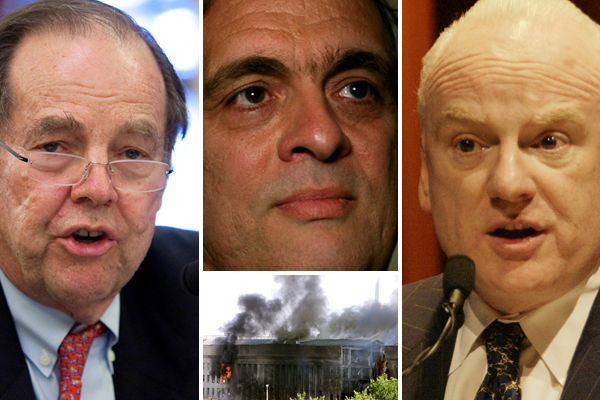
Tom Kean, George Tenet, Richard Clarke. Inset: The Pentagon on fire after an aircraft crashes into it, Sept. 11, 2001.

A growing number of former government insiders — all responsible officials who served in a number of federal posts — are now on record as doubting ex-CIA director George Tenet’s account of events leading up to the Sept. 11, 2001, attacks on the United States. Among them are several special agents of the FBI, the former counterterrorism head in the Clinton and Bush administrations, and the chairman of the 9/11 Commission, who told us the CIA chief had been “obviously not forthcoming” in his testimony and had misled the commissioners.

These doubts about the CIA first emerged among a group of 9/11 victims’ families whose struggle to force the government to investigate the causes of the attacks, we chronicled in our 2006 documentary film “Press for Truth.” At that time, we thought we were done with the subject. But tantalizing information unearthed by the 9/11 Commission’s final report and spotted by the families (Chapter 6, footnote 44) raised a question too important to be put aside:

Did Tenet fail to share intelligence with the White House and the FBI in 2000 and 2001 that could have prevented the attacks? Specifically, did a group in the CIA’s al-Qaida office engage in a domestic covert action operation involving two of the 9/11 hijackers, that — however legitimate the agency’s goals may have been — hindered the type of intelligence-sharing that could have prevented the attacks? And if not, then what would explain seemingly inexplicable actions by CIA employees?

As we sought to clarify how the CIA had handled information about the hijackers before 9/11, we found a half dozen former government insiders who came away from the Sept. 11 tragedy feeling burned by the CIA, particularly by a small group of employees within the agency’s bin Laden unit in 2000 and 2001, then known as Alec Station.

Among them was Gov. Thomas Kean, co-chairman of the National Commission on Terrorist Attacks Upon the United States, which was responsible for investigating 9/11. He agreed to an on-camera interview for our documentary in 2008. He surprised us by voicing many doubts and questions about the CIA’s actions preceding Sept. 11 — and especially about former CIA director George Tenet.

Four years after Tenet testified to the commission, Kean said the CIA director had been “obviously not forthcoming” in some of his testimony. Tenet said under oath that he had not met with President Bush in the month of August 2001, Kean recalled. It was later learned he had done so twice.

Did Tenet misspeak? we asked the New Jersey Republican.

“No, I don’t think he misspoke,” Kean responded. “I think he misled.”

A tale of two hijackers

The story buried in footnote 44 of Chapter 6 of the 9/11 Commission report was this:

The commission became aware in early 2004 of a warning written by Doug Miller, an FBI agent working inside the CIA’s Alec Station. In January 2000, Miller tried to inform his bosses about a man named Khalid Al Mihdhar, who had previously been identified as a member of an al-Qaida operational cadre. By the spring of 2000, the CIA had learned that Mihdhar and another suspected al-Qaida operative, Nawaf Al Hazmi, had likely arrived in Southern California. But the CIA did not pass along the information to the FBI.

The draft cable — blocked by Miller’s CIA superiors — was not turned over to the commissioners or to the earlier congressional investigation. It was discovered in CIA records by an investigator working for a concurrent inquiry conducted by the Justice Department’s inspector general. Apparently it had been missed by Tenet’s DCI Review Group, convened immediately after the attacks to examine CIA records in order to prepare the director for the coming government investigations.

Kean was disturbed by the revelation.

“The idea that that information was left out of something that was so essential for the FBI, whose job it is to work within the United States and track these people … you know, it’s one of the most troubling aspects of our entire report, that particular thing,” Kean said.

We pushed Kean. Could it be this was a simple mistake, a failure to recognize the significance of Mihdhar and Hazmi, as the CIA had initially characterized it?

“Oh, it wasn’t careless oversight,” Kean replied. “It was purposeful. No question about that in my mind … In the DNA of these organizations was secrecy.”

Mihdhar and Hazmi boarded American Flight 77 at Washington Dulles airport on the morning of Sept. 11. After the plane took off, they joined three other men in commandeering the aircraft and flying it into the Pentagon, killing a total of 184 people.

So how then had George Tenet and those responsible at the CIA managed to get away with misrepresenting the incident as a mistake for so long?

“Tenet was a likable guy,” Kean concluded. “He got away with some stuff because people liked him.”

“Malfeasance and misfeasance”

In 2009, former White House counterterrorism chief Richard Clarke took the scenario further. In an on-camera interview he suggested that Tenet, once a close friend and colleague, had ordered the withholding of the information about the two al-Qaida operatives from the FBI and from the White House.

Clarke explained why he had come to that remarkable conclusion. Tenet, he said, followed all information about al-Qaida “in microscopic detail” and would call Clarke at the White House several times a day to share “the most trivial of information.” In addition, there were terrorism threat meetings held in person every other day.

We must have had dozens, scores of threat committee meetings over the time when they knew these guys had entered the country … They told us everything except this … So now the question is, why?

The only explanation Clarke could offer was admittedly speculative: that the CIA may have been running an operation to recruit the two al-Qaida operatives while they were living under their own names in Southern California. This might appear to have been a reasonable thing for the CIA to do. After all, Bill Clinton’s White House had long complained to the agency about the lack of penetration agents in al-Qaida.

But if the CIA was following or recruiting or monitoring Mihdhar and Hazmi in the United States, that might well have qualified as operating on U.S. soil, a violation of the agency’s charter. Once the two men were identified as hijackers on Flight 77, CIA officials may have begun a coverup of their earlier “malfeasance and misfeasance,” as Clarke charges.

His language is blunt, especially for a national security policymaker.

“I am outraged and have been ever since I first learned that the CIA knew these guys were in the country,” explained Clarke. “But I believed for the longest time that this was probably one or two low-level CIA people who made the decision not to disseminate the information. Now that I know that 50 CIA officers knew this, and they included all kinds of people who were regularly talking to me, saying I’m pissed doesn’t begin to describe it.”

Clarke said he assumed that “there was a high-level decision in the CIA ordering people not to share that information.” When asked who might have issued such an order, he replied, “I would think it would have been made by the director,” referring to Tenet — although he added that Tenet and others would never admit to the truth today “even if you waterboarded them.”

The view from the FBI

We found the same suspicion was also prevalent among FBI counterterrorism agents from the time, particularly those who had worked under a legendary FBI agent named John O’Neill in New York. O’Neill, movingly portrayed in Lawrence Wright’s Pulitzer Prize-winning “The Looming Tower,” was one of the special agents in charge of counterterrorism in the FBI’s New York office. He retired to serve as chief of security at the World Trade Center and was killed in the Sept. 11 attacks, only three weeks after leaving the bureau.

O’Neill’s deputy for counterterrorism was Pasquale D’Amuro, who was appointed inspector in charge of the FBI’s investigation into the attacks.

“I am cautious about saying it, because you have to deal with the facts,” D’Amuro told us. He said that he was told that Richard Blee, the chief of Alec Station, and his deputy, Tom Wilshere, had blocked the sharing of intelligence on Mihdhar and Hazmi with the FBI.

“I had heard that Blee stopped it from coming over, that Blee and Wilshere had had the conversation and stopped it,” D’Amuro said. “There’s no doubt in my mind that that went up further in the agency than just those two guys. And why they didn’t send it over — to this day, I don’t know why.”

Jack Cloonan, former manager at the FBI’s al-Qaida-busting I-49 Squad, is another insider pained by the CIA’s actions.

“If you start to look into everything that’s Khalid Al Mihdhar and Nawaf Al Hazmi, you can’t help but conclude to most people’s minds that this is it,” Cloonan, said during an emotional interview in his New Jersey living room. “9/11 occurred not because the systems failed. The systems actually worked. Somebody made a critical decision not to share this information … If you look at this, it’s really just a handful of people. I don’t know how they sleep at night, I really don’t.”

The CIA’s failure to inform the FBI meant that a last chance to stop the hijackers was missed, says Clarke.

“And if they had….” Clarke told us, his voice trailing off. “Even as late as Sept. 4,” he went on, “we would have conducted a massive sweep. We would have conducted it publicly. We would have found those assholes. There’s no doubt in my mind — even with only a week left — we would have found them…”

Clarke is not an infallible or even a disinterested witness. As a top counterterrorism adviser at the time of the attack, he cannot help but take the tragedy personally. That said, the fact that at least three FBI agents share his views certainly enhances his credibility.

A spokesman for the CIA rejects the notion, telling Salon, “any suggestion that the CIA purposely refused to share critical lead information on the 9/11 plots with the FBI is simply wrong.” The spokesman cited the 9/11 Commission report and a report of the CIA’s independent inspector general. (The latter study, completed in 2004, has never been made public.)

The story of the alleged CIA intelligence failure attracted little other media interest until this August. That’s when Tenet, Richard Blee and another CIA official criticized by Clarke, Counterterrorism Center director J. Cofer Black, replied to our request for an interview. We had asked them to respond to Clarke’s speculation.

Although they declined to be interviewed, Tenet, Black and Blee sent us a joint written statement that charged Clarke was “reckless and profoundly wrong” and that he had “suddenly invented baseless allegations which are belied by the record and unworthy of serious consideration.”

The statement, which we shared with the Daily Beast, was newsworthy because the three men had never before felt the need to explain their actions directly to the American public.

“We testified under oath about what we did, and what we didn’t know,” they stated. “We stand by that testimony.”

The relevance of their testimony to Clarke’s theory is hard to assess. Tenet and Black were never asked about the surveillance of Mihdhar and Hazmi, at least in their public testimony. Blee’s testimony has never been made public.

“You’re not going to say anything”

The CIA’s explanation is not convincing to Mark Rossini, an FBI agent who was assigned to Alec Station in 2000 and 2001. The assignment of tracking Khalid Al Mihdhar, he told us, had been given to a young staff operations officer who shared responsibility for watching events in Yemen along with Alec Station deputy chief Tom Wilshere.

Rossini, who resigned from the FBI in the wake of legal troubles, recalled in a phone interview that the staff officer’s direct supervisor was a redheaded analyst working directly for Wilshere. He says that this supervisor, not referred to by even so much as an alias in any of the government reports on 9/11, is the same woman who told congressional investigators that she had hand-delivered Mihdhar’s visa information to FBI headquarters. This was later proven false when the investigators checked the log books at the FBI headquarters, discovering that she had never set foot in the building. Eleanor Hill, staff director of the congressional inquiry, also told us that her investigators found no evidence that the FBI had ever received the information.

Rossini remembered that the staff operations officer working under that redhead had ordered him and his fellow FBI agent Doug Miller not to tell their colleagues at the bureau, including John O’Neill’s New York office, that Mihdhar was likely on his way to the United States in early 2000.

“She got a little heated,” Rossini recalled. “She just put her hand on her hip and just said to me, ‘Listen, it’s not an FBI case. It’s not an FBI matter. When we want the FBI to know, we’ll let them know. And you’re not going to say anything.’”

Only two days before, this same officer had sent a message internally throughout the CIA misleading her fellow agents into believing that the information had been passed on to the FBI. Her later conversation with Rossini makes it appear that this was a deliberate misstatement. According to the Justice Department inspector general, she sent the misleading message only hours after posting an electronic note on Doug Miller’s draft warning to the FBI: “pls hold off … for now per [the CIA deputy chief of bin Laden unit],” a reference to Tom Wilshere.

We now know the staff officer is a woman named Michael Anne Casey. Her red-haired supervisor was a woman named Alfreda Frances Bikowsky.

Google penetrates the CIA

How we learned the names of those two CIA personnel can be summarized in one word: Google. In the case of the redhead, an Associated Press article from February 2011 seemed to refer to her. She had also been referenced in Jane Mayer’s book “The Dark Side,” by her middle name, Frances. The AP article stated that she had an unusual first name. After searching State Department nominations from the past decade — often cover positions for CIA personnel but still entered into the Congressional Record -– a contemporary historian named Kevin Fenton with whom we work closely found a name that seemed to fit.

For the staff officer, we knew three important facts. She had a “man’s name” — most likely Michael, the name used in the Commission Report. She was in her late 20s at the time of the incident, and was a “CIA brat,” meaning she had at least one parent or another family member inside the agency. We wondered if she might be related to a prominent CIA figure, as her boss Richard Blee had turned out to be. One of the first names that came to mind, given her probable birth year, was William J. Casey, Ronald Reagan’s CIA director.

Pairing the first name “Michael” with the last name “Casey,” we found a number of people with that name working in State Department or military positions. Again looking in the Congressional Record, we found the name Michael Anne Casey — a woman with a man’s name — and another website listing Casey as 27 years old in 1999 and living in the D.C. area, which seemed to make her very likely the person in question. (Incidentally, we were later informed that she is no relation to William J. Casey.)

A CIA threat

When we informed the agency’s Public Affairs office that we planned to release an investigative podcast on iTunes on Sunday, Sept. 11, that named Bikowsky and Casey, the agency replied immediately.

“We strongly believe it is irresponsible and a potential violation of criminal law [emphasis added] to print the names of two reported undercover CIA officers who you claim have been involved in the hunt against al-Qaida,” said spokesman Preston Golson.

Erring on the side of caution, we took the names out of our podcast. On the day we released the revised podcast on our website, we heard from Sibel Edmonds. A former FBI analyst and prominent whistleblower, Edmonds posted a story on her blog Sept. 21 stating that she had three credible sources and a document confirming that the redhead in our revised story was Bikowsky. She also stated that the staff officer involved was Michael Anne Casey and cited our website, Secrecy Kills. It was only then that we discovered our webmaster had briefly and inadvertently placed our entire email to the CIA on our site. Edmonds saw the information and published it.

Within minutes the information had spread widely through social media on the Internet. Before long Gawker breathlessly announced the latest of the CIA’s problems: that Bikowsky, who had risen to become the head of the CIA’s global jihad unit, had been outed. The rather more significant story — that a CIA intelligence failure had contributed to the 9/11 attacks — got short shrift from the popular gossip site.

In an effort to clarify the story, we asked the CIA two factual questions. We asked if Bikowsky’s statement to the congressional 9/11 inquiry — that she had delivered Mihdhar’s visa information to the FBI prior to the attacks — was accurate.

We also asked if former FBI agent Mark Rossini’s recollection that Michael Anne Casey had told him not to report information about Mihdhar and Hazmi was accurate.

The agency did not address the specifics of either question.

“We do not, as a rule, publicly confirm or deny the identities of currently serving agency officers,” a spokesman replied. “That includes those dedicated to the disruption of terrorist plots. The officers involved in those critical efforts have, thanks to their skill and focus, saved countless American lives.”

The story of Mihdhar and Hazmi could easily be clarified, says Robert Baer, a retired CIA officer in the Middle East who worked directly with some of the people involved.

“A lot of these people who withheld this information were not covert operatives,” he explained. “There was no reason to hide their names. They are out there in the public. You can find them in data and credit checks and the rest of it … They certainly could have been brought before the House or the Senate in closed session and an explanation and a report put out there.”

Langley on the defensive

The CIA prefers not to disclose but to protect the handful of people at the heart of this story.

Tenet remained George W. Bush’s CIA director for another two and a half years, where he was famously involved in passing along faulty intelligence about weapons of mass destruction that justified the disastrous invasion of Iraq. On Dec. 14, 2004, George Tenet was awarded the Presidential Medal of Freedom by President Bush.

Richard Blee, chief of Alec Station in 2001, reportedly took over the CIA operation during the invasion of Afghanistan to capture or kill Osama bin Laden when bin Laden was surrounded in the mountains of Tora Bora three months after 9/11. According to 23-year career CIA officer Gary Berntsen, as reported in his book, “Jawbreaker,” Blee was in charge at the time bin Laden managed to slip away to Pakistan to live comfortably for nearly a decade. Harper’s Ken Silverstein reported that Blee was active in the controversial renditions and detainee-abuse programs. He is now retired and living in Los Angeles.

We do not know exactly what became of Tom Wilshere, a mysterious figure who has managed to maintain an even lower profile than the rest. Dale Watson, former head of the FBI’s Counterterrorism Division, told us that us that Wilshere became a White House briefer during the Bush era.

Casey and Bikowsky have risen in the CIA’s ranks, despite the fact that Bikowsky has been associated with at least one major blunder. The AP reported that Bikowsky was at the center of “the el-Masri incident,” in which an innocent German citizen was renditioned (a euphemism for kidnapped) by the CIA in 2003 and held under terrible conditions (a euphemism for tortured) in a secret Afghan prison. The AP characterized it as “one of the biggest diplomatic embarrassments of the U.S. war on terrorism.” It was no doubt something more to Khaled el-Masri. Despite that episode Bikowsky was promoted.

As chief of the counterterrorism center, Cofer Black was the boss of Casey, Bikowsky and Blee. He too was associated with the abuses of the extraordinary rendition program. He resigned shortly after George Bush was elected to a second term. Black then served as vice chairman of Blackwater USA, the controversial U.S.-based private security firm, from 2005 to 2008. Earlier this month Republican presidential candidate Mitt Romney announced that Black would join his campaign as a foreign policy adviser.

Rory O’Connor is an award-winning journalist, author and filmmaker, and co-founder and president of the international media firm Globalvision. Producer-writer Ray Nowosielski made his documentary debut directing "Press for Truth" in 2006. Co-founder of the media production company Banded Artists, he also was a senior producer for Globalvision.

Hiding 9/11′s last secrets

The military tribunal for Khalid Sheikh Mohammed means the American people will never know what drove him to terror

(Credit: Reuters//Brennan Linsley)

After a Navy SEAL team killed Osama bin Laden at his Pakistan hideout a year ago this week, it flew his body to the Arabian Sea, weighted it down, and slid it silently off an aircraft carrier into the watery depths.

For many Americans, the secret raid provided a measure of revenge and catharsis for the strikes of Sept. 11, 2001. But it didn’t provide the kind of justice and official reckoning that the country needs to gain real closure. Now the government has a chance to achieve that through a full, fair and open trial of Khalid Sheikh Mohammed and four co-defendants, so the world can finally see the evidence against him as the true architect of the attacks on New York and Washington. The trial kickoff — an arraignment for the men — is scheduled for this Saturday at the U.S.-run detention facility in Guantanamo Bay, Cuba.

This should be our Nuremburg, the defining trial of the 9/11 era and a fitting coda to it.

Unfortunately, the U.S. government appears to be on the verge of squandering this opportunity, and with it, the best, and perhaps only, chance for the public to understand not only how the attacks came to be, but why Mohammed waged a relentless war against America and how we might stop the next would-be terrorist mastermind.

The problems lie within the reformed military-tribunal system that the Obama administration put in place after losing its fight for a civilian trial in New York. Political compromises have resulted in a flawed military commissions process that from outward appearances is not only rigged against the defense, but hyper-choreographed, censored and hermetically sealed.

“The process is designed to achieve a conviction, and to do it with as little revelation as humanly possible, but with the veneer of due process and justice,’’ said one participant who said restrictive gag orders prohibited him from talking publicly. “You’re talking about the most heinous crime ever, and we’re going to afford them less due process, less discovery, less of everything than we would the guy who shoplifted a pack of gum from CVS.’’

Obama administration officials say their reformed military commissions system is a vast improvement over the Bush administration’s version, which Obama moved to shut down on his first day in office in 2009.

Defense lawyers disagree, and insist they have been hamstrung in their efforts to mount the kind of aggressive defense needed to do their jobs including full and unfettered access to evidence, witnesses and even the accused themselves.

Four of the five legal teams had so few of their key players in place in recent months that they did not file the “mitigation submissions’’ that the government said it needed to decide which of the five men should face the death penalty and other key issues, such as whether to try them together or individually. They recently filed motions asking that the charges be thrown out because of fatal flaws in the system, which they say make it impossible for them to defend their clients.

“It’s window dressing,’’ Mohammed’s defense lawyer, David Nevin, said of the government’s improvements. “I am not all satisfied that it is a fair process. In fact, it is not a fair process.’’

Many of the defense lawyers have quit out of frustration or for other personal reasons stemming from the many delays in the process. Only a few have been there long enough to even begin to understand their clients’ case, not to mention the convoluted military commission process.

And they say they will be unable to effectively challenge confessions obtained when their clients were coercively interrogated in the CIA’s black site prisons, if they can broach the subject at all. This is important for the four men accused of helping Mohammed with the logistics of the plot. Several claim they have been wrongly accused, tortured into confessing, or both.

It is also important with regard to Mohammed, who confessed to dozens of plots while being waterboarded 183 times, and has said he may plead guilty even before the trial begins. Few U.S. counterterrorism officials believe all of his often boastful confessions, and it is important for the public to hear what, exactly, evidence the government has with regard to what he did and didn’t do, and whom he might have been protecting.

The team of Defense and Justice Department officials overseeing the military commission process, and the presiding judge, should quickly address the defense lawyers’ complaints, or a proceeding that some call “The Trial of the Century’’ will be delayed further by legal wrangling — and forever tainted by accusations of being unfair.

A full, fair and transparent trial, above all, will benefit the public. There is much the public doesn’t know about Mohammed, including the details of how he devised the plot, convinced bin Laden to let him do it and then orchestrated it “from A to Z,’’ to use his own words. It was Mohammed who masterminded dozens of other plots and attacks, some while staying a step ahead of the largest-ever criminal manhunt.

Mohammed, not bin Laden, was the one who traveled the world as a kind of “Johnny Appleseed’’ of terrorism, establishing alliances and creating a network of cells and lieutenants that in some cases remains today. And it was Mohammed who personally recruited young jihadist prospects much like a baseball scout, many of them Westerners, tapping into their grievances to turn them to his cause.

The U.S. government has kept the details of what Mohammed did — and how and why he did it — hidden in its most classified files since his capture in Pakistan nine years ago. The government should set the record straight on that, because there is an important lesson to be learned from the largely untold tale of Khalid Sheikh Mohammed: It isn’t some monolithic group like al-Qaida that poses a continuing threat, it’s the one intelligent and energetic person who can emerge from nowhere and orchestrate a 9/11 while the world focuses elsewhere.

To that end, the government should declassify as much evidence as possible, and explain how it obtained it. It should call numerous witnesses to testify, especially since the one who has been publicly identified, Majid Khan, claims he was tortured while in CIA custody overseas.

Instead of limiting access to a few closed-circuit TVs, it should consider televising the proceedings. It should ensure that censorship is minimized, and used only to protect intelligence sources and methods, not to save the government from embarrassment. And it should let Mohammed and the others testify at length on their behalf if they so desire.

By doing so, the Obama administration will be able to say it did its best to put on the kind of civilian trial it has wanted all along, and one with a similar outcome to that of the al Qaida members charged with blowing up two U.S. embassies in Africa in 1998.

Those of us who witnessed that trial in Manhattan in 2001 saw the defendants squirm in their chairs as prosecutors introduced mountains of evidence against them. We saw eyewitnesses point the finger at the accused, and surviving victims glare at them from the pews.

We heard from the terrorists themselves, and learned a lot about why they did it, about how terrorist networks operate and about what might be done to stop people like them. And when the jury convicted them, there was no question that justice was done.

Continue Reading Close

Josh Meyer is the author, with Terry McDermott, of the new book, "The Hunt for KSM: Inside the Pursuit and Takedown of the Real 9/11 Mastermind, Khalid Sheikh Mohammed.’’

Marky Mark saves the universe!

The "Contraband" star suggests he could have stopped 9/11 -- and inspires a genius viral art explosion online SLIDE SHOW

(Credit: quickmeme.com)

View the slide show

Mark Wahlberg’s insensitive comments about 9/11 have sparked incredulity everywhere from Twitter to the cover of the New York Post. Earlier this week, in an interview with Men’s Journal, the actor seemed to confuse himself with Chuck Norris:

If I was on that plane with my kids, it wouldn’t have went down like it did. There would have been a lot of blood in that first-class cabin and then me saying, ‘OK, we’re going to land somewhere safely, don’t worry.’

Wahlberg has apologized profusely for his lightning-rod remarks — but the pocket pundits of Tumblr and other meme machines have already had their say. Check out the following slide show for some of the most notable examples of Wahlberg-inspired Internet art.

View the slide show

Continue Reading Close

Emma Mustich is a Salon contributor. Follow her on Twitter: @emustich.

An “incredibly close” screening

A preview of “Extremely Loud and Incredibly Close” turns into group therapy for post-9/11 New Yorkers

A movie that asks are we ready to talk about 9/11?

I knew all those years of sitting in darkened theaters on sunny afternoons, awash in movies new and old, stale popcorn and gallons of diet soda, would pay off some day. For one, there was the woman I met in 1975 at the late, lamented Carnegie Hall Cinema during a Mel Brooks double feature. She came and sat next to me when a guy kept bothering her during “Blazing Saddles” and we wound up dating — until she lit out for a career in the hinterlands, acting in summer stock.

But as lovely as she was, that’s not the payoff I mean. All that time reading about and watching movies didn’t just prepare me for romance, or Jeopardy and Trivial Pursuit, if it comes to that. (Quick—the address of Charles Foster Kane’s love nest with Susan Alexander? 185 West 74th Street.)

What it did ready me for is one of my favorite things, interviewing screenwriters about their work. In my various capacities at the Writers Guild of America, East, I’ve had the opportunity over the last decade and a half to talk with many of them, in private for articles or video archives, and in public, in front of an audience, at screenings of their films. Sometimes the director and one or two of the actors come, too.

This has led to some odd experiences: like dealing with the emotionally fragile starlet who recently had gone through a very public break-up. I had to gently coax her out of her limo and into the screening because she was afraid of the paparazzi, who were covering a premiere at the theater next door. They didn’t notice.

Or the time the writer knelt next to me during his film and frantically whispered that an entire reel had been skipped, the next to last one. We let everyone see it when the movie was over but discovered that the hapless projectionist had been showing it that way – to critics – for weeks.  The film opened and closed very quickly.

There was the incomprehensible interview with Jean-Luc Godard, which was not because my French was worse than his English, or vice versa, but simply because he’s Jean-Luc Godard; and the Q & A with British writer and director Mike Leigh – my first question triggered a rapid-fire, twenty-minute monologue that was impossible to interrupt. Because he covered virtually every one of my prepared questions, it wasn’t so bad. By the time he had worn himself out, we were ready for questions from the audience.

But one of the most unusual interviews took place just last month, a week or so before Christmas. I was scheduled to introduce a screening of “Extremely Loud & Incredibly Close” and talk afterwards with the author of its screenplay, Eric Roth, whose other credits include “Forrest Gump” and “The Curious Case of Benjamin Button.”

When I arrived at the theater, a representative from Warner Brothers let me know that the film’s director, Stephen Daldry, would be joining us as well. I had to pretty much toss the interview I’d prepared – most of my questions were about Eric’s work and screenwriting in general – but it would be okay. Stephen and I had met several years ago when he was promoting his movie “The Hours” and I was interviewing its screenwriter, David Hare.

If you haven’t heard by now, “Extremely Loud & Incredibly Close,” adapted from the novel by Jonathan Safran Foer, is a tough movie to watch, especially if you’re a New Yorker who was here on 9/11. But in my opinion, it’s well worth it; the engaging, entertaining and powerful story of an emotionally troubled Asperger’s kid who seeks to reconnect with the father he lost at the World Trade Center. The boy travels across the city trying to solve the riddle of a mysterious key he finds in his father’s closet a year after the attacks.

The film ended and there was applause, which doesn’t always happen at these things; we are, after all, jaded, Manhattan media sophisticates. The lights came up, I introduced Eric and Stephen and started to ask my first question.

Stephen interrupted (he’s a director). “I’d like to know what people think about the film. We’ve only just finished it and only shown it to a handful of audiences, so I’d like to know what you think.”

Silence.

I think we’re all experiencing a bit of shellshock, I said. Most of us were here on 9/11. Ten years later, it’s still kind of raw. Stephen repeated his question – what did you think?

Slowly, people began to respond, positively for the most part but in each of us the film triggered memories. People had friends in the buildings. A man who worked as an extra in the film – you see a split-second shot of him in a Batman costume – had a job in wire transfers at Bank of America. He worked the night shift at the Trade Center and left just minutes before American Airlines Flight 11 hit the North Tower. He’s still suffering from survivor guilt.

For me, it was a moment toward the end of the film when the boy, Oskar (an incredible performance by young, first-time actor Thomas Horn), visits an office downtown in the middle of the night. Security takes his photo and prints out a building ID. That would seem innocuous to most, but I remembered an evening about a week and a half after what Oskar calls “the worst day.” George Bush was addressing a joint session of Congress.

My then wife and I were burning candles to cover the smell from Ground Zero, which had shifted that rainy night from an odor of burning electrical cables and melted metal to something more feral and decaying. As we listened to Bush and I made dinner, she sat and sorted through a basket of odds and ends, then handed me something: a security ID with my picture — like Oskar’s — but taken the last time I had gone to the World Trade Center for a meeting.

The rest of my interview with Stephen and Eric went like that. I got a couple of my original questions in, but the evening had turned into a group therapy session, and that was fine. As Daldry recently said in the Los Angeles Times, “It’s a loss that’s very public and one that everyone has very rich stories about. One has to be responsible to the original author’s book … and you have to be aware of the truth of the reality of what happened to thousands of people who lost loved ones.

I heard a new ad for ”Extremely Loud & Incredibly Close” on the radio this morning, its pitch apparently readjusted, aimed at those averse to a movie about the Trade Center calamity. It’s “not about 9/11,” the spot’s announcer declared, “but every day after.”

Nice try. The question is, as Stephen told the Times, “Is it time? Can we start to tell these stories yet or is it too early?” The film opens nationally on January 20. Spend a couple of hours in a darkened movie theater and find out what you think.

Continue Reading Close

Michael Winship is senior writing fellow at Demos and a senior writer of the new series, Moyers & Company, airing on public television.

How the feds fueled the militarization of police

Billions in post-9/11 taxpayer dollars have paid for combat-style gear on display in the Occupy crackdowns

Police in riot gear move to a location at the port facilities in Longview, Wash., Wednesday, Sept. 21, 2011. (Credit: AP/Don Ryan)

The militarization of America’s metropolitan police forces was on full display in recent months as police from Los Angeles to New York cracked down on Occupy protests, decked out in full SWAT gear and occasionally using strange pieces of military hardware.

Less well known is that police forces in small towns and far-flung cities have also been stocking up on heavy equipment in the years since Sept. 11, 2001.

In spite of strained city and state budgets in local years, the trend has continued thanks to generous federal grants. According to a new story by the Center for Investigative Reporting, $34 billion in federal grant money has financed the past decade’s shopping spree.

To learn more about the trend, I spoke with G.W. Schultz, who co-authored the story with Andrew Becker. (Also worth a look is the slide show accompanying the story.)

You start your piece with Fargo, N.D., where the police have a “$256,643 armored truck, complete with a rotating turret,” kevlar helmets and assault rifles in their squad cars. What did they say when you asked why they need this kind of heavy equipment?

Their view is that they need to be as prepared as a city like New York. We’ve been studying the grant programs for a while. You see this in city after city. Everyone has got an explanation for why they need more and not less grant money. I grew up in Tulsa; there’s still a lot of sensitivity around the Oklahoma City bombing. So the attitude is, “Look, we could have a similar attack and we need to be ready for it.” Now I live in Austin. The attitude here is, we could have an incident like the one in which a guy smashed his plane into the IRS building a few years ago, or the one in which a guy started shooting people from a tower at the Uniersity of Texas a few decades ago. Every city has an answer like that. The approach to security spending is based on speculation about what could happen, however remote. That attitude enables you to buy everything without limit because you can never attain 100 percent security.

What is the federal grant program that is handing out all this money?

What we learned over time is that it’s not just one grant program, it’s grant programs. There is a dizzying array of grants that local communities are eligible for from the Department of Homeland Security and sometimes the Justice Department. A few grants existed prior to 9/11. After DHS was created, Congress kept creating new programs to meet perceived needs around security. For example, “We need a bulletproof vehicle to send in our SWAT unit if a Mumbai-style attack occurs.” That led to a spree of spending on bulletproof vehicles. Each round of purchases is fueled by a what-if scenario.

You write in your piece that there’s a lot of information still lacking about this spending. What don’t we know? 

We’ve been working on this Homeland Security research for a few years. The feds have never had a listing of everything the local police and other local government agencies bought with the grant money. You literally can’t go to Washington and find a listing of how the $34 billion was spent; you have to go state by state. We set out to do that; after a period of many months, we still only have records from 41 states, and they are wildly inconsistent. We wanted to build a nationwide database of how the money was spent, but there turned out to be just no way to do it because of the lack of information. But we spent so much time with grant records, we were able to identify trends; we knew many communities were buying SWAT-style trucks, combat-style protective gear, and so on.

Has most of this equipment — assault rifles and armored vehicles and so on — just not been used? 

It’s hard to tell. We can say from available audits that a lot of the equipment purchased with grant funds is not used. As the years pass by, you see more people in government concede that particularly during the early years after 9/11, a lot of the stuff that was bought was never used, and a lot of money was wasted. I was recently at a small public safety summit in Austin and the chief of police here rhetorically asked the audience, “All the protective attire that you bought after 9/11 for a chemical attack, have you used any of that?” And the room kind of giggled a little bit. In the end there’s still an attitude in law enforcement and the government that it could be used and we need to be prepared.

Who is making money off of all this?

Well, defense contractors are not manufacturing F-35s or big ships for local cops. But these companies and Wall Street in general think in terms of diversity. They want small profit margins and large profit margins. Companies like Northrop Grumman have sold a lot of bomb-dismantling robots to local police. Some traditional defense contractors like Raytheon have also gotten into the intelligence side, selling things like information-sharing tools and radio equipment. I went to a conference a few weeks ago where Raytheon had a big presence, offering expensive communications equipment for dispatchers and so on.

It’s important to point out you can’t buy guns with Homeland Security grants — but it’s about the only thing you can’t buy. That’s a restriction the feds decided to place early on. But if a local police department can take care of some of the capabilities they believe they need to have with grants, that leaves money to buy things like AR-15s. In the 10 years since 9/11, they’ve done both — both combat-style SWAT attire and assault rifles. That’s partly why you see images now of SWAT police looking very much like combat troops in Baghdad or Kabul.

Are there any dissenting voices within the police community about all this militarization? 

There are even folks in the SWAT community — some of the older folks who have observed the evolution of SWAT — who are concerned about this. They’re concerned about whether or not the training is going to meet all the equipment that’s being bought. Part of the reason for that is the training is not as sexy as the equipment. The image and romance of battling bad guys with lots of tough-looking equipment and guns maybe isn’t as exciting as investing in training. There’s also concern among some police about deploying tactical units too often — for low-risk warrant executions and things like that. But, the counter-voice in law enforcement is, “Look, this enhances safety for officers.” They look back at a couple of really bad shootings and say, “We’re never going to let that happen again. We’re going to get whatever equipment or training we need.” But that comes at a cost.

Does it make police look more intimidating to be wielding AR-15s with all kinds of devices attached to them? Especially in a country that’s been working for years to implement community policing strategies. In a place like Los Angeles, there were years of work done to soften the image of law enforcement and improve the department’s relationship with minority communities. Is that threatened by the wider adoption of combat stye equipment and training?

Continue Reading Close
Justin Elliott

Justin Elliott is a reporter for ProPublica. You can follow him on Twitter @ElliottJustin

“Extremely Loud & Incredibly Close”: Post-9/11 trauma, made cute and dull

The sentimental bestseller "Extremely Loud & Incredibly Close" becomes a dreary Tom Hanks-Sandra Bullock weeper

Thomas Horn and Tom Hanks in "Extremely Loud and Incredibly Close"

A few weeks ago I wrote a largely negative review of Kenneth Lonergan’s long-delayed “Margaret,” a sprawling and ambitious attempt at weaving a multi-character cinematic tapestry about life in post-9/11 New York. I stand by every word, but I also understand why a group of critics and cinephiles have campaigned to get “Margaret” on the awards-season radar screen, in the face of Fox Searchlight’s evident decision to abandon it on the curb like a stillborn hamster. “Margaret” is coming back to New York’s Cinema Village this weekend, and if you’re in the neighborhood and want to see a flawed, big-hearted, intermittently marvelous and maddening epic about the legacy of 9/11, go check it out. You certainly won’t find any such grand emotions in “Extremely Loud & Incredibly Close,” which renders Jonathan Safran Foer’s best-selling 2005 novel into unconvincing Hollywood mush.

“Extremely Loud & Incredibly Close” is pretty much the last of this year’s supposedly major holiday movies to be unveiled for the press and public, and if I were director Stephen Daldry (he of “The Hours” and “Billy Elliot”), I might’ve wanted to sit on it a bit longer. It’s not a terrible film, exactly, but something worse, an irritating and enervating one. A longtime theater director who made the switch to film in the early 2000s, Daldry has a propensity for pretty, almost vampiric movies that are elegantly staged but drain the life out of their source material — and Foer’s novel didn’t have too much of that to begin with. A whimsical fable about an overly precious and eccentric 9-year-old, loaded down with Asperger-ish tics and phobias, who goes on a self-appointed citywide treasure hunt after his father dies in the twin towers, “Extremely Loud” always struck me as a sentimental contrivance. (I started the book and couldn’t finish it.)

Daldry and screenwriter Eric Roth remove some of the book’s more maddening byways and curlicues (such as the epistolary back story of the main character’s German grandparents) but can’t evade its biggest problems. What they wind up with is something like an especially slow-moving and unnaturally grave Wes Anderson movie, with a hero you constantly want to smack, mixed with an after-school special about grief and healing. Throw in a bunch of awkward, still-life supporting performances — Sandra Bullock, Max von Sydow, Viola Davis and Jeffrey Wright, all sitting around looking sad — skillful cinematography by British vet Chris Menges and a Minimalist orchestral score by Alexandre Desplat, and it all adds up to something that looks and feels classy yet is really minor-league schmaltz.

Nine-year-old Oskar Schell (played by one-time “Teen Jeopardy” contestant Thomas Horn, in his acting debut) feels like a literary creation all the way, a precocious and painfully odd city kid who’s afraid of almost everything and way too dependent on his dad, a Manhattan jeweler named Thomas. (You know, I like Tom Hanks, and he’s perfectly OK in this role, but he’s almost the last guy I would consider to play a New York shopkeeper of German and/or Jewish extraction.) Thomas has constructed a long-running scavenger hunt designed to draw Oskar out of his shell, and purportedly to solve the mystery of the missing “sixth borough” of New York City, which was dragged away at some point by secretive authorities for unknown reasons. This quest is interrupted after Thomas is vaporized in the World Trade Center, and the traumatized Oskar conceals his father’s last phone messages from his mother (Bullock). But when Oskar finds a key hidden inside a vase in his dad’s closet, he thinks it’s a clue from beyond the grave, and sets out on a mission to interview all 800-odd New Yorkers who share the surname Black (which was written on the envelope that held the key).

I get that you either have to suspend your disbelief and travel with the tambourine-jingling, subway-phobic Oskar from Fort Greene to Hamilton Heights to Astoria to Broad Channel — enjoying the journey and not fixating on the destination, etc. — or simply bail out, but I was supposed to write this review and couldn’t do the latter. In a larger sense, the problem with Daldry’s film is that it’s much too polite and pretty and classed-up, and lacks the nebbishy intensity and conviction that Foer’s mock-Salinger universe at least pretends to possess. “Extremely Loud & Incredibly Close” demanded the real Wes Anderson or, better still, Michel Gondry — someone who would treat Oskar’s filing systems and maps and sets of regulations and French Foreign Legion-style accessories with the utmost seriousness, and even make them the point of the whole enterprise.

What we get instead is frankly a drag, a slow-moving tale of healing and redemption with a low-wattage resolution you’ll glimpse miles away and a whole bunch of trailing loose ends. (Two of the major questions you’re asking yourself after reading my plot synopsis are never answered.) Oh, it’s enjoyable enough when von Sydow’s on hand as Oskar’s mysterious European grandfather, mostly because the titanic Swede is always terrific even when absolutely silent (as here). I did hear a little sniffling around me in the darkness, so if you’re an easy mark you may need a hankie. But, for the love of God, a movie that’s about 9/11 and autism and growing up without a dad should leave you crying buckets, and this one is too restrained and arty and highfalutin — I believe the correct expression in Daldry’s homeland would be “piss-elegant” — even to accomplish that.

Continue Reading Close

Page 1 of 54 in 9/11

www.salon.com/topic/911/