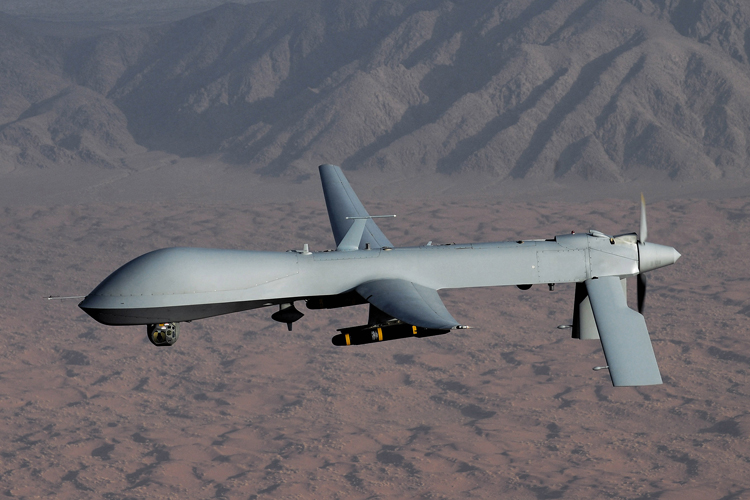

They increasingly dot the planet. There’s a facility outside Las Vegas where “pilots” work in climate-controlled trailers, another at a dusty camp in Africa formerly used by the French Foreign Legion, a third at a big air base in Afghanistan where Air Force personnel sit in front of multiple computer screens, and a fourth at an air base in the United Arab Emirates that almost no one talks about.
And that leaves at least 56 more such facilities to mention in an expanding American empire of unmanned drone bases being set up worldwide. Despite frequent news reports on the drone assassination campaign launched in support of America’s ever-widening undeclared wars and a spate of stories on drone bases in Africa and the Middle East, most of these facilities have remained unnoted, uncounted, and remarkably anonymous — until now.
Run by the military, the Central Intelligence Agency, and their proxies, these bases — some little more than desolate airstrips, others sophisticated command and control centers filled with computer screens and high-tech electronic equipment — are the backbone of a new American robotic way of war. They are also the latest development in a long-evolving saga of American power projection abroad — in this case, remote-controlled strikes anywhere on the planet with a minimal foreign “footprint” and little accountability.
Using military documents, press accounts and other open source information, an in-depth analysis by TomDispatch has identified at least 60 bases integral to U.S. military and CIA drone operations. There may, however, be more, since a cloak of secrecy about drone warfare leaves the full size and scope of these bases distinctly in the shadows.
A Galaxy of Bases
Over the last decade, the American use of unmanned aerial vehicles (UAVs) and unmanned aerial systems (UAS) has expanded exponentially, as has media coverage of their use. On September 21st, the Wall Street Journal reported that the military has deployed missile-armed MQ-9 Reaper drones on the “island nation of Seychelles to intensify attacks on al Qaeda affiliates, particularly in Somalia.” A day earlier, a Washington Post piece also mentioned the same base on the tiny Indian Ocean archipelago, as well as one in the African nation of Djibouti, another under construction in Ethiopia, and a secret CIA airstrip being built for drones in an unnamed Middle Eastern country. (Some suspect it’s Saudi Arabia.)
Post journalists Greg Miller and Craig Whitlock reported that the “Obama administration is assembling a constellation of secret drone bases for counterterrorism operations in the Horn of Africa and the Arabian Peninsula as part of a newly aggressive campaign to attack al-Qaeda affiliates in Somalia and Yemen.” Within days, the Post also reported that a drone from the new CIA base in that unidentified Middle Eastern country had carried out the assassination of radical al-Qaeda preacher and American citizen Anwar al-Awlaki in Yemen.
With the killing of al-Awlaki, the Obama Administration has expanded its armed drone campaign to no fewer than six countries, though the CIA, which killed al-Awlaki, refuses to officially acknowledge its drone assassination program. The Air Force is less coy about its drone operations, yet there are many aspects of those, too, that remain in the shadows. Air Force spokesman Lieutenant Colonel John Haynes recently told TomDispatch that, “for operational security reasons, we do not discuss worldwide operating locations of Remotely Piloted Aircraft, to include numbers of locations around the world.”
Still, those 60 military and CIA bases worldwide, directly connected to the drone program, tell us much about America’s war-making future. From command and control and piloting to maintenance and arming, these facilities perform key functions that allow drone campaigns to continue expanding, as they have for more than a decade. Other bases are already under construction or in the planning stages. When presented with our list of Air Force sites within America’s galaxy of drone bases, Lieutenant Colonel Haynes responded, “I have nothing further to add to what I’ve already said.”
Even in the face of government secrecy, however, much can be discovered. Here, then, for the record is a TomDispatch accounting of America’s drone bases in the United States and around the world.
The Near Abroad
News reports have frequently focused on Creech Air Force Base outside Las Vegas as ground zero in America’s military drone campaign. Sitting in darkened, air-conditioned rooms 7,500 miles from Afghanistan, drone pilots dressed in flight suits remotely control MQ-9 Reapers and their progenitors, the less heavily-armed MQ-1 Predators. Beside them, sensor operators manipulate the TV camera, infrared camera, and other high-tech sensors on board the plane. Their faces are lit up by digital displays showing video feeds from the battle zone. By squeezing a trigger on a joystick, one of those Air Force “pilots” can loose a Hellfire missile on a person half a world away.
While Creech gets the lion’s share of media attention — it even has its own drones on site — numerous other bases on U.S. soil have played critical roles in America’s drone wars. The same video-game-style warfare is carried out by U.S and British pilots not far away at Nevada’s Nellis Air Force Base, the home of the Air Force’s 2nd Special Operations Squadron (SOS). According to a factsheet provided to TomDispatch by the Air Force, the 2nd SOS and its drone operators are scheduled to be relocated to the Air Force Special Operations Command at Hurlburt Field in Florida in the coming months.
Reapers or Predators are also being flown from Davis-Monthan Air Force Base in Arizona, Whiteman Air Force Base in Missouri, March Air Reserve Base in California, Springfield Air National Guard Base in Ohio, Cannon Air Force Base and Holloman Air Force Base in New Mexico, Ellington Airport in Houston, Texas, the Air National Guard base in Fargo, North Dakota, Ellsworth Air Force Base in South Dakota, and Hancock Field Air National Guard Base in Syracuse, New York. Recently, it was announced that Reapers flown by Hancock’s pilots would begin taking off on training missions from the Army’s Fort Drum, also in New York State.
Meanwhile, at Langley Air Force Base in Virginia, according to a report by the New York Times, teams of camouflage-clad Air Force analysts sit in a secret intelligence and surveillance installation monitoring cell-phone intercepts, high-altitude photographs, and most notably, multiple screens of streaming live video from drones in Afghanistan. They call it “Death TV” and are constantly instant-messaging with and talking to commanders on the ground in order to supply them with real-time intelligence on enemy troop movements. Air Force analysts also closely monitor the battlefield from Air Force Special Operations Command in Florida and a facility in Terre Haute, Indiana.
CIA drone operators also reportedly pilot their aircraft from the Agency’s nearby Langley, Virginia headquarters. It was from here that analysts apparently watched footage of Osama bin Laden’s compound in Pakistan, for example, thanks to video sent back by the RQ-170 Sentinel, an advanced drone nicknamed the “Beast of Kandahar.” According to Air Force documents, the Sentinel is flown from both Creech Air Force Base and Tonopah Test Range in Nevada.
Predators, Reapers, and Sentinels are just part of the story. At Beale Air Force Base in California, Air Force personnel pilot the RQ-4 Global Hawk, an unmanned drone used for long-range, high-altitude surveillance missions, some of them originating from Anderson Air Force Base in Guam (a staging ground for drone flights over Asia). Other Global Hawks are stationed at Grand Forks Air Force Base in North Dakota, while the Aeronautical Systems Center at Wright-Patterson Air Force Base in Ohio manages the Global Hawk as well as the Predator and Reaper programs for the Air Force.
Other bases have been intimately involved in training drone operators, including Randolph Air Force Base in Texas and New Mexico’s Kirtland Air Force Base, as is the Army’s Fort Huachuca in Arizona, which is home to “the world’s largest UAV training center,” according to a report by National Defense magazine. There, hundreds of employees of defense giant General Dynamics train military personnel to fly smaller tactical drones like the Hunter and the Shadow. The physical testing of drones goes on at adjoining Libby Army Airfield and “two UAV runways located approximately four miles west of Libby,” according to Global Security, an on-line clearinghouse for military information.
Additionally, small drone training for the Army is carried out at Fort Benning in Georgia while at Fort Rucker, Alabama — “the home of Army aviation” — the Unmanned Aircraft Systems program coordinates doctrine, strategy, and concepts pertaining to UAVs. Recently, Fort Benning also saw the early testing of true robotic drones — which fly without human guidance or a hand on any joystick. This, wrote the Washington Post, is considered the next step toward a future in which drones will “hunt, identify, and kill the enemy based on calculations made by software, not decisions made by humans.”
The Army has also carried out UAV training exercises at Dugway Proving Ground in Utah and, earlier this year, the Navy launched its X-47B, a next-generation semi-autonomous stealth drone, on its first flight at Edwards Air Force Base in California. That flying robot — designed to operate from the decks of aircraft carriers — has since been sent on to Maryland’s Naval Air Station Patuxent River for further testing. At nearby Webster Field, the Navy worked out kinks in its Fire Scout pilotless helicopter, which has also been tested at Fort Rucker and Yuma Proving Ground in Arizona, as well as Florida’s Mayport Naval Station and Jacksonville Naval Air Station. The latter base was also where the Navy’s Broad Area Maritime Surveillance (BAMS) unmanned aerial system was developed. It is now based there and at Naval Air Station Whidbey Island in Washington State.
Foreign Jewels in the Crown
The Navy is actively looking for a suitable site in the Western Pacific for a BAMS base, and is currently in talks with several Persian Gulf states about a site in the Middle East. It already has Global Hawks perched at its base in Sigonella, Italy.
The Air Force is now negotiating with Turkey to relocate some of the Predator drones still operating in Iraq to the giant air base at Incirlik next year. Many different UAVs have been based in Iraq since the American invasion of that country, including small tactical models like the Raven-B that troops launched by hand from Kirkuk Regional Air Base, Shadow UAVs that flew from Forward Operating Base Normandy in Baqubah Province, Predators operating out of Balad Airbase, miniature Desert Hawk drones launched from Tallil Air Base, and Scan Eagles based at Al Asad Air Base.
Elsewhere in the Greater Middle East, according to Aviation Week, the military is launching Global Hawks from Al Dhafra Air Base in the United Arab Emirates, piloted by personnel stationed at Naval Air Station Patuxent River in Maryland, to track “shipping traffic in the Persian Gulf, Strait of Hormuz, and Arabian Sea.” There are unconfirmed reports that the CIA may be operating drones from the Emirates as well. In the past, other UAVs have apparently been flown from Kuwait’s Ali Al Salem Air Base and Al Jaber Air Base, as well as Seeb Air Base in Oman.
At Al-Udeid Air Base in Qatar, the Air Force runs an air operations command and control facility, critical to the drone wars in Afghanistan and Pakistan. The new secret CIA base on the Arabian peninsula, used to assassinate Anwar al-Awlaki, may or may not be the airstrip in Saudi Arabia whose existence a senior U.S. military official recently confirmed to Fox News. In the past, the CIA has also operated UAVs out of Tuzel, Uzbekistan.
In neighboring Afghanistan, drones fly from many bases including Jalalabad Air Base, Kandahar Air Field, the air base at Bagram, Camp Leatherneck, Camp Dwyer, Combat Outpost Payne, Forward Operating Base (FOB) Edinburgh and FOB Delaram II, to name a few. Afghan bases are, however, more than just locations where drones take off and land.
It is a common misconception that U.S.-based operators are the only ones who “fly” America’s armed drones. In fact, in and around America’s war zones, UAVs begin and end their flights under the control of local “pilots.” Take Afghanistan’s massive Bagram Air Base. After performing preflight checks alongside a technician who focuses on the drone’s sensors, a local airman sits in front of a Dell computer tower and multiple monitors, two keyboards, a joystick, a throttle, a rollerball, a mouse, and various switches, overseeing the plane’s takeoff before handing it over to a stateside counterpart with a similar electronics set-up. After the mission is complete, the controls are transferred back to the local operators for the landing. Additionally, crews in Afghanistan perform general maintenance and repairs on the drones.
In the wake of a devastating suicide attack by an al-Qaeda double agent that killed CIA officers and contractors at Forward Operating Base Chapman in Afghanistan’s eastern province of Khost in 2009, it came to light that the facility was heavily involved in target selection for drone strikes across the border in Pakistan. The drones themselves, as the Washington Post noted at the time, were “flown from separate bases in Afghanistan and Pakistan.”
Both the Air Force and the CIA have conducted operations in Pakistani air space, with some missions originating in Afghanistan and others from inside Pakistan. In 2006, images of what appear to be Predator drones stationed at Shamsi Air Base in Pakistan’s Balochistan province were found on Google Earth and later published. In 2009, the New York Times reported that operatives from Xe Services, the company formerly known as Blackwater, had taken over the task of arming Predator drones at the CIA’s “hidden bases in Pakistan and Afghanistan.”
Following the May Navy SEAL raid into Pakistan that killed Osama bin Laden, that country’s leaders reportedly ordered the United States to leave Shamsi. The Obama administration evidently refused and word leaked out, according to the Washington Post, that the base was actually owned and sublet to the U.S. by the United Arab Emirates, which had built the airfield “as an arrival point for falconry and other hunting expeditions in Pakistan.”
The U.S. and Pakistani governments have since claimed that Shamsi is no longer being used for drone strikes. True or not, the U.S. evidently also uses other Pakistani bases for its drones, including possibly PAF Base Shahbaz, located near the city of Jacocobad, and another base located near Ghazi.
The New Scramble for Africa
Recently, the headline story, when it comes to the expansion of the empire of drone bases, has been Africa. For the last decade, the U.S. military has been operating out of Camp Lemonier, a former French Foreign Legion base in the tiny African nation of Djibouti. Not long after the attacks of September 11, 2001, it became a base for Predator drones and has since been used to conduct missions over neighboring Somalia.
For some time, rumors have also been circulating about a secret American base in Ethiopia. Recently, a U.S. official revealed to the Washington Post that discussions about a drone base there had been underway for up to four years, “but that plan was delayed because ‘the Ethiopians were not all that jazzed.’” Now construction is evidently underway, if not complete.
Then, of course, there is that base on the Seychelles in the Indian Ocean. A small fleet of Navy and Air Force drones began operating openly there in 2009 to track pirates in the region’s waters. Classified diplomatic cables obtained by Wikileaks, however, reveal that those drones have also secretly been used to carry out missions in Somalia. “Based in a hangar located about a quarter-mile from the main passenger terminal at the airport,” the Post reports, the base consists of three or four “Reapers and about 100 U.S. military personnel and contractors, according to the cables.”
The U.S. has also recently sent four smaller tactical drones to the African nations of Uganda and Burundi for use by those countries’ militaries.
New and Old Empires
Even if the Pentagon budget were to begin to shrink, expansion of America’s empire of drone bases is a sure thing in the years to come. Drones are now the bedrock of Washington’s future military planning and — with counterinsurgency out of favor — the preferred way of carrying out wars abroad.
During the eight years of George W. Bush’s presidency, as the U.S. was building up its drone fleets, the country launched wars in Afghanistan and Iraq, and carried out limited strikes in Yemen, Pakistan, and Somalia, using drones in at least four of those countries. In less than three years under President Obama, the U.S. has launched drone strikes in Afghanistan, Iraq, Libya, Pakistan, Somalia, and Yemen. It maintains that it has carte blanche to kill suspected enemies in any nation (or at least any nation in the global south).
According to a report by the Congressional Budget Office published earlier this year, “the Department of Defense plans to purchase about 730 new medium-sized and large unmanned aircraft systems” over the next decade. In practical terms, this means more drones like the Reaper.
Military officials told the Wall Street Journal that the Reaper “can fly 1,150 miles from base, conduct missions, and return home… [T]he time a drone can stay aloft depends on how heavily armed it is.” According to a drone operator training document obtained by TomDispatch, at maximum payload, meaning with 3,750 pounds worth of Hellfire missiles and GBU-12 or GBU-30 bombs on board, the Reaper can remain aloft for 16 to 20 hours.
Even a glance at a world map tells you that, if the U.S. is to carry out ever more drone strikes across the developing world, it will need more bases for its future UAVs. As an unnamed senior military official pointed out to a Washington Post reporter, speaking of all those new drone bases clustered around the Somali and Yemeni war zones, “If you look at it geographically, it makes sense — you get out a ruler and draw the distances [drones] can fly and where they take off from.”
Earlier this year, an analysis by TomDispatch determined that there are more than 1,000 U.S. military bases scattered across the globe — a shadowy base-world providing plenty of existing sites that can, and no doubt will, host drones. But facilities selected for a pre-drone world may not always prove optimal locations for America’s current and future undeclared wars and assassination campaigns. So further expansion in Africa, the Middle East, and Asia is a likelihood.
What are the Air Force’s plans in this regard? Lieutenant Colonel John Haynes was typically circumspect, saying, “We are constantly evaluating potential operating locations based on evolving mission needs.” If the last decade is any indication, those “needs” will only continue to grow.
To stay on top of important articles like these, sign up to receive the latest updates from TomDispatch.com here
People who thought the repeal of “don’t ask, don’t tell” was the final word on discrimination against gay and lesbian soldiers were mistaken. As the House of Representatives debates the National Defense Authorization Act this week, Republicans will push for two amendments to permit the military to discriminate against gay and lesbian service members, using “religious freedom” as a cover.
One amendment, offered by Mississippi Republican Steven Palazzo, would prohibit the use of military property to “officiate, solemnize, or perform a marriage or marriage-like ceremony, involving anything other than the union of one man with one woman,” even on bases in states in which same-sex marriage is legal. Rep. Todd Akin’s, R-Mo., amendment would require the military to “accommodate the conscience and sincerely held moral principles and religious beliefs of the members of the Armed Forces concerning the appropriate and inappropriate expression of human sexuality” and would prohibit “adverse personnel actions” against them.
The amendments are another step in a campaign waged by congressional Republicans, religious right activists and their allies in a new organization, the Chaplain Alliance for Religious Liberty, to protect military chaplains who discriminate against gay and lesbian service members. This campaign — infused with overheated rhetoric about repression and persecution of Christians — has emerged as a key piece of the religious right’s strategy of portraying the Obama administration and its allies as hostile to religion.
House Republicans have sought to portray anti-gay military chaplains as in need of protection to freely express their belief that homosexuality is a sin. Akin’s effort to protect the “conscience” rights of chaplains and religious service members “is trying to solve a problem that does not exist,” Aubrey Sarvis, executive director of the Servicemembers Legal Defense Network, which fought for DADT repeal, said in a statement. Sarvis added that there are already adequate protections for chaplains’ and other service members’ consciences, and no one is being punished for their personal religious beliefs. Palazzo’s amendment conflicts with Defense Department policy requiring neutral use of facilities, according to SDLN.
Last year, similar amendments in the House version of the NDAA were stripped out in conference committee. But House Republicans have persisted in their push for “religious freedom” against the rights of gay and lesbian service members to be free of discrimination, harassment and stigmatization. It’s a fight, in Akin’s words, against “[t]his liberal agenda” that “has infiltrated our military, where service members and chaplains are facing recrimination for their sincerely held moral and religious beliefs.” Akin claimed that raising “moral or religious concerns” about same sex marriage or the DADT repeal “have become potentially career-ending” for some chaplains and charged that Obama’s support for same-sex marriage “will only add fuel to this fire.”
President Obama’s new position on marriage equality, the anti-gay activists claim, is yet more evidence that the government seeks to repress their religious speech and practices and eventually drive them out of the military.
“In part this was triggered by repeal of ‘don’t ask, don’t tell,’” said Ron Crews, a retired military chaplain and executive director of the Chaplain Alliance for Religious Liberty. But he, too, tied his group’s activism to the broader claim that Obama is hostile to religious freedom.
“There’s just concern right now about this administration’s seeming lack of understanding of religious liberty issues, and this is just one symptom of that,” Crews told me. He cited the administration’s contraception coverage policy as another example. Since senior Defense Department officials are political appointees, he added, the legislative efforts are an attempt to “counterbalance” administration policy.
The Chaplain Alliance is made up of retired chaplains who are now “endorsing agents” for active military chaplains serving as representatives of their religious group or denomination. The Alliance is entirely Christian and represents 2,500 active chaplains, said Crews.
The military, said Crews, “has become another laboratory for social engineering” as the DADT repeal “validated behavior in the military that a good number of faith groups acknowledge as sinful behavior and so the government has put its stamp of approval on behavior that faith groups find sinful and harmful, actually, to the individual and to the broader society.”
To advocates for the rights of non-theists and non-Christians to be free from evangelism in the military, though, the military chaplains’ complaints ring hollow. “Chaplains are senior officers with their commanders’ ear, unfettered access to service members, and the right to preach their beliefs from the pulpit,” said Jason Torpy, president of the Military Association of Atheists and Freethinkers, which opposes the amendments and has worked to end discrimination against non-theists in the military. The MAAF has documented and advocated against aggressive evangelizing in the military, including command promotion of prayer, disparagement of non-believers, religious counseling and “spiritual fitness” programs (which promote Christianity as an essential part of military service), evangelical concerts and baptism of troops.
“These amendments are intended to give chaplains the additional power to force their beliefs on others by belittling and ridiculing fellow service members,” Torpy added. “When did the honorable concept of free exercise of religion give way to the free infliction of religion?”
“We think the language they have put forth would allow people the license to bully, and then blame it on their religion requires them to do this,” said Edwina Rogers, executive director of the Secular Coalition for America, which also opposes the amendments.
The Chaplain Alliance claims, however, that chaplains are the ones at risk of being bullied. In a letter to the House Armed Services Committee supporting a similar, stand-alone bill, the Military Religious Freedom Protection Act, the Chaplain Alliance ominously warned of a “hostility” to the chaplaincy that could cause them to lose their endorsements “because of their inability to preach, teach, or share with their fellow servants the full counsel of God,” leading to a “constitutional crisis” because “the military cannot function without the chaplaincy, much less a partial chaplaincy.”
But when I asked Crews about retaliation, he said, “we have not had any chaplains reprimanded as yet for anything they’ve said in the pulpit,” and admitted there are protections for chaplains speaking at a worship service. But, he added, “we’re not just concerned with what happens inside the walls of the chapel,” but with “the overall ministry of a chaplain.”
Crews pointed to the Strong Bonds program, which sponsors military retreats to help service members “strengthen” their marriages under the stress of multiple deployments. “The question becomes will chaplains be required to take same-sex soldiers on those retreats if the chaplain upholds the view of the definition of marriage from a biblical perspective that marriage is between one man and one woman. We’re just waiting right now for an incident to occur. This is one of the unknowns.”
Crews’ worry that chaplains will be forced, against their religious beliefs, to provide marriage counseling to same-sex couples underscores how the religious right has disregarded the Establishment Clause as it complains of religious persecution. Strong Bonds, which uses Christian materials, has long been a target of criticism from the Secular Coalition, the MAAF, and other advocates of church-state separation, for using federal money to lecture service members with sectarian religious advice.
Several years ago, Laurel Williams, an Army major who attended a Strong Bonds retreat in Orlando, Fla., in 2008, showed me an array of evangelistic materials she received there. One item was a book by Gary Chapman, described as the “leading biblical marriage counselor in the U.S.,” whose phrase “love your partner like Jesus loved the church was repeated over and over throughout the weekend seminar,” Williams told me. One book used in the program promised its readers that “you can be equipped to develop an affair with the one and only lover who can satisfy all your innermost desires: Jesus Christ.”
Torpy, of the military atheist group, obtained a copy of a strategy memorandum sent by an Akins aide to House staff and several religious right leaders, which shows Republicans decided to offer two separate amendments because it “gives us the strongest hand going into conference with the Senate.”
But Rogers said she had “high hopes” that the Senate would not adopt the amendments, even if they are passed by the House, and that they would once again be removed in conference. “To roll the clock back and say, now you can discriminate based on what you believe,” said Rogers, “sounds like a serious problem.” But discriminating based on their religion is exactly what the “religious freedom” crusaders want to achieve, and it doesn’t look like they’re going to give up any time soon.
Continue Reading
Close
When I was growing up, I ate books for breakfast, lunch and dinner, and since I was constantly running out of reading material, I read everyone else’s — which for a girl with older brothers meant science fiction. The books were supposed to be about the future, but they always turned out to be very much about this very moment.
Some of them — Robert Heinlein’s “Stranger in a Strange Land” — were comically of their time: that novel’s vision of the good life seemed to owe an awful lot to the Playboy Mansion in its prime, only with telepathy and being nice added in. Frank Herbert’s “Dune” had similarly sixties social mores, but its vision of an intergalactic world of disciplined desert jihadis and a great game for the substance that made all long-distance transit possible is even more relevant now. Think: drug cartels meet the oil industry in the deep desert.
We now live in a world that is wilder than a lot of science fiction from my youth. My phone is 58 times faster than IBM’s fastest mainframe computer in 1964 (calculates my older brother Steve) and more powerful than the computers on the Apollo spaceship we landed on the moon in 1969 (adds my nephew Jason). Though we never got the promised jetpacks and the Martians were a bust, we do live in a time when genetic engineers use jellyfish genes to make mammals glow in the dark and nerds in southern Nevada kill people in Pakistan and Afghanistan with unmanned drones. Anyone who time-traveled from the sixties would be astonished by our age, for its wonders and its horrors and its profound social changes. But science fiction is about the present more than the future, and we do have a new science fiction trilogy that’s perfect for this very moment.
Sacrificing the Young in the Arenas of Capital
“The Hunger Games,” Suzanne Collins’s bestselling young-adult novel and top-grossing blockbuster movie, is all about this very moment in so many ways. For those of you hiding out deep in the woods, it’s set in a dystopian future North America, a continent divided into downtrodden, fearful districts ruled by a decadent, luxurious oligarchy in the Capitol. Supposedly to punish the districts for an uprising 74 years ago, but really to provide Roman-style blood and circuses to intimidate and distract, the Capitol requires each district to provide two adolescent Tributes, drawn by lottery each year, to compete in the gladiatorial Hunger Games broadcast across the nation.
That these 24 youths battle each other to the death with one lone victor allowed to survive makes it like — and yet not exactly like — high school, that concentration camp for angst and competition into which we force our young. After all, even such real-life situations can be fatal: witness the gay Iowa teen who took his life only a few weeks ago after being outed and taunted by his peers, not to speak of the epidemic of other suicides by queer teens that Dan Savage’s “It Gets Better” website, film and books aspire to reduce.
But really, in this moment, the cruelty of teens to teens is far from the most atrocious thing in the land. “The Hunger Games” reminds us of that. Its Capitol is, of course, the land of the 1 percent, a sort of amalgamation of Fashion Week, Versailles and the KGB/CIA. Collins’s timely trilogy makes it clear that the 1 percent, having created a system of deeply embedded cruelty, should go, something highlighted by the surly defiance of heroine Katniss Everdeen — Annie Oakley, Tank Girl and Robin Hood all rolled into one – who refuses to be disposed of.
Now, in our world, gladiatorial entertainment and the disposability of the young are mostly separate things (except in football, boxing, hockey and other contact sports that regularly result in brain damage and sometimes even in death). But while the Capitol is portrayed as brutal for annually sacrificing 23 teenagers from the Districts, what about our own Capitol in the District of Columbia? It has a war or two on, if you hadn’t noticed.
In Iraq, 4,486 mostly young Americans died. If you want to count Iraqis (which you should indeed want to do), the deaths of babies, children, grandmothers, young men and others total more than 106,000 by the most conservative count, hundreds of thousands by others. Even the lowest numbers represent enough kill to fill nearly 5,000 years of Hunger Games.
Then, of course, there are thousands more Americans who were so grievously wounded they might have died in previous conflicts, but are now surviving with severe brain damage, multiple missing limbs, or other profound mutilations. And don’t forget the trauma and mental illness that mostly goes unacknowledged and untreated or the far more devastating Iraqi version of the same. And never mind Afghanistan, with its own grim numbers and horrific consequences.
Our wartime carnage has been on a grand scale, but it hasn’t been on television in any meaningful way; it’s generally been semi-hidden by most of the American media and the government, which censored images of returning coffins, corpses, civilian casualties and anything else uncomfortable (though in our science-fiction era when every phone is potentially a video camera, the leakage has still been colossal). Most of us did a good job of being distracted by other things — including reality TV, of course. The U.S. Ambassador and military commander in Afghanistan were furious not that our soldiers struck jokey poses with severed limbs, but that the Los Angeles Times dared to publish them last month. And those whistleblowers who took the effort to reveal the little men behind the throne are facing severe punishment. Witness one Hunger-Games-style hero, Bradley Manning, the slight young soldier turned alleged leaker, long held in inhumane conditions and now facing a potential life sentence.
The Return of Debt Peonage
In “The Hunger Games,” kids in poor families take out extra chances in their District lottery — that is, extra chances to die — in return for extra food rations; in ours, poor kids enlist in the military to feed their families and maybe escape economic doom. Many are seduced by military recruiters who stalk them in high school with promises as slippery as those the slave trade uses to recruit poor young women for sex work abroad.
And then there’s another form of debt peonage that is far more widespread in our strange and ever-changing land: student loans. The young are constantly told that only a college education can give them a decent future. Then they’re told that, to pay for it, they need to go into debt — usually into five figures, sometimes well into six. And these debts are, in turn, governed by special laws that don’t allow you to declare bankruptcy — no matter what. In other words, they are guaranteed to follow you all your life.
One of my close friends wept when her husband began to earn enough money to pay off her $45,000 loan, structured so that it looked like she would continue to pay interest on it for the rest of her life; not so dissimilar, that is, from the debts sharecroppers and workers in company towns used to incur.
In other words, we’re creating a new generation of debt peonage. And she’s not the worst case by far. Early in the Occupy Wall Street moment, she told me, someone arrived at Zuccotti Park in downtown Manhattan with markers and cardboard on which participants were to write their debt. What shocked her was how many of the occupiers in their early twenties were already carrying huge debt burdens.
According to the website for Occupy Student Debt, 36,000,000 Americans have student debts. These have increased more than fivefold since 1999, creating a debt load that’s approaching a trillion dollars, with students borrowing $96 billion more every year to pay for their educations. Two-thirds of college students find themselves in this trap nowadays. As commentator Malcolm Harris put it in N + 1 magazine:
Since 1978, the price of tuition at U.S. colleges has increased over 900 percent, 650 points above inflation. To put that number in perspective, housing prices, the bubble that nearly burst the U.S. economy, then the global one, increased only fifty points above the Consumer Price Index during those years. But… wages for college-educated workers outside of the inflated finance industry have stagnated or diminished. Unemployment has hit recent graduates especially hard, nearly doubling in the post-2007 recession. The result is that the most indebted generation in history is without the dependable jobs it needs to escape debt.
About a third are already in default. You can only hope that this bubble will burst in a wildcat strike against student debt, and if we’re lucky, a move to force tuition lower and have a debt jubilee.
The rest of us, the 99 percent, need to remember that, when it comes to public education, the crisis has everything to do with slashed tax rates — to the wealthy and corporations in particular — over the last 30 years. We went into bondage so that they might be free. Getting an education to make your way out of poverty and maybe expand your mind is becoming another way of being trapped forever in poverty. For too many, there’s no way out of the hunger labyrinth.
The Labyrinths of Poverty
Which brings us to the hungriest in our 2012 real-life version of the Hunger Games: the poor. The wealthiest and most powerful nation the world has ever seen is full of hungry people. You know it, and you know why. In this vast, bountiful, food-producing, food-wasting nation, it’s a crisis of distribution, also known as economic inequality, described at last with clarity and force by the Occupy movement.
One of the sad and moving spectacles of camps like Occupy Oakland last year was the way they became de facto soup kitchens as the homeless and hungry came out of the shadows for the chance at a decent meal. Some of the camps had really dedicated chefs who cooked superbly. They also had rudimentary medical clinics where the poor received the healthcare they couldn’t get anywhere else.
We are in a new era of desperation, when lots of people who were getting by these last several decades aren’t anymore. There are no jobs, or the jobs available pay so abysmally that workers can barely survive on them.
Of course, we do have one arena in which meals are guaranteed, and the population there keeps growing. Six million Americans live there, and it often does get gladiatorial inside. It’s called prison, and we have the highest percentage of prisoners per population in the world, higher than in the U.S.SR gulags under Stalin. Half of them are there for drug offenses, 80 percent of those for simple possession.
Which, as I’m sure you’ve noticed, hasn’t stopped the flow of drugs meant to numb the pain we’re so good at creating here. We should create a measure for Gross National Suffering (GNS) before we even think about the Gross National Happiness they measure in Bhutan.
And once our prisoners get out, they’re a stigmatized caste, uniquely ill-suited to survival in this economy — speaking of hunger, debt, poverty, being branded for life and hopelessness. Like universities, prisons are profitable industries, though not for the human beings who are the raw material they process. In this age, both systems seem increasingly like so many factories.
In the Shadow of 900 Tornados
But if you want to think about all the ways we’re dooming the young, there’s one that puts the others in the shade, a form of destruction that includes not just American youth, or human youth, but all species everywhere, from coral reefs to caribou. That’s climate change, of course.
Our failure to do anything adequate about it has rocketed us into the science-fiction world Bill McKibben so eloquently warned us about in his 2010 book “Eaarth.” His argument is that we’ve so altered the planet we live on that we might as well have landed on a new one (with an extra “a” in its name), more turbulent and far less hospitable than the beautiful Holocene one we trashed.
There were 160 tornados reported on March 2nd of this year. Remember that, in April of 2011, 900 tornadoes were ripping up interior United States, and this April was similarly volatile. Remember the unprecedented wildfires, the catastrophic floods, the heat waves, the bizarrely hot North American January and other oddities? That’s science fiction of the scariest sort, and we’re in it. Or on it, on the crazy new planet we’ve made ourselves. Here in the U.S.A sector of Eaarth in the year 2012, 15,000 high-temperature records were broken in March alone, and summer is yet to come. A town in north-central Texas hit 111 degrees — in April! What turbulent planet is this?
One grain of good news: a lot of us, even in this country, finally seem to be of aware of the strangeness of the planet we’re now on. As the New York Times reported, a new survey “shows that a large majority of Americans believe that this year’s unusually warm winter, last year’s blistering summer, and some other weather disasters were probably made worse by global warming. And by a 2-to-1 margin, the public says the weather has been getting worse, rather than better, in recent years.”
If you want to talk about hunger, talk about the unprecedented flooding that’s turned Pakistan from one of the world’s breadbaskets into a net food-importing nation, with dire consequences for the agricultural poor. Talk about China’s many impending ecological disasters, its degraded soil, contaminated air and water, its many systems ready to collapse. There’s more disruption of food production to come, a lot more, and lots more hunger, too.
Around this point in science fiction books and even history books, a revolution seems necessary. The good news I have for you this May Day is that it’s underway.
Revolution 2012
2011 was the year of strange weather, but it was also the year of global uprisings, and they’re far from over. They erupted in Russia, Israel, Spain, Greece, Britain, much of the Arab-speaking world, parts of Africa and Chile, among other spots in Latin America (some of which got their revolutions underway earlier in the millennium). Uprisings have blossomed even in what the rest of the hungry world sees as the elite Capitol, the United States and much of the English-speaking world, from London to New Zealand.
Remember that revolution doesn’t look much like revolution used to. That might be the most retrograde aspect of the very violent “Hunger Games” trilogy, the way in which the author’s imagination travels along conventional or old-fashioned lines. There, violence is truly the arbitrator of power, along with cunning, whether in the ways the teenagers survive in the gladiatorial arena or the Capitol, or how both sides operate in conflicts between the Districts and the Capitol. In our own world, the state is very good at violence, whether in its wars overseas or in pepper-spraying and clubbing young demonstrators. You’ll notice, however, that neither the Iraqis, nor the Afghanis, nor the Occupiers were subjugated by these means.
Violence is not power, as Jonathan Schell makes strikingly clear in “The Unconquerable World,” it’s what the state uses when we are not otherwise under control. In addition, when we speak of “nonviolence” as an alternative to violence, we can’t help but underestimate our own power. That word, unfortunately, sounds like it’s describing an absence, a polite refraining from action, when what’s at stake — as demonstrators around the world proved last year — is a force to be reckoned with; so call it “people power” instead.
When we come together as civil society to exercise this power, regimes tremble and history is made. Not instantly and not exactly according to plan, but who ever expected that?
Still, many regimes have been toppled by this power, and the capacity to do so is ours in the present. As Erica Chenoweth and Maria Stephan point out in their recent “Why Civil Resistance Works: The Strategic Logic of Nonviolent Conflict“, since 1900 people-power campaigns have been successful in achieving regime change more than twice as often as violent campaigns.
It’s May Day, a worldwide General Strike has been called, and last week tiny Occupy Norman (Oklahoma) announced that it “had won a major battle”: their city is moving all its money out of Bank of America into a local bank. Last fall’s Move Your Money campaign included city money from the outset and quiet victories like this could begin to reshape our economic landscape. Activism in the streets is so intimidating that next month’s G8 Summit scheduled for Chicago will hole up at Camp David instead.
Meanwhile last week, both the Wells Fargo and General Electric shareholders’ meetings were under siege from Occupy activists. The Wells Fargo meeting and protests took place in San Francisco, and afterward an arrested friend of mine posted this on Facebook: “I forgot to mention that Max gave me the Hunger Games salute in jail today. It was awesome.”
In this way do fiction and reality meld in misery and triumph as, this very day, janitors in California go out on strike and even Golden Gate Bridge workers will be protesting. May Day actions are planned across the globe.
Still alive and kicking, Occupy is chipping away in a thousand places at the status quo. 350.org, the little organization that defeated the Keystone XL Pipeline (so far), is holding a global Climate Impacts Day on May 5th and plans to take on the petroleum industry in its next round of actions.
Of course, this is only a beginning, and the banking and oil companies, the 1 percent, and the prison and education rackets are more than capable of pushing back. So we need one more tool in our arsenal, and that’s a picture of what we want, of what a better world looks like. McKibben’s “Eaarth” and “Deep Economy” offer such a picture, as does William Morris’s “News from Nowhere,” even 120-odd years later, but we won’t get that from “The Hunger Games,” which, for all its thrilling, subversive and surly delights, is all dystopia all the way home. We may still get it, however, on our stranger-than-fiction planet.
May Day is a day of liberation — a day to be seized and celebrated, a day to remember who was shot down on it and who fought for it. It’s a day to join those who fought and fight for liberation, to imagine what its most delicious and profound possibilities might look like.
So skip work, flip a bird at the Capitol, commit your deepest love and solidarity to the young whose lives are being gambled away, feed the hungry, take a long look at how beautiful our planet still is, find your way into solidarity and people power, and dream big about other futures. Resistance is one of your obligations, but it’s also a pleasure and a way of stealing back hope.
To stay on top of important articles like these, sign up to receive the latest updates from TomDispatch.com here.
Continue Reading
Close
Take off your hat. Taps is playing. Almost four decades late, the Vietnam War and its post-war spawn, the Vietnam Syndrome, are finally heading for their American grave. It may qualify as the longest attempted burial in history. Last words — both eulogies and curses — have been offered too many times to mention, and yet no American administration found the silver bullet that would put that war away for keeps.
Richard Nixon tried to get rid of it while it was still going on by “Vietnamizing” it. Seven years after it ended, Ronald Reagan tried to praise it into the dustbin of history, hailing it as “a noble cause.” Instead, it morphed from a defeat in the imperium into a “syndrome,” an unhealthy aversion to war-making believed to afflict the American people to their core.
A decade later, after the U.S. military smashed Saddam Hussein’s army in Kuwait in the First Gulf War, George H.W. Bush exulted that the country had finally “kicked the Vietnam Syndrome once and for all.” As it turned out, despite the organization of massive “victory parades” at home to prove that this hadn’t been Vietnam redux, that war kicked back. Another decade passed and there were H.W.’s son W. and his advisors planning the invasion of Iraq through a haze of Vietnam-constrained obsessions.
W.’s top officials and the Pentagon would actually organize the public relations aspect of that invasion and the occupation that followed as a Vietnam opposite’s game — no “body counts” to turn off the public, plenty of embedded reporters so that journalists couldn’t roam free and (as in Vietnam) harm the war effort, and so on. The one thing they weren’t going to do was lose another war the way Vietnam had been lost. Yet they managed once again to bog the U.S. military down in disaster on the Eurasian mainland, could barely manage to win a heart or a mind, and even began issuing body counts of the enemy dead.
“We don’t do body counts,” General Tommy Franks, Afghan War commander, had insisted in 2001, and as late as November 2006, the president was still expressing his irritation about Iraq to a group of conservative news columnists this way: “We don’t get to say that — a thousand of the enemy killed or whatever the number was. It’s happening. You just don’t know it.” The problem, he explained, was: “We have made a conscious effort not to be a body count team” (à la Vietnam). And then, of course, those body counts began appearing.
Somehow, over the endless years, no matter what any American president tried, The War — that war — and its doppelganger of a syndrome, a symbol of defeat so deep and puzzling Americans could never bear to fully take it in, refused to depart town. They were the ghosts on the battlements of American life, representing — despite the application of firepower of a historic nature — a defeat by a small Asian peasant land so unexpected that it simply couldn’t be shaken, nor its “lessons” learned.
National Security Advisor Henry Kissinger was typical at the time in dismissing North Vietnam in disgust as “a little fourth rate power,” just as Chairman of the Joint Chiefs Admiral Thomas Moorer would term it “a third-rate country with a population of less than two counties in one of the 50 states of the United States.” All of which made its victory, in some sense, beyond comprehension.
A Titleholder for Pure, Long-Term Futility
That was then. This is now and, though the frustration must seem familiar, Washington has gotten itself into a situation on the Eurasian mainland so vexing and perplexing that Vietnam has finally been left in the dust. In fact, if you hadn’t noticed — and weirdly enough no one has — that former war finally seems to have all but vanished.
If you care to pick a moment when it first headed for the exits, when we all should have registered something new in American consciousness, it would undoubtedly have been mid-2010 when the media decided that the Afghan War, then 8½ years old, had superseded Vietnam as “the longest war” in U.S. history. Today, that claim has become commonplace, even though it remains historically dubious (which may be why it’s significant).
Afghanistan is, in fact, only longer than Vietnam if you decide to date the start of the American war there to 1964, when Congress passed the Tonkin Gulf Resolution (in place of an actual declaration of war), or 1965, when American “combat troops” first arrived in South Vietnam. By then, however, there were already 16,000 armed American “advisors” there, Green Berets fighting there, American helicopters flying there. It would be far more reasonable to date America’s war in Vietnam to 1961, the year of its first official battlefield casualty and the moment when the Kennedy administration sent in 3,000 military advisors to join the 900 already there from the Eisenhower years. (The date of the first American death on the Vietnam Wall, however, is 1956, and the first American military man to die in Vietnam — an American lieutenant colonel mistaken by Vietnamese guerrillas for a French officer — was killed in Saigon in 1945.)
Of course, massive U.S. support for the French version of the Vietnam War in the early 1950s could drive that date back further. Similarly, if you wanted to add in America’s first Afghan War, the CIA-financed anti-Soviet war of the mujahideen from 1980 to 1989, you might once again have a “longest war” competition.
The essential problem in dating wars these days is that we no longer declare them, so they just tend to creep up on us. In addition, because undeclared war has melded into something like permanent war on the American scene, we might well be setting records every day on the Eurasian mainland — if, for instance, you care to include the First Gulf War and the continued military actions against Saddam Hussein’s Iraq which, after 2001, blended into the Bush administration’s Global War on Terror, its invasion of Afghanistan, and then, of course, Iraq (again).
For those who want a definitive “longest,” however, the latest news is promising. Obama administration negotiations with Afghan President Hamid Karzai’s government are reportedly close to complete. The two sides are expected to arrive at a “strategic partnership” agreement leaving U.S. forces (trainers, advisors, special operations troops and undoubtedly scads of private contractors) ensconced on bases in Afghanistan well beyond 2014. If such official desire becomes reality, then the Vietnam record might indeed be at an end.
What’s important, however, isn’t which war holds the record, but that media urge in 2010 to anoint Afghanistan the titleholder for pure long-term futility. In retrospect, that represented a changing-of-the-guard moment.
Now, skip ahead almost two years and consider what’s missing in action today. After all, dealing with the Afghan War in Vietnam-analogy terms right now would be like lining up ducks at a shooting gallery. Just take a run through the essential Vietnam War checklist: there’s “quagmire” (check!); dropping the idea of winning “hearts and minds” (check!); the fact that we’ve entered the “Afghanization” phase of the war, with endless rosy prognostications about, followed by grim reports on, the training of the Afghan army to replace U.S. combat troops (check!).
There are those sagging public opinion polls about the war, dropping steadily into late-Vietnam territory (check!); the continued insistence of American military officials that “progress” is being made in the face of disaster and disintegration (not quite “light at the end of the tunnel” territory, but nonetheless a check! for sure).
There are those bomb-able, or in our era drone-able, “sanctuaries” across the border (check!); American massacre stories, most recently a one-man version of My Lai (check!); a prickly leader who irritates his American counterparts and is seen as an obstacle to success (check!), and so on — and on and on.
While the Afghan War has always had its many non-Vietnam aspects — geographical, historical, geopolitical and in terms of casualties — anyone could have had a Vietnam field day with the present situation. At almost any previous moment in the last decades, many undoubtedly would have, and yet what’s striking is that this time around no one has. Unlike any administration since the Nixon years, nobody in Obama’s crowd now seems to have Vietnam obsessively on the brain.
What was taken as the last significant reference to the war from a major official came from Bush holdover Secretary of Defense Robert Gates. In February 2011, four months before he left the Pentagon, Gates gave a “farewell” address at West Point in which he told the cadets, “[I]n my opinion, any future defense secretary who advises the president to again send a big American land army into Asia or into the Middle East or Africa should ‘have his head examined,’ as General MacArthur so delicately put it.” This, press reports incorrectly claimed, was that general’s Vietnam advice for President Kennedy in 1961. (The statement Gates quoted, however, was made in 1950 after the North Koreans invaded South Korea.)
A Vietnam Analogy Memorial
Since then, Washington generally seems to have dropped Vietnam through the memory hole. Well-connected pundits seldom mention its example any more. Critics have generally stopped using it to anathematize the ongoing war in Afghanistan. In a wasteland of growing disasters, that war now seems to have gained full recognition as a quagmire in its own right. No help needed.
And yet I did find one recent exception to the general rule. Let me offer it here as my own memorial to the Vietnam analogy. Recently in a news briefing, U.S. war commander in Afghanistan General John Allen tried to offer context for a phenomenon that seems close to unique in modern history. (You might have to go back to the Sepoy Rebellion in British India of the nineteenth century to find its like.) Afghan “allies” in police or army uniforms have been continually blasting away American and NATO soldiers they live and work with — something now common enough to have its own military term: “green on blue” violence. In doing so, Allen made a passing comment that might be thought of as the last Vietnam War analogy of our era. “I think it is a characteristic of counterinsurgencies that we’ve experienced before,” he said. “We experienced these in Iraq. We experienced them in Vietnam… It is a characteristic of this kind of warfare.”
How appropriate that, almost 40 years later, the general, who was still attending the U.S. Naval Academy when Vietnam ended, evidently remembers that war about as accurately as he might recall the War of 1812. In fact, Vietnamese allies did not regularly, or even rarely, turn their guns on their American allies. In the far more “fratricidal” acts of that era, what might then have been termed “khaki on khaki” violence, the “Afghans” of the moment were American troops who reasonably regularly committed acts of violence — called “fragging” for the fragmentation grenades of the period — against their own officers. (“Word of the deaths of officers will bring cheers at troop movies or in bivouacs of certain units,” wrote Marine historian Col. Robert Heinl, Jr., in 1971. “In one such division… fraggings during 1971 have been authoritatively estimated to be running about one a week.”)
Still, credit must be given. Increasingly poorly remembered, Vietnam is now one for the ages. After so many years, Afghanistan has finally emerged as a quagmire beholden to no other war. What an achievement! Our moment, Afghanistan included, has proven so extreme, so disastrous, that it’s finally put the unquiet ghost of Vietnam in its grave. And here’s the miracle: it has all happened without anyone in Washington grasping the essence of that now-ancient defeat, or understanding a thing.
The “lessons of Vietnam,” fruitlessly discussed for five decades, taught Washington so little that it remains trapped in a hopeless war on the Eurasian mainland, continues to pursue a military-first policy globally that might even surprise American leaders of the Vietnam era, has turned the planet into a “free fire zone,” and considers military power its major asset, a first not a last resort, and the Pentagon the appropriate place to burn its national treasure.
After Vietnam, the U.S. at least took a few years to lick its wounds. Now, it just ramps up the latest military flavor of the month — at the moment, special operations forces and drones — elsewhere.
Call it not the fog, but the smog of war.
And in case you haven’t noticed, the vans are already on the block. The Afghan Syndrome is moving into the neighborhood and the welcome wagons are out.
To stay on top of important articles like these, sign up to receive the latest updates from TomDispatch.com here.
Continue Reading
Close