The Walking Dead

Dead from the neck up

AMC's zombie show has craft and atmosphere; if only the characters weren't so insufferably earnest and dense

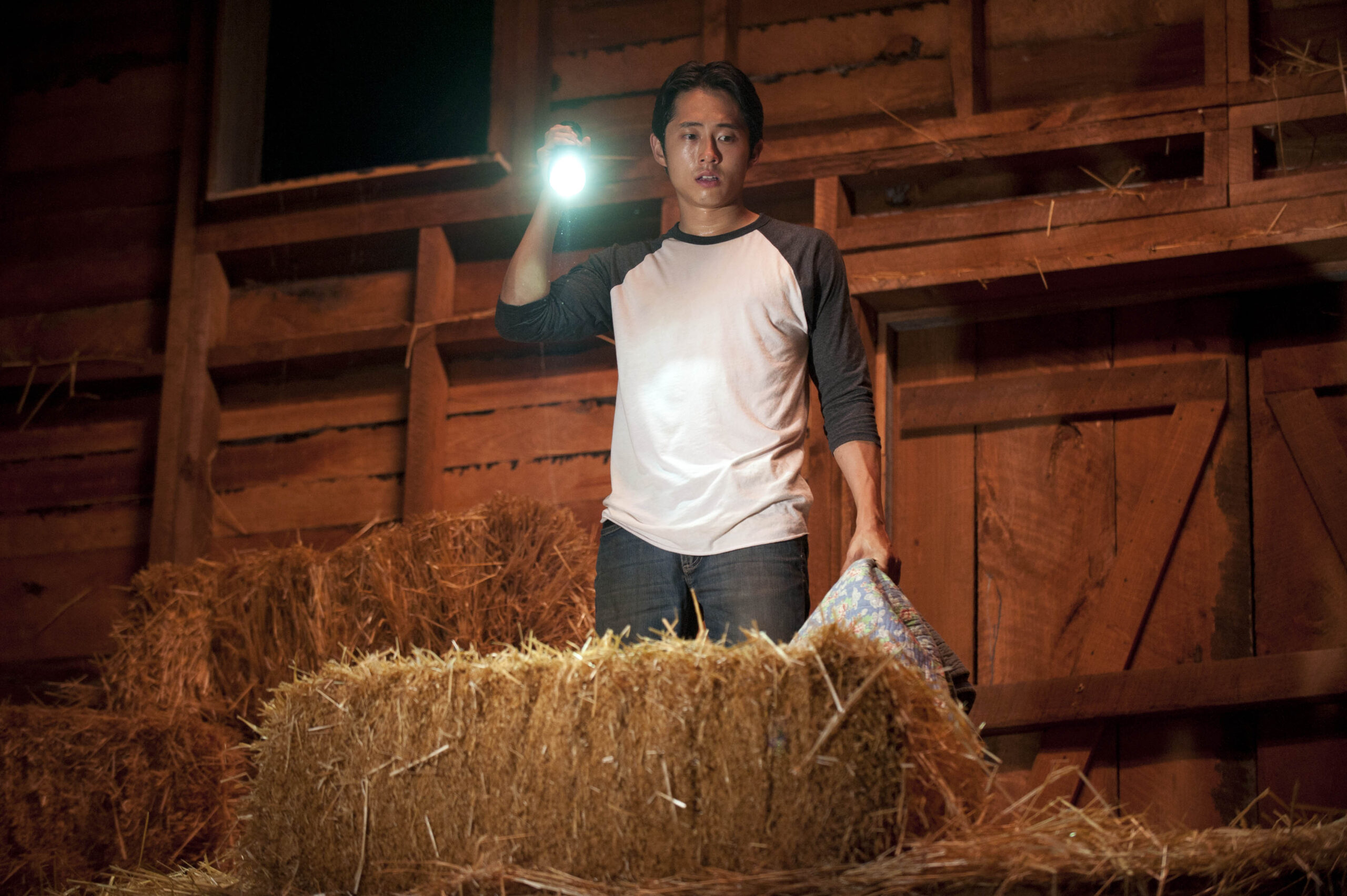
Glenn (Steven Yeun) makes a horrifying discovery in "The Walking Dead." (Credit: Gene Page/AMC)
This recap contains spoilers for "The Walking Dead" Season Two, episode 5, "Chupacabra." Read at your own risk.

There were huge revelations on Sunday’s episode of “The Walking Dead,” including a tantalizing hint that the missing girl Sophie might still be alive, and a climactic reveal that the courtly old religious veterinarian Hershel (Scott Greene) was keeping captured zombies alive inside his barn, presumably in hopes of one day curing them. There was another big revelation last week in the form of a surprise pregnancy, Lori’s.

But that’s not enough to stave off charges that “The Walking Dead” is taking a Hamburger Helper approach to TV drama, padding out meager amounts of dramatic meat with bags of bland dramatic stuffing. Sophie has been missing for the entire season; Carl has been bedridden since the end of episode two; Lori found out about her pregnancy last week but still hasn’t told Rick; etc. If you added up the screen time devoted to the genuinely interesting elements, they might total maybe ten minutes per episode, if that. The rest is wandering, suffering, and talking, talking, talking, courtesy of characters who are for the most part so naive and/or irritating that if you were watching them on a big screen at a drive-in movie theater, you’d cheer for them to be eaten.

The “WTF?” count in my “Walking Dead” notebook is nearing 200 by now, and this week’s installment, “Chupacabra”, added a few more, including the cutesy back-and-forth between end-of-the-world sex buddies Glenn (Steven Yeun) and Maggie (Laurie Cohen), complete with scribbled dinner-table notes; the protracted sequence of the wounded Daryl (Norman Reedus) falling down that cliff, then climbing up, then falling again; and that somebody-please-kill-all-these-stupid-characters moment when Andrea (Lauren Holden) mistook the returning Daryl for a zombie and winged him across the temple with a rifle shot. (I’m sure the producers didn’t intend this as a “You can’t trust women with guns” moment, but given the male-dominated power structure on this series, that’s how it played.)

What a frustrating show. It does difficult and impressive things confidently while thoroughly fudging the basics. The openings of “The Walking Dead” are often misleadingly enticing, and this week’s curtain-raising flashback to the early days of the undead apocalypse was no exception; I loved the spooky blue-white light on that gridlocked line of cars, the shot of jets roaring overhead, the panoramic image of Atlanta being napalmed, and the expression on Shane’s face as he pulled the terrified Lori, his then-comatose partner’s wife, close to him. (Jon Bernthal plays oily opportunism very convincingly; he seems more like a Richard Gere-style sociopath antihero with each passing week.) I also liked the subtle mirroring in two scenes — the one where Shane tells Lori that he’ll do anything to protect her and Carl (more emotional manipulation by a selfish bastard) and the moment where Sophie’s mother Carol (Melissa Suzanne McBride) goes to Daryl’s bedside and thanks him for his heroic efforts, and he can’t even look her in the face. Shane believes he’s infinitely better than he is, and Daryl (who was haunted in the woods by the image of his leering, sadistic, racist older brother, Merle) thinks he’s infinitely worse.

There are some interesting elements bouncing around inside the scripts, including the notion that it makes more sense to try to cure zombies (also advanced in that laboratory one-off near the end of season 1) than to mow down as many as possible and hope the plague burns itself out someday. But the latter was explored more imaginatively in earlier zombie pictures, and the nihilistic violence-vs.-hopeful science conundrum is presented in such a clunky way here that it makes me want to throw things at my TV.

The bland philosophical discussions that keep slowing the show’s master narrative like speed bumps also fail to distinguish between short- and long-term survival behavior. Shane’s me-first attitude seems appalling when juxtaposed with Rick and Lori’s ostentatious goodness, but he’s not unreasonable to place a higher value on the people he really knows and loves than on whoever he happens to stumble across during his travels (this was nicely paralleled in the flashback opening, in that exchange between Carol and her husband about whether or not to give some of their rations to fellow escapees). And under these dire circumstances, Shane’s hard attitude makes a certain harsh sense; ditto Hershel’s insistence on setting “boundaries” between his people and Rick’s. Lori’s description of Shane thinking in terms of math was more reasonable than her distressed tone made it sound. God knows almost all of this show’s “likable” characters could stand to toughen up, and shut up. “It’s a wonder you people have survived this long,” said Hershel, tending to Daryl’s temple scrape. Yep.

I miss the pulp vitality that “The Walking Dead” displayed early on — particularly the first couple of chapters, which concentrated on Rick’s post-coma struggle to survive. We got a fleeting reminder of that energy in the sequence a few weeks back when we learned that Shane murdered Otis (Pruitt Taylor Vince) to assure his own escape from a zombie-infested high school. This series needs more of that kind of dark energy. It should be meaner, crazier and uglier. It’s the end of the world as we know it, and nobody should feel fine.

In this sense, the reappearance of Daryl’s brother Merle (Michael Rooker) in the form of a taunting specter was oddly invigorating. He’s a trashy pulp character, reminiscent of one of those hate-filled human monsters that Stephen King writes so well (like George LeBay, the old man in “Christine” who calls everyone “shitter”). Last season I wrote Merle off as a redneck cliche, and I  suppose he still is, but at least he’s exciting and disreputable, and every time he’s seen — or even discussed — it gives a mostly torpid series a mild electrical jolt. Here, at last, was a character whom the writers were not remotely interested in making sympathetic. He’s a representative of the reptilian brain, the “bad object” of therapy lingo granted physical form.

The sequences in which Merle teased and mocked and terrorized his younger brother into surviving had an accidental metaphoric dimension, one that the writers of “The Walking Dead” might do well to study. If these characters are going to survive, they’re going to have to get in touch with their inner Merle. And if “The Walking Dead” is going to hold a big audience’s interest over a long span of time, it’s going to have to channel the B-movie and R-rated comic book luridness that a character like Merle represents, and make the storytelling speedier, bigger and bolder. Drop the quill pen and pick up a spray paint can, people. The zombie film is an surprisingly versatile and resilient genre, but one thing you can’t do with it is try to make it respectable. That’s a surefire way to sap a story’s energy, as reliably final as a blow to a walker’s brain.

“Walking Dead” creator: Get ready for breakneck pace

Robert Kirkman heard fans' howls about Season 2 being dull, and promises to bring the action starting Sunday

(Credit: AMC/Gene Page)

“The Walking Dead” returns Sunday to AMC to finish its second season, with sheriff Rick Grimes’ revolver still smoking from the first half’s shocking finale. While audience numbers have stayed high, the show has run into problems other than the packs of drooling undead. Showrunner Frank Darabont left for unspecified reasons, the pace of action noticeably dropped – to what creator Robert Kirkman admits now was “a little bit slower than it should” — and the zombies, when they did appear, seemed to be moving a lot faster than you’d expect from a group called walkers.

The affable Kirkman, 33, who also created the bestselling “The Walking Dead” comic book series, paused to address these issues as well as hint about new threats and locales to be encountered by the characters, and discuss the approach of new showrunner Glen Mazzara, who he says will bring a comparatively “breakneck pace” to the show as it resumes. (For those who haven’t finished the first half, there may be one spoiler included.)

What are you calling this point in the series, anyway, Part 2 of Season 2?

We call it all kinds of different things in the writers’ room: It’s Season 2.5; it’s the second half of the second season, which sometimes seems a little cumbersome, so I don’t know. It’s the last six episodes of Season 2.

I guess cutting it in half is now a common way for cable networks to present its seasons. How do you look at starting in the middle like this?

There’s a lot of different ways to look at it. I sort of enjoy the “mini-season finale” thing because I think season finales are really kind of cool and I’m a big fan of cliffhangers. Also, it’s nice to have a little break. It’s also nice to structurally make your season have some sort of punch in the first half and more punch in the second half. So structurally, it’s kind of cool. It helps writing-wise. But I don’t know, I could take it or leave it.

Consensus on the first half of the season is that it had a much different pace than the first season. Did you just want to slow the storytelling down?

It appears that the first half of second season moves a little bit slower than maybe it should. And I think that’s a byproduct of building to our midseason finale and knowing where we were going to end up, and putting all our pieces in place, and trying to tell the story in a somewhat cinematic kind of way, which may or may not work in episodic television.

I will say that’s one of the holdovers from Frank Darabont. He really wanted to take things slow and spend a lot of time dealing with different things. He was very much a big fan of the slow burn. Because he’s no longer on the show and Glen Mazzara took over as showrunner, he’s a big fan of much more fast-paced storytelling. So I think there will be somewhat of a shift when we come back with the season where we’re going to be a little more action-packed and are going to move at kind of a breakneck pace compared to the first few episodes.

And I think, looking at whole season together, when you see the first two parts, you’ll see that the first half of season kind of works, because we were building towards an event. And once that event happens  — when Sophia emerges from the barn — things just continue to escalate. So it will make sense and the whole season will be cool to watch as a whole. But there is going to be some drastically different pacing issues now that Glen Mazzara is running the show.

Do you regret that it went as slow as it did in the first half?

I don’t know that I regret anything. I think that despite the criticisms of it being slow, it was good to take the time to know the characters a little more and it was nice to see them interacting at that farm and I think that that sense of security and that tranquility, when it’s played against the chaos of coming episodes, will make chaos seem that much more intense. I think it will accentuate these episodes. So I liked it. But if I had to do it over again, I might have tried to cram some more stuff in.

From this side of the screen, it appeared that there were fewer zombies so far this season, and setting it at a farm seemed a little less expensive than clearing out part of the city. People assume it was a cost-saving measure.

No, it wasn’t a cost-saving measure at all. It was just adapting what we did in my comic book series. If you read the comics, you’ll see that eight years ago, when those stories were being told, there was a little bit of Atlanta action and then they moved into the more rural parts of Georgia and went there for safety. So it was just a decision to follow where the comics went. Filming out in the woods is not as cheap as you might think.

What has it been like for you to write for two different versions of your story,  first for the comic and then for TV? Do you consider them the same story or separate?

I kind of have to view it as separate. That’s really the only way to do it. I still write the comics month in and month out, putting new issues out. If I weren’t able to separate the two into two separate projects, it would be a little confusing.

But I’m having a lot of fun on the show. The collaborative medium of television is a really cool thing. I really do enjoy working in the writers’ room and getting to experience working in a group and forming a kind of a hive mind to try and tell stories. It’s a very different way of doing things for me.

Comic books are also kind of a collaborative medium in that you work with an artist and you tell that story together through words and pictures. But the artist on “The Walking Dead,” Charlie Adlard, he lives in the U.K, so I’m never in a room with him saying, “Wouldn’t it be cool if we did this.” It’s a very solitary working environment, where I’m in a room — I was in Kentucky and now I’m in Los Angeles — and then he’s in his room on the other side of the ocean, and we’re making a product together. But working in a room with guys and coming up with ideas and really having that exchange and pushing each other is a lot of fun for me. I really enjoy it.

We’re actually in our third or fourth week of working on Season 3 right now in the writers’ room. And one of the first things we did is we basically blocked out what happened in the comic book series in a chunk of time, from issue X to issue whatever, and said, “This is the story that we want to cover in our third season. What from this do we think is essential? What do we want to keep? Is there anything we want to add?”

It’s kind of cool to look at the comic book as a framework to improve upon; being able to have seven other talented writers look at your previous work and say, “Oh, you could have expanded this, I would have glossed over that, it would be cool if this had happened instead of that.” And for me to be involved in that process, it’s kind of a cool thing.

I guess it can be a little nerve-wracking to sit in a room with seven people and pick apart something you wrote seven years ago, but I don’t know, I think it’s a fun experience and I like being in the mix. And even I’m going, “Well, this led to this and it might be good to leave that out and it might be better if we did this instead and this really worked, people really liked this, I think we should definitely do this.”  Being able to do that, and have this give and take, is a lot of fun.

But at the same time you want to have surprises for fans of the comic book.

Absolutely. That’s why there are so many differences in the show. People who read “The Walking Dead” comic, I think one of the appealing things about it is when you sit down and read an issue, you have no idea what’s going to happen. So to lose that in the show, for people who have read the comic, I think, would be a horrible thing. So even when we adapt something in the show, we try to arrive upon an event in such a different way that it still holds a bit of surprise for people who are absolutely familiar with the comic. I like to change things up, and keep people guessing.

The comic is so similar in form to a storyboard. Does that explain why the series is so much more visual than most?

Yeah, well, it’s not really an action show. But there is definitely a lot more to be done with the visuals in this show than I think other shows. Because we’re adapting the comic, I think there are a lot of visuals to adapt from the comics. I think Charlie Adlard in particular is a fantastic artist who has been doing some real cool stuff. To leave that stuff on the cutting room floor would be a mistake. Also we have Greg Nicotero doing an amazing job bringing our zombie creatures to life. His team at KNB Efx are really essential to the show. So there’s definitely a wealth of visual storytelling for us to draw upon in order to make this series happen.

But there’s quite a lot visually happening, with those big wide establishing shots, or those subtle scenes, like the one Sunday where Daryl and Carol just sit there and don’t even speak a word. A lot of shows don’t do that.

Yeah, well, I think that’s good storytelling. When you’re making people talk just to make people talk, I think that’s when things start to be kind of fake.

So what is it about zombies in general that people are so interested in them these days?

First of all, they’re awesome. They look cool. They do cool things. There’s definitely a lot of reasons to love zombies. Culturally, the last time zombies were this popular was the height of the Cold War. So I think any time there’s a sense of unrest in society, it tends to drive people toward stories of the apocalypse and the end of the world. It makes it interesting to sit on your couch and think: OK, if society did collapse, would I be like Daryl Dixon? Would I be like Shane Walsh? Would I be like Rick Grimes? Which person would I be like? What decisions would I make? And analyzing that kind of stuff makes it easier to ignore the economic collapse or the crisis with oil prices, or whatever is going on in the world today. It’s much easier to sit in the safety of your living room and analyze it rather than to actually think about all the horrible things that are going on out in the world.

With the current cultural zombie takeover, is there a possibility of reaching overkill, as vampires seem to be doing?

Vampires cycle in and out every few years; they get really popular, then they go on the back burner for a while. I think that zombies reaching this level of popularity is a cool thing. In the history of entertainment, zombies have never got that kind of height of popularity where there is an overkill of people making zombie things and telling zombie stories. It’s kind of a cool thing for zombies to reach that level.

But I definitely feel the big budget World War Z movie with Brad Pitt and things like that that will carry it along, ‘The Walking Dead’ included. It will shoot back down eventually. But I think “The Walking Dead” hangs its hat on drama. And isn’t necessarily just a zombie adventure. It’s about human characters dealing with survival after the fall of civilization and I think that kind of story is always going to hold a vast appeal for audiences, whether it’s got zombies running around or unicorns or whatever.

While vampires (and unicorns, for that matter) seem to have their rules set in stone, things seem to be not quite nailed down yet for zombies.

One of the things I was trying to do with “The Walking Dead” was canonize zombie lore. Most people do try to reinvent the wheel when they do the zombie thing. Sometimes you have to dismember them completely, sometimes you have to shoot them in the head. Sometimes they eat brains, sometimes they eat flesh — people try to play around with it a little bit too much.

With “The Walking Dead,” I try to take the best part of the Romero model – George Romero by far did the best zombie movies in history — and his films are all consistent. Then I wanted to use most of those rules, because those are the best, and then add a few of my own — things that are logical; things that to me make sense. To just to try and say: Look, there should be some set rules on zombies. There are certain set things that make zombies cool, and we should try to maintain them.

That said, it seems like the zombies in “The Walking Dead” are a little speedier the second season than they were in the first. And why weren’t, say, the dead people in the highway pileup at the start of Season 2 not all turned into zombies as well?

There were definitely a few zombies trucking around in the first season as well. I don’t know if people didn’t notice them, or maybe they should just go back and watch it. One of the rules that we have in “The Walking Dead” is, depending on how fresh the corpse is, or how rotted it is, would logically make it fast or slow.

I don’t think we have any Olympic sprinters or anything like that. But a fairly recently formed zombie would be able to move somewhat like a human, but not quite. And we definitely have zombies that are much slower and mill about as they get more rotted. We’re trying to do things that are logical and make sense. And then every so often, you have an overzealous extra who is moving a little bit too quick, and we have to edit around that.

What about those bodies in the cars?

That’s the whole ting. That’s part of the fun of “The Walking Dead” is that you don’t really know all of the rules yet. What’s going on with those dead bodies? Why are they not zombies? Why are they just sitting in cars? That’s part of our specific set of rules that will be revealed over time.

So there are going to be mysteries like that: Why is that guy a zombie and the other guy isn’t? What happened with that guy, and various different things. I think by the end of Season 2, you’ll have a better understanding of what makes a zombie, and what goes into it and why those zombies in the car weren’t walking around.

So, in the short term, what can we expect?

We’re getting off the farm a little bit, and we’re introducing a lot of new characters and new threats. The very first episode that we come back on, on Sunday, we introduce new characters that represent a larger threat that is going to be coming after Rick and the rest of the group. And that’s really going to be a driving force that gets us right up to our finale. We’re going to be dealing with a lot of big problems.

There are a lot of questions as to whether or not Hershel knew that Sophia was in the barn, or how he and Rick are going to deal with that. And that’s not really what we’re going to be dealing with. We’re not going to have time to rest on our laurels and analyze the whole Sophia situation. There’s so much more happening and so many more threats coming into the forefront that we’re going to have to hit the ground running and deal with all these problems on our feet as we go.

“The Walking Dead” resumes its second season Sunday at 9 p.m. on AMC.

Continue Reading Close

Dear “Walking Dead”: Please shut up

When AMC's zombie show dramatizes its pulpy predicaments, it's riveting; when the characters talk, it's awful VIDEO

Shane Walsh (Jon Bernthal) - The Walking Dead - Season 2, Episode 3 - Photo Credit: Gene Page/AMC
[The following recap of "The Walking Dead" season 2, episode 3 contains spoilers; read at your own risk.]

The best and worst qualities of “The Walking Dead” were on display in tonight’s episode; the extremes were so pronounced that my notes suggest the exuberant jottings of a split personality. “Gorgeous.” “Oh, for chrissakes, quit while you’re ahead — you already showed that, why re-hash it?” “Some of the best atmosphere on TV.” “Oh, shut up.” “Jon Bernthal is KILLING in this episode; he has Richard Gere’s oily, furtive, ‘What am I not guilty of’ body language.” “I wish Rick and Lori would get eaten so I didn’t have to hear their ‘discussions’ anymore.” “Brilliant ending — best of series so far.”

My sister, my daughter, my sister, my daughter, slap, slap, slap.

Scott M. Gimple wrote this episode; “Sopranos” veteran Phil Abraham directed. It was the best of “Dead,” it was the worst of “Dead.” Bottom line: When “The Walking Dead” is dramatizing its characters ‘ moral and ethical conundrums and letting them play out through physical action (or inaction), it’s as good as the very best zombie films that inspired it. But when one character says to another, “Can I talk to you for a second?” the show’s slow-burn momentum halts so abruptly that they might as well signal an upcoming heart-to-heart by laying a “screeching brakes” noise on the soundtrack. (“Hey, Shane, ya got a minute?” SCR-EEEeeeeEEEEEEEE!) I wish this show would have faith in its B-movie spirit and considerable filmmaking prowess, model its dialogue on an old cowboy picture, and keep things moving. There’s no reason to keep turning every scene into Zombie Oprah. Honest.

I didn’t need to hear any of the discussion between Rick and Lori on the porch early in the episode, especially not Lori’s facepalm-worthy line line “This isn’t a world for children anymore.” Everything the couple discussed was implicit in the episode’s action, and did not need to be highlighted. Their earnest discussions of the futility of optimism and the moral defensibility of letting their wounded son die paled beside three vivid B-movie moments: 1) the hanging zombie’s suicide note, “Got bit / Fever hit / World gone to shit / Might as well quit”; 2) Rick ignoring warnings that another blood drawing might kill him, because a dad’s gotta do what a dad’s gotta do; 3) the momentarily lucid Carl’s account of the last thing he saw before he got shot: that beautiful deer. (You could argue that we didn’t need Carl’s deer memory, either — that it was too unbelievable, or too sweet, or too something — but I liked it; pulp is allowed to be sentimental as long as the sentiment is on-point.) The prayer talk scene between farmer/veterinarian Hershel’s daughter Maggie (the excellent Lauren Cohan) and Glenn (Steven Yeun) was similarly overcooked. It would have been just fine if it had ended after Glenn’s admission that this was the first time he’d ever prayed; but it had to keep going. Glenn: “You think God exists?” Maggie: “I always took it on faith. Lately, I’ve wondered. Everything that happened, there must have been a lot of praying going on, and it seems quite a few went unanswered.” Just … shut … UP.

If Howard Hawks had directed last night’s episode, he would have boiled that awkward pop-psych conversation between Dale and Andrea by the Winnebago down to a series of terse gestures — and just three lines. Andrea opens the door of the vehicle just as Dale approaches and says her name. Andrea pauses for a moment and makes eye contact with Dale. Dale produces a pistol and extends it butt-first; Andrea takes the gun, looks at it for a moment, then says, “I’ll take watch.” Dale says, “Glad you’re back,” and goes inside. Andrea climbs the ladder to the RV’s roof. Aaaand scene. None of that “… but I can still ask — and none of this is to make you guilty, or put me ahead of you — but I can still ask, please, don’t make me regret this,” which sounds like a line from an as-yet-unaired “Treehouse of Horror” episode titled “Zombie thirtysomething.”

The episode’s last five minutes were brilliant, and I’m not just saying that because its depiction of a brutally self-interested man briefly allayed my worries that “The Walking Dead” has a “niceness problem.” Shane is not an essentially decent man with heel-ish tendencies; he’s a sociopath whose moony adolescent fixation on Lori, his post-apocalyptic hookup, might be the only thing stopping him from shooting the other survivors in their sleep, stuffing their food and supplies into the first working muscle car he can find, and taking off for the coast.

The compositions in that bathroom scene briefly (and falsely) implied that Shane had gotten bitten or scratched by a walker and was in danger of turning ghoul. The way he glowered at himself from underneath a Kubrickian ape-man brow made him look (intentionally, I’m sure) zombie-like, and reminded us that the show’s title has a double meaning: In a world without law or civilization, we are all walking dead. Although Shane is, in fact, still mortal, the ghoul/not a ghoul distinction now seems almost moot. The flashback revelations confirmed that he’s a warm-blooded, autonomous walker — a monster capable of committing murder to save himself, then lying to cover it up. As my friend Josh Spiegel noted, the sequence might have been more powerful if it hadn’t been telegraphed with an “in medias res” opening. But it was still strong stuff: undiluted pulp that explored morality (and amorality) through gory action.

I would have loved the sequence even more if I weren’t dreading the stilted conversation about it that’s surely on deck for next week. “Hey, Rick, can I talk to you for a second?” SCR-EEEeeeeEEEEEEEE!

Continue Reading Close

“The Walking Dead’s” niceness problem

Suspense, atmosphere, gore: This series is aces in every department but one -- the characters are obvious and dull

Fresh meat! Andrew Lincoln, Sarah Wayne Callies and Chandler Riggs on AMC's "The Walking Dead." (Credit: AMC.)
This article contains spoilers for the season two premiere of "The Walking Dead." Read at your own risk.

“The Walking Dead,” which returned for a second season last night on AMC, is a frustrating show. It has everything it needs to be great: a compelling premise (humans fighting for survival in a ghoul-infested world), expertly constructed suspense scenes, gore that’s horrifying even by the already-inflated standards of the zombie genre, and a knack for exploiting series TV’s greatest strength, its elasticity of time. The sequence in last night’s premiere in which Rick (Andrew Lincoln) and his hardy band hid beneath stalled cars on a highway to avoid a herd of zombies shambling through was one of the tensest action scenes I’ve seen on TV; it was all the more impressive because it wasn’t so much about what was happening to the characters, which was already horrifying enough, but what might happen to them. The drawn-out pacing in this sequence — and in others, such as the group’s search for the disappeared little girl Sophia (Madison Lintz), and the gradual walk-up to the church, with its John Donne bell tolling for thee — was a sterling example of old school classical filmmaking. I even like the show’s didactic arguments about ethics and morality, which has always been the zombie genre’s main reason for being anyhow.  In a post-apocalyptic world, the phrase “do unto others” takes on a different meaning. The sorts of arguments you see on “Walking Dead” have to happen in zombie stories, just as they had to happen in “The Lord of the Flies” or “The Road” or any disaster narrative — though admittedly they could be a lot more elegantly conceived, so that you don’t see them coming and think, “Now would be a good time to do the dishes.”

No, the show’s main problem is its lack of compelling characters. It isn’t a question of whether or not they’re “likable.” They are likable. If they lived on your block you’d say good morning to them, maybe even invite them to a party. That’s the problem, actually — they’re likable to a fault. More specifically, they’re “relatable,” to use a favorite Hollywood studio executive buzzword that I despise — a word that doesn’t mean “recognizably human, with glaring contradictions and faults,” but something more along the lines of “thoroughly decent but slightly fuzzy characters who would be bloodless ciphers if they weren’t played by professional actors.”

The actors on “Walking Dead” are professional, often very skillful, but as we head into Season 2, it’s becoming increasingly clear that they can’t make these characters interesting, because they’re too thinly conceived. My initial enthusiasm for this show had everything to do with the genre, the concept and the mostly strong execution; in retrospect I was way, way too patient with the characters, maybe because I assumed they were going to show me new and troubling shadings that still haven’t materialized.

Rick; his wife, Lori (Sarah Wayne Callies); and his son, Carl (Chander Riggs); Rick’s former colleague and secret romantic rival Shane (John Bernthal); grey-bearded Dale (Jeffrey DeMunn) with his “On Golden Pond” hat; even burly T-Dog (IronE Singleton), are all just so damned decent, so obviously striving to do the right thing at every possible second, that I’m already kind of tired of them. (They’re mostly TV-pretty and Caucasian, too — a point that the wounded T-Dog addresses in an upcoming episode when he notes, “I’m the only black guy here.”) Click over to Steven Spielberg’s lavishly budgeted sci-fi series “Terra Nova” on Fox — or better yet, don’t — and you’ll see a similar strategy at work.

When a network or studio is spending boatloads of money on a sci-fi or horror or other genre spectacular, there’s great pressure to center the action on characters whom “everyone” can relate to, meaning the upper-middle-class white folks prized by advertisers. That often results in a core cast that would fit right into a sprightly 1940s western about homesteaders, or a 1950s sitcom with a pipe-smoking dad and a mom who vacuums in heels. The heroes are likely to be guys like Rick, who looks like a human action figure and whose worst quality is that he wants so badly to be a hero and rescue everybody that he sometimes makes bad calls, or Shane, who likewise presents as a Rick-like do-gooder. (For some reason, Jon Bernthal’s performance exudes untrustworthiness; I keeping hoping he’ll turn out to be a conniving and selfish character, the kind of guy that the young Burt Lancaster or Kirk Douglas might have played back in the day. The moment where Shane takes aim at the clueless Rick in the woods, then notices Dale watching him and lowers his rifle, suggests that Shane has that potential — but really, does anyone think “The Walking Dead” has the guts to go down that road?) I hope that poor little Carl survives being shot at the end of the premiere not because he’s an interesting character, but because he’s a cute kid.

Yes, I know, “The Walking Dead” takes most of its characters and situations from a graphic novel, as detailed in this Salon piece by Simon Abrams. But adaptation is all about making choices of what to keep and what to change; the source material in this case is hardly “Dune,” or even “Harry Potter”; recently-ousted show-runner Frank Darabont and company could have swapped out most of the main characters, or at least deepened or complicated them or jumped away from them for long stretches, without sparking audience revolt. Anyone who’s watching this show doubtless has prior experience with zombie pictures — or what I call “zombie-by-proxy” pictures, which avoid the undead angle but which are otherwise textbook examples of the genre — so they’re used to seeing genuinely quirky, even off-putting characters navigating a monster-infested universe. I hardly think they’d tune out if the show served up a similarly spicy array of mixed nuts.

The original “Dawn of the Dead” and its 2004 remake, “28 Days Later,” “Day of the Dead,” “Land of the Dead,” both versions of “The Crazies,” “28 Weeks Later,” “Dead Alive,” “Shaun of the Dead,” “Zombieland” — all these films and others offered a more lively array of main characters than “Walking Dead.” Yes, when you watch a zombie film, you’re likely to encounter milquetoast straight-arrow hero-types and generic best buddies and significant others, but also people who were hopelessly deluded, or so paralyzed by grief and fear that they’re no help to anyone including themselves, and comic relief characters, and stalwart average guys like Brendan Gleeson’s burly dad in “28 Days Later,” and even straight-up sociopaths who are secretly thrilled to be living in Hobbes’ State of Nature, and who only pretend to be working on behalf of the group. And what would a zombie picture be without at least one lazy, grousing, hilariously nihilistic dirtbag, like the smug yuppie played by Ty Burrell in the 2004 “Dawn of the Dead”? (“You know, I would love to help,” Steve says, justifying his laziness, “but the captain never works alongside his men.”)

Remember early last season when the main characters encountered that group of gangbangers who were caring for citizens of a nursing home? I loved those characters; why didn’t we see more of them? Late in the season, when the show suddenly jumped away from the main story line to give us an extended flashback of Noah Emmerich’s Centers for Disease Control researcher trying and failing to develop a cure, my heart jumped, not just because Emmerich is a fantastic actor, but because the show was giving me a change of scenery and putting me in the head space of a different character. Emmerich had just one more episode to go, alas.

The only recurring “Walking Dead” characters I find truly interesting are the irascible or alienated ones who harbor socially unacceptable attitudes — the characters who are obviously only there to contrast with Rick and Shane and Lori and Dale and the other Nice Folks and eventually become “civilized” or otherwise “likable.” I’m fascinated by Andrea, who insisted on personally shooting her own kid sister, Amy, when she turned zombie, and who has become withdrawn and faintly self-destructive in the aftermath. (There’s a reason why no one wants her to have a gun.) Laurie Holden, the actress who plays Andrea, enacts grief and anger in a subtle, stingingly real way. She’s off-putting in the way that real trauma survivors are off-putting. I like the way she looks at Rick and Lori and the others, as if she knows they’re posers who are ultimately no more emotionally together than she is — and that if she weren’t in such a vulnerable place, she’d tell them so.

My favorite regular character, though, is Daryl Dixon (Norman Reedus), the crossbow-toting hillbilly white supremacist whose brother — a vastly more unpleasant redneck psycho played, inevitably, by Michael Rooker — (maybe) bought it in Season 1. Daryl is a walking rebuke to Rick, a Dudley Do-Right type with a cleft chin and trooper hat; he’s the kind of guy that a cop like Shane would enjoy arresting, and who would mysteriously manage to “accidentally” bang his forehead every time he got shoved into the back of a squad car. I don’t know if Daryl would make an altogether better leader than Rick, but when you’re wandering around a landscape populated by flesh-eating ghouls, there’s something to be said for an unsentimental demeanor and a ruthless streak. (The show seems to be softening Daryl, too, though; there’s nothing like a zombie plague to make you reconsider your prejudices.)

Rick’s big speech to the Jesus statue at the end of the Season 2 premiere encapsulated the show’s character problems. It was one of the most awkward and unconvincing moments in the series’ run to date — and not just because the show had already communicated everything Rick (and Sophie’s mother, Carol — played by Melissa Suzanne McBride) had to say about God’s indifference to human suffering and the uselessness of Jesus’ message in zombie-world by rack-focusing from Rick splattering a walker to the Christ statue hanging on the church wall behind him. The church sequence needed to push much, much further than it did; instead of communicating a good man’s despair over not being able to do more good (which already comes through in every scene Rick plays), I wanted to see the self-pitying, martyr side of Rick come flooding out; I wanted to see hints of the deeply screwed-up fury that drove Matthew Fox’s character on “Lost” — selflessness as a manifestation of vanity and fear of worthlessness. When Rick killed two walkers with stones early in the episode, we saw a hint of giddy blood lust in his face, but the episode didn’t follow up on it. Has “Walking Dead” decided not to explore Rick’s latent potential for darkness for fear of making him “unlikable,” or somehow not “relatable”?

Whatever the explanation, there was more complexity and power in Daryl’s tossed-off exit line at the end of the zombie church showdown, when he glared over his shoulder at the Jesus statue and muttered, “You take requests?”

Continue Reading Close

How TV improved “The Walking Dead”

AMC's zombie series returns for season two tonight, already more powerful than the long-running comic it's based on

(L-R) Carol (Melissa Suzanne McBride), Glenn (Steven Yeun), Lori Grimes (Sarah Wayne Callies) and Andrea (Laurie Holden)(Credit: AMC/Gene Page)

Continuity is a double-edged sword in “The Walking Dead.” According to Robert Kirkman, the writer and co-creator of the comic book that AMC’s acclaimed show is based on, the intent of his series was to follow a single character, Rick Grimes, as he survives the Zombie Apocalypse. This has made the comic a consummately ambitious experiment in long-form narrative storytelling  — and it creates challenges for the TV version, which begins its second season tonight. Eighty-nine issues into its seemingly indomitable run, Kirkman’s comic is messy, sprawling and often poorly realized. And a big reason why is that we know that Rick can’t die. That’s the series’ hook — and its biggest problem.

This wouldn’t create such a dilemma for the show’s writers if Rick were likable. Unfortunately, he’s not. As originally conceived in Kirkman’s comics, Rick is a fundamentally desperate and needy character. He inserts himself into situations and tries to control events where he is in over his head. He sees himself romantically as a benevolent savior — and he almost always gets his way. After Rick gets his bearings in the show’s pilot, “Days Gone Bye,” he finds a horse, saddles up and rides into a zombie-infested Atlanta with a bag full of guns slung over his shoulder. He has no idea how ill-prepared he is for what awaits him in the city.

In both the comics and the TV show, Rick Grimes is a true-blue hero but, in the comics, he is also intolerably self-righteous. As sketched by Kirkman, he’s got a messiah complex, one that’s not even semi-cured until many story arcs later when he goes a little crazy, loses a hand and starts hearing voices.

But Rick’s character is one of the many things that Frank Darabont, the AMC show’s former show-runner, and Kirkman, as executive producer and a writer, have done better on screen. In AMC’s show, Rick is just a standard bearer for a central rag-tag group of survivors. He’s also much less strident than he used to be in the comics. Darabont and Kirkman have smoothed out some of the bumps in Kirkman’s original vision and delivered something closer to what the original source comic’s epic narrative could have been.

Last season, in “Days Gone Bye,” Darabont established that actions necessarily have consequences. After Rick is attacked by a horde of zombies, he falls off his horse and drops his bag of guns. Once he’s regrouped with a cluster of other survivors, he decides to retrace his steps and retrieve his bag in “Vatos,” the show’s fourth episode. Similarly, after Rick joins a group of survivors in a mall in “Guts,” episode two, they wind up abandoning one of their own and leave him to die. Admittedly, Merle Dixon (Michael Rooker), the guy that they turn their back on, is a bigot and a panicked opportunist, plain and simple. But he’s also a human being so leaving him behind matters.

To be fair, Kirkman and co-creator/original series penciller Tony Moore’s first “Walking Dead” story also managed to show that the only way to stay human in a crisis is to force oneself to consider one’s actions, both past and present. Still, the directness with which Darabont and Kirkman show us this philosophy in action within the span of six scant episodes is very refreshing. It’s great to see that AMC’s first season does not follow in the foot-steps of Kirkman and Moore’s first narrative arc by leaving viewers wondering how Rick’s group will survive after zombies attack and infect a couple of their loved ones and new friends. That happens in “Vatos,” leaving two more episodes in which the character consider what has happened and try to pick up the pieces.

Season one doesn’t even end after Rick and the group discover Edwin Jenner (Noah Emmerich), a scientist that’s struggling to find a cure to the virus, in “Wildfire.” Instead, Darabont and Kirkman wrapped up those episodes in such a way that, while they’ve left room for further travails, they’ve also given viewers a clear thematic resolution.

There are a number of reasons why season one of “The Walking Dead” is more satisfying then Kirkman and Moore’s first story arc, chief among them being how Darabont and Kirkman’s relative directness is a result of the series being adapted from comics to TV. Darabont and his writers had less wiggle-room to work with than Kirkman and Moore did. They had to put all of their cards on the table in six episodes.

Darabont and Kirkman’s need to immediately show and not tell what they had planned for their characters didn’t however make “The Walking Dead’s” first season an across-the-board success. The events of season one are sped-up to a ridiculous, quasi-Benny Hill-level pace, making it necessary for the show’s writers to frequently rely on short-hand storytelling techniques to get the job done. Power dynamics needed to be set up quickly and simply, leaving a lot of room for improvement when it comes to dialogue. In “Guts,” Darabont establishes the macho archetype that he tries to move Rick away from by having Glenn (Steven Yeun), one of the show’s main protagonists, explicitly spell them out. “Nice moves there, Clint Eastwood,” Glenn sarcastically spits out at Rick. “You the new Sheriff? Come riding in, to clean up the town?” Of course, Rick isn’t, but he very well could be. And that’s the problem as we’re meant to simplistically understand it.

Then again, season one is as successful as it is because it delivers a clearly delineated start and finish to the existential melancholy that initially afflicts Rick in “Days Gone Bye” and then subsequently is shown to affect the rest of his group in later episodes. Darabont began the series with scenes of Rick wordlessly exploring a post-civilized world. Bodies are heaped around the hospital Rick wakes up from a coma in and zombies are now everywhere. The sight of a woman with half her face missing, her guts trailing out from behind her and her left leg reduced to a stump makes our stalwart hero realize that he’s facing something indomitably inhuman, something that will inevitably force him to throw up his hands and wonder what the point of going on is.

Rick and his group reach emotional rock bottom in “TS-19,” and they do so with a necessary amount of speed. By this point, the abnormally brisk pace of the rest of the series makes sense. When the group meets Jenner, they suddenly realize just how despondent they’ve become since the world as they knew it ended. Jenner, a man that seems to have everything except the things that he really wants, shows the survivors that they’re all emotionally drained and basically unhappy. Some of them even want to kill themselves just so they don’t have to go through the motions of looking for a sign of hope that they’re convinced doesn’t really exist.

Now, after the events of “TS-19,” Rick and the remaining survivors know that they want to live. They have a newfound sense of resolve, one that the teaser for season two promises will be almost immediately broken. A wordless scene of a now-feral Rick stalking and bashing in the skull of a zombie promises that the fragile sense of peace that he and his crew have found at the end of season one will be dispelled almost immediately.

Still, season two promises to excite if it will probably only cursorily follow the plot of the comics’ second story arc. The TV series seems to be miles ahead of where the comics left off at the end of its first six installments. One wonders whether or not the show’s current developers will have the group discover Wiltshire Estates, a gated community, and later a farm where zombies are kept locked in a protective survivor’s basement. The TV show’s protagonists already know that they need to live with a lot of grief and make tough decisions, especially the necessity of either abandoning newly infected loved ones or shooting them once they’ve been turned into zombies. In that sense, the frantic pace of season one has really paid off. Because even after seven years of Kirkman’s comics, it’s pretty hard to know what will come next in this new and significantly improved “Walking Dead.”

Continue Reading Close

Five pop culture items we missed

Today's catch: Angus T. Jones misses Charlie Sheen, a fun celebrity art game, and Kathie Lee picks up a new meme

Kathie Lee and Hoda engage in some mild horse(manning)play.

1. Internet art project of the day: Videogum’s challenge to its readers to draw their own signs complaining about celebrities, just like this pizza restaurant owner did about that cheapskate Adam Sandler.

2. Pretend meme picked up by a morning show of the day: Horsemanning, as demonstrated by Kathie Lee and Hoda on “Today.” From the screenshot, I’m guessing it’s like owling or planking, except you have to be drunk on white wine at 9 a.m. in order for it to count.

3. Adorably sad/misguided quote of the day: “For sure I miss Charlie,” said Angus T. Jones regarding his former “Two and a Half Men” costar Charlie Sheen. “I still want to hang out with him and stuff. We’re still friends.” (You might want to ask your parents permission about that first, kiddo.)

4. Zombie conspiracy of the day: Remember how “The Walking Dead’s” show-runner Frank Darabont left the AMC hit abruptly under mysterious circumstances? Well, The Hollywood Reporter has some theories about what happened. Like Darabont getting fired for being “notoriously a pain in the ass.”

5. Interview of the day: Now that the annual Gathering of the Juggalos is officially underway, Adult Swim quizzes the Insane Clown Posse on the movies that give them the creeps.

Continue Reading Close

Drew Grant is a staff writer for Salon. Follow her on Twitter at @videodrew.

Page 1 of 2 in The Walking Dead