
Birth Control
Will Obama cave to Catholic bishops on birth control coverage?
A powerful Catholic lobby group thinks it has the president's ear on contraception coverage. Are they right?
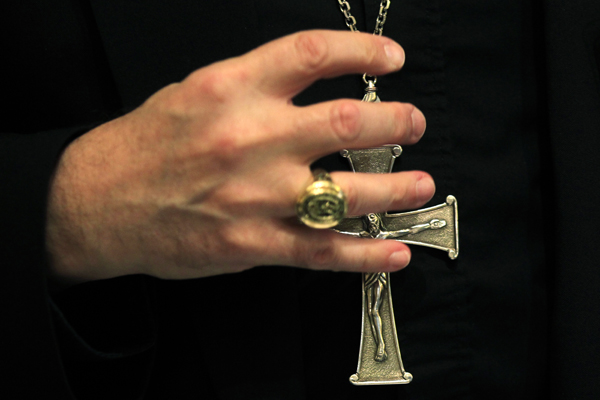
A bishop grasps his pectoral cross during the United States Conference of Catholic Bishops in Baltimore (Credit: Kevin Lamarque / Reuters) If you want to lower the number of abortions, you support better access to birth control. Except if you’re a Catholic bishop!
Pro-choicers cheered when the Department of Health and Human Services agreed that birth control is preventative care, meaning that under the Affordable Care Act, insurers must provide it without a co-pay. (Again, we are talking about requirements for private insurance plans, not government funding.) But this week there’s fresh concern that the Catholic bishops are lobbying the Obama administration hard to capitulate — and to keep birth control coverage away from as many people as they can get away with.
The Affordable Care Act guidelines already include a religious exemption. An institution which provides its employees with health benefits can qualify for it, if its major purpose is to employ and serve co-religionists — like a church. That’s not enough for the Catholic Church, which says (though possibly not in these words) that it doesn’t want to subsidize the shameful non-procreative sexing of its employees at affiliated hospitals, charities and universities, whether they agree with the Church about birth control or not. The United States Conference of Catholic Bishops are pushing for a far more expansive religious exemption. By the way, even actual self-identified Catholics ignore these particular edicts from a bunch of celibate men — 98 percent of sexually active Catholic women have used contraception, according to Guttmacher.
The bishops are allowed to lobby for whatever they want, of course. But the Obama administration is under no obligation to listen. That’s why everyone who thinks access to birth control is a good idea was alarmed this week when Archbishop Timothy Dolan, the USCCB’s president, dropped heavy hints that they would get their way. After a private meeting with Obama, Dolan told reporters, “I found the president of the United States to be very open to the sensitivities of the Catholic community. I left there feeling a bit more at peace about this issue than when I entered.”
Right now, the USCCB’s preferred line of argument is that they are just fighting for their religious liberty. Of course, that translates into the alleged right to deny others essential medical care. “We’re seeing with increasing frequency institutions and individuals all claiming the right to discriminate in the name of religious freedom,” said Louise Melling, deputy legal director of the ACLU.
That includes not just the women and men who happen to work for Catholic-affiliated institutions — it also spans the victims of sex trafficking. Until the Obama administration started taking the contracts elsewhere, the USCCB received millions in government grants to provide social services for trafficking victims — but refused to refer these women, often raped by their traffickers — to contraceptive or abortion services. Does Dolan’s “peace” come from a deal on the trafficking contracts that will allow the group to deny emergency contraception to raped and trafficked women? Only if the Obama administration won’t hold its ground.
Irin Carmon is a staff writer for Salon. Follow her on Twitter at @irincarmon or email her at icarmon@salon.com. More Irin Carmon.
Catholic Church: Time for a new war on birth control
Notre Dame and other Catholic institutions have revived their fight against contraception with a new lawsuit
Abortion protesters in South Bend, Ind., in 2009. (Credit: AP/Joe Raymond) Until Rush Limbaugh called Sandra Fluke a slut, the United States Conference of Catholic Bishops had almost convinced the public that fighting the contraceptive coverage mandate in the Affordable Care Act was about religious freedom. Now, 43 plaintiffs, including 13 dioceses and, most prominently, the University of Notre Dame, would like to bring back the argument that the Obama administration is encroaching on their religious rights.
“This lawsuit is about one of America’s most cherished freedoms: the freedom to practice one’s religion without government interference,” opens the Notre Dame suit, which was filed Monday. “It is not about whether people have a right to abortion-inducing drugs, sterilization and contraception.”
Continue Reading Close
Irin Carmon is a staff writer for Salon. Follow her on Twitter at @irincarmon or email her at icarmon@salon.com. More Irin Carmon.
“Birth control doesn’t matter”
A new survey reveals just how ignorant young people are about contraception and pregnancy
(Credit: restyler via Shutterstock) When it comes to sex and reproduction, even the most mind-numbingly intuitive conclusions can be politicized or disbelieved. So they bear repeating and resubstantiation. Take this recent Guttmacher study on contraceptive knowledge. Surveying 1,800 men and women ages 18–29, the authors “found that the lower the level of contraceptive knowledge among young women, the greater the likelihood that they expected to have unprotected sex in the next three months, behavior that puts them at risk for an unplanned pregnancy.” In other words, access to factual information helps prevent risky behavior.
Continue Reading Close
Irin Carmon is a staff writer for Salon. Follow her on Twitter at @irincarmon or email her at icarmon@salon.com. More Irin Carmon.
Abortions made public
States want more data on abortion patients. Zealots want their hands on it. Shame is the new anti-choice strategy
(Credit: Cannaregio via Shutterstock/Salon/Benjamin Wheelock) It was an “anonymous informant,” Operation Rescue claimed last week, after someone slipped them the April records of 86 women who were treated at Central Family Medical. The clinic’s lawyer was blunter. “It certainly appears to me that a crime was committed,” Cheryl Pilate told the Kansas City Star. Though the clinic (which performs abortions) had already reported a break-in to a locked dumpster, Pilate said it wouldn’t have contained patient records, which are shredded. The “informant” must have gotten the documents – containing names, addresses and details of procedures – another way.
Continue Reading Close
Irin Carmon is a staff writer for Salon. Follow her on Twitter at @irincarmon or email her at icarmon@salon.com. More Irin Carmon.
The myth of the “morning-after abortion pill”
There's a reason why people mistake emergency contraception and abortion: The right intentionally confuses the two
(Credit: Shutterstock/Salon/Benjamin Wheelock) It started around February, when Republicans were still eager to talk about contraception. The Obama administration, or so Mitt Romney charged in Colorado, was forcing religious institutions to provide “morning-after pills –in other words abortive pills — and the like, at no cost.”
It was, of course, a lie. Romney was conflating two different pills: emergency contraception, known as the morning-after pill, which prevents a pregnancy; and chemical abortion, or mifepristone, which ends a pregnancy of up to seven weeks’ gestation and isn’t covered under the new guidelines. Since both pills were marketed in the U.S. around the same time, even some pro-choicers have gotten confused. But Colorado happens to be the epicenter of people confusing them on purpose. It’s the birthplace of the Personhood movement and home to Focus on the Family, both of which have strategically called emergency contraception “abortion” on the scientifically unproven basis that they could block a fertilized egg from implanting.
Continue Reading Close
Irin Carmon is a staff writer for Salon. Follow her on Twitter at @irincarmon or email her at icarmon@salon.com. More Irin Carmon.
Mockery: Women’s new weapon
From a sex strike to satirical anti-Viagra bills, the war on reproductive rights has some responding with laughs
From a proposed sex strike to mock legislation restricting access to Viagra, women are coming up with increasingly creative ways to respond to attacks on reproductive rights. Many of them are relying on something ladies are often said to be without: a sense of humor.
In case you didn’t catch on, the sex strike is tongue-in-cheek. Annette Maxberry-Carrara, founder of Liberal Ladies Who Lunch — the group that proposed the “Access Denied” protest — tells me with a laugh, “We’re not looking at it as a literal strike.” But they are making a serious political statement. The event’s tagline reads, “If our reproductive choices are denied, so are yours.”
Continue Reading Close
Tracy Clark-Flory is a staff writer at Salon. Follow @tracyclarkflory on Twitter. More Tracy Clark-Flory.
Page 1 of 23 in Birth Control