
Egyptian Protests
Egypt uses U.S. teargas on pro-democracy crowds
600 injured as military clashes with demonstrators demanding return to civilian rule
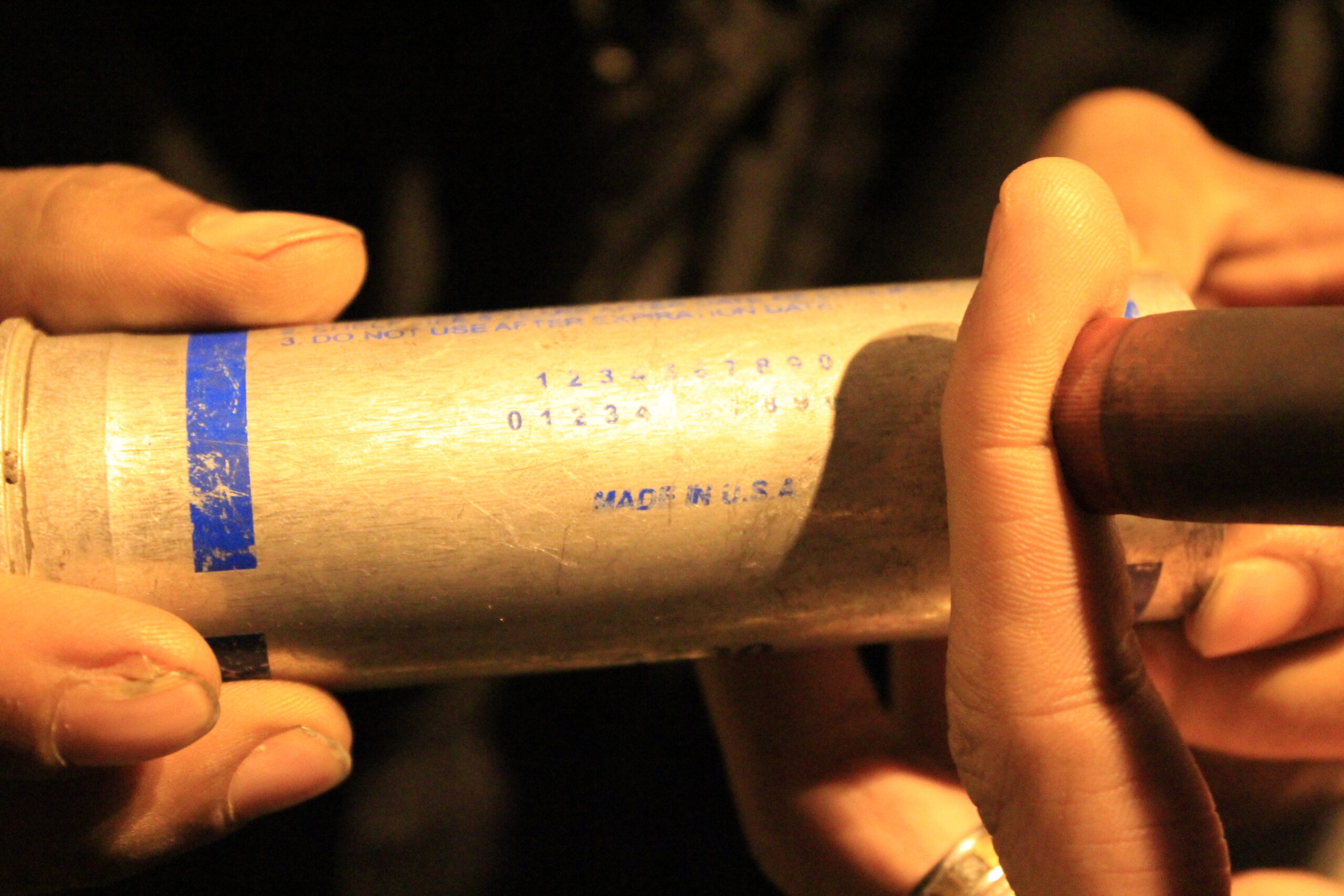
"Made in USA" teargas cannister CAIRO–Late Saturday evening the air here was heavy with suffocating smoke as Egyptian security personnel battled street protesters for control of Tahrir Square. A protester, who told me his name was Karim, held up a used teargas canister and pointed to the label: “Made in USA.”
“People need to know where this comes from,” he told me as the crowd chanted: “The people demand an end to military rule.”
The serial number and blue markings on the tear gas canister indicate that it was manufactured by Combined Systems Incorporated (CSI), a weapons manufacturer based in Jamestown, Pennsylvania.
This is not the first time CSI ‘s products have been used against Egyptian citizens. During Egypt’s January revolution, CSI tear gas was employed by the Mubarak regime against demonstrators in Tahrir Square.
Nearly nine months later, these same canisters have been raining down on demonstrators for the past eight hours as Egyptian security forces clash with protesters throughout downtown Cairo. The violence on Saturday came a day after peaceful protesters occupied Tahrir Square on Friday demanding the ruling Supreme Council of the Armed Forces (SCAF) accelerate the transition to civilian rule.
The use of U.S-made tear gas against the protesters in Cairo is the result of the U.S. military aid policy. In exchange for nearly $1.3 billion in aid, the United States requires that Egypt buy its hardware from U.S. manufacturers.
CSI’s website announces that the firms sell an“ innovative line of less-lethal munitions, tactical munitions and crowd control products . . . to a wide range of international military and law enforcement customers.” CSI will not confirm or deny whether they sell arms to Egypt, but their distinct labels are evidence enough.
According to the State Department web site, the United States gave Egypt $1.2 million in 2009 for tear gas, riot control agents, and associated equipment.
Clashes in Tahrir Square
During Friday’s protests, a diverse group of political parties and activists joined together for a rowdy but peaceful denunciation of military rule. A small group of demonstrators stayed the night, vowing to occupy the Square until the military steps aside.
Beginning in the early afternoon on Saturday, security forces moved to clear the square of the remaining demonstrators, but the protesters stood their ground. By late Saturday night, after nearly eight hours of violent street clashes, protesters had secured the periphery of Tahrir Square and were checking ID’s at makeshift barricades.
Chaos still reigned outside the Square as security personal faced down groups of rock-throwing youths.
On the corner of Mohammad Mahoud Street, across from Tahrir Square, young men with their faces covered in surgical masks rushed forward to grab a smoking canister and fling it back at a line of riot-police.
A block away, on Tahrir Street, a resident hurled Molotov cocktails at the advancing riot police and dropped water bottles to exhausted protestors. At the end of the street, protesters lit piles of trash on fire to obstruct the oncoming policemen.
The wounded were treated at a makeshift hospital set up outside a Kentucky Fried Chicken at the edge of Tahrir Square. A man, who identified himself as a doctor, tolds me that hundred of protesters have been wounded and several have died.
A spokesperson for the Healthy Ministry, Mohammed Sherbini, confirmed that more 600 protesters have been wounded in the clashes. The Ministry of Interior claims that 40 police officers have been wounded as well.
State TV Spreads Military Propaganda
Reports on military-controlled State TV blamed the violence on the protesters. But thousands ignored the propaganda and streamed into Tahrir Square to express their dissatisfaction with the military and to take part in the clashes.
Rami Sizar, a native of the working class neighborhood of Imbaba, told me he came straight to the Square as soon as he heard the police were clashing with protesters. “I didn’t believe the State TV,” he explained. “Everyone has the right to protest in the Square,” his friend Amr added.
In the middle of Tahrir Square, protesters held up teargas canisters and bullet shells and ask journalists to take pictures. One man gestured at a canister and asks me why the United States was helping the SCAF “attack” the Egyptian people.
As of midnight in Cairo, there was no indication that the protesters would leave Tahrir Square. A group of men have hoisted a banner which reads “the people want a civil ruling council.” The violent crackdown seems to have only strengthened the resolve of protesters. “The revolution continues,” tweeted activist Hossam el-Homalawy, as protesters braced themselves for further attacks.
Avi Asher-Schapiro is a writer living in Cairo. More Avi Asher-Schapiro.
Can Egypt reignite the Arab Spring?
Huge protests marked the revolution's anniversary as many dissidents hope to spark an uprising against the army
(Credit: AP Photo/Muhammed Muheisen) CAIRO, Egypt — It may have been the largest demonstration Egypt’s ever seen.
Hundreds of thousands — some boasted a million — descended on Cairo’s iconic Tahrir Square Wednesday to mark the first anniversary of the uprising that toppled President Hosni Mubarak and to call for an end to military rule.
The square was so packed that the crowds spilled onto the bridges and streets that fan out from the plaza and into Cairo’s downtown streets, with chants for freedom thundering against the area’s crumbling, colonial-era buildings.
Continue Reading CloseThe devastating crackdown on Egypt’s revolution
Since Mubarak was deposed, over 12,000 civilians have been tried by shadowy military tribunals
Om Ahmed demonstrates for the release of her son and his friend on July 1, 2011. Both were sentenced to five years in prison in a military trial for breaking curfew. (Credit: Mona Seif/Courtesy) CAIRO — Before the pro-democracy movement’s demonstrations swelled the streets of this city and ousted President Hosni Mubarak, Amr El-Beheiry was a 32-year-old factory worker who hailed from Nile Delta and was proud of his large and very close family.
El-Beheiry struggled like most Egyptians, but his family says he kept a simple dream of being able to afford an apartment and to save enough to finance a modest wedding. He minded his own business.
Continue Reading Close“Liberation Square”: A thrilling account of Egypt’s revolution
From Facebook martyrs to camelback attacks, a Cairo reporter gives a street-level view of history in the making
Ashraf Khalil The overthrow of Hosni Mubarak’s regime in Egypt last year served as dramatic proof that the Arab Spring wasn’t just a passing, or purely Tunisian, phenomenon. Egypt’s revolution heralds the coming obsolescence of the late-20th-century-style militarized pseudo-democracy in the Middle East, and its influence has extended as far as Wall Street’s Zuccotti Park. Future generations will surely study Tahrir Square and what happened there intensively, but anyone in search of an expert account today need look no further than Ashraf Khalil’s “Liberation Square: Inside the Egyptian Revolution and the Rebirth of a Nation.”
Continue Reading Close
Laura Miller is a senior writer for Salon. She is the author of "The Magician's Book: A Skeptic's Adventures in Narnia" and has a Web site, magiciansbook.com. More Laura Miller.
Thanks to you!
The people we're most grateful to have around this year
Clockwise from upper left: Elizabeth Warren, Wael Ghonim, Diane Ravitch and Ray Lewis Admittedly, I spend a lot of time grousing and naysaying. Today, though, we put that negativity briefly aside, as we celebrate a day of thoughtful reflection, and a night without a GOP presidential debate. I thought it appropriate, on the occasion of Thanksgiving, to thank some of the people who’ve worked to make the country and the world a better place over the least 12 months.
Thanks to Wall Street Occupier Jesse LaGreca, who didn’t only show up the Fox reporter sent to embarrass occupiers, but also managed to get the OWS message across on a Sunday political chat show, which is essentially unheard of. So thanks to you, for bringing up economic justice to the ancient panel of crusty establishmentarians on “Meet on Press.”
Continue Reading Close
Alex Pareene writes about politics for Salon and is the author of "The Rude Guide to Mitt." Email him at apareene@salon.com and follow him on Twitter @pareene More Alex Pareene.
Amid street fighting, Egypt’s cabinet resigns
Demonstrators flooding Tahrir Square demand military relent to civilian rule
Protesters move away from tear gas fired by Egyptian riot police during clashes near Tahrir Square in Cairo on Monday. (Credit: AP/Tara Todras-Whitehill) CAIRO — The military-appointed cabinet of the Egyptian government submitted letters of resignation late Monday night after three days of demonstrations rocked downtown Cairo and claimed nearly 40 lives. Just a week before Egypt’s planned parliamentary elections, the real political battle is being fought on the streets of Cairo while the military government and nascent political parties play catch-up.
The tumult began last Friday when thousands of peaceful protesters marched in Tahrir Square to condemn a constitutional proposal which would place the Supreme Council of the Armed Forces (SCAF) beyond civilian control. On Saturday afternoon, military police then cleared the square of demonstrators using tear gas but the crowds soon returned, forcing the security personnel out. Ever since, protesters and police have been playing an ever-escalating game of cat-and-mouse through the downtown streets.
Continue Reading CloseAvi Asher-Schapiro is a writer living in Cairo. More Avi Asher-Schapiro.
Page 1 of 46 in Egyptian Protests
