War Room

Liberals are not uniquely “unreasonable”

A widely discussed critique of the left's attitude toward Obama forgets some important history

By now, you’re probably familiar with Jonathan Chait’s provocatively titled New York magazine story: “When Did Liberals Become So Unreasonable?” Chait’s answer is that they’ve pretty much always been unreasonable – that the same “unceasingly despairing” attitude the left has taken toward Barack Obama’s presidency emerges whenever a Democrat claims the White House.

Of course, Chait is overstating the current depths of liberal despair, given that the outspoken frustration of some left-of-center commentators hasn’t exactly trickled down to the liberal masses, and that overall support and enthusiasm for Obama has fallen more significantly among non-liberal Democrats than among liberals. Joan Walsh did a nice job earlier this week of pointing this out, and of addressing many of the specific points Chait made about Obama’s record.

But the bigger problem is that Chait seems to be misreading history in some important ways.

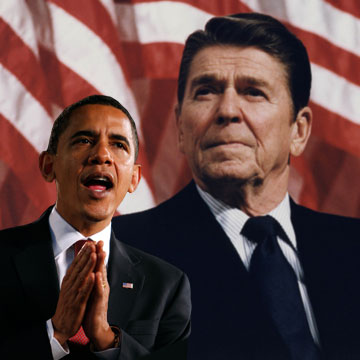
Take his claim that the historical pattern of despair he describes is a uniquely liberal tradition – that conservatives, because they have “higher levels of respect for and obedience to authority,” don’t exhibit the same level of disappointment with their leaders. This is hard to swallow if you lived through or have spent much time studying Ronald Reagan’s presidency, which featured the same loud and consistent cries of “Betrayal!” from conservative opinion-leaders that we’ve heard from liberals since 2009.

Chait seems to understand this on some level; he acknowledges that the Reagan of the modern conservative imagination is far different from the Reagan who ran the country in the 1980s – a president who “spent most of his administration raising taxes, signing arms-control treaties, and otherwise betraying right-wing dogma.” But what Chait doesn’t grapple with is the fact that conservative leaders of the Reagan-era were very much aware of and appalled by all of this – and didn’t hesitate to say so publicly.

The Reagan story is worth considering because he’s the closest mirror image to Obama among modern Republican presidents. Just like Obama, his party’s base was with him from the very beginning, embracing him as the true believer they’d long been waiting for. Conservatives in the 1980 general election didn’t just vote for Reagan because they wanted to get rid of Jimmy Carter; they also saw an opportunity to impose sweeping conservative change. Liberal voters had similar feelings about Obama in 2008.

Now let’s compare each president’s relationship with his party’s base. Obama, Chait claims, began losing the left a month before he took office, when he asked the socially conservative evangelical pastor Rick Warren to deliver the invocation at his swearing-in. But you can similarly argue that Reagan began losing the right within weeks of his 44-state landslide in November 1980, when he announced that Jim Baker – a moderate Republican and close friend of George H.W. Bush, who had run to Reagan’s left in the 1980 GOP primaries and belittled his supply-side blueprint as “voodoo economics” – would be his White House chief of staff.

The carping that Baker’s selection prompted set the tone for what was to come, with conservative leaders convinced for much of Reagan’s tenure that they were being sold out by the man in whom they’d invested so much hope. The conservative press wasn’t nearly as well-developed then as it is now – there was no Fox News, no Internet and no Rush Limbaugh – but right-wing organs like Human Events, Conservative Digest and the Evans and Novak syndicated column fed this siege mentality, especially in the early years of Reagan’s tenure. The main critique was identical to the one liberals now make about Obama: that President Reagan had proven to be the kind of compromise-happy incrementalist that candidate Reagan had disdained.

As the painful early ‘80s recession – the last time before the Obama administration that the unemployment rate climbed over 10 percent – dragged down Reagan’s job approval rating, conservative leaders convinced themselves that the Reagan presidency was failing because it had abandoned its ideological mission. In June 1982, for instance, a top Reagan donor and conservative Christian leader, Clymer Wright, convened a meeting of about two dozen “New Right” leaders in Texas. The agenda: figuring out how to convince Reagan to tune out Baker and all of the other non-true believer voices he’d installed in the White House. “We want to hold Ronald Reagan’s feet to the fire Ronald Reagan lighted,” Josh Loftin, the Conservative Digest editor, told Newsweek.

Months later, after Republicans suffered through a miserable midterm election and with Reagan’s approval rating well under 40 percent, a band of conservatives led by Richard Viguerie and Howard Phillips called on Reagan not to seek reelection – and began plotting a potential primary challenge against him in case he did run.

“It’s just not a very conservative administration,” Viguerie declared. “It seems like every day they hit us with something that makes us mad. But we don’t even bother getting mad anymore. We want to do something about it.” In a February 1983 article titled “The New Right: Betrayed?” Newsweek provided this explanation for conservative despair:

What infuriates conservative leaders is how far they are from achieving their agenda even though a man they thought of as one of their own sits in the White House. They blame the pragmatic strategies of Reagan chief of staff James A. Baker III, and their list of complaints is lengthy: record budget deficits, adherence to Jimmy Carter’s unratified SALT II policy and the premise that an agreement signed by the Soviets could become a cornerstone of future U.S. policy. The cabinet appointments of Dole and former Massachusetts Rep. Margaret Heckler were particularly irritating since both, though at least nominally opposed to abortion, are viewed by the right as aggressive feminists. New Right leaders acknowledge Reagan’s State of the Union references to public-school prayer, tuition tax credits and a spending freeze — but doubt his true intent or ability to follow through on those issues dear to their hearts. “That sounded good, but he offered no plan to win,” says Viguerie.

All of this is a long way of saying that the right can be as “unreasonable” in judging a supposedly conservative president as the left can be in judging a supposedly liberal one.

Chait claims that conservative frustration is much milder than liberal frustration. But how do you quantify this? After all, if you consider the first two-and-a-half years of their presidencies, Reagan’s job approval rating among Republicans was slightly lower than Obama’s was among Democrats. It was only when the economy began rapidly expanding in the middle of 1983 that Reagan’s standing – with Republicans and with all voters – began climbing and the press stopped paying so much attention to the idea of a conservative revolt. Even then, conservative leaders remained on guard; if you need a refresher, just look at news stories from December 1987, when Reagan was declared excommunicated from the conservative movement by multiple New Right leaders for his advocacy of the INF treaty with the Soviets.

It’s hard to believe the same basic story wouldn’t play out with Obama if the economy were to come roaring back to life now – an overall surge in popularity, the restoration of approval ratings over 90 percent among Democrats, and a precipitous decline in coverage of liberal disgruntlement, even with some liberal activists and commentators still insisting he’d betrayed the cause.

The other issue with Chait’s history lesson is that it fails to distinguish between the concept of a liberal president and a Democratic president. This sets up something of a straw man, allowing Chait to point to one example after another of liberals rejoicing upon the election of a new Democratic president only to hold that president to unreasonable standards. What Chait doesn’t acknowledge is that of the three Democratic presidents elected since 1976, only one – Obama – can accurately be described as the choice of his party’s base. The other two, Jimmy Carter and Bill Clinton, were viewed with suspicion by liberals from the earliest days of their campaigns, and for good reason.

Take Carter, whose emergence as the Democratic nominee in 1976 was essentially a fluke, a product of his campaign’s ability to grasp the significance of the party’s radically expanded primary and caucus calendar before anyone else. Thus was Carter, then a conservative Southern Democrat who had poor relations with organized labor and other traditional liberal constituencies, able to spend the winter and spring of ’76 racking up delegates and building momentum while the party establishment planned for a brokered convention that never came to pass. (It also helped Carter that Ted Kennedy, who could easily have unified the liberal establishment, declined to run and that multiple liberals — Mo Udall, Fred Harris, Frank Church, Jerry Brown and Hubert Humphrey — vied to be the anti-Carter.)

So while most liberals were happy enough with Carter’s fall victory over Gerald Ford and hopeful that liberal voices like Vice President Walter Mondale would prevail in his administration, they were also understandably apprehensive. And when President Carter proved hostile to labor and to the traditional Democratic establishment, liberals understandably revolted, ultimately lining up with Ted Kennedy in his 1980 primary challenge. This seems more a case of a party base doing its job – not a party base being unreasonable.

The story is the same for Clinton. Again, liberals were quite happy when he defeated George H.W. Bush in 1992 and ended 12 years of Republican rule. And they were hopeful too. But that optimism was mixed with trepidation, because he had hardly been their first choice for the Democratic nomination.

The context here is worth remembering. Clinton entered the ’92 race as the anti-liberal candidate, a moderate Southerner and a product of the Democratic Leadership Council, which had been created to push the party away from Mondale/Dukakis-style liberalism. The initial plan was for Clinton to win the nomination by running to the right, under the assumption that his chief rival would be either New York Gov. Mario Cuomo or (if Cuomo didn’t run) Iowa Sen. Tom Harkin, both of whom embodied the Mondale/Dukakis tradition.

The twist is that Cuomo begged off and Harkin failed to ignite, allowing Paul Tsongas, of all people, to emerge as Clinton’s chief foe. Amazingly, Tsongas was even farther to the right than Clinton – a born-again deficit hawk who lectured about the virtues of capitalism and promised to be Wall Street’s best friend as president. When Tsongas won the New Hampshire primary, Clinton improvised and sold himself as the last best hope of the liberal coalition, scaring unions, senior citizens, Jews and minorities away from Tsongas with a slick and effective negative campaign that pushed Tsongas to the sidelines by the middle of March. Thus can it be said that Clinton ran as the liberal candidate for several weeks in 1992 – and that’s about it.

As soon as the nomination was his, Clinton junked the liberalism and went back to showing Middle America that he wasn’t another Mondale. His famous “Sister Souljah” moment – when Clinton intentionally provoked liberal ire by calling out a black rapper while addressing Jesse Jackson’s Rainbow Coalition – well reflected his post-Tsongas posturing

Against this backdrop, the liberal frustration with President Clinton that Chait documents doesn’t seem quite so unreasonable. For instance, maybe you think Clinton was right in enacting welfare reform in 1996; maybe you don’t. Either way, it’s hard to blame any liberal who watched Clinton sign the bill, grew angry, and exclaimed, “This never would have happened under President Cuomo.”

There’s plenty of good history in Chait’s piece, and his point about how modern assessments of presidents often distort their actual records is well-taken. Nor would I contest his belief that there are some real difference in how conservatives and liberals think about their leaders; reverence for a strong, singular executive does seem much more pronounced on the right. It’s also true that Republican voters remained extremely loyal to George W. Bush throughout his entire presidency, even when his overall numbers cratered. (Of course, this may have been a product of 9/11 and his self-styled image as a wartime president, which created intraparty cohesion that might otherwise not have existed.)

Overall, though, modern political history just isn’t as neat and tidy as Chait suggests. He’s far too quick to treat any liberal criticism of any Democratic president as “unreasonable” and far too hesitant to acknowledge that conservatives can – and have been – just as “unreasonable.” In other words, what he’s documented isn’t so much a phenomenon of the left; it’s a phenomenon of all true believers.

Steve Kornacki

Steve Kornacki writes about politics for Salon. Reach him by email at SKornacki@salon.com and follow him on Twitter @SteveKornacki

W’s elevator endorsement trick

The 43rd president is a willing accomplice in the Romney effort to pretend 2008 never happened

George W. Bush (Credit: Reuters/Kevin Lamarque)

George W. Bush may have established a new world record today for the shortest, most awkward public endorsement statement in presidential campaign history:

“I’m for Mitt Romney,” Bush told ABC News this morning as the doors of an elevator closed on him, after he gave a speech on human rights a block from his old home — the White House.

The reason for this strange scene is obvious: Romney and his fellow Republicans want absolutely nothing to do with the 43rd president, lest voters connect the epic financial meltdown that played out on his watch to the economic anxiety they’re now feeling. As Jamelle Bouie explained today, the case that Romney is making for voting out President Obama depends on the public downplaying (or forgetting altogether) that he inherited an economy that was in the throes of a crisis not seen in generations:

In this narrative, the GOP didn’t mismanage the economy into the deepest downturn since the Great Depression. Rather, the economic crisis simply happened, ex nihilo, and Obama did nothing to stop or mitigate it. What’s more, he made things worse, with government spending and an explosion of debt.

The problem for Obama, as Bouie points out, is that there’s real appeal to this story. The electorate tends to exist perpetually in the present tense, with little collective memory or foresight. Republicans began banking on this the moment Obama was sworn in: Just stand against everything he’s doing, and if the economy remains in rough shape, sooner or later the public will hold him responsible, just because he’s the guy in charge. As it turned out, it took only about nine months for Obama’s approval rating to fall under the 50 percent mark, and it’s hovered around there ever since, putting him in danger of losing this fall.

One way the Obama campaign is attempting to counteract this is by challenging Romney’s own economic and job-creation credentials. The presumptive GOP nominee has been relentlessly touting his business (and not government) experience, hoping that voters will assume he knows how to fix the economy because of his private sector success. Polls suggest voters are buying it, at least to a degree, with Romney generally outpacing the president by several points on which candidate would be better on creating jobs and boosting the economy. This is the reason Obama’s campaign unveiled a brutal two-minute attack ad yesterday on Romney and Bain Capital on Monday; the idea is to convince voters that there’s not necessarily a connection between making money in business and understanding how the economy works.

It’s hard to say whether this will work. Romney is fighting back by highlighting jobs that were created through Bain and with a new video that tells the stories of struggling Americans who have been victimized by “the Obama economy.” As Greg Sargent explains, the video is a perfect reflection of both the misleading simplicity of Romney’s message and its potential effectiveness. There’s just a lot the Romney campaign can say and do to deflect from the impact of the Bain attacks.

In this way, Bush’s very brief reemergence today raises the question of whether Obama ought to be invoking his predecessor more frequently and more explicitly, and to make him a more central figure in the campaign. Polls show that voters still remember what happened on Bush’s watch and still hold him responsible for at least some of the country’s current problems. Obama does frequently make reference to what he inherited, and to the failure of the GOP to come up with a new economic platform during its White House exile. But more than anything else, it seems that Romney’s campaign fears being tied to Bush. And Bush, as his elevator trick shows, is willing to help them out by remaining inconspicuous. If Obama’s team wants it, there’s some slack to be picked up.

Continue Reading Close
Steve Kornacki

Steve Kornacki writes about politics for Salon. Reach him by email at SKornacki@salon.com and follow him on Twitter @SteveKornacki

The Bain beast returns

A scathing new anti-Romney ad from the Obama campaign picks up right where Rick Perry and Newt Gingrich left off

Mitt Romney (Credit: Reuters/Rebecca Cook)

With the release of a new two-minute (!) negative ad from the Obama campaign, it’s now official: Mitt Romney’s perfect record of being attacked over his Bain Capital days is still intact.

OK, there’s an asterisk: Technically, Bain didn’t come up in Romney’s first campaign, for the 1994 Republican Senate nomination in Massachusetts. But that was barely a race: His opponent, John Lakian, had been shamed out of politics by a résumé embellishment scandal a dozen years earlier, barely qualified for the primary ballot, and lost to Romney by 66 points. And Lakian’s background was in venture capital too, so Bain was not exactly a logical topic for him to raise.

But outside of that ’94 primary, every time Romney has been in a competitive race, an opponent has accused him of making his fortune by gutting companies and ruining the lives of innocent workers.

The new Obama ad, which is airing in Virginia, Pennsylvania and Colorado, focuses on the story of GST Steel, a company in which Bain purchased a majority stake in 1993, just before Romney’s first foray into politics. In 2001, after Romney had left his day-to-day role with Bain and was overseeing the Olympics in Utah, GST’s Kansas City plant was shuttered, costing more than 700 workers their jobs even as Bain itself profited. The ad mixes in clips of Romney boasting about his job creation record and empathy for the jobless with testimonials from those whose lives were affected by the plant’s closure.

“It was like a vampire,” one former GST employee says of Bain. “It came in and sucked the life out of us.”

It’s a dramatic, well-produced ad that paints a damning portrait of the presumptive GOP nominee and the firm he built. The question is whether it will be effective, and the track record for previous Bain assaults on Romney is mixed:

1994 Senate general election: Here is the example the Obama team is hoping to emulate. After his September ’94 GOP primary win, a poll gave Romney a narrow edge over Ted Kennedy, whose own popularity had waned in the wake of the William Kennedy Smith trial. By the end of the month, the Kennedy campaign settled on Bain as Romney’s prime vulnerability, and made the firm’s acquisition of an Indiana company, SCM, a major point of emphasis. Here is one of several SCM ads that Kennedy’s campaign ran:


Interestingly, when this assault began, the Boston Globe noted that Romney had been running warm and fuzzy ads about his personal story for a few months and suggested that “voters may see this series as the powerful Kennedy machine beating up on that nice young man.” But by early October, Kennedy was comfortably ahead again, and the race wasn’t close the rest of the way, with the incumbent prevailing by 17 points. Were the Bain spots responsible for the giant polling shift? It’s impossible to say for sure, but they clearly didn’t hurt.

2002 gubernatorial general election: Romney spent much of the fall campaign running behind the Democratic nominee, state Treasurer Shannon O’Brien. He seemed to gain traction, though, with an attack ad that played up the losses that the state’s pension fund incurred on O’Brien’s watch from investments in Enron.

O’Brien countered by reviving the SCM story, running ads on the incident and calling Romney “the face of corporate greed in America.” She also launched an spot called “Sizzle” that featured a laid-off worker from GST – the same steel company Obama is now highlighting – who told viewers:

“It’s hard to believe that a man like Mitt Romney can have enough power and influence and money behind him to come in, destroy families, put people out of work that’s sick, with no health insurance. There’s nothing left. We have nothing left.”

O’Brien, though, lost to Romney by 7 points. This doesn’t mean the Bain attacks backfired. As Boston journalist Dan Kennedy noted today, Romney struggled throughout the ’02 general election more than the prior two GOP candidates – Paul Cellucci and Bill Weld – had. And it may have been a last-minute push by Romney to link O’Brien to unpopular Democratic leaders in the state Legislature that moved voters. Still, the fact remains that O’Brien played the Bain card aggressively, and it didn’t bring her to victory.

2008 Republican primaries: Bain was not a huge issue in this race, but when Mike Huckabee said that Romney reminds people of “the guy who laid you off,” he was clearly trying to harness the instinctively negative feelings that even many blue-collar Republicans have toward the world of venture capital. That line may have helped Huckabee in Iowa, where he beat Romney by 9 points.

Then, in the run-up to Florida’s primary, John McCain directly attacked Romney over Bain, arguing that “as head of his investment company he presided over the acquisition of companies that laid off thousands of workers.” McCain ended up winning Florida narrowly, a result that cemented him as the clear front-runner and dealt a severe blow to Romney’s hopes.

2012 Republican primaries: The attacks on Bain were far more pointed in Romney’s second bid for the GOP nomination, with Rick Perry accusing him of practicing “vulture capitalism” and Newt Gingrich branding him a “predatory corporate raider.” The Gingrich campaign even created a vicious 29-minute video titled “King of Bain,” which was released about a week before the South Carolina primary:

Democrats, of course, were delighted by this development, and an income gap came to define the GOP race, with Romney generally cleaning up with affluent Republicans voters but often losing to Gingrich (and later Rick Santorum) with those in the working and middle classes. At the same time, Gingrich took immense heat from leading Republican voices, who blasted him for doing dirty work for Democrats and defended Romney’s Bain work. And Santorum refused to join the Bain pile-on, saying that “I just don’t think as a conservative and someone who believes in business that we should be out there playing the games that the Democrats play, saying somehow capitalism is bad.”

Continue Reading Close
Steve Kornacki

Steve Kornacki writes about politics for Salon. Reach him by email at SKornacki@salon.com and follow him on Twitter @SteveKornacki

Ron Paul’s chaos threat

Paul-ites wreak havoc at yet another GOP state convention, and this time their victim is Mitt Romney’s son

Ron Paul (Credit: AP)

This weekend brought another reminder of the real threat that Ron Paul and his supporters pose to Mitt Romney: chaos in Tampa, Fla.

As they’ve done elsewhere, hundreds of supporters of the libertarian congressman descended on Saturday’s state Republican convention in Arizona, which was being held to choose delegates to the party’s national convention. The state’s delegation will be pledged to support Mitt Romney, who easily won Arizona’s Feb. 28 winner-take-all primary, in Tampa, but there’s nothing to prevent Paul-ites from packing state conventions and gobbling up delegate slots, even if they won’t actually be able to vote for their candidate.

What the Paul crowd can do, though, is make noise – loud, uncontrollable noise that disrupts the proceedings and gives the media something to play up. Exhibit A: The headline from the Arizona Republic’s story about Saturday’s convention: “Arizona Ron Paul supporters boo Romney’s son off stage.”

There’s some dispute over the accuracy of that headline, which was mimicked by leading national publications. According to the Republic’s report, Josh Romney, who was representing his father’s campaign at the convention, “had to stop repeatedly as people booed and yelled for Paul.” But some Paul supporters say Romney was only jeered when he encouraged attendees to support his father’s slate and that he wasn’t forced to leave the stage. The video that’s available doesn’t clear things up.

Not that it really matters: Whether it was over and over again or just once, the bottom line is that Paul’s crowd loudly booed the son of their party’s presumptive nominee. And it’s hardly the first time something like this has happened at a state convention. When they seized control of Alaska’s convention last month, for instance, pro-Paul attendees heckled two United States senators, Lisa Murkowski and John Barrasso, who were there to speak. That too made national news.

Similar behavior by Paul backers in Tampa could spoil what for the Romney campaign is supposed to be a nationally televised infomercial. The problem for Romney and convention organizers is that, short of giving up and letting Ron Paul have the nomination, there’s not much they can do to pacify the Paul-ites.

Under the extreme worst-case scenario for Republicans, Paul supporters end up with a giant share of the delegate slots (a quarter of them, say) and launch a four-day heckle-fest, bitterly resist any effort to quiet them or evict them from the hall – a modern version of the chaos that reigned inside Chicago Stadium Chicago’s International Ampitheatre at the Democrats’ 1968 convention. In a more optimistic scenario, there’s only limited booing from a handful of delegates, and it rates on the nuisance scale somewhere near the annoying air horns that were a little too audible during Ronald Reagan’s 1980 acceptance speech in Detroit.

The good news for Republicans is that Paul himself will have an incentive to help them, since he’s interested in his son Rand’s long-term political viability and probably won’t want the family name forever associated with a destructive national convention. So if his supporters get too exuberant in Tampa, Paul might simply express to them how important he believes it is that they treat speakers with respect – sort of like when a rowdy crowd at a sporting event starts to disrupt the game and the home team’s coach steps in to quiet them down. Here’s former Cincinnati Bengals coach Sam Wyche with a lesson in how it’s done:

Continue Reading Close
Steve Kornacki

Steve Kornacki writes about politics for Salon. Reach him by email at SKornacki@salon.com and follow him on Twitter @SteveKornacki

Scott Walker’s politically suicidal exchange

He tells a billionaire donor about his “divide and conquer” anti-union strategy – on camera

Scott Walker’s hopes of surviving Wisconsin’s June 5 recall election in part depend on his ability to convince voters that he’s only worried about a very particular type of union – and only because of fiscal issues, not philosophical ones. Democrats’ hopes of ousting him depend in part on convincing voters this isn’t true, and that their governor is waging an ideological war on all unions.

This is why a newly-released video could be very significant. The video, which was shot by a pro-Tom Barrett filmmaker who is working on a documentary, shows Walker in January 2011 talking with Diana Hendricks, the billionaire owner of a roofing company. She asks him if there’s any chance he’ll be able to make Wisconsin a right-to-work state. Walker tells her that “we’re going to start in a couple weeks with our budget adjustment bill. The first step is we’re going to deal with collective bargaining for all public employee unions, because you use divide and conquer.”

Those last three words are the key. The bill to strip public employees of their right to bargain collectively was introduced a few weeks after Walker’s chat with Hendricks, prompting protests of an unprecedented scale in Madison and giving rise to the recall effort. Walker has long argued that he was responding to a budgetary emergency, and that unduly generous contracts won by public sector unions were a big reason for it. His desire, the line goes, was merely to correct a flawed system that encouraged elected officials to commit huge sums of taxpayer money to public employees, for fear of incurring their wrath in elections.

What Walker swears he wasn’t – and isn’t – interested in doing is taking power away from private sector unions. There’s a very practical reason for this. In Wisconsin, an unusually large segment of the electorate – 26 percent, in the most recent statewide election — is composed of voters from union households. (Nationally, the figure is 17 percent.) And the union tradition is ingrained in the state’s history. So Walker, in his public comments, routinely distinguishes between the two types of unions. “Private sector unions,” he said recently, “have been our partner in the economic revival we’ve had in this state. A bigger issue is the impact the public-sector unions have had on the taxpayers.”

Union leaders and their Democratic allies have been pleading with voters to see this as a ruse, a way for Walker to divide the union movement by pitting public employees against private sector workers. Which makes the new video so powerful. Here is the governor conversing with a billionaire (who later gave $500,000 to his campaign) and telling her all about his “divide and conquer” strategy against union power. Granted, it’s not clear if Walker is actually laying out a road map to make Wisconsin a right-to-work state (a complete transcript of the exchange isn’t much help), but the video basically conveys everything that Democrats have been trying to get voters to see about him. And its run-time is 28 seconds – ready-made for a television ad.

Continue Reading Close
Steve Kornacki

Steve Kornacki writes about politics for Salon. Reach him by email at SKornacki@salon.com and follow him on Twitter @SteveKornacki

Mitt and the price of Liberty

The timing couldn’t be much worse for Romney to give the commencement address at Jerry Falwell’s school

Mitt Romney (Credit: AP/Carlos Osorio)

The timing seemed a little odd when it was announced last month that Mitt Romney would be delivering an address at Liberty University’s commencement, which will take place this weekend. It was the kind of appearance you might have expected Romney to make in the spring of 2011, when he was just setting out to woo Republican primary voters, but not in the spring of 2012, after he’d secured the nomination and was setting out to win over general election swing voters.

That he felt compelled to do this speaks to the lack of confidence his campaign continues to feel about Romney’s support among a major chunk of the GOP base: white evangelical Christians, who continued to vote against him in primaries even as his nomination became inevitable.

There are two main theories about why this resistance exists. The first has to do with Romney’s religion, and the widely held conviction among evangelicals that Mormonism is, as one conservative Christian leader memorably put it, a “theological cult.” The other involves the premium that evangelical voters tend to place on cultural issues, and Romney’s suspect credentials on them (from back in his Massachusetts days, when he was avowedly pro-choice and pitched himself as a stronger advocate for gay rights than Ted Kennedy).

Whatever the exact explanation, Romney and his team clearly do not feel that they can take the support and – maybe more important – the enthusiasm of evangelicals for granted the way most previous Republican nominees could. This could severely complicate Romney’s efforts to separate himself from what to general election swing voters are some of the most unappealing aspects of the modern Republican Party. Any position he takes or utterance he makes that puts him at odds with the Christian right threatens to prompt a loud uproar from evangelical leaders. How much slack (if any) they’re willing to cut Romney in the name of general election expediency is unclear at this point.

This is why the timing of Romney’s Liberty speech is even more awkward now than when it was initially announced. No one knew back then that the week leading up to it would feature an endorsement of gay marriage from President Obama. In the run-up to Obama’s announcement, talk focused on the political risks that would be involved for him. But in the aftermath, it’s becoming clear that Romney and other top Republicans see just as much risk for themselves.

Public opinion is moving fast on gay marriage, and already a clear majority of independent voters support it, which explains why Romney has shown little interest this week in playing up his opposition and tried to change the subject when asked about it.  (House Speaker John Boehner has been doing the same thing.)  And even when Romney did discuss the issue on Thursday, he made sure to note his support for gay adoption, something he never would have mentioned during the primaries, given that evangelical leaders do not share this view.

At Liberty, Romney will be in something of a bind. A more confident nominee might see the venue as ideal for a Sister Souljah moment, defiantly distancing himself from the ardent culture war politics that Liberty embodies. But this would entail serious risks – an intraparty civil war? – that Romney has consistently shown he’s not comfortable taking. The opposite strategy – pandering to a crowd that has spent the past week hearing about a supposed assault on traditional marriage – is just as problematic, since it would reinforce Romney’s problems with swing voters.

That leaves Option C, which is for Romney to mostly ignore the elephant in the room and instead speak broadly about values and his own family life, while weaving in a few shots at Obama over the economy. Based on the excerpts that have already been released, this is what Romney plans to do. At best, this will allow him to get through Saturday without offending skeptical evangelicals or alarming swing voters. At worst, it will reinforce two real general election liabilities for Romney: his party’s alliance with evangelical conservatives, and the degree to which he lives in fear of offending them.

Continue Reading Close
Steve Kornacki

Steve Kornacki writes about politics for Salon. Reach him by email at SKornacki@salon.com and follow him on Twitter @SteveKornacki

Page 1 of 2650 in War Room

www.salon.com/topic/war_room/