
Taxes
Attack of the deadbeat corporations, Part 2
We already knew U.S. companies weren't paying enough federal taxes. But the same is also true at the state level
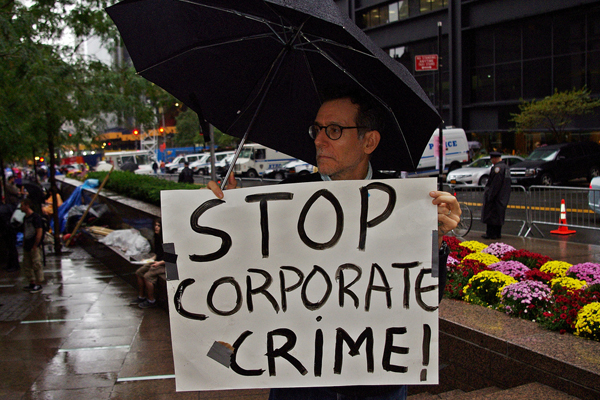
(Credit: david_shankbone / CC BY 3.0) Why do those mean people at the Citizens for Tax Justice and the Institute on Taxation and Economic Policy keep picking on American corporations? Just one month ago, they released a damning report pointing out how hundreds of the bluest of American blue-chip corporations were flat-out deadbeats when it came to paying their federal income taxes. But that wasn’t enough. Now they’re piling on with even more nasty numbers — a breakdown of how many of those same Fortune 500 companies are also slipping out from under their state tax liability.
Bottom line: The average statutory corporate tax rate is 6.2 percent. But between 2008 and 2010, the 265 companies analyzed in the report “paid state income taxes equal to only 3.1 percent.” If they had paid the full rate, states would have collected another $82.6 billion in revenues, money sorely needed to pay Medicaid bills and keep parks open and employ teachers and firefighters.
We can’t repeat this enough: When you hear someone say that American corporations suffer from high taxes, take a moment to point out that, as far as taxes are concerned, it’s never been better than right now to be an American corporation.
As recently as 1986, state corporate income taxes equaled 0.5 percent of nationwide Gross State Product (a measure of nationwide economic activity). But in fiscal year2010, state and local corporate income taxes were just 0.28 percent of nationwide GSP, equaling the low-water mark set in 2002. For the three years between fiscal 2009 and 2011, in fact, state corporate income taxes were at their lowest sustained level, as a share of the U.S. economy, since World War Two.
The report cites three major reasons to explain the ongoing decline in state corporate income tax revenue — “the trickledown impact of federal corporate tax cuts, ill-advised tax ‘incentives’ intentionally enacted by state lawmakers, and unintended tax shelters created by companies armed with creative accounting staffs.” The report also proposes a sheaf of well-meaning, sensible policy responses and strategies for reversing the trend. But ultimately, the proposed fixes all run head on into exactly the same political reality that any attempt to rationalize the federal income tax debacle faces: at the congressional level, politicians are still attempting to reduce corporate tax liabilities.
Earlier this year, the House Judiciary Committee approved H.R. 1439, the so-called “Business Activity Tax Simplification Act” (BATSA), which would make it substantially more difficult for states to effectively tax the income earned by corporations from activities within their borders.
The bill’s sponsors — and the corporate lobbyists pushing this plan — say that the goal of the bill is to limit state and local governments to taxing only those businesses with a “physical presence” in a state.
Of course, as the authors point out, the “physical presence” standard makes no sense in the Internet age. Even worse, any corporation with accountants who know what they are doing can easily structure subsidiaries to carry out physical operations in such a fashion as to escape local taxes.
Which leads us to one final inescapable conclusion. Today, a not insignificant amount of corporate creativity and innovation is channeled directly into the task of avoiding taxes. Our patchwork system of federal and state incentives and tax breaks creates fertile ground for game-playing. In a simpler world, you would have to think that energy could be directed to more productive uses.
Andrew Leonard is a staff writer at Salon. On Twitter, @koxinga21. More Andrew Leonard.
Kansas’ nasty new tax plan
Here's how it works when conservatives control everything: The wealthy get coddled and the poor get a bum's rush
Kansas is special. In most American states in which Republicans control the state legislature, the GOP busies itself with redistricting efforts designed to minimize the chances of Democratic electoral success. But in Kansas, the fight is over new districts cooked up to get rid of moderate Republicans. Similarly, nearly all Republican-dominated states are working hard to limit the ability of women to get abortions, but only in Kansas will you hear a state legislator compare rape to a flat tire.
Continue Reading Close
Andrew Leonard is a staff writer at Salon. On Twitter, @koxinga21. More Andrew Leonard.
A radical tax solution
The "centrist" Simpson-Bowles plan concedes too much to conservatives. What America needs is a consumption tax
Alan Simpson (Credit: AP/Evan Vucci) Nobody can complain that ideas are missing from the debate about American tax policy, which will heat up as the 2013 expiration of the Bush tax cuts approaches. There are plenty of competing ideas for tax reform. Unfortunately, most of the ideas are misguided. America needs radical tax reform — but of a kind different from the conventional proposals offered by the center, right and left.
The dominant approach to tax reform is considered to be “centrist” and symbolized by, among others, the Simpson-Bowles plan.
Continue Reading CloseMichael Lind’s new book, "Land of Promise: An Economic History of the United States", will be published in April and can be pre-ordered at Amazon.com. More Michael Lind.
Scrap the lotto
Politicians encourage irresponsible gambling in order to avoid facing America's desperate need to raise taxes
(Credit: AP/Paul Sakuma) In the days following the historic Mega Millions lottery, there’s been no shortage of drama. Rather than capping off a crescendo of excitement, the drawing ignited an explosion of who-won-it speculation. News organizations breathlessly reported the stories of false victors, lost tickets and state officials envisioning a revenue windfall from possible winners in their income-tax jurisdiction. Almost completely ignored in the hysteria was any examination of America’s problematic obsession with lottery mania.
Continue Reading Close
David Sirota is a best-selling author of the new book "Back to Our Future: How the 1980s Explain the World We Live In Now." He hosts the morning show on AM760 in Colorado. E-mail him at ds@davidsirota.com, follow him on Twitter @davidsirota or visit his website at www.davidsirota.com. More David Sirota.
Obama’s new Wall Street foes
Former allies are turning on the president now that he wants to close gaping tax loopholes for the 1 percent
President Barack Obama speaks in the Eisenhower Executive Office Building across from the White House in Washington, Wednesday, April 4, 2012, before he signed the Stop Trading on Congressional Knowledge (STOCK) Act. (AP Photo/Charles Dharapak)(Credit: AP) Benjamin Franklin, who used his many talents to become a wealthy man, famously said that the only things certain in life are death and taxes. But if you’re a corporate CEO in America today, even they can be put on the back burner – death held at bay by the best medical care money can buy and the latest in surgical and life extension techniques, taxes conveniently shunted aside courtesy of loopholes, overseas investment and governments that conveniently look the other way.
In a story headlined, “For Big Companies, Life Is Good,” the Wall Street Journal reports that big American companies have emerged from the deepest recession since World War II more profitable than ever: flush with cash, less burdened by debt, and with a greater share of the country’s income. But, the paper notes, “Many of the 1.1 million jobs the big companies added since 2007 were outside the U.S. So, too, was much of the $1.2 trillion added to corporate treasuries.”
Continue Reading CloseBill Moyers is managing editor of the new weekly public affairs program, "Moyers & Company," airing on public television. Check local airtimes or comment at www.BillMoyers.com. More Bill Moyers.
Michael Winship is senior writing fellow at Demos and a senior writer of the new series, Moyers & Company, airing on public television. More Michael Winship.
The Buffett rule, explained
Obama's plan to tax the rich won't become law any time soon, but will still play a major role in the campaign
President Obama shakes hands with supporters after speaking about tax fairness and the economy in Boca Raton, Florida, on Tuesday. (Credit: Reuters/Kevin Lamarque) 1) What is the Buffett rule?
Inspired by financier Warren Buffett’s revelation that his secretary paid a higher percentage of her income taxes than he did, the Buffett rule is a change in the tax code designed to ensure that the wealthiest Americans do not pay a lower share of their income in taxes than members of the middle class. According to a report released by the White House on Tuesday, 22,000 American households made more than $1 million in 2009 but paid a tax rate of less than 15 percent.
Continue Reading Close
Andrew Leonard is a staff writer at Salon. On Twitter, @koxinga21. More Andrew Leonard.
Page 1 of 50 in Taxes