

Anyone who’s ever tried to get reimbursed by a health insurance company after seeing a psychiatrist or psychotherapist, or taking a child or teenager to one, has no doubt noticed the incomprehensible numbers that appear on the clinician’s statement, perhaps preceding some slightly less imponderable phrase.
Maybe you are a 296.22 (major depressive disorder, single episode, mild) or a 300.00 (anxiety disorder NOS–not otherwise specified). Hopefully, you are not a 301.83 (borderline personality disorder). Your kid might be a 313.81 (oppositional defiant disorder) or, more likely, a 314.01 (attention deficit hyperactivity disorder, predominantly hyperactive-impulsive type).
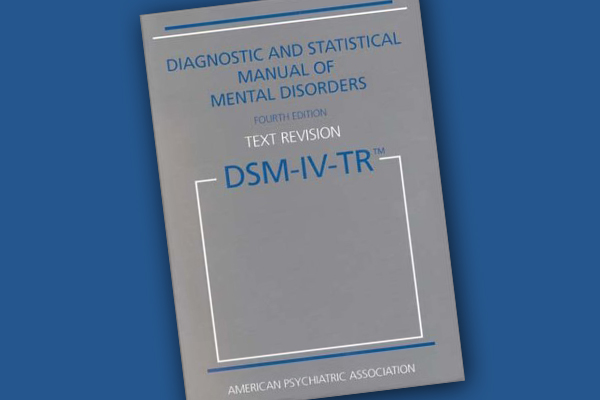
Since 1952, a tome called the Diagnostic and Statistical Manual of Mental Disorders, better known as the DSM, has been reducing to a few digits the psychological malady said to afflict a patient. This bible of mental health treatment, published by the American Psychiatric Association (APA), provides a list and description of every mental health condition known to—or invented by—psychiatry, from histrionic personality disorder (301.50) to transvestic fetishism (302.3).
Over the decades, the manual, adapted from a guide for mental diseases developed by Army and Navy psychiatrists, has ballooned. The number of listed disorders tripled to nearly 300. A few have been discredited and dumped along the way. Most famous were battles over the inclusion of homosexuality. Successive iterations of the manual listed homosexuality as a “sociopathic personality disturbance,” then modified that to describe a more limited “sexual orientation disturbance” among people who were “in conflict with” their attraction to people of the same sex. That was later replaced by a disorder called “ego-dystonic homosexuality,” applied to those whose homosexual arousal was a source of distress. That item was dropped in the DSM-III-R, published in 1987.
The great book’s coming edition, the DSM-5, is slated for publication in May 2013. As the task force producing it has posted drafts on its website, an undercurrent of dissatisfaction has exploded into a full-scale revolt by members of U.S. and British psychological and counseling organizations. The chief complaint is that the newest version will lower the criteria needed to diagnose some conditions, creating “subthreshold” disorders, and generally making it easier for healthcare professionals to label a person with a psychiatric disorder and medicate him or her.
The latest rebellion against the DSM-5 began with a salvo from across the Atlantic. In June, a special committee of the British Psychological Society complained in a letter to the APA that “clients and the general public are negatively affected by the continued and continuous medicalisation of their natural and normal responses to their experiences.” The committee criticized the proposed creation of an “attenuated psychosis syndrome”—a sort of poor-man’s psychosis with less severe symptoms—“as an opportunity to stigmatize eccentric people.” They also objected to a proposed reduction in the number of symptoms needed to diagnose adolescents with attention deficit disorder (ADD) because it might increase diagnoses and the use of meds.
Then David Elkins, professor emeritus at Pepperdine University and president of the Society for Humanistic Psychology, a division of the American Psychological Association, formed a committee to discuss similar objections and draft a petition enumerating them. In October, he posted the petition online. “I figured we’d get a couple hundred signatures,’’ Elkins said.
The response stunned him and his colleagues. The petition attracted more than 6,000 signatures in three weeks; as of mid-December it had topped 9,300 signatories and garnered the endorsement of 35 organizations. On Nov. 8, American Counseling Association president Don Locke jumped in with a letter to the APA objecting to the “incomplete or insufficient empirical evidence” underlying the proposed revisions and expressing “uncertainty about the quality and credibility” of the DSM-5.
“This has become a grassroots movement among mental health professionals, who are saying we already have a national problem with overmedication of children and the elderly, and we don’t want to exacerbate that,” says Elkins.
For many critics, Exhibit A is childhood ADD. As the disorder describing fidgety, easily distracted kids morphed from “hyperkinetic reaction of childhood” to the current “attention deficit hyperactivity disorder,” the number of children given the diagnosis exploded, fueling, by one account, a 700 percent increase in the use of Ritalin and other stimulants in the 1990s. Diagnosis requires checking six of nine boxes from a list of symptoms that include “often does not seem to listen when spoken to directly” and “often fidgets with hands or feet or squirms in seat.” Sound familiar, parents?
Two other newly proposed disorders singled out as problematic in the petition are “mild neurocognitive disorder” in the elderly and “disruptive mood dysregulation disorder” in children and adolescents. Both lack a solid basis in research and may fuel the use of powerful antipsychotic medications, which cause weight gain, diabetes and a host of other metabolic problems, the petition says.
“We are gravely concerned that if this is published as is in 2013, it will create false epidemics where hundreds of thousands of children and the elderly who really are normal will be diagnosed with a mental disorder and given powerful psychiatric medications that have dangerous side effects,” Elkins says. “That is not tolerable.”
David Kupfer, the University of Pittsburgh psychiatrist who chairs the task force overseeing the manual’s preparation, says he expects the final number of disorders included in the DSM-5 to be about the same as in the current book. He says he welcomes the criticism and that nothing is final. The task force has been testing proposed new diagnoses in 2,300 patients at seven adult treatment centers and four adolescent centers that are acting as field-test sites, he says.
“There’s a myth that all the decisions have been made, when in fact, all the decisions haven’t been made,” he says. “Just because [things have] been proposed doesn’t necessarily mean they’ll end up in the DSM-5. If they don’t achieve a level of reliability, clinician acceptability, and utility, it’s unlikely they’ll go forward.”
The most surprising critic of the DSM is a one-time pillar of the psychiatric establishment. Allen Frances, professor emeritus at Duke University, chaired the task force that created the DSM-4. Now he’s railing against both the process and proposed content of the new DSM in blogs on the website for Psychology Today that blast the new revision as “untested” and “unscientific.”
Psychiatric diagnoses are loose enough already, Frances told me, and that laxity has led to “epidemics of over-diagnosis in child psychiatry” causing huge numbers of children to be unnecessarily labeled with attention deficit disorder and bipolar disorder and treated with medications.
“DSM has to be a safe, reliable and credible guide to current clinical practice,” he says. “It can’t be an untested program for future research.’’
The user revolt against the DSM-5 has emerged as a major challenge to the document, Frances says, and its future is looking unclear. He and Elkins are proposing that an independent committee of experts review the proposed draft and make recommendations.
The fight over the DSM-5 pits some of the greatest minds and biggest egos in the world of psychiatry, but it’s more than a battle among 301.81s (narcissistic personality disorder). For people seeking help for life’s problems who don’t want to be labeled mentally ill or have their treatment limited to medication, and for clinicians who want to help people without reducing them to a category, the stakes are high.
