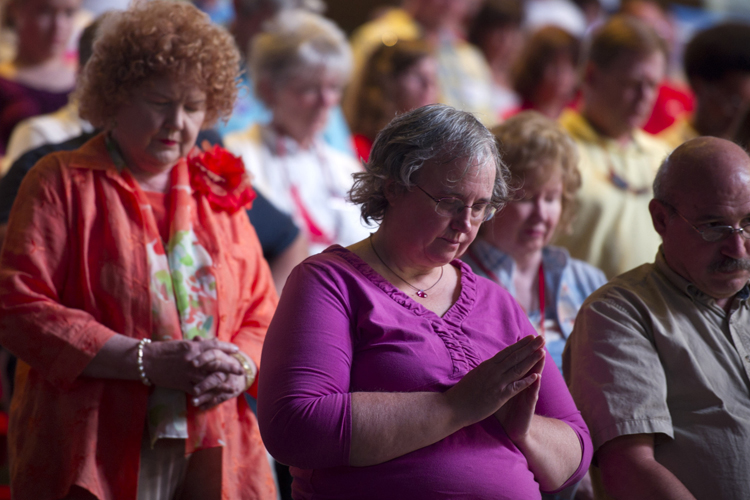

Will the prayers of Iowa voters be answered? (Credit: Reuters/Daniel Acker)
Having previously taught for some years in Cedar Falls, Iowa, we can claim up-close knowledge of a culture that the media has inspected, prodded, polled and broken bread with, day after day, for many months. The Iowa caucus has revealed a widespread affinity for “family values” – who would’ve thunk it? Or maybe it’s as predictable as the pledge of allegiance.
Rick Santorum’s fireside sweater vests won in Iowa. Santorum’s family man uniform vied successfully with Mitt Romney’s mechanical corporate image, Ron Paul’s icy charm, and Michele Bachmann’s 6,000 foster children. Portentously (and meaninglessly) defining his campaign as the “cause of liberty,” Santorum ended his valedictory speech after midnight the same way he began it: talking about his wife and kids and “the dignity of the womb.”
The current model of conservative campaigning shows that there are two Americas. We’re not so much talking about the haves and have nots, although many minds have been so twisted as to imagine that the 2012 contest is between capitalism and socialism. Rather, it’s Apple vs. Apple Pie, and open-minded, 21st-century creativity vs. a more repressive, small town “Happy Days” routine, where “Leave It to Beaver” families flourish. If you want to reexperience the 1950s, there’s still a taste of it in Iowa. They’re not all stay-at-home moms, but the celebration of “true conservative” breeding has yet to contend honestly with its bastard brother: blindness to the dysfunctional family writ large that is America.
So many of the Iowans interviewed on TV amid the Santorum surge focused on the “values” he ostensibly lives by. He who has bred the most children is the best candidate, and American values win. It seems to be that simple for the values voters. You choose a president not because he is best equipped or qualified for the job, but because his “family-oriented” positions make him the most qualified. As the nation’s chief executive, Santorum would keep Jesus in Christmas, and everything else good will flow from there.
The real problem facing “values voters” is that what they believe in is a humongous lie. The yearning for a “forever ’50s” churchgoing America overlooks a moral hypocrisy, no less profound than that of Romney supporters who are convinced that 1 percenter greed is no more than a blip on the radar, and business will save America from socialism. The Republicans’ Iowa advertising assault revealed a cynical depravity of unprecedented proportions – at least since the monopoly-led Gilded Age. And all of this as we were going through the “season of giving,” with its hopeful Christmas message of love and harmony.
What better proves that America has lost its moral compass than the campaigning in Iowa?
Santorum gained ground in Iowa as Gingrich’s past caught up with him. But are Rick’s ideas of family values healthier than, say, your garden-variety loving gay parents, whom he rails at for their immorality? Rick Perry was so desperate for votes that he fell in lockstep with conservative darling Mike Huckabee by declaring that he now believes that abortion should not be allowed in cases of incest. Not that Perry is known for his sharp thinking, but, really, is this the moral high ground? Who are the victims of incest? Children – young girls manipulated and raped by their fathers. Given the ongoing Penn State controversy, in which a football coach is on trial for raping young boys, it is deeply disturbing that children are being used as political pawns. Is it less heinous for a father to rape his daughter than for a coach to rape a boy? Is forcing a young girl to give birth really a principled stand based on family values?
So, what qualities are “values voters” really looking for? Americans’ ideal man of presidential character has always been the first president, George Washington. Never mind that the real Washington was a hungry speculator in land, an aloof man with a hot temper, who made sure his aides saw to it that no other general upstaged him. He was, in fact, universally admired for his detachment, civility and sacrifice.
Washington was fortunate in not having to run against anyone when he stood for the highest office in the land. About as fast on his feet as Rick Perry after a long night, he did not know the first thing about engaging in clever repartee. He studiously worked at concealing his volatile temper, and learned, step by step, that governance required moderation rather than angry words. Washington became, in death, what Ronald Reagan has become to the Republican Party: a kindly, fatherly protector, distant head of the national family. But Washington himself would probably be heckled off the stage at a Republican presidential debate.
Do we need more proof our values are disappearing? Thanks to the Supreme Court decision in Citizens United, we are less and less of a democracy. Flag pin-bearing Republicans constantly proclaim us the “freest people in the world,” when, in fact, the power of the franchise actually means less than it has in ages. The absurd districts created by gerrymandering limit change in Congress. Corporate giants write arbitration clauses into contracts that make it impossible for their ugliest abuses to get an airing in court. CEOs and their political allies are enriched, and decent people are crushed under the weight of greed’s power. Blindly proclaiming ourselves “the freest people in the world” has become as much of a fairy tale as young George Washington’s cherry tree chopping.
In “A Christmas Carol,” the lessons Dickens provides are timely and enduring. Moral worth is measured, as Scrooge came to learn, through the joy of giving, whether in providing charity for the poor, insuring a fair living wage for Bob Cratchit and others of his caste, or paying for medical care for Tiny Tim and the daily multiplying millions. Lest we forget Tiny Tim, Santorum closed his victory speech Tuesday night by celebrating his own special needs toddler, supplying the “God bless” himself. But a few weeks earlier, would the Tea Party crowd have cheered if Ron Paul were asked whether Tiny Tim should wither and die because he lacked health insurance?
Genuine moral values do not have to be broadcast. And have we not yet learned that adherence to a particular religious creed or membership in a church does not insure moral action? As Thomas Jefferson contended, believing in 20 gods or no god “neither picks my pocket nor breaks my leg.” Morality can only be measured by a good life, he insisted. For that observation, the social conservatives of his day branded him a Bible-burning atheist.
Those Christmas tales Americans watched last month are simple but not banal. In “It’s a Wonderful Life,” George Bailey is saved because his friends and neighbors recognized his years of selfless devotion to their small town. In the political atmosphere of today, however, as rewritten for the Iowa caucuses, cranky old Mr. Potter – not the popular, generous-spirited George Bailey – would be running for the nomination, and, at least for a week or two, garnering 30 percent of the vote for having vigorously protested “government handouts” while excoriating the deadbeats he had to throw out of their rental units in Pottersville.
As Mr. Potter — or the departed Ms. Bachmann — would tell you, go help yourself instead of protesting against the bankers who tanked the economy. And stop looking to government, which is uniformly wasteful and inefficient, and won’t do you any good by injecting itself into your life and depriving you of your freedom. It’s corporate America that works for you. Even if it doesn’t respect you.
So, if these are conservative Republican pro-family moral values, what exactly does “pro-family” mean? And are these “values”?
Andrew Burstein and Nancy Isenberg are Professors of History at Louisiana State University and coauthors of "Madison and Jefferson." (Random House, 2010).
More Andrew Burstein, Nancy Isenberg.
Now that Mitt Romney is the presumptive nominee of the Republican Party, the media is already handicapping the presidential election big time, and the neck-and-neck opinion polls are pouring in. But whether President Obama gets his second term or Romney enters the Oval Office, there’s a third candidate no one’s paying much attention to, and that candidate is guaranteed to be the one clear winner of election 2012: the U.S. military and our ever-surging national security state.
The reasons are easy enough to explain. Despite his record as a “warrior-president,” despite the breathless “Obama got Osama” campaign boosterism, common inside-the-Beltway wisdom has it that the president has backed himself into a national security corner. He must continue to appear strong and uncompromising on defense or else he’ll get the usual Democrat-as-war-wimp label tattooed on his arm by the Republicans.
Similarly, to have a realistic chance of defeating him — so goes American political thinking — candidate Romney must be seen as even stronger and more uncompromising, a hawk among hawks. Whatever military spending Obama calls for, however much he caters to neo-conservative agendas, however often he confesses his undying love for and extols the virtues of our troops, Romney will surpass him with promises of even more military spending, an even more muscular and interventionist foreign policy, and an even deeper love of our troops.
Indeed, with respect to the national security complex, candidate Romney already comes across like Edward G. Robinson’s Johnny Rocco in the classic film Key Largo: he knows he wants one thing, and that thing is more. More ships for the Navy. More planes for the Air Force. More troops in general — perhaps 100,000 more. And much more spending on national defense.
Clearly, come November, whoever wins or loses, the national security state will be the true victor in the presidential sweepstakes.
Of course, the election cycle alone is hardly responsible for our national love of weaponry and war. Even in today’s straitened fiscal climate, with all the talk of government austerity, Congress feels obliged to trump an already generous president by adding yet more money for military appropriations. Ever since the attacks of 9/11, surging defense budgets, forever war, and fear-mongering have become omnipresent features of our national landscape, together with pro-military celebrations that elevate our warriors and warfighters to hero status. In fact, the uneasier Americans grow when it comes to the economy and signs of national decline, the more breathlessly we praise our military and its image of overwhelming power. Neither Obama nor Romney show any sign of challenging this celebratory global “lock and load” mentality.
To explain why, one must consider not only the pro-military positions of each candidate, but their vulnerabilities — real or perceived — on military issues. Mitt Romney is the easier to handicap. As a Mormon missionary in France and later as the beneficiary of a high draft lottery number, Romney avoided military service during the Vietnam War. Perhaps because he lacks military experience, he has already gone on record (during the Republican presidential debates) as deferring to military commanders on decisions such as whether we should bomb Iran. A President Romney, it seems, would be more implementer-in-chief than civilian commander-in-chief.
Romney’s métier at Bain Capital was competence in the limited sense of buying low and selling high, along with a certain calculated ruthlessness in dividing companies and discarding people to manufacture profit. These skills, such as they are, earn him little respect in military circles. Compare him to Harry Truman or Teddy Roosevelt, both take-charge leaders with solid military credentials. Rather than a Trumanesque “the buck stops here,” Romney is more about “make a buck here.” Rather than Teddy Roosevelt’s bloodied but unbowed “man in the arena,” Romney is more bloodless equity capitalist circling high above the fray in a fancy suit.
Consider as well Romney’s five telegenic sons. It’s hard to square Mitt’s professions of love for our military with his sons’ lack of interest in military service. Indeed, when asked about their lack of enthusiasm for joining the armed forces during the surge in Iraq in 2007, Mitt off-handedly replied that his sons were already performing an invaluable national service by helping him get elected.
An old American upper class sense of noblesse oblige, of sons of privilege like George H.W. Bush or John F. Kennedy volunteering for national service in wartime, has been dead for decades in our otherwise military-happy country. When it comes to sending American sons (and increasingly daughters) into harm’s way, for President Romney it’ll be another case of chickenhawk guts and working-class blood.
For election 2012, however, the main point is that the Romney family’s collective lack of service makes him vulnerable on national defense, a weakness that has already led Mitt and his campaign to overcompensate with ever more pro-military policy pronouncements supplemented with the usual bellicose rhetoric of all Republicans (Ron Paul excepted). As a result, President-elect Romney will ultimately find himself confined, cowed, and controlled by the national security complex — and he’ll have only himself (and Barack Obama) to blame.
Obama, by way of contrast, has already shown a passion for military force that in saner times would make him invulnerable to charges of being “weak” on defense. Fond of dressing up in military flight jackets and praising the troops to the rafters, Obama has substance to go with his style. He’s made some tough calls like sending SEAL Team 6 into Pakistan to kill Osama Bin Laden; using NATO airpower to take down Qaddafi in Libya; expanding special ops and drone warfare in Afghanistan, Yemen, and elsewhere, including the assassination of U.S. citizens without judicial process. America’s Nobel Peace Prize winner of 2009 has become a devotee of special forces, kill teams, and high-tech drones that challenge the very reality of national sovereignty. Surely such a man can’t be accused of being weak on defense.
The political reality, of course, is different. Despite his record, the Republican Party is forever at pains to portray Obama as suspect (that middle name Hussein!), divided in his loyalties (that Kenyan connection!), and not slavish enough in his devotion to “underdog” Israel. (Could he be a crypto-Muslim?)
The president and his campaign staff are no fools. Since any sign of “weakness” vis-à-vis Iran and similar enemies du jour or any expression of less than boundless admiration for our military will be exploited ruthlessly by Romney et al., Obama will continue to tack rightwards on military issues and national defense. As a result, once elected he, too, will be a prisoner of the Complex. In this process, the only surefire winner and all-time champ: once again, the national security state.
So what can we expect on the campaign trail this summer and fall? Certainly not prospective civilian commanders-in-chief confident in the vitally important role of restraining or even reversing the worst excesses of an imperial state. Rather, we’ll witness two men vying to be cheerleader-in-chief for continued U.S. imperial dominance achieved at nearly any price.
Election 2012 will be all about preserving the imperial status quo, only more so. Come January 2013, regardless of which man takes the oath of office, we’ll remain a country with a manic enthusiasm for the military. Rather than a president who urges us to abhor endless war, we’ll be led by a man intent on keeping us oblivious to the way we’re squandering our nation’s future in fruitless conflicts that ultimately compromise our core constitutional principles.
For all the suspense the media will gin up in the coming months, the ballots are already in and the real winner of election 2012 will be the national security state. Unless you’re a denizen of that special interest state, we know the loser, too. It’s you.
William J. Astore, a retired lieutenant colonel (USAF), is a TomDispatch regular. He welcomes reader comments at <em>wjastore@gmail.com. To listen to Timothy MacBain’s latest Tomcast audio interview in which Astore discusses how the two presidential candidates are sure to out-militarize each other in the coming election campaign, click here or download it to your iPod here.
Recently, Mitt Romney used a conversation he had with a firefighter as part of his campaign pitch. “I spoke with a fireman yesterday, and he has a one-bedroom apartment, and his wife is pregnant, and he can’t afford a second bedroom,” he told an audience in Virginia. “I asked the firefighters I was meeting with, about 15 of them, how many had had to take another job to make ends meet, and almost every one of them had.”
Just because Romney is a fan of firemen doesn’t mean that firemen are fans of Romney, however: pick a random donor from the Obama and Romney campaigns, and the Obama donor is 10 times as likely to be a firefighter. How do we know this? From campaign finance disclosure data. As it turns out, campaigns must make “best efforts” to obtain the occupation and employer of anyone who contributes more than $200.
With over 500,000 contributions to the 2012 Romney and Obama campaigns, these contributions represent a lot of money ($177 million, to be exact) and a ton of fascinating data. By counting how often certain job titles appear in these disclosures, we can create a data-driven summary of the degree to which different professions support each candidate. For example, contributions to President Obama’s campaign are 80 percent more likely to be from dancers than those to Gov. Romney’s. And even though Obama enjoys nearly a 30 percent lead with physicians, surgeons favor Romney by almost 200 percent.
An important note on these figures: in the 2012 election cycle, Obama has received the lion’s share of reported contributions (445,000 vs. Romney’s 90,000), although the total amount raised via individual contributions is much closer ($100 million vs. $77 million). Therefore, the numbers in this article reflect the percentage of a candidate’s contributions associated with a particular job title, not the absolute count — because Obama simply has a much larger sample of job titles. Additionally, while I’ve tried to match synonymous titles wherever possible, there may be a slight bias embedded in the self-reporting of titles.
Some of the conclusions drawn from this analysis confirm what we already know. First, that retirees are very active politically, accounting for about a quarter of the donations to both campaigns. Since retirees dwarf every other category, they are excluded from the graphs below. Also unsurprising is that executives and financial professionals are more likely to donate to the Romney campaign, while academics, creative professionals and workers in unionized professions favor Obama. For every contribution to Romney’s campaign, Obama receives (again, on a relative basis) 3.12 from architects, 2.65 from designers, 2.37 from those in advertising, and 1.96 from art dealers. By contrast, for every contribution to Obama’s campaign, Romney sees 16.22 from investment bankers, 4.85 from financial advisors, 3.63 from CFOs, and 3.21 from CPAs.
Let’s look at the top professions that have contributed to each campaign. We immediately notice a few interesting trends. The top three positions for both campaigns are identical, though in a slightly different order: homemakers, attorneys and physicians. The next six positions, however, are wildly different. And, in a remarkable contrast, the “not employed” make Obama’s list, while the “self-employed” make Romney’s:
Credit: Benjamin Wheelock
Medicine is one category that turns up some of the more skewed title-by-title results. Among those who list “doctor” or “physician” anywhere in their occupation, Obama receives 142 percent of the donations directed to Romney’s campaign on a relative basis. An insignificant number of these are “postdoctoral fellows” or the like. Even more strikingly, nurses give to Obama 617 percent more often. Yet Romney still has something to smile about: he sees, relatively, 145 percent more donations than Obama from dentists and 196 percent more from anesthesiologists. Surgeons, neurosurgeons, and podiatrists also prefer Romney, by 186 percent, 456 percent and 702 percent, respectively. Curiously, optometrists see things evenly, as do radiologists.
There are some specific professions that show a slight and surprising — to me, at least — skew. Bus drivers steer slightly toward Romney (by 32 percent), as do pilots (24 percent) and police officers (49 percent). Obama received contributions from 28 people with “Mary Kay” in their title, compared to Romney’s one. Barbers would prefer to trim Obama from the ticket … (sorry, these puns write themselves). Some other pro-Romney professions: appraisers, locomotive engineers, jewelers and coal miners. Those favoring Obama include travel agents, truck drivers, librarians and diplomats.
Credit: Benjamin Wheelock
In many cases, an entire sector skews strongly toward one candidate, yet shows some subtle differences on a more specific position-by-position basis. Across technical roles, for example, programmers, software engineers and those with “IT” in their title give to Obama about five times as frequently, while database and “Web” professionals are doubly pro-Obama. Similarly, those in academia tilt heavily toward Obama — Romney donors are 15 percent as likely to be professors as Obama donors, although that figure jumps to 50 percent for economists and 74 percent for mathematicians. Interestingly, no philosophy or English professors gave to the Romney campaign.
If you’re interested in seeing the data for yourself, head over to the FEC website where you can download comprehensive information for President Obama and Gov. Romney. Though, if you do — and if your job title includes the word “data” or “analyst” — keep in mind that your peers make up a 112 percent larger share of Obama contributors.
Former Obama auto “czar” Steve Rattner stepped on his old boss’s message a little Monday morning, telling the folks on “Morning Joe” that President Obama’s just-released ad blasting Mitt Romney’s Bain career was “unfair.” As Rattner explained: “Bain Capital’s responsibility was never to create 100,000 jobs, or some other number, it was to make profits for its investors.” Rattner is a big Democratic Party donor who worked at Lehman Brothers before starting his own private equity firm, Quadrangle (where he was accused of participating in a New York state pension fund kickback scheme and paid millions of dollars in settlements without admitting wrongdoing).
Rattner’s reaction to Obama’s tough Bain ad shows why Democrats have had a hard time capitalizing on anti-Wall Street sentiment among worried, screwed-over American voters: because for the last 20 years, at least, they’ve too often done Wall Street’s bidding almost as reliably as the GOP.
But Obama is to be praised for his aggressive rollout of RomneyEconomics.com, which features the new ads. The president is going to have a problem with voters who are not seeing signs of the economic recovery, particularly working-class whites who didn’t go to college. He probably can’t win a majority, but he has to defend his margin in 2008, when he did better with that group than John Kerry or Al Gore before him. He may not be able to do much before the election to make those voters feel less economic pain, but he can make clear that Romney would only make their pain worse. Because that’s what he’s done his whole career.
Obama’s new ad released Monday, which will run in the swing states of Iowa, Ohio, Pennsylvania, Virginia and Colorado, features laid-off workers from GST Steel in Kansas City describing how Romney’s Bain Capital acquired their employer and gutted it. GST went into bankruptcy in 2001, throwing 750 employees out of work with no health benefits and reduced pensions. Ultimately the federal government had to spend $44 million to bail out its pension fund. But Bain made $12 million on its original $8 million investment, along with another $4.5 million in “consulting fees.” This wasn’t an unusual situation for Bain: 22 percent of the company’s investments ultimately wound up in bankruptcy, but the company made healthy profits and consulting fees nonetheless.
“Bain Capital walked away with a lot of money that they made off this plant,” steel worker John Wiseman says. “We view Mitt Romney as a job destroyer.”
If that sounds familiar, that’s because Republican primary opponents Newt Gingrich and Rick Perry made similar charges against Romney. Obama’s ad accuses him of “vampire capitalism”; Perry accused him of “vulture capitalism.” Either one works for me. But the class warfare appeal didn’t seem to work in the GOP primary, where party leaders were more concerned about protecting business than trying to fake populism, and smacked down Gingrich and Perry for emulating Obama’s rhetoric. Will it work in November?
I think it will, as long as Obama combines it with practical proposals to ease the unemployment and underemployment crisis. One Wall Street Journal story that didn’t get enough attention last week found that if it wasn’t for public sector layoffs, the nation’s unemployment rate would be at roughly 7 percent. And those layoffs have been concentrated in red states, particularly Texas, Ohio, Wisconsin, Indiana, Michigan and Florida, where high-profile GOP governors have been spreading the pain on a state level that Paul Ryan would like to extend nationally. The nation’s unemployment crisis is at least partly a Republican production.
The economy is all Romney has against Obama. Just Monday morning, Romney spokesperson Andrea Saul falsely but energetically claimed that “Mitt Romney helped create more jobs in his private sector experience and more jobs as Governor of Massachusetts than President Obama has for the entire nation.” They’re brazen; they’ll keep repeating that without evidence. The most recent Gallup poll shows that 61 percent of voters say Romney would do a “good or very good job” with the economy if elected president. The CBS/New York Times poll released Monday showed Romney up over Obama by 3 points, with voters saying the economy was the most important issue to them. (The poll needs an asterisk because it’s following up with an earlier group of voters previously sampled, and only got in touch with two-thirds of them, which some analysts say could skew the results.)
But most voters haven’t tuned in to the presidential campaign yet. It’s important that Obama help those voters understand that Romney’s touted “experience” with the economy has more to do with job destruction than creation. The Obama ad features Romney saying, “I know why jobs come and why they go.” That last part is true. He certainly knows “why jobs go”: because guys like him make a fortune eliminating them.
I talked about the president’s new Bain Capital ad focus with Rep. Chaka Fattah on MSNBC’s “Politics Nation” with Rev. Al Sharpton:
Condoleezza Rice and Michael Bloomberg (Credit: AP)
Poor Americans Elect. The well-funded experiment in fielding a third-party presidential candidate selected by the Internet is this close to giving up. It doesn’t have a candidate. It was apparent back in March that none of the declared candidates would meet the threshold of support necessary to qualify it for the online primary votes scheduled for May. Since then, no white knight has emerged.
John Avlon, the “No Labels” co-founder and Daily Beast contributor, is very sad about the news. He reports that they nearly called it quits last week:
Late last week, leaders at the well-funded insurgent organization were planning to pull the plug entirely on this year’s effort. There was talk of focusing instead on building the organization at the local level going forward, following a model like Angus King’s independent Senate campaign in Maine. But this abandonment would be devastating to overall efforts that aim to inject increased independence and competition into the political process, effectively wasting the 2.5 million signatures the group collected to get on the ballot in 26 states to date.
Well, the signatures have already been wasted. (Much, much more wasted: Peter Ackerman’s money.) They were used to win ballot access for a vague idea. Vague ideas can’t be elected president.
Basically everyone not affiliated with No Labels finds the failure of Americans Elect amusing (so it has succeeded in uniting the Weekly Standard and Paul Krugman!), but I actually feel kind of bad for those Americans Elect goobers. It’s not their fault that Americans don’t actually want an independent moderate unity presidential ticket. (It is their fault that they spent $10 zillion pushing the idea.) But there is really no excuse for the bizarre belief that anyone wants Joe Lieberman to be president.
Yes, according to Kenneth Vogel, AE recently sought to interest the soon-to-be former senator from Connecticut in mounting a run on the AE ticket, because what Americans are crying out for is a moralizing hawkish lifelong politician with no fixed ideology beyond reflexive baby-splitting and bombing everywhere forever. (It also reached out to Lamar Alexander, because it is beyond parody.)
A lot of the more prominent AE supporters and many of the people involved in organizing the group are disillusioned Republicans — like former Giuliani speechwriter John Avlon and former Bush strategist Mark McKinnon — which helps explain why AE keeps going after people who only appeal to … disillusioned moderate Republicans.
AE dreamed that superstars like New York City Mayor Michael Bloomberg or former Secretary of State Condoleezza Rice would decide to jump into the race once AE did the hard work of securing ballot access. You may note that neither of those candidates represents a significant national constituency whose interests are currently being ignored by the two major parties. (Bloomberg is essentially an old-fashioned Eastern Establishment Republican, or, in other words, a modern moderate Democrat. He is maybe a hair to the right of Obama on economic issues. Condoleezza Rice has never revealed much about her domestic policy preferences, besides that she is pro-choice, but on foreign policy she is known for being one of the people who repeatedly told scary stories to America and Congress until we agreed to launch the Iraq war.) But the movement isn’t about policies at all: It’s about finding the party system distasteful and being narcissistic enough to imagine that some massive silent majority of Americans agrees with you about everything.
When Rice and Bloomberg declined their advances, various AE insiders moved on to begging David Walker to enter the race. (David Walker! Does anyone not currently riding the Acela to or from D.C. know who David Walker is?) AE will announce its future plans on Thursday. So, you know, there’s still time for Jon Huntsman to shake things up. Huntsman/Walker ’12!
Alex Pareene writes about politics for Salon and is the author of "The Rude Guide to Mitt." Email him at apareene@salon.com and follow him on Twitter @pareene
More Alex Pareene.
President Obama at Barnard College and Mitt Romney at Liberty University
(Credit: AP)
It’s come to this: “An incredibly boring white guy.” That was how a “Republican official familiar with the campaign officials” described the “prized pick” for Mitt Romney’s vice presidential candidate. Framed as the Romney campaign’s desire not to make John McCain’s mistakes, it distills something fundamental about this election — how it’s become a culture war in the most profound sense, one way of looking at the world diametrically opposed to the other.
This is not supposed to be the “change” election, and yet somehow we have an incumbent who, at a commencement address at Barnard just today, approvingly drew continuity from “Seneca Falls to Selma to Stonewall,” and talked about black and Latina girls seeing themselves in his administration. His challenger, meanwhile, visibly hopes same-old and presumed competence carry the day. There was so much in the 2008 election that scrambled the familiar calculus and allegiances – the young black man with the exotic upbringing against Hillary, the white boomer woman; and McCain, the only “white guy” in the picture, recruiting a guns-and-baby-toting Republican woman praising Title IX. But this week all you have to do is read Barack Obama’s speech at Barnard and Mitt Romney’s at Liberty University to see a dichotomy as stark as the one on either side of a picket line.
What mattered in Obama’s speech wasn’t the standard praise for his wife, mother or mother-in-law, or his hopes for his daughters. It was how he talked about the Constitution, of which he said, “Yes, it had its flaws — flaws that this nation has strived to perfect over time. Questions of race and gender were unresolved. No woman’s signature graced the original document.” But, he added, “What made this document special was that it provided the space — the possibility — for those who had been left out of our charter to fight their way in. It provided people the language to appeal to principles and ideals that broadened democracy’s reach. It allowed for protest, and movements, and the dissemination of new ideas that would repeatedly, decade after decade, change the world — a constant forward movement that continues to this day.”
It’s a formulation that sees the inclusion and participation of the excluded – even when the process is painful – as the consummation of the country’s ideals, not something from which it needs to be “taken back.” Contrast that with Romney at Liberty this weekend, in which he cited David Landes to declare that “Culture makes all the difference … Central to America’s rise to global leadership is our Judeo-Christian tradition, with its vision of the goodness and possibilities of every life.” There was the purposeful declaration that “marriage is a relationship between one man and one woman,” the shout-out to the anti-gay marriage Chick-fil-A founder and various clergy, the sermonizing. And crucially, there was an invocation of resentment, of persecution: “Your values will not always be the object of public admiration. In fact, the more you live by your beliefs, the more you will endure the censure of the world.” (Who’s supposed to play the politics of victimization, again?)
As for “incredibly boring white guy,” no one sentient would deny picking Palin was a mistake, but it wasn’t a mistake because she was a woman – the implication of that unnamed Republican’s comment, intended or not. It was a mistake because the McCain campaign thought demographics alone would give them the sheen of being transformative, and it blinded them to all else.
It’s not crazy to think that this time, safety and competence might appeal at a time of economic uncertainty. The Romney campaign didn’t create the supposition that a white guy is the standard, the safe and the certain, or that “diversity” is something you get one chance to try — even if they’re only too happy to exploit it. But in the end, from what can be determined from her wildly erratic public performance, Palin turned out to be a fairly conventional social conservative. (The erratic part ended up making all the difference.) This time around, Romney and his camp are manifestly uninterested in heeding what, per Newsweek’s headline today, “New Mexico’s Governor can teach the GOP.” That would be Susana Martinez, the first Latina governor, a pro-life, pro-gun Republican who differs from Palin in a crucial way: The worst thing a critic is quoted saying about her is that she’s “maintaining a competent, minimalist administration so there’s nothing to hang around her neck during the next campaign.” That sounds … incredibly boring, actually.
It’s not just being female and Latina that would set Martinez apart from the current GOP direction, though given their steady alienation of those groups, that’s not nothing. She’s chosen not to be a mother, off-message for a Republican moment that considers elaborate mother-worship an effective rejoinder to accusations of misogyny, and she has no patience for what little we know about Romney’s immigration stance (“‘Self-deport?’ What the heck does that mean?”).
But most significantly of all, she essentially dismisses the fiercest conservative dogma of the moment, calling the mantra of “lower taxes” “this five-liner of nothingness,” to Newsweek. The primary caretaker for a disabled sister, she says, “I believe in providing services to adults and children who can’t take care of themselves … Sometimes Republicans engage in number-crunching analysis that doesn’t always take the neediest into account.” It was a clear shot at the Ryan budget, an article of faith for Republicans – and a reminder that even when wrapped in social conservatism, there’s a whole other sort of radicalism at stake in this election.