
Immigration

GOP’s Latino problem gets worse

Romney's Spanish-language TV ads can't overcome the party's poor reputation among Hispanics

  • more
    • All Share Services

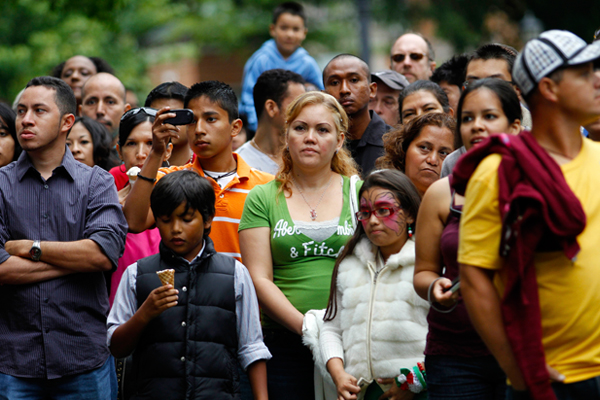
GOP's Latino problem gets worse How do you say 'Republican' in Spanish? (Credit: AP/AP/Jim R. Bounds)

“We have to fix our problems with the Hispanics,” said John McCain last week when asked by MSNBC’s Chuck Todd about the Republican Party’s competitiveness in the Southwest in the 2012 election.. “It starts with a way to address the issue of immigration in a humane and caring fashion, at the same time emphasizing the need to secure our borders because of the drug cartels and the people who transport people across our border and treat them terribly.”

A tip for McCain, front-runner Mitt Romney and other Republicans: drop the “the” in front of references to Hispanics. Use of the definite article sounds a bit too much like the cringe-worthy “that one” line McCain dropped on Barack Obama during their October 2008 presidential debate in Nashville, and smacks of the sort of “these/those people” phrases that only turn away the groups described. This week, Romney smartly released his first Spanish-language campaign ad, a positive sign. But language is only a small part of the GOP’s problems with minorities, and Latino voters in particular.

Democrats dominate among non-white groups, winning among African-Americans and Asian Americans as well as Latinos. In 2008 Obama carried 67 percent of the Latino vote, and even won the Cuban-American subset previously loyal to Republicans. For GOP presidential candidates, the party’s struggle to attract Latino voters is particularly troubling for two reasons. First, the Latino vote is significant and growing quickly, and will in the near future surpass African-Americans as the nation’s largest ethnic minority voting bloc. (Latinos already outnumber blacks as a share of the population.) Second, unlike in the South where white Republican performance rates can counterbalance African-Americans’ overwhelming support for Democrats, the Latino vote outside Florida and Texas tends to be concentrated in Southwestern states where the offsetting effects of white Republicans are often insufficient.

George W. Bush set the party’s standard for successful outreach and performance among Latinos. In 2004, exit polls indicated that a remarkable 44 percent of Latinos had voted for Bush. Minority voting experts believe this figure is inaccurately high, but there is general agreement that Bush came close if not breached the critical 40 percent national threshold. And there’s no doubt his Latino support in 2004 helped him win four key Southwestern states — Arizona, Colorado, Nevada and New Mexico — that either Bill Clinton or Al Gore had previously carried. By 2008, however, Obama swung all but McCain’s home state of Arizona back into the Democratic column, and did so rather comfortably, winning Colorado, Nevada and New Mexico by at least 9 percentage points.

What explains the Republicans’ swift reversal? Although other issues have contributed to the GOP’s struggles with Latino voters, the party’s strident opposition to immigration reform has poisoned the electoral well. From California’s Proposition 187 referendum in the 1990s to Arizona Gov. Jan Brewer’s signing of the most anti-immigrant law in the country in 2010; from the antics of crusading Maricopa County Sheriff Joe Arpaio to the state-level attempts to secure borders to denying benefits to immigrants or their children, conservative groups and their Republican allies are leading the anti-immigrant charge.

“The GOP’s reputation among Latinos is as bad as it has ever been, driven primarily by statements and state legislation on immigration,” Gary Segura, a Stanford political scientist, co-investigator on the National Latino Survey, and president of Latino Decisions polling firm, told me. “Though President Obama’s early inaction on immigration reform and his record deportations significantly undercut his support within the community, there is not a single Republican presidential candidate willing or able to exploit that weakness; they are all too busy tacking to the right to please their base.”

Only 17 percent of Latinos say that the Republican Party is doing a “good job,” according to a Latino Decisions poll taken last month. Forty-six percent agreed that the GOP “doesn’t care too much” and another 27 percent described the party as “hostile” to Latino interests. With a combined 73 percent of Latinos expressing generally or strongly negative attitudes to the party, the Republican nominee is almost guaranteed to win a minority of Latino votes in 2012.

The GOP needn’t carry the Latino vote to win presidential elections, so what matters are the splits nationally and in key states. Segura estimates that if Romney or any other Republican nominee fails to get 40 percent to 42 percent of the Latino vote nationwide, Obama will likely hold Nevada, Colorado and New Mexico, and possibly win Arizona without McCain at the top of the ticket. “Absent a significantly refocusing event — and not even [Florida Sen. Marco] Rubio as the vice-presidential choice is likely to meet that standard — I cannot envision a way for Romney or any of his rivals to do better than Sen. McCain did four years ago among this rapidly growing segment of the electorate.”

In fact, there’s a very real possibility that, despite Latino frustrations with the Obama administration, Romney may do worse this year than did his newfound ally McCain four years ago.

“The current dynamic among Latinos is mild disappointment with Obama but outright fear of the GOP,” wrote Simon Rosenberg, president of NDN, a center-left think tank known for its analysis of Latino politics, to me by email. “Obama’s numbers have held, and Romney’s are far below McCain’s from 2008. And given Romney’s firm embrace of the anti-immigrant wing of the GOP, it is very hard to see how he makes up lost ground in 2012.”

Purple Strategies political consulting firm partner Rob Collins disagrees. One of the co-creators of the Hispanic Leadership Network, Collins cites three reasons why Romney or whoever wins the GOP nomination has a strong chance to outperform McCain with Latino voters.

“First and most important, Obama’s weak polling transcends all ethnic distinctions,” Collins told me, echoing recent evidence that Obama’s support among Latinos is slipping, partly in response to the president’s record-setting deportation of illegal immigrants.

Second, says Collins, conservative groups like American Crossroads and the HLN, along with the Republican Party, have invested significant resources on outreach and messaging to the Latino community. Collins argues that Republican politicians and strategists, who he admits not long ago suffered from viewing the Latino vote monolithically — failing, for example, to distinguish among Mexican Americans, Cubans, Salvadorans, Dominicans, Puerto Ricans and other subgroups — now better understand the “nuances and differences” among these varied political sub-elements within the community.

Finally, Collins believes electoral success itself breeds success. “The Republican bench of Hispanic elected officials is deeper than ever,” he notes, citing the recent elections of Florida Sen. Marco Rubio, plus Govs. Brian Sandoval of Nevada, Susana Martinez of New Mexico and Louis Fortuno of Puerto Rico.

Collins does not deny the GOP’s problems on immigration policy, but contends that there is a significant and growing gap between the “reality” and “ideology” of anti-immigration reform. Although most conservatives undoubtedly favor taking strong action to secure America’s borders, most are less fervent about rounding up and deporting every illegal immigrant.

This tension between strident rhetoric and reasonable action was evident in the mixed response to Newt Gingrich’s call for a reasonable deportation and amnesty policy — comments that drew praise from the likes of Miami Herald columnist Andres Oppenheimer, but scorn from Republican hard-liners like Michele Bachmann. Collins predicts that Harry Reid and Senate Democrats will make a major immigration reform push at some point this summer or fall, not in order to actually pass legislation but to demonize the Republican ticket and split the party in the months before the general election.

As Republicans try to simultaneously please both the xenophobic elements within the conservative base and the Latino voters it needs to compete nationally, they may be tempted to seek a quick-fix solution, notably the selection of a Latino vice-presidential running mate. Symbolic shortcuts to demographic parity don’t necessarily work, of course, and may create as many problems as they solve. (Think of all the female independents and disgruntled Hillary Clinton supporters driven immediately and irreversibly to Obama’s candidacy after McCain in 2008 picked Sarah Palin as his running mate.)

But the choice of a young, smart, talented, swing-state rising star like Rubio — subject of a Ken Auletta feature piece in this week’s New Yorker — may not be a panacea for the GOP. Indeed, selecting him may only bring the party’s internal conflicts into fuller, public view. “Rubio’s ability to reach into the non-Cuban Hispanic vote is unproven,” says Rosenberg. “He does not do well with non-Cubans in Florida, and he has taken stances — no on Comprehensive Immigration Reform, the Dream Act, the appointments of [Supreme Court justice] Sonya Sotomayor and [Ambassador] Mari Carmen Aponte, and yes on English-only language — which in some ways put him to the right of Romney and arguably against the interests of those who must migrate to the United States in a traditional path, something Cubans do not have to do.”

John McCain is right: The GOP has a problem with “the” Hispanics. In general elections and especially during primaries, Republican candidates increasingly depend upon support and money from older, whiter voters who hold more reactionary views than younger Americans do toward minorities and immigrants. The intraparty conflicts that result could diminish over time, as the party replaces older voters with younger ones, and attitudes toward minorities soften, but only if the GOP doesn’t box itself into an electoral corner from which it cannot escape.

Thomas F. Schaller is professor of political science at the University of Maryland, Baltimore County and the author of "Whistling Past Dixie: How Democrats Can Win Without the South." Follow him @schaller67.

Florida purging voter rolls

Governor Rick Scott moves forward with a plan to disqualify thousands of mostly Hispanic and Democratic voters

  • more
    • All Share Services

Florida purging voter rollsRick Scott (Credit: Reuters/Brendan McDermid)

Hated Florida Governor Rick Scott has a great idea: A big, massive purge of the state’s voter roll right before a sure-to-be-close presidential election. The governor ordered his secretary of state to compile a list of registered voters who might not be citizens, based on an unreliable and out-of-date state motor vehicle administration database. The secretary of state made a list and then realized the list was not actually very useful or accurate. Then he resigned, and now Scott is just purging away.

Some people (communists) have noted that the timing of this big voter roll purge is a bit suspect and that it’s also weird that the vast majority of people on the list are Hispanics who are registered Democrats or independents. But as hero-senator Marco Rubio said recently of voter ID laws, “What’s the big deal?” Hundreds of the 1,638 people flagged as ineligible in Miami-Dade County have already offered proof of citizenship, so the system works. Let’s assume the 1,200 people who haven’t responded to the letter are all definitely not qualified.

(If I were an illegal immigrant, do you know what I would definitely not ever try to do? Vote! When you’re evading detection by the government, registering to vote and then casting a ballot — and in the process committing a felony — seems like asking for trouble.)

As must always be pointed out when writing about these sorts of things, there is no voter fraud epidemic. At all. Where there is genuinely illegal voting, it tends to be accidental or so small-scale as to present no challenge to the legitimacy of an election. The liberal position on election security is something like, “Better to let a couple of isolated instances of fraudulent or improper voting happen than to preemptively disenfranchise hundreds or even thousands of perfectly legal voters.” The conservative position tends to be, “We mustn’t let the Mexicans steal the election for the nanny state socialists ACORN ACORN BILL AYERS ACORN.”

Here’s the Tampa Bay Times with more on Florida’s war on (certain people) voting:

This is part of a pattern. Republicans actively gin up voter fraud claims to justify turning voting into an obstacle course to dissuade Democratic-leaning constituencies. It’s what happened in Florida last year when the Legislature used voter fraud as an excuse to cut early voting days and make it harder for renters and college students to vote a regular ballot. The most disgraceful part of the law imposes steep penalties and fines on groups conducting voter registration drives that fail to meet burdensome bureaucratic rules and turn forms in within 48 hours, causing the League of Women Voters to cancel its drive.

But if we let renters vote, why would anyone buy a house? Then how would we save the economy?

Don’t worry, though, it will still be very easy for… certain other kinds of people to cast votes:

Meanwhile, there was no attempt by the Florida Legislature to tighten rules for absentee voting, which is probably the easiest way to produce a fraudulent ballot since there is no way of knowing who fills it out. Maybe this lack of interest stemmed from the fact that absentee voters tend to lean Republican, while early voters typically lean Democrat.

Well. Now that I know how easy it is to absentee vote in Florida, I am off to commit some voter fraud with my illegal immigrant friends. Next stop, Sharia!

Continue Reading Close
Alex Pareene

Alex Pareene writes about politics for Salon and is the author of "The Rude Guide to Mitt." Email him at apareene@salon.com and follow him on Twitter @pareene

Will Latinos elect Obama?

Hispanic voters may not be as decisive a voting bloc as everyone assumes. Just look at the swing states

  • more
    • All Share Services

Will Latinos elect Obama?(Credit: AP/Jae C. Hong)

The conventional wisdom is that the growing Latino vote is key to President Obama’s reelection prospects. By all accounts, Latinos favor the president over Mitt Romney by wider margins than they favored him over John McCain in 2008, when he won two-thirds of the Hispanic vote and captured crucial swing states with large Hispanic populations, including Colorado, Nevada and Florida. Bloomberg reported this week that lower-than-average unemployment in the key battleground states “coupled with the growth of adult minority populations in those states create a higher bar” for Romney in his quest to oust the incumbent.

But a closer look at the numbers is not so reassuring for the president. Much of the growth in the Latino population has occurred in California, Texas, Illinois and New York, which are not likely to be competitive come Election Day. While the Latino population is growing fast, the Latino electorate is not. Compared to other ethnic/racial groups, Latinos are more likely than whites to be under 18 years of age or to be non-citizens. “For every 100 Hispanic residents in the United States, only 44 are eligible voters aged 18 and over and U.S. citizens,” notes William Frey, demographer at the Brookings Institution. “In contrast, 78 of every 100 white residents are able to vote.”

Frey has argued that “minorities will decide” the 2012 election, but he acknowledged in a telephone interview that Latinos, as a group, do not loom large in most of the dozen battleground states. According to his analysis of 2008 and 2012 census data, Latinos comprise less than 2 percent of the voting population in Ohio and Virginia. In North Carolina, New Hampshire and Iowa, they comprise 3 percent or less of the electorate. In Wisconsin, they comprise 3.1 percent of voters, down from 3.7 percent in 2008.  Even if Obama won an additional 10 percent of the Latino electorate in these states over what he did against McCain, the increase would be smaller than his margin of victory in 2008 in every case.

That leaves Florida, Nevada, New Mexico and Colorado, where the Latino vote appears to be large enough to be decisive in a close race. The good news for Obama is that many of those states could make the difference between winning and losing the White House. The bad news is that the outlook is distinctly less favorable to a more decisive Latino role than 2008.

As Frey has noted:

Minorities mattered in 2008 for three reasons: first, their relative sizes compared with whites increased in each state; second, their enthusiasm for the Democratic candidate was greater than in 2004; and third, white support for the Republican candidate (John McCain) waned in comparison to the previous election.

None of those factors appear to hold true in Florida. Latinos comprise about 15 percent of the state’s voters, unchanged from 2008. While a Gallup swing state poll earlier this month found Democrats are more enthusiastic about the president than Republicans are about Romney, they are also less enthusiastic about Obama’s candidacy now than they were in 2008, especially minority voters. As Real Clear Politics  has noted:

Enthusiasm among non-white voters is down from 74 percent at this point in 2008 (vs. 58 percent for whites) to 48 percent today (the same goes for whites). And, indeed, in 2010, African-American turnout reverted to the mean. If this occurs in 2012, Democrats will need a massive surge in the minority population elsewhere to make up for this regression.

The most likely place for this to occur is within the Latino community. That population grew smartly over the 2000s. But — much less remarked upon — the Latino electorate did not. Indeed, since 2004, it has been almost perfectly flat, and it contributed only marginally to the decline of the white vote from 2004 to 2008.

Only in the three swing states of the Southwest — New Mexico, Nevada and Colorado — does the Latino vote seem big enough to be decisive. In New Mexico, Latinos are 38 percent of the electorate, down slightly from 2008. In Nevada, Latinos are now 17.3 percent of all voters, up from 13.3 percent from four years ago. And in Colorado, Latinos are now 12.1 percent of all voters, up from 11.3 percent in 2008.  Only in these states does the combination of the size and growth of the Latino electorate and Obama’s edge on Romney appear capable of giving him a margin of victory he might otherwise lack. In the rest of the swing states, he’s going to need something else.

Continue Reading Close
Jefferson Morley

Jefferson Morley is a staff writer for Salon in Washington and author of the forthcoming book, Snow-Storm in August: Washington City, Francis Scott Key, and the Forgotten Race Riot of 1835 (Nan Talese/Doubleday).

Rep. Steve King: Immigrants are like dogs

Updated: On Monday, the Iowa GOP rep used a degrading metaphor to describe how America should select immigrants

  • more
    • All Share Services

Rep. Steve King: Immigrants are like dogsSteve King (Credit: Reuters/Larry Downing)

[Updated below]

Rep. Steve King, R-Iowa, compared immigrants to dogs at a town hall meeting yesterday, telling constituents that the U.S. should pick only the best immigrants the way one chooses the “pick of the litter.”

King told the crowd in Pocahontas, Iowa, that he’s owned lots of bird dogs over the years and advised, “You want a good bird dog? You want one that’s going to be aggressive? Pick the one that’s the friskiest … not the one that’s over there sleeping in the corner.”

King suggested lazy immigrants should be avoided as well. “You get the pick of the litter and you got yourself a pretty good bird dog. Well, we’ve got the pick of every donor civilization on the planet,” King said. “We’ve got the vigor from the planet to come to America.” The liberal research group American Bridge captured the comments:

King has long been one of Congress’ most vociferous and toxic opponents of illegal immigration and “amnesty,” often partnering with notorious immigration hawks like former congressman Tom Tancredo and Maricopa County, Ariz., Sheriff Joe Arpaio. In 2010, he took to the House floor to declare that he could detect “illegals” by their footwear and his “sixth sense.”

Lately, however, King has backed off his inflammatory rhetoric, thanks to a tough challenge from Democrat Christie Vilsack. His bird dog comments suggest, however, that his mouth will continue to dog him.

Update: In a statement, Vilsack’s campaign said, “If we’re going to have a real discussion on immigration, we should start by acknowledging that immigrants are human beings. Iowans are taught in their community, in their church, and at the dinner table to respect each other, not to compare people to dogs. People expect a serious discussion between candidates and that’s what we’re committed to.”

Continue Reading Close

Alex Seitz-Wald is Salon's political reporter. Email him at aseitz-wald@salon.com, and follow him on Twitter @aseitzwald.

Mitt’s new Latino hurdle

The conservative Hispanic group Romney will address this week once slammed "right-wing extremists" on immigration

  • more
    • All Share Services

Mitt's new Latino hurdleMitt Romney (Credit: AP)

As part of an effort to win back Latino voters, Mitt Romney will address a conservative Latino business group this week that has advocated immigration policy views in stark contrast to his own. Romney’s “self-deportation” policy put him well to the right of many of his GOP primary challengers, and the Latino Coalition once slammed “right-wing extremists” who opposed comprehensive immigration reform.

The presumed GOP nominee’s Wednesday speech to the Latino Coalition comes as polls show Romney way behind President Obama among Latino voters and with little hope of capturing the 44 percent of the bloc George W. Bush won in 2004, a highwater mark for the GOP.  Even New Mexico Gov. Susana Martinez (R) — whom Romney floated as a potential vice-presidential choice — mocked the presumed GOP’s immigration policy last week.

The Romney campaign’s response has been that immigration is irrelevant to winning over Latino voters — jobs and the economy are the only things that matter. But his speech this week underscores just how difficult an argument that will be for him to make: In the past, the Latino Coalition has argued that immigration reform is part of a pro-business platform, not separate from it.

These days, the only immigration issue the Coalition mentions on its website is the “Mexican Trucking issue.” But the group aggressively advocated for comprehensive immigration reform under President Bush. In 2007, the Coalition’s president slammed “far right extremists” who opposed “common-sense [immigration reform] legislation that is so important for the security and economic vitality of our country.” The group “urge[d] Speaker Nancy Pelosi (D-CA) and the Democratic leadership in the House to demonstrate courage and leadership on this issue and take on immigration reform,” saying Pelosi could pass a bill “without the level of Republican support she is demanding.”

In the 2008 GOP primary, the Latino Coalition favored Rudy Giuliani — a veritable leftist on immigration reform compared to most Republicans — with the former New York mayor capturing 64 percent of the vote in a straw poll of the group’s members. Romney apparently finished behind Sen. John McCain and former Sen. Fred Thompson, as his name was not mentioned in the statement.

Meanwhile, the Chamber of Commerce, whose grand D.C. offices will host the event Wednesday, also supported comprehensive reform under Bush, similarly seeing it as a boon for free market capitalism. The powerful business lobby still calls for “an effective and streamlined temporary worker program so that employers can hire immigrant workers” and “a pathway to legal status for undocumented workers currently in the United States.”

This was essentially Bush’s policy too. But Romney’s infamous immigration advisor, Kansas Secretary of State Kris Kobach, who authored the draconian anti-immigration laws in Arizona and Alabama, said his candidate would not support any kind of pathway to legalization for undocumented immigrants.

The Romney campaign briefly attempted to disown Kobach after Romney won the primary and the advisor’s utility was spent, but he may have to throw his entire immigration policy under the bus with Kobach if he hopes to win over the Latino business owners on Wednesday, let alone Hispanic voters more generally.

Continue Reading Close

Alex Seitz-Wald is Salon's political reporter. Email him at aseitz-wald@salon.com, and follow him on Twitter @aseitzwald.

Obama’s broken immigration promise

ICE said it would target dangerous immigrants, but it's actually deporting a higher percentage of non-criminals

  • more
    • All Share Services

Obama's broken immigration promiseA man in Ciudad Juarez, Mexico, stands next to the border fence as two U.S. law enforcement officers look on from the U.S. side of the fence. (Credit: AP/Raymundo Ruiz)

The Obama administration claims that it is deporting record numbers of illegal immigrants while focusing on those with criminal records. But new data from Immigration and Customs Enforcement shows that the number of deportation orders has declined dramatically since last summer and non-criminals comprise a growing percentage of those expelled from the country.

That wasn’t supposed to happen under a policy of “prosecutorial discretion” announced by ICE director John Morton last June. The goal of the policy, announced with much fanfare in the Spanish language media, was to spare “longtime lawful residents” from deportation and to focus on criminals.

Since then, the adminstration has deported many fewer non-criminal aliens. But non-criminals remain the vast majority of those deported. And those with no criminal record now actually comprise a slightly larger percentage of those forced to leave the country than they did before Morton’s announcement.

In the three months before the policy was announced last summer ICE filed for deportation proceedings against 61,192 people of whom 15 percent had criminal records. In the first three months of 2012, ICE sought 37,659 deportations orders, 14 percent of which involved people with criminal records.

“The agency continues to be headed in the opposite direction of its stated goals,” said Susan Long, co-director of the Transactional Records Access Clearinghouse at Syracuse University, which collected the data from ICE via a Freedom of Information Act request.

The goal of prosecutorial discretion, Long said in a conference call with reporters, “was to target and bring before the court those with more serious criminal history. As yet we’re not seeing any change. They have not turned the ship around.”

The administration implemented prosecutorial discretion in response to complaints that young people with no criminal records continue to face deportation. But the new data will come as no surprise to student groups such as United We Dream, National Immigrant Youth Alliance and DreamActivist, which continue to highlight the cases of law-abiding young people facing deportation.

Rep. Luis Gutierrez, D-Ill., has championed the case of a South Carolina man, Gabino Sánchez, a married father of two, who was arrested for driving without a license last year and now faces deportation.

“Gabino Sánchez has lived and worked and raised a family here for more than a decade and it is not in anyone’s interest to have him deported,” Rep. Gutierrez told Fox News Latino on Tuesday after a deportation hearing in North Carolina.  ”I do not understand why ICE has not followed President Obama’s guidelines and decided to move on from this case to go after someone else, someone who is a threat to his community or a serious criminal.”

In response to the TRAC findings, Gutierrez  said, “The president should make sure the Department of Homeland Security is actually following its own rules and he should proclaim proudly and loudly that he will not deport another DREAMer or anyone else who fits the prosecutorial discretion criteria.”

Continue Reading Close
Jefferson Morley

Jefferson Morley is a staff writer for Salon in Washington and author of the forthcoming book, Snow-Storm in August: Washington City, Francis Scott Key, and the Forgotten Race Riot of 1835 (Nan Talese/Doubleday).

Page 1 of 69 in Immigration