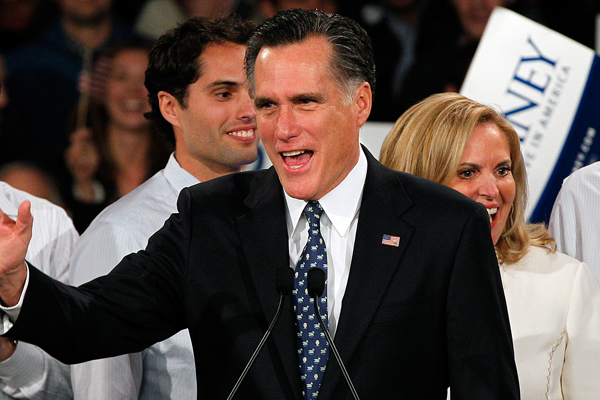

MANCHESTER, N.H. — Mitt Romney got everything he could have hoped for out of New Hampshire on Tuesday night.
He won decisively, improved on his 2008 showing in the state, and was declared the winner very early in the night, allowing him to deliver a triumphant, Obama-bashing speech in front of the largest possible television audience. He also neutralized a potential threat, Jon Huntsman, who failed to post the breakout performance he was counting on and who may not be long for the race now, and saw the two candidates vying to serve as the right’s default anti-Romney candidate — Newt Gingrich and Rick Santorum — finish in a virtual tie for a distant, meaningless fourth place. Oh, and he can also now boast of an achievement that has eluded every other Republican presidential candidate in the modern campaign era, including Ronald Reagan: the Iowa/New Hampshire one-two punch.
Romney’s reward for all of this: 11 days of political hell, starting first thing tomorrow morning and lasting until the polls close in South Carolina two Saturdays from now. The Palmetto State’s primary is the test that the former Massachusetts governor’s nomination ambitions have been building toward for years.
On paper, the state embodies all of the demographic realities and intraparty dynamics that have made him such a tough sell to the party base. If Romney’s Mormonism really is a deal-breaker with the religious right, we will find out. About 60 percent of the state’s GOP primary universe is composed of evangelical Christians, a group that Romney has struggled with in both of his presidential campaigns. The state is also the unofficial capital of Tea Party Republicanism, with its emphasis on ideological purity and intense suspicion of the party establishment. Romney, with his economically moderate past and reputation as the “next in line” guy, reeks of the type of Republican South Carolina conservatives turned on in 2010. His Yankee roots surely don’t help, either. No wonder Romney won just 15 percent in the state in 2008 — by far his worst showing in any early contest that year.
The bigger problem for Romney, though, is that the candidates who will oppose him in South Carolina are desperate — and at least one of them will be aided by an avalanche of cash.
That would be Newt Gingrich, who it should also be noted is on a personal mission to destroy Romney, payback for the barrage of negative ads that a pro-Romney Super PAC dumped on the former House speaker in Iowa (and that Romney pretended, unconvincingly, to know nothing about). Gingrich will head to South Carolina intent on exploiting every one of Romney’s vulnerabilities in the state, and he’ll be aided by at least $5 million from a casino magnate, Sheldon Adelson, who is bankrolling a Super PAC that aims to do to Romney what Romney did to Gingrich in Iowa.
Gingrich is now billing the race as a contest between a “Reagan conservative” and a “Massachusetts moderate,” but the heart of his assault (and the Super PAC’s assault) will involve Romney’s business record. In the past few days, Gingrich has begun blasting Romney as a corporate “raider” who “looted” companies, fired workers and lined his own pockets. The volume of this will now increase radically. It echoes the case that Mike Huckabee, who nearly won South Carolina in 2008, made against Romney back then, when he said that Romney tends to remind people of “the guy who laid you off.” It also mirrors the case that Democrats are already making against Romney.
And the Gingrich attacks are just the tip of the iceberg. Rick Perry, who barely registered in New Hampshire, is attempting to make a campaign-saving stand in South Carolina. He won’t, of course, but he has plenty of money to burn and he’s already using the same script as Gingrich to go after Romney. Huntsman, too, has no chance of winning the nomination, but if he does press on to South Carolina, he and his allies could potentially toss a few million more dollars into the anti-Mitt pot. And while Santorum is vowing not to join the Bain pile-on, he’s just as desperate as Gingrich and the others to stop the Romney train, meaning that he can be counted on to play up any potential vulnerability that Romney has with the Christian right (and there are many of them).
Romney enters South Carolina as the favorite. A poll last week, just after Iowa, put him at 37 percent, his best showing of the entire campaign and nearly 20 points ahead of the next candidate. The numbers showed that Romney is very capable of winning the state, especially if the rest of the field remains split (Santorum finished second in the poll with 19 percent, while Gingrich was at 18 — meaning that together they accounted for the same share of the vote as Romney). But the numbers also came with a giant asterisk: Millions and millions of dollars in vicious attack ads aimed at reminding South Carolinians of all of the many reasons they have to be suspicious of Romney had not yet run.
Those ads will hit the airwaves tomorrow and won’t stop until the 21st. Romney may still emerge with a victory, and thus the nomination. But it’s not going to be pretty.
The most telling sign about where the Wisconsin recall race stands is probably this: The only encouraging polling news for Democrats these past few weeks has come from Democratic polls.
Last week, a Greenberg Quinlan Rosner survey purported to show Democratic Tom Barrett breathing down Gov. Scott Walker’s neck, trailing by just three points, while today Democratic pollster Celinda Lake is claiming the race is tied at 49 percent. Generally, there’s good reason to be skeptical about partisan and internal polls, and sure enough, just hours after Lake’s numbers leaked came a new independent poll – this one from Marquette Law School — showing a very different result: Walker 52, Barrett 45.
This is consistent with the previous Marquette poll from a few weeks ago, which showed Walker ahead by six points, and a Wisconsin Public Radio survey last week that put Walker up five. Is it possible that these findings are all outliers or were produced by flawed methodology, and that the numbers being pushed by the pro-recall side are actually accurate? I guess so, but it’s a lot easier to see the incentive that Democrats have to come up with encouraging data to counter the conventional wisdom that Walker has opened a clear lead.
That said, it remains true that there’s no reliable precedent for predicting what turnout will look like next Tuesday. The expectation is that it will be significantly higher than it was in 2010, when Walker first beat Barrett, but there’s never been a gubernatorial recall in Wisconsin before, and there’ve barely been any across the country. There’s a wide range of possibilities in terms of how many people will show up, what their partisan breakdown will be, and what effect mobilization efforts by both parties and outside groups will have.
So yes, Walker still could be recalled. But for that to happen at this point, some reputable independent pollsters in Wisconsin will have to be wrong about what the voting universe will look like.
Continue Reading
Close
Get ready to hear a lot about Massachusetts in the days and weeks ahead. It’s the next component of Mitt Romney’s resume that the Obama campaign plans to focus its attacks on, as ABC News reports:
Team Obama will point to Romney’s rhetoric on job creation, size of government, education, deficits and taxes during the 2002 gubernatorial campaign and draw parallels with his presidential stump speeches of 2012. The goal is to illustrate that Romney has made the same promises before with unimpressive results, officials say.
Undermining Romney’s perceived competence as an economic policymaker is, as Greg Sargent keeps explaining, critical to Obama’s November prospects. The Romney formula depends on economically anxious swing voters simply wanting to throw the incumbent out, a strategy that could well produce a victory in the current climate. Obama’s mission is to embed context about Romney’s own background and values into those same voters’ minds – to give them pause before simply checking off his name as a suitable vehicle for their frustrations.
The question, obviously, is whether voters will buy into the idea that Romney was a lousy governor – and, even if they do, if it will end up affecting their decisions. Two relatively recent campaigns offer some conflicting lessons.
Democrats would ideally like to do to Romney what Republicans did to the last Massachusetts governor who sought the presidency: Michael Dukakis in 1988. About the only attack that anyone remembers from that campaign was the racially inflammatory Willie Horton ad that an “independent” pro-George H.W. Bush group ran.
That spot highlighted a specific incident from Dukakis’s governorship, but what’s often forgotten is the degree to which the Bush campaign made Massachusetts the centerpiece of its efforts. A wave of attack ads in the summer and fall portrayed Dukakis’s gubernatorial tenure as a festival of tax hikes, rampant spending, criminal coddling, environmental pollution and general incompetence, each ending with the tag line: “Michael Dukakis says he wants to do for America what he’s done for Massachusetts. America can’t afford to take that risk.”
(A good compilation of many of the Bush attack ads can be found here.)
Bush personally paid two high-profile visits to the Bay State, one to tour Boston Harbor – then known as the dirtiest harbor in the country – and the other to receive the endorsement of the Boston Police Patrolman’s Association.
”My opponent will say that he will do for America what he’s done for Massachusetts,” Bush said during the harbor swing. “No, that’s why I fear for the country.”
It’s hard to quantify, but the relentless attacks clearly damaged Dukakis, who enjoyed a lead of 17 points just after the July Democratic convention only to find himself trailing by the same amount in the campaign’s closing weeks. The numbers tightened in the final days, but Dukakis still lost by eight points. Exit polls found that nearly half of Bush’s voters said they supported him mainly to stop Dukakis. “The distortion of my record contributed a great deal to my defeat,” Dukakis acknowledged the morning after the election.
Four years later, though, Democrats nominated another governor with a record the Bush team believed was ripe for exploitation: Bill Clinton, whose state of Arkansas ranked near the bottom in a host of important-seeming statistical categories.
Of course, Clinton had other baggage too, mainly involving “character” issues and widespread concerns about his honesty, and the Bush campaign spent plenty of time highlighting those issues. Bush also tried to play up the tax increases that Clinton had signed as governor, but the attack was compromised by his own infamous “Read my lips!” flip-flop.
In the final weeks of the race, though, with polls showing Clinton comfortably ahead, Bush began criticizing Clinton’s gubernatorial record much more aggressively. In an October 19 debate, for instance, Bush replied to Clinton’s vow to be solely responsible for his administration’s economic policy by saying:
That’s what worries me — that he’s going to be responsible. He’s going to do — and he would do for the U.S. what he’s done to Arkansas. He would do for the U.S. what he’s done to Arkansas. We do not want to be the lowest of the low. We are not a nation in decline.
Clinton soon interrupted with this:
Jim, you permitted Mr. Bush to break the rules, he said, to defend the honor of the country. What about the honor of my state? We rank first in the country in job growth, we got the lowest spending, state and local, in the country, and the second lowest tax burden. And the difference between Arkansas and the U.S. is that we’re going in the right direction and this country’s going in the wrong direction. And I have to defend the honor of my state.
The Arkansas attacks never got Bush anywhere in ’92. That Clinton was prepared to counter dire-seeming statistics with happier ones of his own surely helped, as did his salesmanship skills. Perhaps a different candidate wouldn’t have defended himself as ably. On the other hand, it may also be that voters, unnerved by what seemed to be a rotten economy, simply decided to tune Bush out and to regard his attacks as desperate excuse-making and blame-deflection. That’s exactly what Romney’s campaign is counting on happening this year.
Continue Reading
Close
Rep. Thaddeus McCotter, a four-term Republican from Michigan, just became the first incumbent congressman in seven decades not to qualify for his party’s primary ballot.
Of the 1,830 signatures that his campaign turned in, election officials have decreed that just 244 are valid – well short of the 1,000 needed for ballot access. So while the state attorney general’s office looks into whether there was any intentional fraud on his campaign’s part, McCotter will now run as a write-in candidate in the August 7 primary. He still might survive – he says party leaders are on-board with the effort, and the only candidate whose name will be on the ballot has little money or name recognition – but Michigan’s rules for write-in candidates are a bit stringent, and the use of ballot stickers is barred.
That it’s come to this is, obviously, an indictment of the competence of McCotter’s political operation and, perhaps, the congressman’s judgment. (In trying to account for the snafu, he said that “someone… lied to me.”) But in a way, it’s also a cautionary tale about what can go wrong when your average backbench member of Congress becomes a minor cable news celebrity and mistakes it for having a genuine national following.
This is what led the 46-year-old McCotter to enter the Republican presidential race last July. First elected to the House in 2002, he gained a measure of prominence in the Obama-era through his House floor speeches and his appearances on the overnight Fox News show “Red Eye,” showcasing what Jim Newell called “his brand of ‘wry’ Republican and Tea Party humor, which is really just the same old nonsense with a twist of sarcastic condescension.” With Mitt Romney facing a skeptical party base, McCotter apparently spotted an opening and jumped in.
His campaign lasted for just two months, during which time he was roundly ignored by the media, donors and party leaders and finished dead last in the Iowa straw poll with a total of 35 votes – 0.2 percent. His most visible campaign activity consisted of pointedly tweeting about unrelated subjects during GOP debates he wasn’t invited to, and the most press attention he got came through sarcastic reporter tweets about the futility of his efforts. In September, he dropped out.
There may or may not be a direct relationship between that quixotic adventure and McCotter’s current nightmare. It’s possible his attempts to make it on the national stage caused him to take his eye off the ball on his House reelection, or maybe it’s just a coincidence. Either way, a presidential campaign that he thought would elevate his standing ended up having the opposite effect, and it looks more foolish than ever in light of this week’s news.
This is not the first time a story like this has played out. There’s the classic example of “B-1” Bob Dornan, the far-right Orange County congressman who tried to parlay C-Span prominence into a campaign for the 1996 GOP nomination. Unlike McCotter, he actually made it into the debates, but it didn’t matter. On the weekend before the New Hampshire primary, Dornan ended up literally begging a roomful of New Hampshire Republicans to check his name off so that he’d get at least one percent of the vote. They ignored him and he dropped out, then returned home to find his House seat in jeopardy. His vanity mission hadn’t gone over well with the locals, who ousted him in favor of Democrat Loretta Sanchez that fall. Dornan was last seen mounting a random 2004 primary challenge against Rep. Dana Rohrabacher, falling short by 68 points.
McCotter may yet avoid Dornan’s fate, and when you consider that even Herman Cain managed to gain traction last year, you can at least begin to understand why he decided to give the White House race a shot. But if he had it to do over, here’s guessing McCotter would have spent less time worrying about the Ames straw poll and more time focusing on his own backyard.
Continue Reading
Close
Nearly two months after he began sporting the title “presumptive Republican nominee,” Mitt Romney is poised to cross the magic 1,144-delegate threshold in Texas today. In terms of the current campaign, it’s a ho-hum milestone; the political world’s attention long ago shifted to the Romney/Obama general election fight. But take a step back, and the circumstances are a bit more remarkable.
After all, it was almost exactly one year ago that another development in Texas seemed to put Romney’s nomination prospects in grave danger: Rick Perry’s unexpected May 27, 2011, announcement that he was considering jumping into the race.
This came at the end of a month in which Romney’s supposed “healthcare problem” dominated coverage of the race, with the candidate using a speech at the University of Michigan to plead with Republicans that they not consider his Massachusetts law as the blueprint for ObamaCare. Early polling wasn’t encouraging; already Romney had been (briefly) lapped by Donald Trump, and now Herman Cain was making a move. The only thing keeping Romney in contention, conventional wisdom held, was the lack of a truly credible alternative – someone ideologically acceptable to the base but with a resumé weighty enough to satisfy party leaders. Perry, the third-term governor of the nation’s second-largest state, seemed like he might fit the bill.
That Romney overcame this can, of course, be attributed to Perry’s utter incompetence as a communicator. When Perry finally entered the race in August, he immediately opened a large lead over Romney and – and unlike, say, Cain – had an opportunity to cement it by uniting the party’s opinion-shaping class behind him. But Perry’s trainwreck debate performances scared those Republicans away and hastened his demise.
But it’s also true that Romney was actually fairly well-positioned at this time last year. Healthcare was never that big of a problem for him, since it was simply the idea of ObamaCare – and not any of the particulars of the actual law – that enraged the GOP base. This allowed Romney to rail against ObamaCare while spouting gobbledygook to claim that he’d done something completely different in Massachusetts. If he’d defended the federal law for some reason, Romney would have been giving away the nomination, but he knew better than to do that.
The other advantage Romney enjoyed, as Seth Masket points out, has to do with the Tea Party-era evolution of the definition of conservatism. The policy positions that the right now demands were relegated to the fringes just a few years ago – meaning that there really never was going to be an alternative to Romney who was both ideologically pure and credible as a national candidate. Even Perry, as it turned out, had some ideological baggage. And besides Perry, Romney only had to fend off candidates that party leaders were never interested in lining up behind – Cain, Newt Gingrich, Rick Santorum, Michele Bachmann.
This doesn’t mean the nomination was in the bag for Romney the whole time. Perry was a legitimate threat (and Tim Pawlenty perhaps could have been one, had he shown any life on the trail), and a major chunk of the GOP base – white evangelical Christians, especially in the South – remained resistant to Romney even as it became clear he’d be the nominee. But the predictions of his imminent demise that popped up throughout 2011 seem a bit foolish now.
Is there a lesson here for the next time around, even given the odd circumstances and candidate roster that defined the 2012 GOP race? Maybe it’s this: If a front-runner seems wounded and vulnerable, don’t write him or her off until there’s a truly credible alternative on the stage.
Continue Reading
Close
There’s still a week left, but the prevailing expectation is that Scott Walker will survive Wisconsin’s June 5 recall election.
The Republican incumbent has led by a margin in the mid-single digits for the past few weeks, though Democrats insist their internal polls are closer. Tom Barrett, the Democratic candidate, turned in an aggressive and generally well-received performance in a Friday debate, the first of two head-to-head showdowns, and is now playing up the ongoing federal inquiry into Walker’s fundraising practices from his days as a county executive. The possibility of a late charge by Barrett can’t be dismissed, but he enters the campaign’s final days as a decided underdog.
Not surprisingly, this has Republicans pointing to the state as a ripe November target for Mitt Romney. There’s plenty of logic to this. The recall effort has been the story in Wisconsin for a year now, and the partisan and ideological lines are clearly drawn. So, given this polarized, high-interest climate, if the numbers end up breaking the GOP’s way on June 5, how could it not be some kind of harbinger for the fall?
Actually, there’s a good reason to think it won’t be: The same polls that have Walker well-positioned to fend off Barrett don’t give Romney quite the same strength. The most recent public survey, released last week by St. Norbert College and Wisconsin Public Radio, put Walker ahead 50 to 45 percent in the recall race and Obama up 49 to 43 percent on the presidential side. Before that, a poll from Marquette Law School gave Walker a six-point lead while showing a dead heat in the Romney-Obama contest.
It’s a reminder of the very mixed partisan and ideological messages that swing voters frequently send. In theory, it’s hard to imagine a voter brushing off the Democratic portrayal of Walker as a far-right ideologue, tool of the rich and destroyer of middle-class jobs while simultaneously buying into the same caricature of Romney. But swing voters often aren’t making straight judgments on policy and ideology, which is why where they say they stand on major issues often doesn’t line up with how they say they’ll vote in an election. So it’s very possible that Wisconsin voters will give Walker the go-ahead to finish his term and then vote to give Obama a second one this fall.
There have been so few statewide recall campaigns in American history that it’s hard to draw meaningful lessons from the past, but the example of California is worth keeping in mind here. In October 2003, the state’s voters recalled Gray Davis and installed Arnold Schwarzenegger as governor. Added together, Schwarzenegger and the other major Republican candidate on the ballot, Tom McClintock, took 62 percent of the vote, prompting Republicans to argue that the state’s political terrain had shifted and that George W. Bush would have a shot of winning it in 2004.
“Anybody who says California is impossible or out of play is wrong,” Ken Mehlman, who was then one of Bush’s top political aides, said at the time.
But the California recall was a harbinger of nothing. In 2004, John Kerry beat Bush by 10 points in the state, a number that was just two points off Al Gore’s 2000 pace – and consistent with a national popular vote shift in Bush’s favor.
Determining how competitive Wisconsin should be this fall is a tricky matter. Viewed one way, the state is a Democratic bastion at the presidential level: Obama won it by 14 points in 2008 and the state has gone blue for six straight elections. Even Michael Dukakis carried it! But this paints a misleading picture. The ’08 result represented the most dramatic swing in the country from 2004, when Kerry won the state by just two-fifths of one point. It was even closer in 2000, when Gore took it by a fifth of a point. And Dukakis’s win in ’88 could be chalked up to a brutal upper-Midwest economy that resulted in just about the only non-coastal patch of blue on that year’s electoral map.
The polls that have Obama and Romney in a close race in the state are a dramatic illustration of the erosion of Obama’s standing with economically anxious middle-class white voters. The state now seems back to being one where Democrats have a small built-in advantage but where Republicans can compete.
But this would have been true with or without the recall. Which means that Obama’s chances in the state are the same right now as they will be the morning after next week’s recall vote – no matter the result.
Continue Reading
Close