
The New York Times
A Romney showdown: Krugman versus Brooks
Will Mitt's CEO experience make him a good president? The New York Times Op-Ed columnists go to war
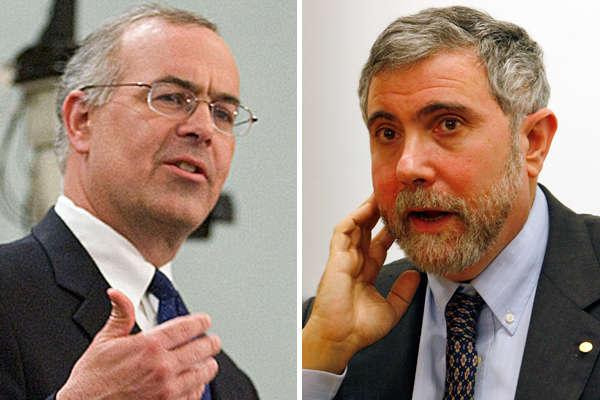
David Brooks and Paul Krugman (Credit: Miller_Center / CC BY 3.0/Reuters) Let no one say that the New York Times Op-Ed page isn’t a festival of diversity. On Friday, two esteemed regular columnists, Paul Krugman and David Brooks, tackled the same question — will Mitt Romney’s business experience position him to be a successful president? — and delivered remarkably different answers.
Wait, no, that’s not quite right. Shockingly, on at least a superficial level, Krugman and Brooks agree: Mitt’s business experience as a private equity wheeler and dealer tells us nothing about whether he’d be a good president.
Krugman’s argument is simple: A country is not a corporation. What might make sense for the corporate bottom line — for example, cutting costs by laying off employees and outsourcing production to foreign countries — makes little sense for a nation. Krugman then moves into a familiar discussion of the downsides of austerity, a topic that, whether or not you agree with Keynesian economic policy, is at least relevant to the question at hand.
Brooks’ take is a little more difficult to follow. This is possibly because, after he introduces the question, he swiftly dismisses any in-depth consideration of how economic policy and business experience may or may not intersect and swerves in an utterly different (and ridiculous) direction.
What the United States needs, suggests Brooks, isn’t a CEO. We need an aristocrat.
First, successful presidents tend to be emotionally secure. They have none of the social resentments and desperate needs that plagued men like Richard Nixon. Instead they were raised, often in an aristocratic family, with a sense that they were the natural leaders of the nation. They were infused, often at an elite prep school, with a sense of obligation and responsibility to perform public service.
Whether it is a George Washington, a Franklin or Theodore Roosevelt or a John F. Kennedy, this sort of president enters the White House with ease and confidence, is relatively unscathed by the criticism of the crowd, is able to separate the mask he must wear for public display from the real honest self he knows himself to be.
With this column, Brooks settles, once and for all, the question of whether he himself is an elitist. And not just any run-of-the-mill elitist! No, Brooks is a heroic, truth-telling elitist, with the courage to say what conventional wisdom about American discourse declares verboten!
In sum, great presidents are often aristocrats and experienced political insiders. They experience great setbacks. They feel the presence of God’s hand on their every move.
Unfortunately, we’re not allowed to talk about these things openly these days. We disdain elitism, political experience and explicit God-talk. Great failure is considered “baggage” in today’s campaign lingo.
I wonder, why might Americans disdain elitism? Could it have something to do with our history, our defining identity as a people who rebelled against monarchy? Could it be that one of our core values, at least until recently, is the idea that anyone, no matter what family they were born into, or how wealthy they are, or what prep school they attended, has (at least theoretically) the potential and opportunity to rise to the highest office in the land?
Brooks doesn’t weigh in on whether Romney qualifies as a true blueblooded aristocrat — although, given the fact that his father was a governor and car company CEO, the implication is obvious. What’s equally obvious, however, is the slam at Obama, who was raised by a single mother and enjoyed none of the advantages that were mother’s milk to Romney.
Who is more emotionally secure? Who can best withstand the “brutal” (Brooks’ word) attacks that are now being directed at Romney and have been hammering on Obama for more than three years. I guess we’ll find out over the next 10 months of mudslinging.
But for now, excuse me while I look for some tea to dump in a nearby harbor. All this talk of benevolent aristocracy is making me want to start a revolution.
Andrew Leonard is a staff writer at Salon. On Twitter, @koxinga21. More Andrew Leonard.
We don’t need truth vigilantes
But we do need good political reporting, and the media's rote repetition of Santorum's JFK lies fell short
Rick Santorum and John F. Kennedy (Credit: AP/Wikipedia) New York Times public editor Arthur Brisbane got a lot of grief last month for a blog post in which he asked readers whether the Times ought to be “a truth vigilante.” I didn’t join the pile-on, because truth be told, I kind of understood what he was getting at. Sure, “truth vigilante” is a shrill, easily mocked term: It doesn’t take “vigilantism” to get at the truth, only good reporting. But there can be questions for editors and reporters about how far is too far – what’s good reporting, and what’s hectoring? What’s debunking, and what’s partisan water-carrying? (Also, I don’t like the practice of mocking people for asking questions, even when we think the answer should be obvious. Better that Brisbane ask than to ignore the issue entirely.) I can understand why some cases aren’t clear.
Continue Reading CloseJoan Walsh is Salon's editor at large. More Joan Walsh.
Anthony Shadid, the best of his generation
The NYT reporter, acclaimed for his unparalleled coverage of the Middle East, died in Syria on Thursday
Anthony Shadid, winner of the 2010 Pulitzer Prize for International Reporting with The Washington Post (Credit: AP) WARSAW, Poland — I woke up this morning to the news that Anthony Shadid has died — apparently of an asthma attack — while on assignment in Syria. Whether you knew his byline or not, the loss is incalculable.
I can speak in absolutes about the quality of his work. No one reported the Middle East with greater clarity and nuance than Shadid. No one brought the humanity of the people of the region, people who live in a perpetual state of stress even when they are living in the comparative comfort of Beirut and Tel Aviv, to the wider world with a surer touch than Anthony.
Continue Reading CloseWhat David Brooks gets right about the left
Relying on a mic check to make strategy is a big mistake
David Brooks, philosophe As he often does, in his column Friday New York Times columnist David Brooks offered what looks like a “nonpartisan” analysis. Social movements, he warned, are suffering because everyone thinks they should make up their own belief system. Unless you’re Nietzsche, Brooks advises, this is a guarantee of failure. Every man is not a political genius.
It’s not a hard task to figure out whom Brooks is really criticizing: Occupy Wall Street. But it’s not alone. The democratization of ideology is vastly more tempting to the self-inventing liberal left than to the authoritarian right. Nobody does emotionally consistent talking points like the conservative right. Nobody does “whatever floats your boat” like the liberal left. The belief that every man is a philosopher makes progressives vastly more vulnerable to the destructive dynamic Brooks describes. It is an irony Brooks would appreciate that the left acts more like the right believes (and vice versa).
Continue Reading CloseLinda Hirshman is the author of “Victory: The Triumphant Gay Revolution,” forthcoming in June 2012. Follow her on Twitter @LindaHirshman1 More Linda Hirshman.
The “education crisis” myth
Ignore the media spin. Wages and working conditions -- not skills -- are the real reasons jobs get outsourced
A production line in Suzhou Etron Electronics Co. Ltd's factory in Suzhou, China on June 8, 2010 (Credit: Reuters) Has the term “education” become a code word? And if so, a code word for what?
These are the major unasked — but resoundingly answered — questions to emerge from two much-discussed articles about the future of American manufacturing. One is a cover story in the Atlantic Monthly about why jobs are being shipped overseas. It concludes that “to solve all the problems that keep people from acquiring skills would require tackling the toughest issues our country faces” — the first of those being “a broken educational system.” The second and even more talked about article comes from the New York Times. It looked at why Apple Computer has moved its production facilities overseas, concluding in sensationalistic fashion that “it isn’t just that workers are cheaper abroad” but that America “has stopped training enough people in the mid-level skills that factories need.”
Continue Reading Close
David Sirota is a best-selling author of the new book "Back to Our Future: How the 1980s Explain the World We Live In Now." He hosts the morning show on AM760 in Colorado. E-mail him at ds@davidsirota.com, follow him on Twitter @davidsirota or visit his website at www.davidsirota.com. More David Sirota.
Newspapers, “truth vigilantes” no more
The NYT's fact-checking question was absurd, but the real problem is that the press has lost its credibility
(Credit: Library of Congress/U.S. Farm Security Administration) Time was when newspaper journalists prided themselves on being working stiffs: skeptical, cynical and worldly-wise. “If your mother says she loves you, check it out.” I’ve always preferred the unofficial motto of my native New Jersey: “Oh yeah, who says?”
Fact-check politicians? Here’s how H.L. Mencken saw things in 1924: “If any genuinely honest and altruistic politician had come to the surface in my time I’d have heard of him, for I have always frequented newspaper offices, and in a newspaper office the news of such a marvel would cause a dreadful tumult.”
Continue Reading CloseArkansas Times columnist Gene Lyons is a National Magazine Award winner and co-author of "The Hunting of the President" (St. Martin's Press, 2000). You can e-mail Lyons at eugenelyons2@yahoo.com. More Gene Lyons.
Page 1 of 70 in The New York Times
