
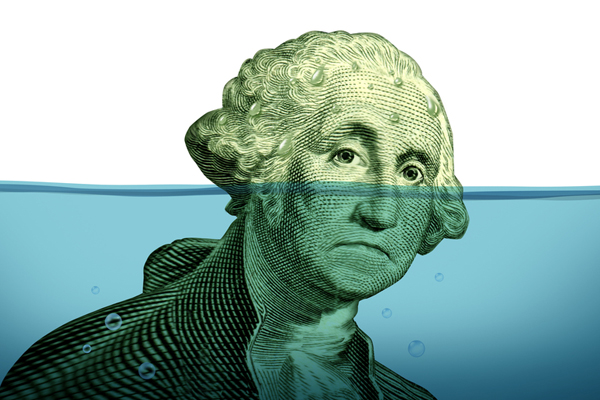

In the US today, debt is ubiquitous. Whether it’s paying back thousands of dollars in student loans, using your Visa card for a pack of gum when you’re out of cash, or taking out a mortgage on a first home, it’s been woven into our financial system so tightly, that even when we suffer the sometimes cruel and unusual detriments of borrowing, we have little to no realistic impetus to stop. But it wasn’t always this way. In fact before the 20th century, debt was a taboo, feared, shameful, and kept in the shadows. So what events and institutions brought debt from its meager beginnings to its central role in American life?
In his new book, “Borrow: The American Way of Debt,” Cornell professor Louis Hyman writes, in essence, a biography of American debt. He traces debt through American history: from the late 19th century, when unpaid dues meant public ignominy, to the 1920s, when the auto industry changed the face of borrowing to the mortgage fallouts that led the Great Depression to the invention of the credit card as we now know it, all the way to the current shambles of our national economic livelihood. Along the way we meet characters like the Henry Ford, the xenophobic inventor of the Model T whose scorn for the liberal age of borrowing got the best him, and Lower East Side grocery clerk Joseph Miraglia, whose miraculous $10,000 spending spree in 1965 made history as one of America’s heftiest credit cart blunders.
Salon got a chance to speak with Hyman last week about America’s long road into debt, the problem with applying morality to economics and, of course, that scene in “Pretty Woman” where Julia Roberts goes on a shopping spree.
Your background is in history and mathematics. How did you become interested in debt?
When I was in graduate school I was fishing around for a history topic that hadn’t been done or worked on before. This was in 2003, before financial history became fashionable again and before people knew there was going to be a crisis.
Little did you know… or maybe you did know, what would happen with the recession?
Unfortunately, as a historian of labor and business, I noticed that a lot of working people were struggling with debt. I thought it was a good topic to get some perspective on. As I got into the topic it was something that lent itself well to the kinds of questions I that interested me. Historians are look at how things actually are, rather than economists who are interested in how things ought to be. My work is in people’s choices, and how our choices are constrained by institutions. It lends itself to a more readable history than just a history of charts and graphs.
In the first chapter of the book you discuss how debt was extremely stigmatized in the 1920s. What was society’s moral view on borrowing then as compared to now?
People approach their checkbook not from a math point of view, but from a moral point of view. I think that’s really a key to understanding all of this. It is shocking how commonplace debt is today, but another difference between then and now is the financial infrastructure of debt. We are told that our grandparents didn’t borrow. That’s not true. People borrowed in the 19th century, they just did it surreptitiously, illegally, or at the margins. It was always stigmatized. That stigmatization arose out of the belief that a mortgage or a debt could easily bankrupt you, or the economy would change, and you would lose everything. In the 1930s, ’40s, and ’50s the atmosphere around debt changed: New federal programs and financial institutions, from the FHA to department stores, enabled people to borrow more safely. So that fear that everything could be lost went away in the middle of the 20th century. In the last 30 years that changed again. Those institutions born in this era of growth have persisted into our era of stagnation.
Is debt being re-stigmatized because of our most recent financial crisis?
Absolutely. In the 70s and 80s, it was like in the movie “Pretty Woman”; how glorious it was for Julia Roberts character to use a credit card. That was because most people in the ’80s didn’t have credit cards. In the ’90s, credit card use started to take on a different cast; it started to be seen as somewhat irresponsible. Mortgages maintained that shine of responsible adulthood until the financial crisis. Now people are questioning whether it’s good to go into debt for houses in a way that they certainly haven’t for 70 years.
In the book, you talk about the balloon mortgage and mortgage-backed securities, which had a big part in the economic collapse in the housing market during the Great Depression.
What’s shocking is that the balloon mortgage and the mortgage-backed security are things that we imagine were invented in the last ten years. At least I did before I started this research. But actually, they were commonplace in the 1920s. Banks would issue bonds to local investors who would use that money to lend interest-only mortgages (or balloon mortgages) to consumers. They were called balloon mortgages because they swelled up so that you’d only pay the interest for 3-5 years and at the end of the 3-5 year period you would just refinance it. The thought then was, you’d try to get the biggest house possible and make some money off of it a few years down the line. Banks had access to all this money to lend because they were selling “mortgage bonds” or “participation certificates.” But the bonds weren’t trade-able, they weren’t like mortgage backed securities are today. They couldn’t be resold. As the markets begin to go south after the crash people stopped buying the bonds, there were foreclosures, people started to withdraw their investments, and others were unable to refinance their mortgages.
And then Fannie Mae was created to help the government fund mortgage lending?
New Deal policy makers set up the FHA, the Federal Housing Administration, which created a set of guidelines to ensure that houses would maintain value over time. They set up an insurance system so that lenders would be repaid in the case of a default, to prevent foreclosures. New Deal policy makers created Fannie Mae, originally called the Federal National Mortgage Association, to buy mortgages from local banks and mortgage companies and sell them to insurance companies and other investors. This way there was no longer a need for bonds.
In the book you give some fascinating historical information on how department stores, and later discount stores, changed the way Americans shopped and changed their intuitions about credit.
What’s interesting about department stores is that they are an amalgamation of a bunch of different kinds of stores, clothing stores, appliances, etc. Credit in the department store in the early 20th century was a service, like delivery. The store didn’t make any money on it at all. That’s the most important thing to realize; that it was not a profit setter. It was something you did because it kept your customers happy. After the war, though, department stores begin to offer what they called “permanent budget accounts.” It allowed people to pay back purchases over many months, and the store was able to charge them interest. By the late 1950s, department stores had more money invested in consumer debt than in their own inventory, so they began to raise the interest rate on credit to 18 percent. It became profitable and they could resell that debt to finance companies. The subcontracting of debt enabled a whole system in which Americans got used to buying on credit and paying interest. Once debt could be resold, discount stores like Wal-mart and Kmart could sell for lower prices and offer the same services as department stores.
You also mention in the book that banks had an essentially trial-by-error process in learning how to profit from credit cards in the ’60s and ’70s. What were some of the regulatory and infrastructural changes that put banks at the forefront of the lending industry?
It’s important to realize that banks were not driving this shift in the ’70s. Banks didn’t come into the credit card industry until 1978 with the Marquette decision, which held that you could charge customers the legal interest rate of whichever state the bank was located in. So banks in states like South Dakota, where you could charge very high interest rates, could lend to people in Nebraska or New York City. That’s when Citibank moved its operation from Long Island to South Dakota, and charged very high interest rates across the country. This shift in the regulatory environment is key as well as the rise of interest rates more generally in the economy during the inflation of the late 1970s.
Why did consumers accept these high interest rates on credit cards?
If you are paying the customary 18 percent a year, it actually isn’t that much as long as you pay off most of your debts every month. And most of the credit cards that were lent in the ’70s and ’80s were to the well-to-do, who could handle the payments.
Nowadays almost anyone can get a credit card, not just the well off. When did that change?
It happened in the early ’90s. Banks continued to get more efficient at lending and their credit models, they believed, got better and better at differentiating between a good credit risk and a bad credit risk. It also became cheaper to borrow so that during the early ’90s from 1991 to 1996, during a five year period, nearly all the expansion in credit card debt was through securitization, when banks resell debt as credit card backed securities, just the way mortgages can be sold again as securities. Because it became cheaper to lend, banks could lend to poorer and poorer people with more vulnerable employment statuses because if these people defaulted, it wasn’t as big of a deal. Statistically, they expected default, and they just thought they could manage those defaults through clever math.
What about the mortgage market in the ’90s? In the book you talk about how an influx of securities into the mortgage market made it ridiculously easy for people to mortgage new homes. How did this lead us into a speculative bubble?
People believed that house prices would go up and that they were good investments. Friends at work, at church, at the gym were telling each other how much money they had made on their houses over the last generation. By 2005 a lot of people bought secondary houses as investments. The speculative bubble happened for many reasons. The most important reason, we think, is that most Americans weren’t making as much money. Median wages stagnated. People couldn’t borrow to invest in the stock market, but they could borrow money from a bank very easily to buy a house. People thought investing in the housing market gave them leverage to make money quickly. You see the collision of a stagnating wage market with a rising house market during a moment of low interest rates. Wages hadn’t gone up for 30 years but wealth had gone up and concentrated at the top, amongst the wealthiest. That money had to be invested somewhere and it looked like housing was a safe, easy way to invest. This money went into houses rather than into business. It went into things that produced nothing rather than things that were economically productive.
You make a really important point comparing the housing market to a Giffen good. A Giffen good is a term, in economics, that refers to something for which demand will increase as its price increases, which works against our typical understanding of the relationship between price and demand.
In economic textbooks, Giffen Goods are described as an anomaly, like a mythical beast or a unicorn that could exist intellectually but never in the real world. But it’s exactly what happened with the housing market: when the price went up, demand went up. The key is that it was not just about borrowers but about lenders. Because there was this ready supply of capital to invest and these lenders were willing to fund all of these mortgages, the housing prices went through the roof. The market wasn’t self-correcting, and there was no equilibrium until there was a crisis.
If it were left up to you, how would you change the way capital is invested in this country? What needs to change?
I think it’s important to realize that we need to use our policies for productive investments. We’ve made it too easy to invest in consumer debt. We can use the same policies to steer money into productive investments. Businesses produce value, they produce jobs, they produce growth, and in our economy, it’s very hard to do that these days. You can get venture capital for fancy high-tech companies, but you can’t get loans for mom and pop operations. I think business investment is something that’s very moderate in a lot of ways from the left and the right. From my perspective it helps us think about how we can actually intervene in the economy rather than just scold people for borrowing too much or being predatory lenders. One of the most important points of this book is to get past moral arguments. We can acknowledge the importance of culture, but I think it’s important to see ways we can actually intervene and make things better.
